29er Mountain Bikes - The Truth
29ers – the new breed of mountain bikes with 29in rather than standard 26in wheels – stir up emotions. To their detractors, they apparently look like clowns’ (or even old men’s) bikes. But, inevitably, many of those who are against big-wheelers haven’t spent much time on them.
Despite opposition in certain circles, 29ers are slowly but surely gaining in popularity. Every year sees more of them on the market and out on the trail. US and UK dealerships almost completely sold out of mainstream-brand big-wheelers during 2010, and world-class racers are now starting to win on them. Perhaps it’s time to take notice.
Size does matter
Way back in 1986, Dr Alex Moulton, famous for his comfy small wheelers, made a 20in-wheel, all-terrain bike. Unfortunately, the Moulton ATB had a fairly fundamental flaw. Its 20in wheels were unduly disturbed by all the little dips and bumps you’d barely notice on a 26er. So despite the comfort and control of Moulton’s suspension – in an era when most mountain bikes were fully rigid – his ATB wasn’t around for long.
If you’ve ever ridden a BMX on a proper mountain bike trail, you’ll know it’s not a great experience. Smaller wheels, not to mention shorter wheelbases, are harder to ride on bumpy ground. Think about it. All other things being equal, a bigger wheel’s shallow angle of curve rolls over uneven terrain more easily. But can we also assume that bigger wheels will roll over rough surfaces faster? Not always – complications arise when you introduce stuff that plays with the ‘all other things being equal’ bit, because they never are.

Is the 29er frenzy worth getting caught up in? Figure out what feel of ride you favour before deciding
Take suspension. In theory, all forms of it, including big tyres, make terrain seem smoother. But fitting suspension around 29in wheels is more complicated than it is for 26in ones. Without redesigning frames, there’s not enough room to fit things in. And bigger wheels will usually require a different frame geometry to make a bike behave at its best.
Bigger wheels and tyres also tend to weigh more, so they don’t accelerate as well. And, while they roll over square-edged bumps more easily, they won’t accelerate down the other sides as quickly. Small wheels are simpler to squirt up to speed but bigger hoops can carry momentum better. So even before we get into the finer points of frame geometry, it’s not as simple as saying that bigger wheels roll smoother so they’re better.
How big can you go?
The mountain bike market is currently dominated by 26in wheels, and understandably so. They’re a good compromise for average-sized riders in terms of tackling rough terrain on fat tyres. And they slot into a typical frame structure without mud clearances being a major issue.
For the uninitiated, the stated size of a mountain bike wheel is the approximate diameter from tyre edge to tyre edge. But tyre height varies, so it’s rare that a wheel and tyre are precisely 26in across. Big tyres with deep air chambers can be as big as 27.5in – some won’t fit into regular suspension forks or between typical chainstays.

The fact that 29ers make riders look little is something some people can't hack
Actually, fitting a high-profile tyre to a 26in wheel gives you an idea of how 650B (27.5in) wheels with normal-profile tyres will feel. 650B is halfway between 26in and 29in – some say it’s the perfect solution, offering most of the nimbleness we’re used to but with some of the softer roll.
650B wheels can be built lighter and stronger than 29ers, and frames for them usually look neater than 29ers (with better clearances), which often look gangly. There’s no doubt that 29ers – and 27.5ers if more rims and tyres become available – are good options if you value a smoother feel, especially for those without a suspension fork. There’s also no questioning that they’re now becoming an increasingly relevant option for taller riders.
Smaller, 26in wheels will continue to dominate the market for the foreseeable future for the average mountain bike rider, but 29ers are definitely experiencing a quiet revolution in popularity. Now we’re going to take a closer look at exactly why bigger wheels are becoming increasingly common.
Early days
When the first mainstream 29ers rolled out, they showed their potential but were hindered by a limited choice of suspension forks and geometry that essentially tried to mimic that of 26ers.
Gary Fisher’s early Genesis measurements were promising, but it’s only in the last couple of years that designers have truly started to understand the differences between ideal 26er geometry and ideal 29er geometry. It’s not just down to tweaking frame angles. The length of the fork, stem, top tube and bottom bracket all have a bearing on the overall stability and ride feel of the complete bike.
And this is all before you’ve even started to consider the pros and cons of longer chainstays, longer wheelbases and the way tyre contact patches influence how a bike grips terrain. Ideas on these elements of 29ers are still evolving, just as thoughts on similar areas on 26ers are.

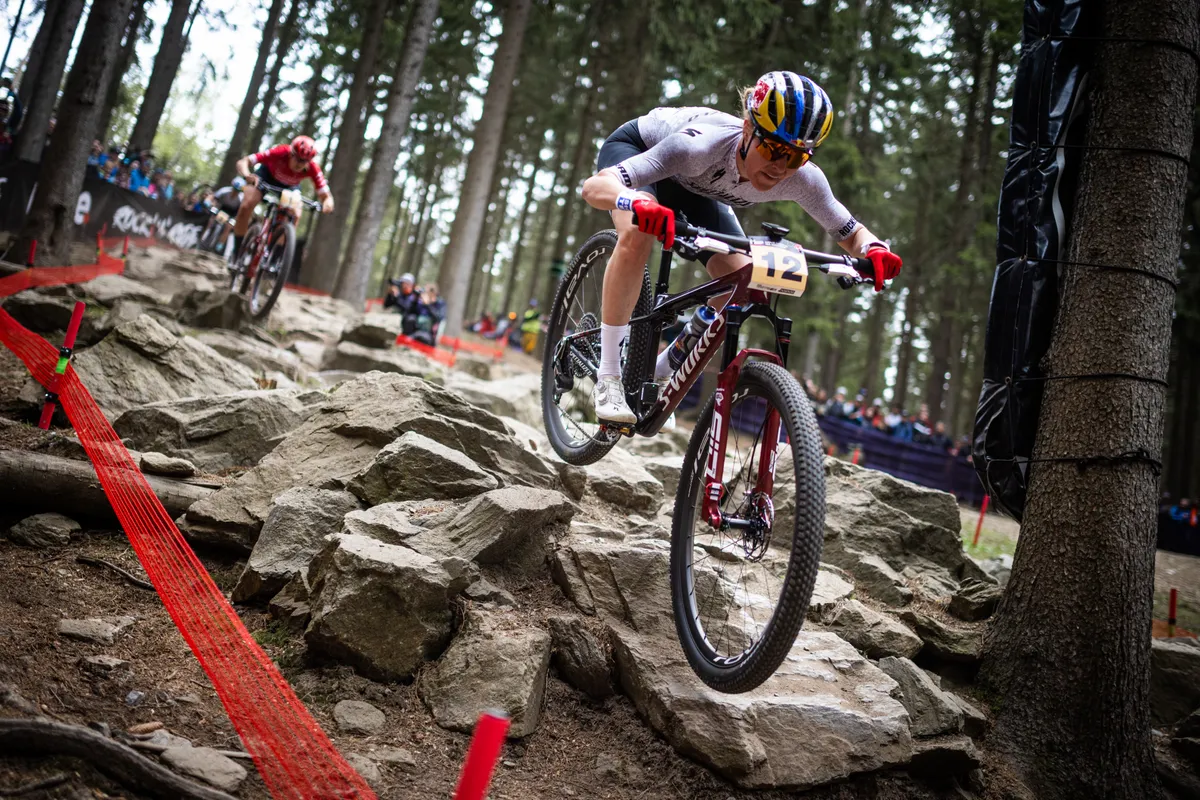
Cross-country racers are converting to 29ers to handle previously unrideable ground
Converts to big-wheelers just seem to love their ability to make riding fast, bumpy trails much easier. The rolling advantages of big-wheel bikes may not offer a convincing overall speed gain on a given cross-country circuit to highly skilled pro racers, but the more we’ve ridden them the more we’ve felt that the best ones can do a lot to boost comfort and confidence during those rough outings.
And remember, a boost in confidence and comfort like that usually equates to more speed simply because of the feel-good factor. This may well be why several of the smallest women on the World Cup cross-country circuit are having great success on 29ers. There are times when they just feel easier to ride. But first, let’s take a look at the stuff people talk about in the 26er versus 29er debate.
How are wheels measured?
Effectively, 26in and 29in refers to the diameter from tyre edge to tyre edge (roughly, because makes obviously vary). A high-profile tyre fitted to a 26in wheel can be 27in or more across. High-profile tyres will roll smoother than low-profile ones, so will offer some of the comfort and traction advantages of bigger wheels.
The halfway-house, harder-to-find 650B tyres result in an edge-to-edge diameter of 27.5in, which fits in some 26in frames/forks. Some suspension fork makers are now changing arch heights on their kit so that you can choose to fit high-profile 26in or 650B wheels in the same forks.
Why is rolling smoother?
The main reason that bigger hoops roll more evenly is the angle of curve. Try rolling a Hula Hoop crisp along, then doing the same with a napkin ring. Okay, there are other differences, but you get the idea.
A shallower angle of curve isn’t as affected by bumps and dips because it bridges the gaps that form hard edges. That’s why riding a BMX down a flight of stairs is harder than it is on a mountain bike. Taken to its logical conclusion, a wheel could be made big enough to simply fill the hard-edged gaps that form a series of steps and roll the edges like a slope.
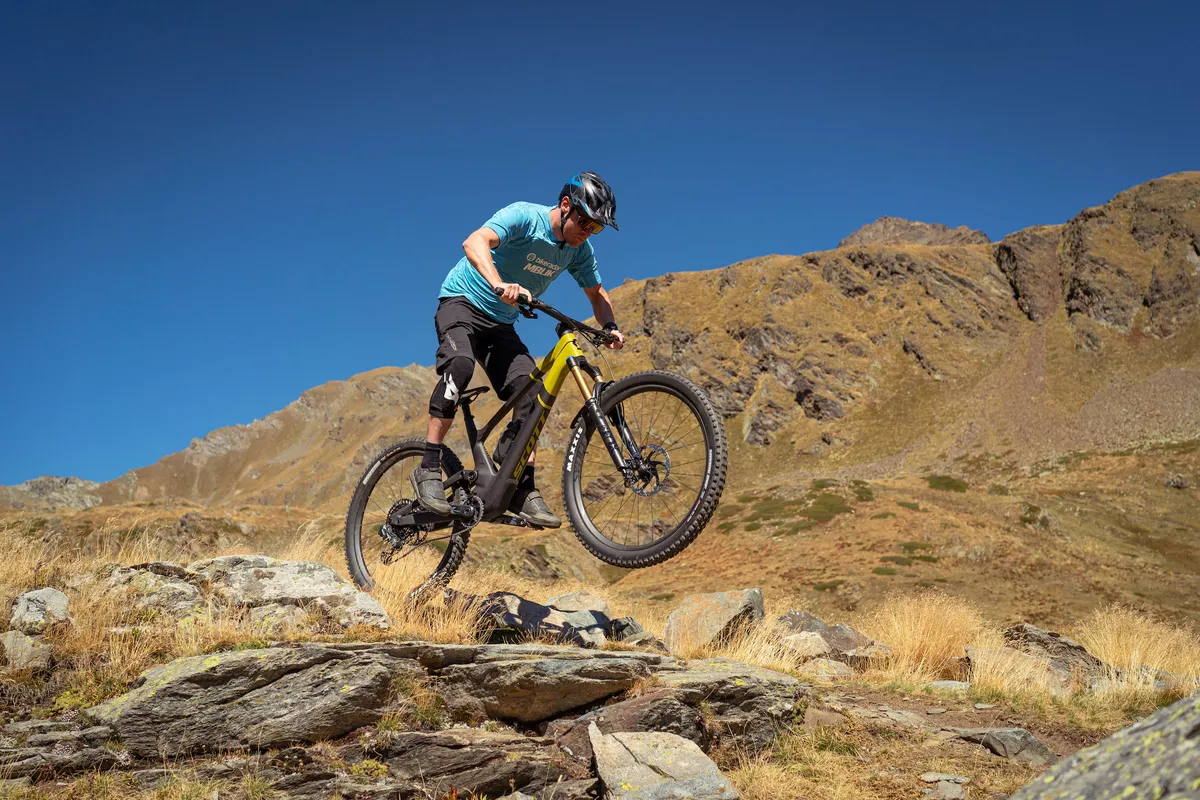
26in vs 29in – small difference, big change to your trail experience
What about traction?
Some common misunderstandings about traction on 29ers versus 26ers are floating around. If a rider sits on a 26er and then a 29er with the same tyre pressures, the length of the tyre area making contact with the ground will theoretically be the same. But even with tyres from the same brand and with the same tread, the differences between volume and shape will often create a wider contact patch on the 29er.
And frame geometry?
There are many factors to consider here. A typical 29er will feel more stable than your average 26er. That’s partly because of the longer wheelbase and the longer back end to make room for the bigger wheels. This could be mimicked on a 26er but rarely is.
Another stability factor is the fact that, though the wheel axles are 1.5in higher on 29ers than on 26ers, you’re sat lower between the wheel axles on a 29er compared to a 26er. So while a big-wheeler on its own has a higher gravity centre (think of the sideways tipping point) than a 26er, a 29er with a rider on board is actually more stable because the person’s body weight is on an axis that’s below the wheel’s axis.
In terms of the way handling is affected by geometry, designers seem to be gradually coming to terms with the way they can alter fork rake and trail to spice up the steering feel of 29ers. With an increasing number of decent suspension forks becoming available, this has already gone some way to correcting the misguided assumption that a 29er will be worse than a 26er on technical singletrack.

The keys to 29er popularity are wheel curvature angles – they're smaller, so rocky terrain is less problematic
Why aren’t all racers on them?
The US men’s and women’s marathon cross-country races were won on 29ers in 2009 and 2010, and several Trek team racers are riding noticeably better since they switched to 29ers. Todd Wells won two US national titles on his 2011 model Specialized Epic full-sus 29er in July. Riders like Willow Koerber and Heather Irmiger have also shown that big-wheelers can suit smaller riders.
Coincidence? Perhaps, but watch the results. It seems that the notoriously conservative attitudes of cross-country racers to bike designs are changing, even if it might seem tempting to just put that down to sponsors’ wishes.
Who are 29ers best for?
With several companies experimenting with bigger wheels on downhill bikes and an increasing number of cross-country racers using them, is it all just marketing pressure or are 29ers genuinely better than 26ers for certain riders? We’ve covered most of the contentious issues in this feature, and keep coming to the conclusion that it’s simply a horses-for-courses situation.
Riders who feel good about the softer roll of 29ers over bumpy terrain may well end up going a little faster as a result. But those who worry about the slight lag in instant acceleration might end up feeling slower as a result. At the end of the day, it’s simply a feel preference thing rather than a more obvious speed benefit thing.

What the experts say
We asked a selection of our test riders, along with some industry insiders, for their views on the 26er versus 29er debate. Here's what they had to say...

James Huang, BikeRadar's US-based technical editor
"Two-niners bring with them some notable advantages but also some challenges in terms of frame, fork and component design. The bigger diameter naturally carries with it increased mass and inertia, more wheel flex, and longer and more flexible frame tubes. But innovations such as wider hub and spoke flange spacing, wider (and thus stiffer) lightweight rims and through-axle dropouts go a long way towards equalizing the playing field. Some manufacturers such as Specialized have already taken the plunge, integrating all three features on their impressive new Epic Carbon.
"Tires need to be different, too. The Finnish test facility Wheel Energy has empirically confirmed that 29er contact patches are indeed longer and narrower than a comparable 26in wheel. As such, side knobs that might grab on one might not on the other, plus the 29in tire can put more center knobs on the ground at any given moment than the 26in, depending on the design.
"Merely carrying over what we know in 26in bicycle and component design gets the job done but real advancement will require a slight shift in thinking. If we're going to be saddled with the inherent drawbacks of 29ers, we may as well fully exploit their potential advantages, too. Once we do that, we may see them gain even more popularity."

Mike Hall, design engineer
“When I first heard of 29ers, I rolled my eyes, shook my head and thought, ‘Those crazy niche seekers – what will they think of next?’. My completely untested opinion that they were a rubbish idea was reinforced when I saw one being raced by a short bloke. ‘If this is the new cool, you can keep it,’ I thought. That was the foundation of my opinion – they looked wrong.
"So imagine my disappointment when they started catching on! I started getting my ass kicked by guys on 29ers. Looking at them again I can see an elegant beauty, whereas before I just saw an ugly frame with a stunted head tube and awkward proportions. On the other hand, maybe the designers have found the right design language for them."

John Stevenson, editor-in-chief of Future Publishing's cycling titles
“The 29er craze is a load of fuss over not much at all. Yes, in theory, a bigger wheel rolls faster. But the difference is lost in the noise of all the other things that effect how a bike runs. The other claimed benefits are either imaginary or could be emulated on 26in bikes. For example, 29ers work for tall riders because the big wheel forces long chainstays and a long wheelbase, so weight distribution is more like that of an average rider on a 26er. Just lengthen the stays on a 26er.
“The claim that 29ers have a bigger contact patch and better grip is based on a misunderstanding of physics. If you and your bike weigh 180lb and you have 30psi in your tyres, then to distribute your weight on the ground you’ll have six square inches of tyre on the ground, regardless of tyre size. Bigger wheels are said to be more stable because of their greater angular momentum. But tests have shown that angular momentum makes little difference to stability. What matters most is trail, a function of head angle and fork offset.
"Diversity of choice is great, so if you love your 29er, ride it and be happy. But don’t try to say that it’s technically superior – race results and physics say otherwise.”

Matt Pacocha, BikeRadar's US editor
"I no longer consider myself a serious cross-country racer. If I did, I’d be riding a 29er all the time – no doubt. Instead, I find myself with a 'quiver' of three bikes, which are all well ridden throughout the season.
"One is a 29er, and it’s a hardtail. It’s aluminum and specced for racing. It’s sub-23lb, which is plenty light enough so that I don’t really have any excuses when it comes to climbing or accelerating. After owning – not just testing – this 29er for more than a year, I can comfortably say there's no longer a reason for me to own a 26in-wheeled hardtail for mountain biking, whether racing or riding.
"My second bike is a 100mm-travel full-suspension racer. It’s what I generally choose to race cross-country on – not necessarily because it’s faster than the 29er, but because I generally have more fun riding it. It weighs more than the 29er hardtail, and subsequently doesn’t go uphill with the same zeal. From what I’ve seen coming down the pike for 2011, however, I think it may be time to trade this bike for one with bigger wheels.
"Finally, my third bike is a 150mm trail ride with a relatively light build that focuses more on fun than going fast. It has 26in wheels with big tires and it's the most fun to ride, but you’ve got to reserve yourself to being slower on the climbs. Here, I don’t yet see an advantage to a bigger wheel. It would add still more weight and with all of the extra travel, I rarely seem to lack traction or squish.
"The moral of my story is that those with a 'quiver' of bikes should be able to find room for at least one big-wheeler. For those whose main goal is to race on cross-country trails, either with their buddies or with a number plate on, I see the big wheel as a truly advantageous option."

Oli Beckingsale, pro cross-country racer
“I can see the rolling benefits of big wheels, but the style is always going to produce heavier wheels. I like my Giant Anthem X a lot. I know there’s going to be an Anthem X 29er, but the weight penalty will be more again compared to my hardtail.
“It comes down to logistics too. I have a lot of 26in wheels and tyres and would need more spare kit, so the only way to do it would be to ditch one system and ride the other 100 percent, which would be a big deal. I’ll leave it up to the sponsors to decide what they want me to ride.”

Guy Kesteven, BikeRadar tester
“Big-wheeled bikes are rubbish. They’re sluggish, flexy, heavy and only for really tall people or tragic attention-seeking old men and beginners who can’t ride. I love it when I hear that because it means my cheating secret is safe for a bit longer.
“To be honest, some of the badly designed bandwagon bikes are crap. Even the good ones don’t do stunts and tricks well and they’re more sluggish to accelerate and weave through really tight sections. All of which means they’ll never suit some people.
“If you asked me what bike is the fastest for long, rough, technical trail rides though I wouldn’t hesitate to say, ‘a 29er’. Even more so after riding the 2011 options. Bigger wheels mean smaller bumps, more momentum and more confidence through rough technical sections.
"They give more speed sustain and traction up climbs or through fast corners. Good 29er hardtails descend like 100mm-travel (3.9in) 26ers. Good 100mm-travel 29ers will match most 152mm-travel (6in) 26ers on fast, rocky trail descents.
"Simply put, riders who lag on 26ers will lead on 29ers. This isn’t just hype and speculation either. I’ve seen it happen on group rides, at endurance races and now even the cross-country World Cup. Like I say, though, I’d rather people didn’t believe me just yet so I can carry on kicking their arses for a bit longer.”
You can follow BikeRadar on Twitter at twitter.com/bikeradar and on Facebook at facebook.com/BikeRadar.
User Comments
There are 31 comments on this post
Showing 1 - 30 of 31 comments
-
scrumpydave
Posted Sat 25 Dec, 10:41 am GMT Flag as inappropriate
Oh no. I've already got a "suspension box" in my house to punish my MTB friends constant bickering. Am I going to need a "wheel size box" now too??
-
gospeedgo
Posted Sat 25 Dec, 3:33 pm GMT Flag as inappropriate
Back around '94, I had a GT mountain bike called a Continuum and it required an odd tire size--700D. I had to buy those from a GT dealer and the tire was called the Gila Monster. The tires didn't last long because the sidewalls would blow out, so I converted the bike to a commuter by mounting a pair of road 700c wheels and letting that be that. Still, I do recall the Continuum being a 'big ride' when I'd go trail riding. I kinda felt like the big man on campus when I'd wheel into the parking lot after a 25-mile ride through the woods on a trail outside Ann Arbor, Michigan.
-
alan_wasono
Posted Sat 25 Dec, 8:16 pm GMT Flag as inappropriate
I've read an article that did some testing on several 2niners and they stated that they spent way too much time truing the big wheels after some big rides. I can see the appeal of a smoother ride but the extra weight and maintenance means I'll stick with my 26 wheels. I'm too much of a short arse anyways.
-
andypaul99
Posted Sat 25 Dec, 9:17 pm GMT Flag as inappropriate
We do keep hearing about how 29ers roll so much faster on the singletrack and travel over rock gardens like they are on a heavenly cushion of air.
The trouble is that races are mostly won and lost on climbs where the benefits of these big wheels get cancelled out completely, I personally cant think of anything more unpleasant than dragging those big wheels and heavy forks up a big hill
forget it, im sticking with my light 26 until somebody proves me otherwise
-
ak-77
Posted Sat 25 Dec, 9:17 pm GMT Flag as inappropriate
I'm a physicist who loves his 29er hardtail, but I'm not going down the road of those who try to throw pseudophysical arguments into this debate. Ride a 29er and you'll know whether or not you'll like it. Ride ten bikes of each size and you'll get an idea which size suits you best.
I'm just wondering about one thing: if you put all the pros and cons of larger wheels together, and you add in aerodynamics, why on earth do road racers ride big wheels?
-
RobertPaulson
Posted Sat 25 Dec, 9:46 pm GMT Flag as inappropriate
I'm sure 29er's never started out this way, but is this really more than a push by the bike companies for the next big thing? Lets face it, they need people to keep buying new bikes and realistically how much further on have the top bikes come in the last few years? I guess a few people out there will 'upgrade' to the BNG special each year and the market for bikes keeps growing with more people coming into the sport, but eventually bike demand is going to stagnate without a new niche to push - hello 29er...
-
Turveyd38
Posted Sat 25 Dec, 10:53 pm GMT Flag as inappropriate
Very good write up, matches well with my experiences of riding a 29" wheel on the front for over 3years.
My only current beeth with 29" is the shallower angle on the rim means high volume tires have to be ridden harder than similar sized 26" tires enough to put 26" back into the picture for me and availability of wide DH 26" rims and the HUGE RQ2.4 front tyre, which only fits as I've got a 29er fork.
Interestingly the 2 1/2 years I rode 29" front only I didn't go over the bars once, where as I've been over 3 times in the past 8months using 26" and barely ridden it due to injurys ( yes there is a 1.5degree angle change but I tweaked other variables to reduce the effect ).
-
tomj113
Posted Sun 26 Dec, 6:11 pm GMT Flag as inappropriate
So whens a 39er coming out then if bigger is better..?
Nah didn't think so..
Apart from the 'roll over' advantage there aren't any. Every other design feature has been thought up to solve a 'designed in' problem when the bigger wheel was introduced.
Personaly if we all continue to ride round on anything from 4-8 inch travel air suspension bikes the wheels could get smaller by an inch and wider, and the tyres larger. Like John Stevenson says above, its more down to angles / fork trail etc. You only have to look at other two wheeled vehicles to notice this.
-
cavegiant
Posted Sun 26 Dec, 7:41 pm GMT Flag as inappropriate
I ride a 29er because it is more fun.
-
angryasian
Posted Mon 27 Dec, 12:23 am GMT Flag as inappropriate
And if we all followed the lead of the moto world, we'd all still be running single pivot bikes, too.
Point being that design philosophies and technologies don't always translate well from one to the other. Different power outputs, different weights, different needs.
-
Barteos
Posted Mon 27 Dec, 2:03 am GMT Flag as inappropriate
IMO 29" wheels make perfect sense on hardtails and short travel full suspension bikes (
-
Barteos
Posted Mon 27 Dec, 2:04 am GMT Flag as inappropriate
... IMO 29" wheels make perfect sense on hardtails and short travel full suspension bikes (
-
Barteos
Posted Mon 27 Dec, 2:05 am GMT Flag as inappropriate
... IMO 29" wheels make perfect sense on hardtails and short travel full suspension bikes.
As you add more travel though, things get complicated and the question is whether it's more beneficial to add inches to the wheels or to suspension.
"Tomj113" has a good point about wider tyres as a good alternative.
I've always been a huge fan of wide rubber and I wouldn't mind seeing some true 3-3.5" lightweight uber-volume fast rolling tyres that would add 0.5"-1.0" to a wheel diameter and extra speed grip and comfort to my 26" 5" fs bike.
Unfortunately tyres wider than 2.35-2.50 (actual width) would never catch on, as the typical lazy consumer lacks understanding of the mechanics of rolling resistance and perceives wider tyres as being slower.
The "issue" of extra weight would obviously blown out of proportion too, especially by those who carry extra weight on themselves :-)
How about 27.5" then? ;-)
-
SimonAH
Posted Mon 27 Dec, 8:18 am GMT Flag as inappropriate
John Stevenson needs to go back to school as his understanding of physics is on a par with my grasp of Russian. Try putting 30psi i'n an air mattress and sitting on it. Four inch contact patch?
-
cavegiant
Posted Mon 27 Dec, 3:15 pm GMT Flag as inappropriate
My 7/6" FS Niner rides very well, most of the negative info out there is given by marketing departments.
Anyone remember that huge article by specialized saying that 29ers were stupid and 26" was the only true bike?
A few years later another article released that says that 29ers are good HT and short travel FS?
A little bit suspicious that any major companies articles seem to match in exactly with their product line?
if you want to know what a 29er is like, ride one.
-
al2098
Posted Mon 27 Dec, 4:33 pm GMT Flag as inappropriate
I though big wheels were better, till' I tried DH on that penny farthing..
But it was great on the canal path..zzzz
-
Henry Cooper
Posted Mon 27 Dec, 9:27 pm GMT Flag as inappropriate
Ride what ever you want to ride 26" 29" who cares.
-
stubs
Posted Tue 28 Dec, 10:13 am GMT Flag as inappropriate
Give it a go you might like it. I tried 3 29rs 2 HTs and a bouncer and I couldnt get on with either of them. Nothing wrong with them I just didnt connect with them and I am not paying out a chunk of money for a bike unless it makes me grin. Whilst I had a Salsa HT on test my mate had a go on it went off for a 20 min spin came back and bought a frame kit on the spot.
-
dunderdon
Posted Tue 28 Dec, 3:39 pm GMT Flag as inappropriate
A certain type of terrain or even a whole racing course may greatly favour one of the wheel sizes, therefore it should be separate classes for racing. Keep in mind that for a shorter rider the 29" option may not fit without making suboptimal choices regarding geometry, yet they have to compete against taller people who can fully enjoy the benefit of the bigger sized wheels.
-
bikedibley.com
Posted Tue 28 Dec, 6:40 pm GMT Flag as inappropriate
OK, I think I'm sold. I'm going to try a 29er this year.
Any suggestions on a 29er hardtail. £1600 MAXIMUM spend?
-
jehannum5
Posted Wed 29 Dec, 12:25 am GMT Flag as inappropriate
My 2 cents worth..... I have ridden a 26 inch mongoose for 12 years, more for fun with the occasional enduro race and long distance ride thrown in. I rode a friend's giant 29er and felt instantly that it was more poised, stable and faster; especially over broken rock surfaces. Although I have been riding a while I am quite a tentative rider and the Giant allowed me toextend my riding more in the space of two days than I had in 12 years.... How much of this is due to the overall better quality of fork and frame and how much is due to the 29er dimensions is conjecture. However, at the same time I tried my friend's anthem 1 (26 inch) and immediately went back to the 29er. I'm sold and will be getting one - even though it's 1/3 more costly than an equivalent 26er. Yeah and I thought it was hype too.....
I'm unsure of the physics behind it, I assumed it was the shallower approach angle of the tyres that made the difference: the same reason that 4wd tyres (and tractor tyres) are bigger for offroad purposes. Perhaps it is all hype, but the giant 29er feels better than any other MTB I've ridden
-
Turveyd38
Posted Wed 29 Dec, 2:20 am GMT Flag as inappropriate
Each to there own and all that, what suites someone might not suite another.
For instance, anything over a 100mm fork ran hard feels horrible to me, far to much movement on braking or hitting a rock trying to throw you over the bars, but running a 160mm fork compared to a 100mm is completely acceptable.
So why not a bigger wheel, although 26" + HUGE Volume is my prefered option at the moment, with a Arrow Savage 3" 26er tyre on route :)
It's the shallow approach or another way to look at it, your wheel hits the rock further way from the low point, it's also turning slower so it mounts a 2" obstacle slower, spreading the same force out over a longer period of time so a lesser peak force. ie smoother :)
Also it allows for bridging of some gaps, a plowed field is a excellent example, 26" wheel drops all the way in where as my 29" wheel bridge the gaps and float across nicely, which i wasn't on a Rigid 69er that day :)
My main 29er gripe is, it's really 28.5" with the tires I had 3years back where as the tyres I was running on 26" worked out at 26.8" so it was only really 9.8% bigger, I want MORE, a True 30" would make it worth while, maybe a 32" :)
I'd also be happy with some proper 2.6" tyres and some wide DH 30mm internal rims, it'll get there hopefully then I'll back back.
-
Turveyd38
Posted Wed 29 Dec, 2:22 am GMT Flag as inappropriate
BikeDibley,
Personally I'd go for the On One Scandium ( not steel, it's just heavy and doesn't give at all ) 29er XT build with the Fox forks I think for less than that, can't really be beat.
-
pedaling princess
Posted Wed 29 Dec, 1:39 pm GMT Flag as inappropriate
i own 4 mt bikes, 3 of witch are 29ers! would never go back now. the climbing issue meantioned above has been fixed with better gearing now. the sprint, well guess what when u race mt bikies sprinting into the woods is not what wins the race, its who comes out of the woods out front that matters. i might not get in the woods first becasue they are slower up to speed but once u get them rolling u fly bye the other girls during the race. this is my first year of racing and im only 5'3" and road my gf 29er hifi all race season and won the series...29rs rock, don't read all this crap about whats good or bad take one out ride it for a couple of weeks and make ur own desicions.
-
simenf
Posted Wed 29 Dec, 2:20 pm GMT Flag as inappropriate
Long rant follows:
Steve Worland - get your physics right about the traction. Listen to someone who knows (like James Huang)!
650B - the train has left the station a long time ago. Last seat in the oddity-compartment was taken by the 29er. 650B will stay a small niche.
John Stephenson - the 26ers you are talking about are not being built because nobody wants them. That is why big wheels came about.
At the moment big wheels are mainly an enthusiast's thing and the shops and importers outside the US are trying to catch up. Few really get it within a short time, and definately not without riding it themselves. To those it will stay "a new thing in the shop" to generate more sales, not a step forward. Just look at what the people interviewed are saying: there are advantages and disadvantages, try it and see if it is for you.
To anyone riding big wheels for a while, the obvious advantages will become apparent. Singletrack is were they really excel, with rolling ability, tech-eating ability and confidence inspiriation being the most important. However, as a sledge hammer will never be a tool for all jobs, neither will the 29er. There are certain things it physically just will not do better than a 26er.
Oli - you do have Giant all over, but I hope you also have a clear idea about what works best for you. If you are to be the best. The rest will be convinced when they see the big names win on big wheels - it happens just now.
Rant mode off.
-
MKASE211
Posted Wed 29 Dec, 4:23 pm GMT Flag as inappropriate
Here in central TX the 29'r is King. Our rocky, undualting terrain is perfect for big wheel fanatics. I work in a shop here and we cannot give away a mountain bike, costing 1K or better, that isn't a 29'r. We have also been succesful getting women into 29'rs especially more beginners. The reason being the stability factor. Choosing a downhill line is not as critical with a 29 when you combine roll over and stability. Our data suggests that in few short years (2-4) that in the US the 26" wheel will be the minority choice. With entry level 29'rs approaching the $500.00 mark, it's soon to be a brave new world. After a short test ride or demo, it's a done deal. They want the 29'r 7 times out of 10.
-
troj
Posted Wed 29 Dec, 9:49 pm GMT Flag as inappropriate
Why is a photo of Steve riding Pacenti 650B in an article discussing the merits of 29ers verses 26ers? Should we be thinking of a third wheel size????
-
ligfietser
Posted Thu 30 Dec, 7:49 pm GMT Flag as inappropriate
For the love of reason, use ETRTO. We're talking 622 rims, right?
-
simenf
Posted Mon 3 Jan, 10:05 am GMT Flag as inappropriate
Are we discussing 29ers against 26ers?
-
big-w
Posted Wed 5 Jan, 9:17 am GMT Flag as inappropriate
Good read cheers.
I find the 29 doubters tend not to have had a proper go on one. Just try it, you might like it. I ride both sizes. The 29 is more fun for me.