Santa Cruz Butcher review

|

$2714

Change Currency What's this?
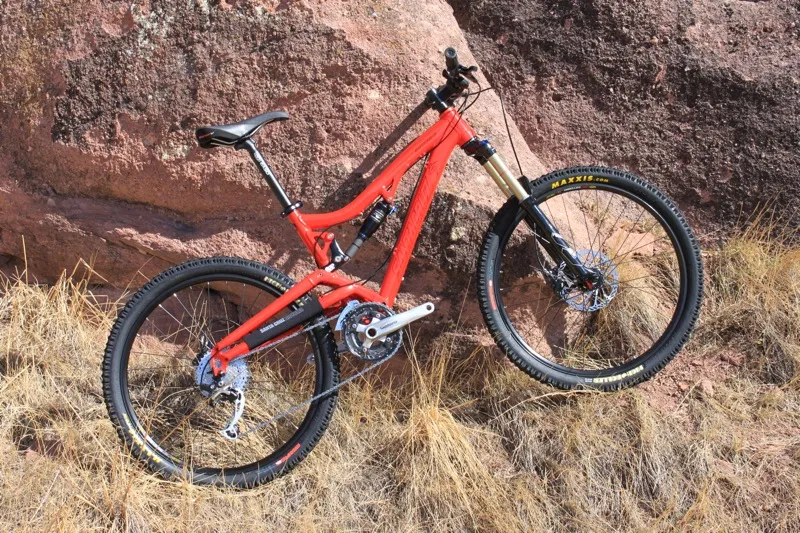
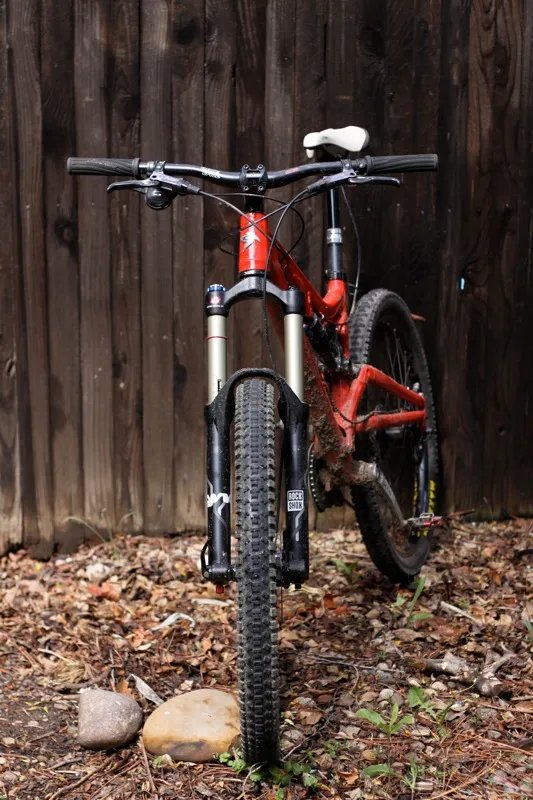
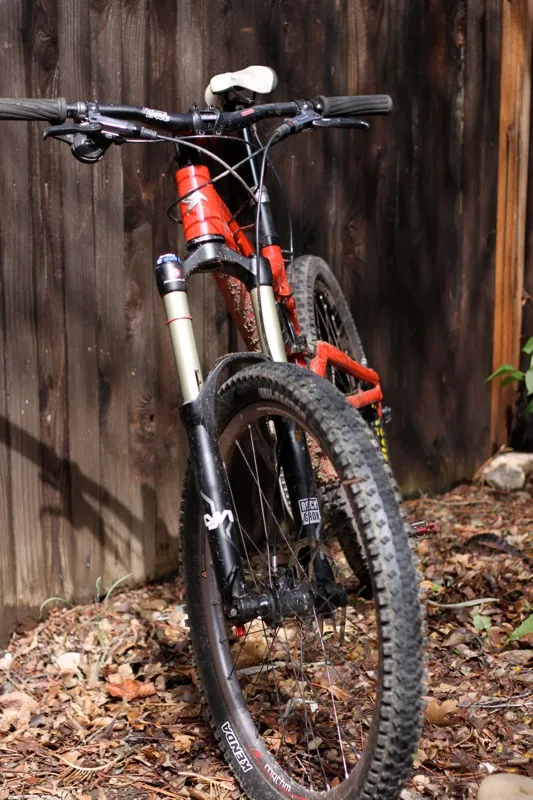
Santa Cruz's 2011 Butcher with 'R am' build kit and Fox Float RP23 shock upgrade

BikeRadar verdict

3.5 out of 5 stars

"Depending on the rider, the Butcher can be an all-day adventure bike or an all-mountain menace; either way Santa Cruz’s budget 150mm bike packs serious punch"

Wed 25 May 2011, 9:00 am BSTBy

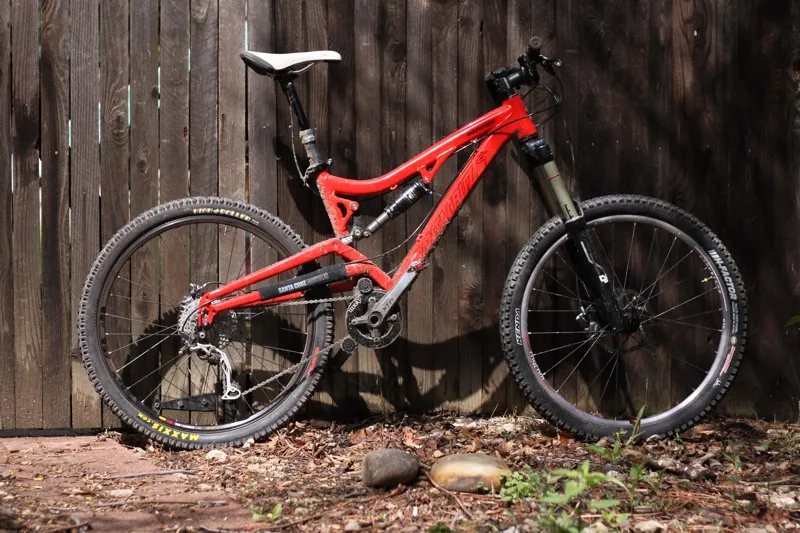
After spending a solid four months on Santa Cruz’s latest trail bike, we have no doubt that the Butcher will continue the legacy of Santa Cruz’s single-pivot bikes — workhorse performers that last forever. This 150mm-travel rig isn’t light, but it's a seriously durable all-rounder, with pretty darn good suspension performance — a perfect combo for any aggressive trail rider.

Ride & handling: Confident descender and surprisingly good climber, but watch the sizing

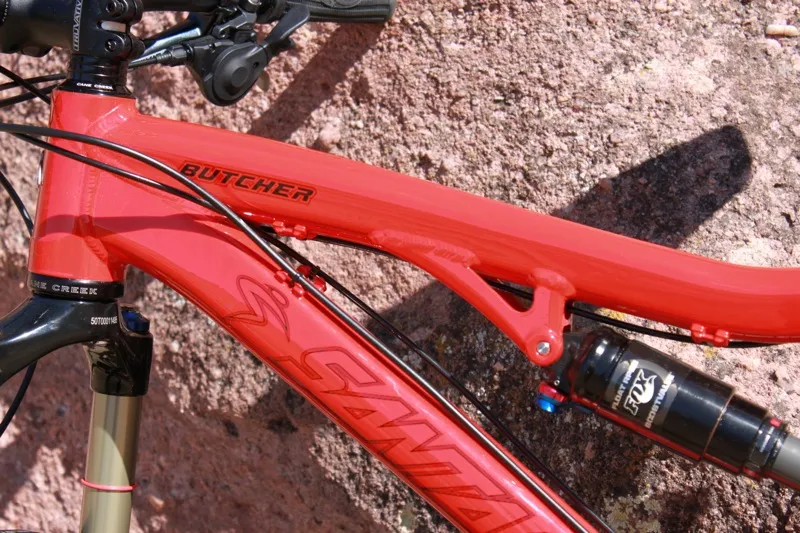
If you want a solid 6in-travel bike and you’re looking at Santa Cruz’s Butcher, the first question you should ask is: what will I do with the bike? If the answer is super-techy all-mountain riding with lots of jumps and drops, go with your normal size. If you're looking for a trail bike to ride all day — something the Butcher is absolutely capable of — you’ll likely want to size up, as top tube lengths run quite short (22.5in for the medium, 23.5in for the large).

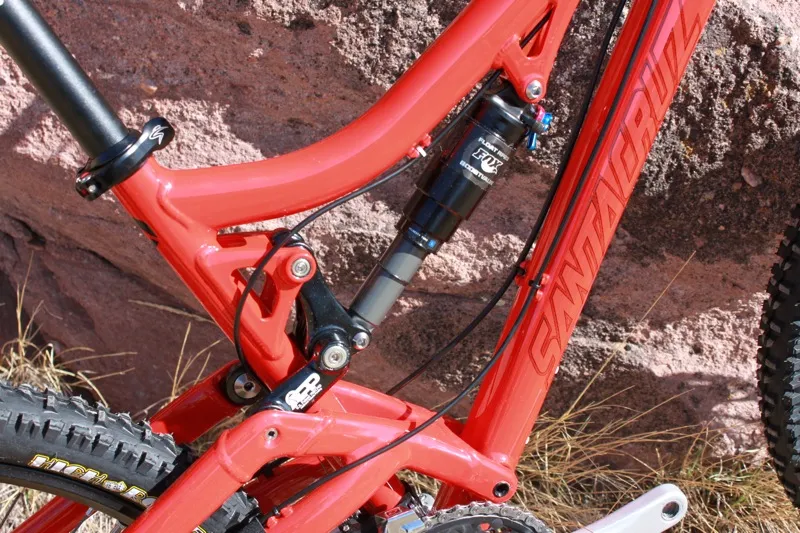
Despite being a short bike, that’s not super-light, we came away impressed with the ride characteristics of the Butcher. Believe it or not, this bike climbs really well. For one, the shock rate curve provided by the linkage-activated single-pivot rear end mirrors that of Santa Cruz’s pricier VPP bikes – slightly falling off the top, providing a plush feel and ample ‘negative travel’, with a flatter mid-stroke and slight ramp up at the end for bottom-out resistance. 

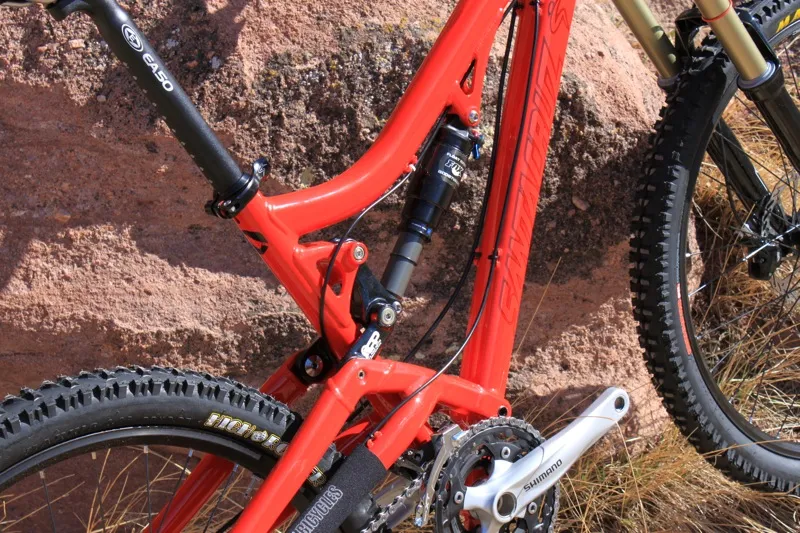
Paired with the high main pivot location — which means the suspension reacts to pedaling inputs, especially in the little ring — this slight softness off the top makes the rear wheel dig in when climbing, resulting in excellent traction. Combined with the ProPedal platform on the Fox Float RP23 (which is a US$115 upgrade, see equipment section) shock, this gives the Butcher's suspension better climbing characteristics than a World Cup cross-country bike we were testing concurrently. The Santa Cruz was slower up hills though, due to its 30lb-plus weight.

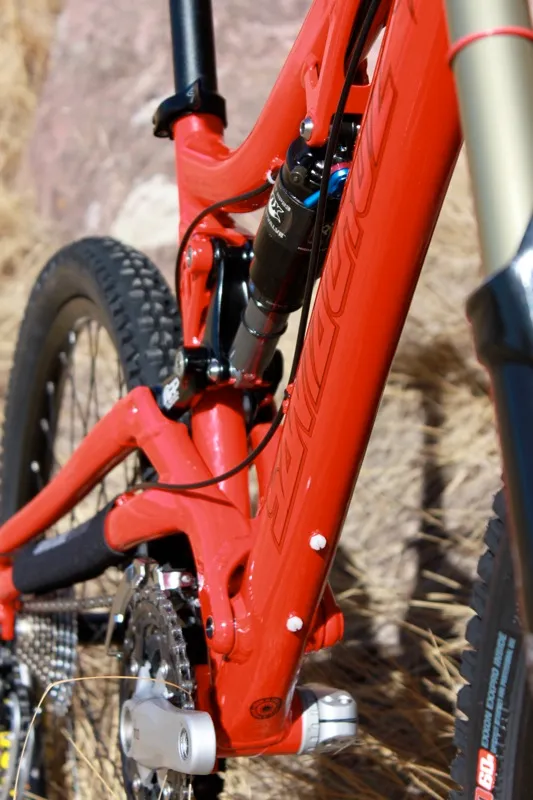
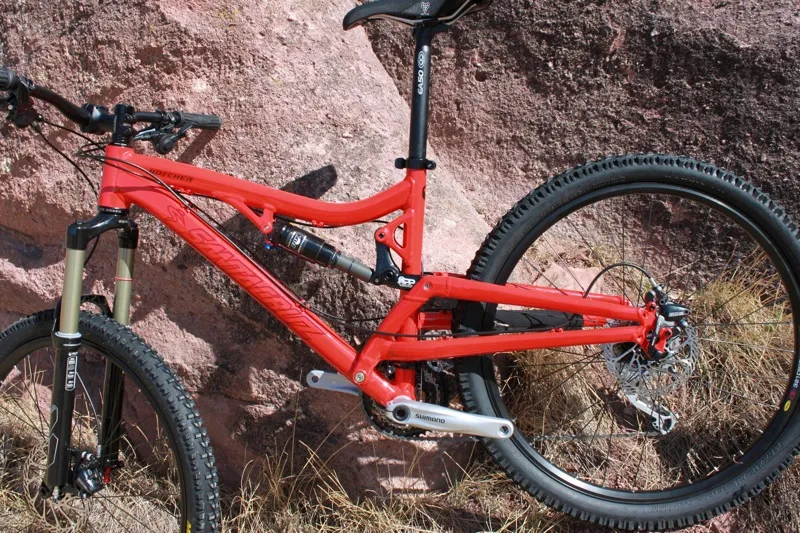
Our test model came with a fox float rp23 shock upgrade; the float r comes standard:

Our test model came with a Fox Float RP23 shock upgrade; the Float R comes standard

When the trail turns down, the Butcher performs almost as well — it's definitely among the best single-pivots we’ve ridden. We did, however, take to riding it with the RP23’s ProPedal turned on in the ‘1’ position (the lowest level of low-speed compression damping), due to some mid-stroke wallow. When riding with the shock ‘open’ we found there wasn’t much to push off in the mid-stroke.

This meant we were left wanting, especially in hard cornering at moderate to fast speeds. This trait makes the chassis ripe for Fox’s new 2012 Adaptive Logic technology, where the rider can choose between a climbing platform similar to the 2011 shock's level '3' and an ‘open’ setting that can range between the current '0', '1' or '2' levels of compression damping.

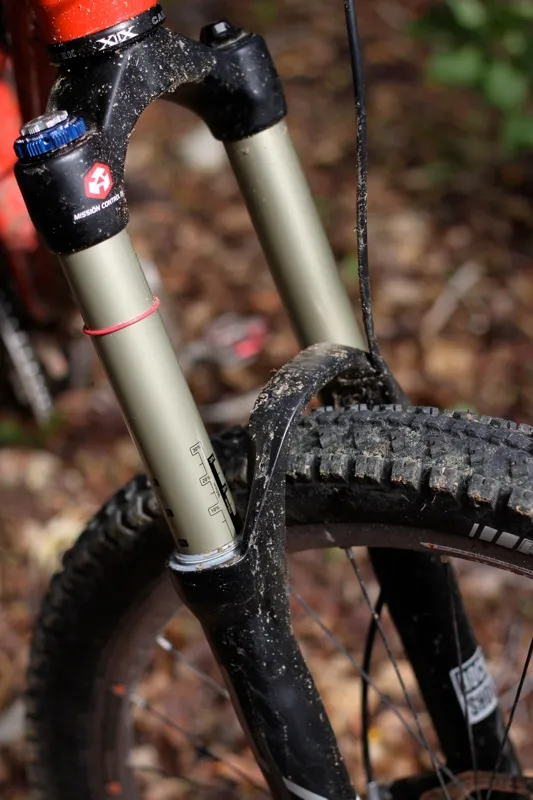
At the end of the stroke, we were hard pressed to get any sort of harsh bottom-out, even when hitting 4-5ft drops while running moderate air pressure (30 percent sag) and ‘ringing the bell’, as evidenced by our travel O-ring being pushed to the very end of the shock shaft.

Frame: Stiff from the front to all the way back... well, almost all the way

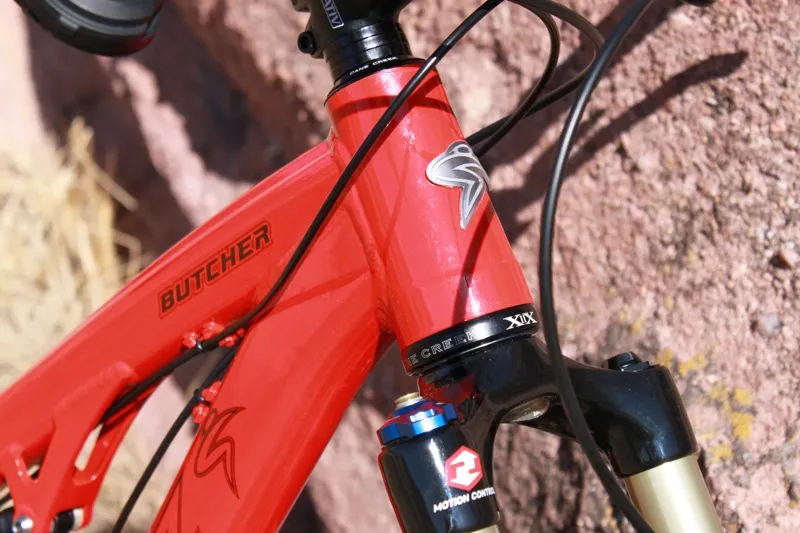
Frame stiffness is really good from the front and through the pivot and elevated chainstays until you get to the very ends of the dropouts. The beefy tapered head tube doesn’t noticeably flex and offers a good foundation for larger all-mountain forks like RockShox’s Lyrik or Fox's 36.

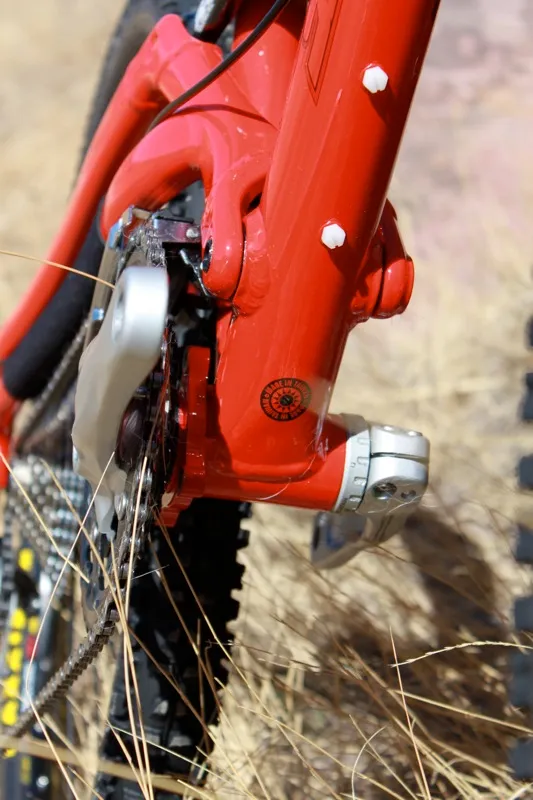
While we agree with Santa Cruz that bikes like the new Blur TRc are better suited to the convenience of open dropouts, we feel that the Butcher would benefit from a through-axle to improve rear end stiffness. We detected some flex, in the form of a wag-like feeling under hard cornering, which we put down to the proximity and narrow stance of the chain- and seatstays.

We found that way the chain- and seatstays taper to the rear dropout makes them a good candidate for a through axle:

The way the stays taper to the rear dropout makes the Butcher a good candidate for a rear through-axle it could use the additional stiffness

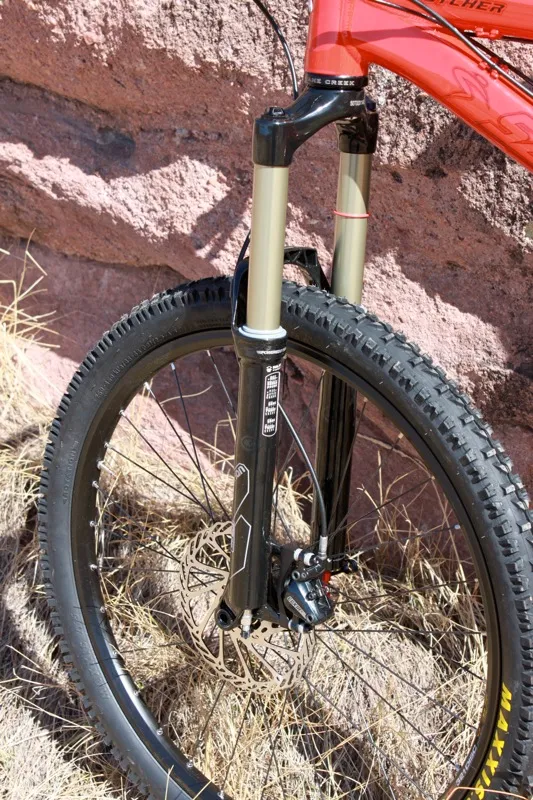
The geometry is pretty slack, depending on fork length, making it a stable bike when things get steep. We tried the Butcher with RockShox’s 150mm Revelation, which produces a 67.5-degree head angle, and 170mm Lyrik, which kicks it out to 66.4 degrees. We actually preferred the longer travel and slacker angle, despite the fact it made things relatively vague on climbs. The Butcher is a prime candidate for a 160 to 170mm travel-adjust fork, should you want to ride it both up- and downhill aggressively.

Despite our criticisms – of unsupported mid-stroke shock performance and slight tail wag – we were pretty darn happy whenever we threw a leg over our Butcher test bike. We rode it, progressed as riders on it and generally put it back in the garage with big smiles on our faces.

Equipment: We were balling on a budget, but the chassis serves many makers

Riders can give the Butcher its own character. Set it up with a light air shock and 10-speed drivetrain for all-day trail riding, or go the route of wide bars, chain guide (the frame has ISCG 05 tabs) and coil-sprung suspension to create a mini gravity rig. Our test bike came with Santa Cruz’s 'R am' kit and a RockShox Revelation RL fork for $2,599. We added an upgraded RP23 shock, upping the price to $2,714.

This economical package builds a very capable bike that will serve any seasoned mountain biker well, yet won't make you cringe too badly when you throw it down in a rock garden. The 'R am' kit combines Shimano’s 10-speed SLX shifters with XT derailleurs and a non-series 552 (Deore-level, 10-speed) three-ring crankset. Avid Elixir R brakes with 160mm rear and 185mm front rotors handle the braking duties.

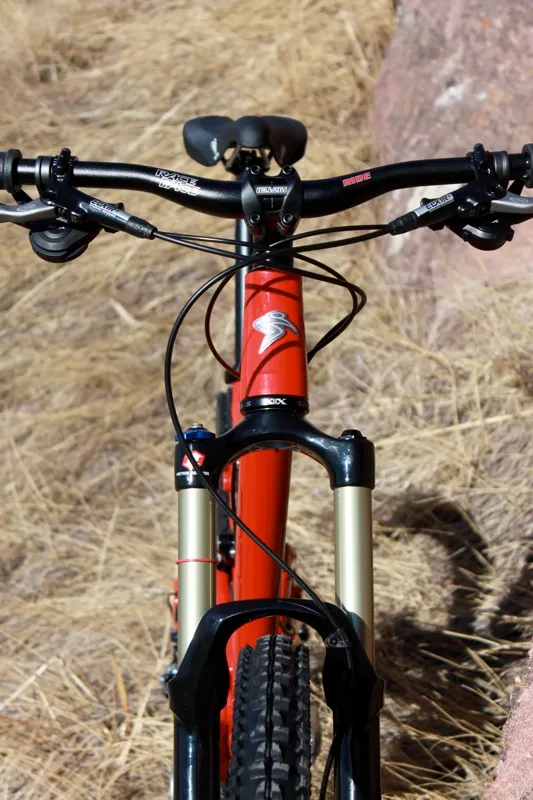
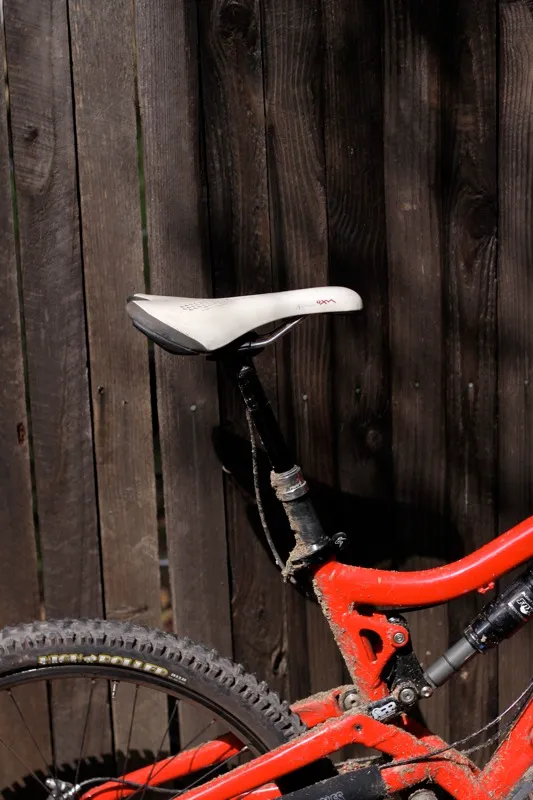
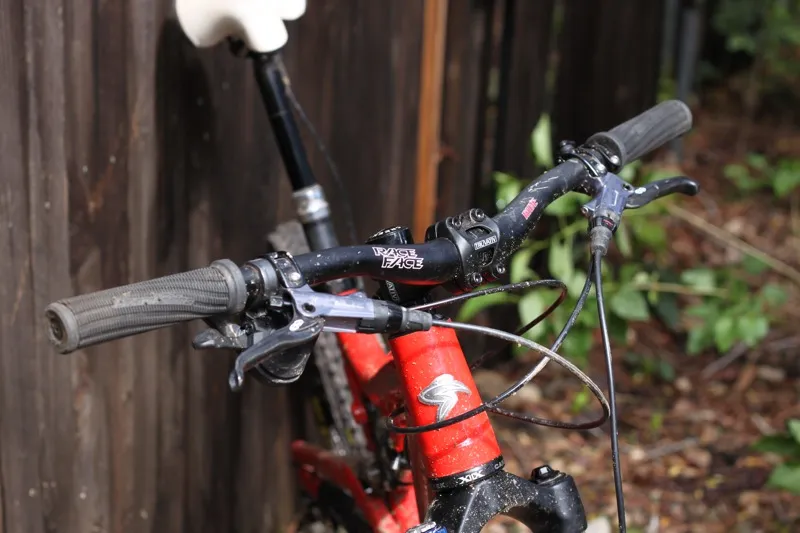
The cockpit is a mix of Truvativ (AKA stem), Race Face (Ride handlebar, which at 680mm wide was too narrow for a bike with all-mountain ambitions) and Easton (EA50 seatpost) kit. Wheels combine Shimano hubs with Mavic XM321 rims and are shod with Maxxis HighRoller 2.35 single-ply wire-bead rubber. The bike is missing one key component, however: a dropper seatpost. Riding without one severely limits its capabilities.

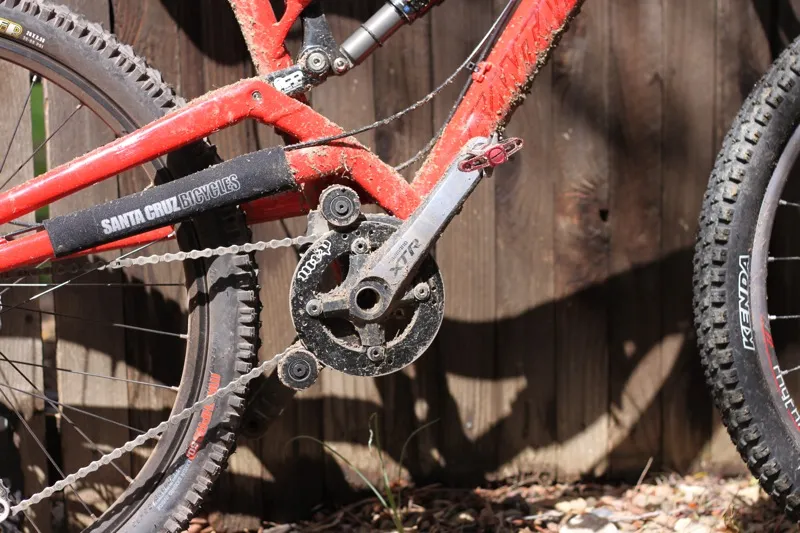
We added a chainguide to offset the design's propensity to throw the chain:

We added a chainguide to offset the design's propensity to throw the chain           

We also found that the Butcher begs some sort of chain management. The elevated chainstay design offers no help keeping the chain on the rings; a standard stay at least limits how far a chain can swing and does sometimes keep it from bouncing off. We were constantly bouncing the chain off the big ring and after a month we switched to an MRP chainguide. The bike's just a bit too heavy for most riders to get away with a single ring, so we'd recommend something like an MRP LRP shift guide or e*thirteen DRS.

At the very end of our test we swapped out the Revelation RL suspension fork for a 170mm-travel Lyrik RC2 DH after riding the lighter trail fork to its limit — we had a couple of bottom-outs on drops that made the fork flex and front end feel like it was squirting away from us. The Lyrik changed the bike drastically, giving it serious stability and making it a much safer tool in our sometimes sketchy hands. Tacking a Monarch Plus or Fox DHX Air rear shock onto the chassis would add yet another level of performance to this workhorse, again confirming that Butcher is a bike for many riders.

What's the score with BikeRadar reviews? You can find a full explanation of our ratings here.

Manufacturers description

Way up in the Sierras near Downieville, California, is a trail that leads into more than 5,000 feet of descending during a sixteen-mile feast of singletrack. Along the way, riders encounter frenzied rock gardens, brake searing straights between tight switchbacks, jarring compressions, flowing turns, sphincter puckering transitions into cliffside traverses, and some of the fastest ripping, tree-lined singletrack anywhere in the world. Superb suspension, strong pedaling legs, a tough bike, and a relaxed grip all count for a lot here. The name of that trail is Butcher Ranch. We named this bike, with six inches of abuse-hungry APP suspension and a frame designed to be shown the meaning of tough love, in it's honor.

User Reviews

There are 9 reviews on this post

Showing 1 - 9 of 9 comments

  • It seems from the last pic that not only did you add a chainguide, you also changed the cranks to XTR? I guess that's because you switched to 1x9 for the chainguide, but isn't that kind of missing the point in what you're billing as a 'budget' Santa Cruz?

  • I just cant understand why we are always seeing journo's/testers tweaking the spec of a bike and scoring it accordingly. Would this bike have got the same score if it had the most entry level components/shock? .... I think not!

    BR needs to address this asI have seen it many times, not to mention MBUK too.

    Test the stock/OEM build, just as a consumer would buy it or loose more of your reputation!

  • I am not even going to read an article that describes a £2799 bike as 'budget' in its intro...

  • And while everyone's having a go, any chance the wheels were changed to? That second photo shows rhythm rims, not the mavic ones listed in the spec.

  • Hey guys, good observations.

    We gave the bike plenty of rides in stock dress... the crank and front wheel are what they are because of the time needed to change things out. Instead of changing rings, we slapped on the XTR crank, which was already set with the single ring and guide. FYI, this bike comes stock with an 11-36t 10-speed casssette.

    Likewise, the front wheel was changed because of the different axle sizes between Revelation and Lyrik; former is 15mm, latter is 20mm.

    As for the economical aspect of the bike, it's not entry level, but it's legitimately below US$3k (and still can be with a Lyrik R) and with the ride it offers, that's quite a deal in our opinion.

  • santa cruz is overpriced. and at 2,799 quids, i don't consider this as a budget bike. and why change the specs of the bike, use it, and then give a review based on the stock/oem parts? coz maybe the OEM parts suck too much? how come the 3 1/2 stars then?

  • Hi all,

    We evaluate complete bikes just as that - complete bikes - and the scores reflect the performance of the bike in its stock form.

    That being said, we sometimes do some parts swapping on test bikes for a number of reasons. First off, when you buy a complete bike you're obviously getting a ready-to-run package but when it really comes down to it, oftentimes what you're really looking at is the chassis. Changing out parts helps us evaluate the core of the bike on its own merits so that we can be sure certain characteristics are inherit to the frame and not by-products of some of the bits that are bolted on.

    Secondly, while owners frequently keep bikes in stock form, many others upgrade parts as skills and budget allow or just as things wear out. Therefore, it's important to take a look at whether bikes are capable of delivering more performance than their stock build kits allow. The harsh reality is that almost none of us have the funds to purchase the bike of our dreams right from the get-go and we feel it's valuable to inform readers if a bike is even worthy of upgrades down the road.

    Third - and especially in the case of this Butcher - some platforms are capable of serving multiple purposes and it's worthwhile to investigate more than just one configuration if we have the parts on hand to do so. Santa Cruz offers the Butcher in more pedaling-friendly trail builds like what was supplied here but also in setups that are decidedly more gravity-oriented. Which ones are good for what purposes? What is this frame *really* capable of? What are the different types of setups you can put on the frame?

    These are all valid questions that came to mind during testing of this bike that we felt worthy of an answer, and we suspect many potential Butcher buyers will be asking the same ones, too.

  • I have a butcher !

    Got it last year August time with Fox 36 tapered Kashima forks,

    I agree with everything in the article, it's short in the top tube, it throws it's chain all the time and it's severely lacking strength in the back end !

    It's ridden hard, it replaced a bullit, and the flex in the back end knocks my confidence !

    I questioned the QR rear 135 before I bought it and having ridden it I now believe that it does require a bolt thro rear axle !

    The front end is so stiff with the tapered forks 20mm bolt thro that it just excentuates any flex in the tail.

    I'm itching to try an Alpine 160 but fear the outcome ?

    Mine has had a couple of pairs of bars until I found some 730mm carbon bars that I'm happy with. Same with tyres and I'm looking at a chain device to try and keep the chain on the front rings ?

    All in all I think the review was pretty much spot on !

    If you are sad enough to sit in front of a computer screen whacking off over different wheels tyres and cranks then you need to get out on the bike more, clear ur head ! Burn off some calories and above all else it will give ur hands something else to do !

  • I have a Butcher too...am 6'4" and 90kg so obv got the XL frame...had it 6 months now, and so far: sooo good!

    I got the frame only option with the RP23...I have a deep seated suspicion that you don't get what you think you're paying for with a fully built bike, (OEM lacks something in my humble opinion!) and are way better building it up with "proper" parts. I had upgraded my '09 Marin Wolfridge with a future frame swap in mind, and everything moved across nicely bar the headset. Fox 36 floats are perfect & 2x9 drivetrain with bash is on the money (have only dropped the chain once so far). I'm running a wide (720 low rise) bar and 70mm stem (would go shorter but need the xtra length to offset short top tube), Mavic 819's on DT 240's with a pair of 2.25 Nobby Nics (prob revert to Rubber Queen upfront come the return of muckyness!), XT cranks, SLX brakes and a Reverb dropper post.

    I was worried that reverting from a Maxle rear end on the Marin to a QR on the Butcher would be a step backwards, but found a compromise10mm QR axle (Superstar's is at least half the price of the DT version) that seems stiff enough for me.

    This is a confidence bike...I feel stronger, faster & braver than before, hitting drops & berms with far more throttle. It eats up the jumps and deals easily with successive hits. Somehow it finds grip everywhere & it climbs like a goat. It weighs in around 32lbs (not bad for an XL big-hitter) and I'm sure that if & when I upgrade the wheelset and get a carbon bar on it'll drop to the 30ish mark.

    My only regret is that it wasn't available in anodised finish as the gloss black paintjob isn't wearing too well...and lets face it, a Maxle wouldn't have gone amiss...belt & braces style baby! I dunno how the off-the-shelf 1 rides, but mine's deelish. Comparatively, my previous bikes are Meta 5.5 (3 outta 5), Wolfridge (3.5 outta 5)...I'd have no hesitation giving the Butcher 4.5...anodising & maxle would seal the deal! Get yourself a Butcher and go forth & prosper...just build it up yourself!

Submit Your Review:

You need to login or register to post comments.

Specification

Name:
Butcher R AM (11)
Built by:
Santa Cruz
Price:
$2714.00

Available Sizes:
L, M, XL, M, L, S, S, M, L, S, M, L, XL, S, M, L, XL, S, M, S, M, L, M, L, XL, M, L, XL, S, S
Available Colours:
Red
Weight (kg):
13.75
Weight (lb):
30.31

Frame & Fork:

 
Frame Material:
6061 Aluminium
Frame Weight (g):
3429 g
Fork Brand:
RockShox
Fork Model:
Revelation RL DA
Fork Weight:
1730 g
Rear Shock Brand:
Fox
Rear Shock Model:
Float RP23
Headset Brand:
Cane Creek
Headset Type:
S3

Geometry:

 
Seat Angle:
72 Degrees
Head Angle:
67.5 Degrees

Brakes:

 
Brake Levers:
Avid
Brakes Brand:
Avid
Brakes Model:
Elixir 5 185/160

Transmission:

 
Cranks Brand:
Shimano
Cranks Model:
M552
Bottom Bracket Brand:
Shimano
Bottom Bracket Model:
M552
Rear Derailleur Brand:
Shimano
Rear Derailleur Model:
XT
Front Derailleur Brand:
Shimano
Front Derailleur Model:
XT
Shifters Brand:
Shimano
Shifters Model:
SLX 10 spd
Chain Brand:
Shimano
Chain Model:
HG 74
Cassette:
Shimano SLX
Pedals Brand:
n/a
Pedals Model:
n/a

Wheels:

 
Front Wheel Weight:
2030 g
Rear Wheel Weight:
2640 g
Rims Brand:
WTB
Rims Model:
Laser Trail
Front Hub Brand:
Shimano
Front Hub Model:
M758 (XT)
Rear Hub Brand:
Shimano XT
Rear Hub Model:
XT M775
Spokes:
Stainless
Tyres Brand:
Maxxis
Front Tyre Model:
Maxxis High Roller 2.35
Front Tyre Size:
2.35in
Rear Tyre Model:
Maxxis High Roller 2.35
Rear Tyre Size:
2.35in

Contact Points:

 
Saddle Brand:
WTB
Saddle Model:
Pure V Race
Seatpost Brand:
Easton
Seatpost Model:
EA 50
Stem Brand:
Truvativ
Stem Model:
AKA
Handlebar Brand:
Truvativ
Handlebar Model:
Stylo Team
Grips/Tape Brand:
Lizard Skin
Grips/Tape Model:
Peaty Lock on

:

 
Bottom Bracket Height (in):
13.8 in
Chainstays (in):
17.1
Seat Tube (in):
17 in
Standover Height (in):
28.4 (in)
Top Tube (in):
22.5 in
Description:
6in (150mm) travel single-pivot trail bike
Wheelbase (in):
43.5 in
Manufacturer's Description:
ay up in the Sierras near Downieville, California, is a trail that leads into more than 5,000 feet of descending during a sixteen-mile feast of singletrack. Along the way, riders encounter frenzied rock gardens, brake searing straights between tight switchbacks, jarring compressions, flowing turns, sphincter puckering transitions into cliffside traverses, and some of the fastest ripping, tree-lined singletrack anywhere in the world. Superb suspension, strong pedaling legs, a tough bike, and a relaxed grip all count for a lot here. The name of that trail is Butcher Ranch. We named this bike, with six inches of abuse-hungry APP suspension and a frame designed to be shown the meaning of tough love, in it's honor.

Also on BikeRadar