Scott Scale 899 – First ride review

Change Currency What's this?
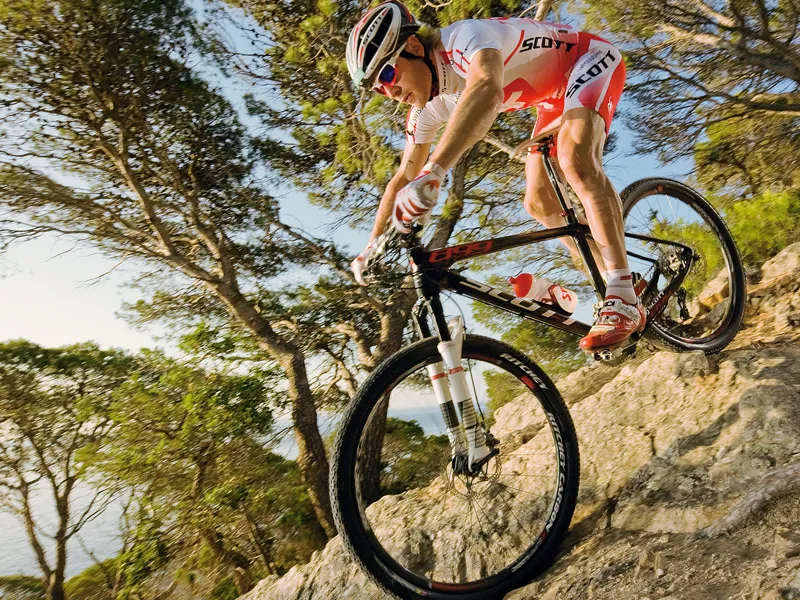
The Scale inspires  confi dence on the downs, feeling stable yet playful

BikeRadar verdict

3 out of 5 stars

"Ridiculously expensive, the 899 boasts a great redesign of an established race-winning pedigree"

Thu 7 Oct 2010, 9:00 am BSTBy

The race is on, in more ways than one. Understandably narked at being outdone in the lightest production mountain bike stakes last year by the Merida 0.Nine, long-time featherweight enthusiasts Scott will turn racers’ heads with their new Scale 899.

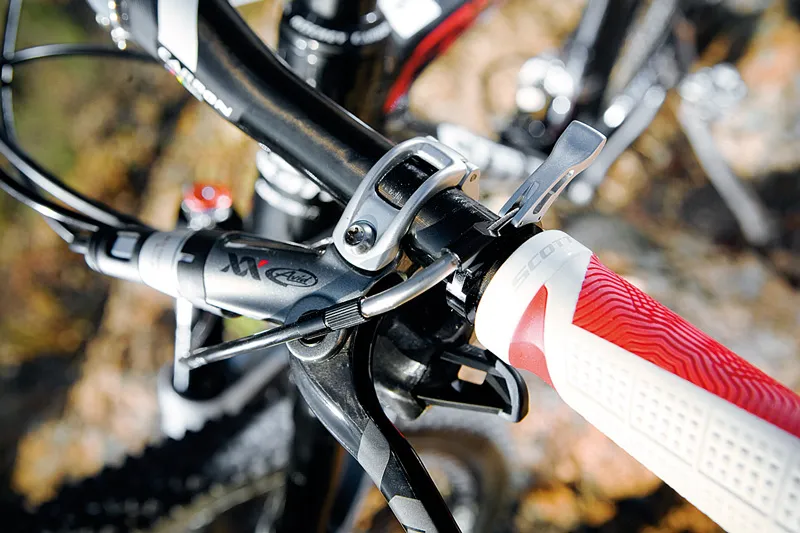
With a guaranteed frame weight of just 899g (for small and medium sizes), the new Scale’s proprietary HMX net carbon frame is beating its nearest established rival by some 31g and the previous Scale by a hefty 100g. Specced with full SRAM XX transmission and brakes, a longer-travel 100mm fork and new geometry to suit, this thoroughbred may prove more than a race-day black beauty.

It'll no doubt grab podium places next year, but while its focus is clearly whippet-like speed, it’s refreshing to see that the designers have also paid attention to the evolving demands of riders and created a bike that boasts a bit more versatility, albeit at a tremendous price.

Ride & handling: Bred purely for the racetrack but still rides like a dream

As soon as we threw a leg over the 899 we found we were impelled to go fast. Put the hammer down and the frame twitches with energy without a murmur of flex. Climbing was a joy, with SRAM’s XX chainrings delivering faultless shifting under power and the new rear triangle delivering ground-hugging compliance.

Rather than skip its way over every bump, the Scale 899 seems to suck up the terrain, helping to retain rear wheel traction – an attribute that reminds us of the legendary GT Zaskar LE’s triple-butted stays of old.

Borrowing technology from their CR1 road frame by way of both ovalising the seatstays and adjusting the carbon direction layup, Scott’s engineers have added a degree of vertical compliance while increasing lateral stiffness, which they claim increases comfort by 30 percent over the old Scale. The result is a rear triangle that is instantly there for you when you put the power on, but glides over climbs almost effortlessly.

Many oh-so-light hardtails are gold on the climbs but can prove skittish on the descents. Not so the Scale 899. From the moment we rolled into the first snaking singletrack descent this bike felt like it was on rails.

The tapered head tube and oversize box section leading the main triangle ooze surefootedness and directional stability, helped by the stiff carbon lower assembly of the fork. The tweaked geometry rewards the 899 with a character that touches on the playful – something you wouldn’t expect from a highly tuned race-ready machine.

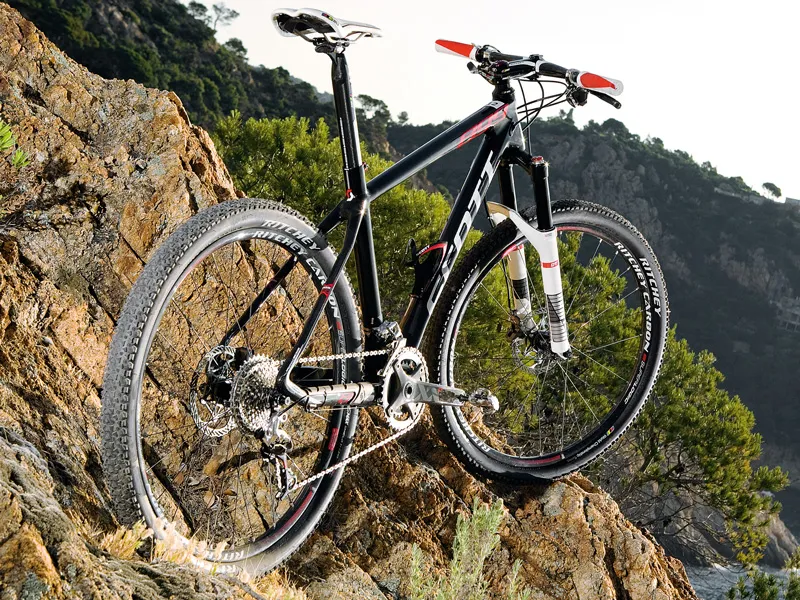
Now the lightest production mountain bike, the new scale is bred purely for the racetrack but still rides like a dream:

Scott’s one-piece 600mm-wide bar and stem carbon combo felt comfortable and positive, though it does represent a limitation to riders looking to customise the front end with their choice of bars and stems. Meanwhile, the tight, snappy frame offered every change of direction with a burst of energy delivered via short 16.5in chainstays.

In performance terms, Scott have nailed it with the 899 – only the value of such a bank balance-busting bike is in serious question. Yes, it rides great, is the world’s lightest production hardtail, oozes tech advances and is a status symbol to boot, but you pay a hefty premium for the privilege.

Not only is it £1,000 more expensive than the Cannondale Flash Team, which weighs a very close 16.6lb (7.5kg), but the 899’s price exceeds the sum of its parts by around £250. So you could buy the frame only, spec it with full SRAM XX, top-end Scott, Ritchey and DT Swiss parts, and it’ll cost you less than to buy the complete bike. Yes, less.

Scott say this is due to the 899 being lavished with some custom parts and finishing flourishes including a one-off DT Swiss wheelset. Realistically, however, most privateers will plump for a lower priced Scale RC (£4,699) or the frame alone (which is both 31g lighter and £139.03 cheaper than the Merida O.Nine frame).

Frame & equipment: Road-bike-light chassis plus top-end race kit

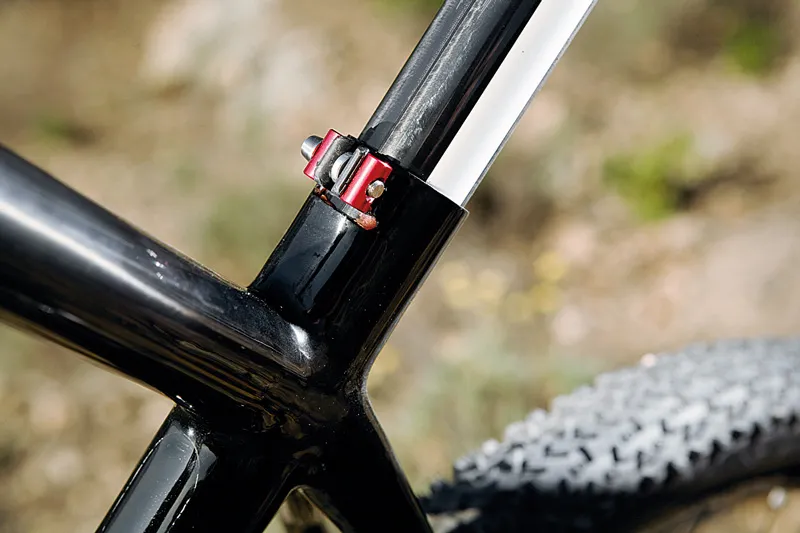
Scott have gone back to the drawing board to shave weight from their already successful Scale carbon frame. While diminutive frame hardware such as the minimalist new integrated seat collar (weighing a scant 5g), post-mount brake mounts and new carbon dropouts visibly shout weight savings, the new frame has a lot more going on out of sight too.

Large one-piece bottom bracket and head tube boxes replace the previous tube-to-tube bonding, making a lighter and – according to Scott – 10 percent stiffer and stronger frame where it most counts. The aluminium BB insert of old has been ditched and the BB (either standard 92 or BB30) is now press-fit, retained in a plastic sleeve to assist servicing.

With its curving one-piece homogenous seat- and chainstays and seamless front triangle, the 899’s skeleton screams contemporary carbon aesthetics. It’s topped off by a raw matt carbon finish and simple red and white graphics that announce in no uncertain terms the weight of your frame: 899g.

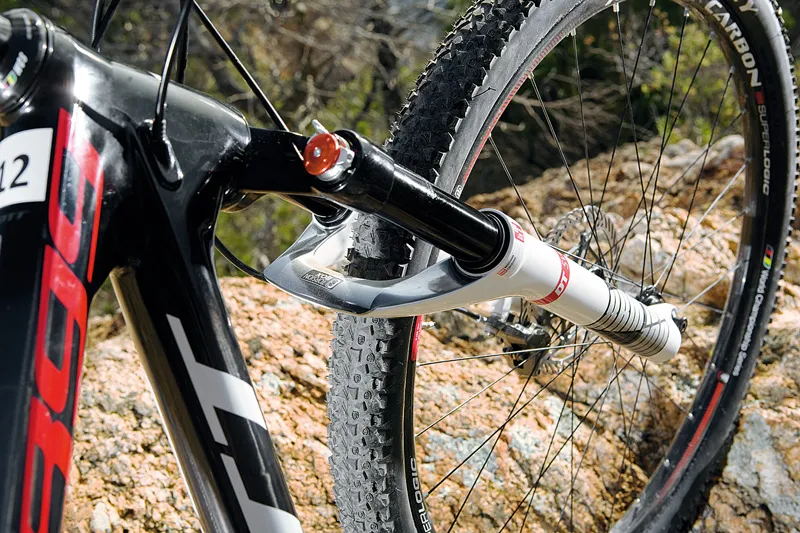
Scott wisely listened to their team riders and added 20mm of travel up front by speccing a new DT XCR 100mm fork – the production bike also gets a carbon steerer and carbon lowers. The bike’s geometry has been tweaked to match the longer travel, with a shorter 90mm stem, 10mm longer top tube, 10mm lower BB and a one degree slacker 70-degree head angle.

All this helps to balance the inherent racy feel with more planted handling. Finished off with a splattering of carbon-tinged componentry and 2x10 SRAM drivetrain, we're under no illusions as to the race-winning intentions of this bike.

The new dt swiss 100mm xcr fork adds stiffness and 20mm of travel:

What's the score with BikeRadar reviews? You can find a full explanation of our ratings here.

User Reviews

There are 12 reviews on this post

Showing 1 - 12 of 12 comments

  • I'm glad to see a review with more than 100 words, but I didn't really get anything out of it. It just seems like you guys gushed about its finer points, used some bike review jargon, shot a few pics, went on about details about how they made it lightweight on how much it's going to cost you for that. Did you even try to find any faults besides the price? I suppose that despite all that gushing, the price makes it lose 2 stars. How about some technical specs, such as geometry differences.

    When I read a bike review, I want to know how it stacks up vs other bikes in its category. I expect to hear someone's expert opinion on a bike; an opinion from someone who's ridden practically everything out there and knows what's hot, what's a great deal, what's pretty to look at, what's good for geeks that like numbers and specs. Granted, there's not much to be excited over with a hardtail, people do notice minute differences that gives a bike its character.

    When bike companies pour so much money into researching and developing a cutting edge product and sees that it gets a score of 3/5, how do you think it affects their future development? Rather than push the limits of technology, would you rather them just simply offer similar or slightly more performance than the competition with a price that makes it irresistible?

    I think the only good feature about this site are the write ups about what the pros rode that allowed them to dominate the field.

  • The £8000 price tag is ridiculous for this Scott.

    I have owned high end carbon bikes for the last 6 years Trek fuel ex 9.5 Fuel ex 9.9 Scott spark 10 and to see the manufacturers increase year after year for minimal technology and weight gains beggars belief.

    example:

    A suzuki GSXR 600 K4 was £7100 new in 2004 the current Suzuki GSXR 600 K10 is currently £7995 (The same as the above Scott!) an increase of 12.5% in 6years.

    My new Trek Fuel EX 9.5 in 2006 was £3300 new and now the new 2011 Trek Fuel ex 9.9 is a whopping £6000, an amazing increase of over 80% from the top spec fuel in 2006.

    I dont doubt that manufacturing and component costs have gone up in recent years but can anyone please explain these ridiculous price increses in this industry?

  • It's really just a road bike with more clearance at the back and soft forks.

    Although saying that it is a strange review. Covering it with praise and then giving it 3 stars due to to its high price. I really think price should be considered separately as it is does not effect hoe the bike rides. These reviews determine if a bike will sell well and dropping 2 stars due to cost only is not really fair. The cost vs value is a very relative thing a depends a lot on how rich you are and what u want the bike for.

    People don't mark down supercars because their prices are ludicrous.

  • A more meaningful review would be to do a comparison between this bike, the o.nine (only just reviewed separately yesterday) and the canondale flash in one feature, and then critique each bike on how they excel in specific areas.

  • Nice bike,gushing review................pipe dream for 99.99% of us.

  • Now heres a question....

    Would this bike really be quicker off road than a sorted Epic or Anthem?

    Personally i doubt it, Its unlikely you would be able to get either fully down to 17lb or less but it would be possible to get an Epic down to sub 20lb im sure, and it wouldnt cost 8K either.

    Lets say you could get the Epic to 20lb and it would maybe cost you 5K (inc frame) that would leave you a spare 3K to spend on the Mrs or get a sorted road bike......

    I think all this rear flex in seat stays is a bit gimmiky and lets face it isnt cheap, im pretty sure that all this tinkering about is for mainland europe who only really buy fullys for downhill and have a hardtail for everything else.

    Personally ill keep hold of my short travel fully thanks

  • blackthorne83:

    This review was called 'first ride' as is standard practice on most magazines. They will compare it with other bikes in a 'group test' later on, no doubt.

    Dan Milner:

    Great review, but maybe I'm biased being a Scott fanatic! By the way, the Merida O.Nine is 950g with BB30 - exactly the same as the Cannondale Flash. So the Scott is actually 51g lighter, maybe lighter still as the Scott is guaranteed to be under 899 where as the others are average weights. I think that any frames heavier than 899g are used for the Scale RC. And before anyone suggests it, yes I am a sad weight weenie.

  • 31g lighter ? Wow ! that's about the same weight as the lump of green dried sheep s**t I removed from the back of my seatpost the other day...

  • £8000 for a hardtail, truly mental.

    The fact it costs more than the some of its parts says it all. Scott know they cater for the "more money than sense" end of the market and so are happy to exploit them for a bit of extra margin

  • Who agrees and overal review score and then a break down:

    Overall - 4/5

    Value - 3/5

    etc etc etc

  • Improves comfort by 30 percent? What sort of measuring device is used for this? I'd have one if I had a spare 8 grand though.

  • i have just bought a scale 10 frame on ebay merlin do xtr wheels at just over £400 a pair sram has gone down in price so just shop around its that easy

Submit Your Review:

You need to login or register to post comments.

Specification

Name:
Scale 899 (11)
Built by:
Scott
Price:
n/a

Available Sizes:
L, L, L, L, L, L, L, L, L, L, L, L, M, M, M, M, M, M, M, M, M, M, M, M, M, M, L, M, L, XL, S, S, S, S, S, S, S, S, S, S, S, S, M, S, M, L, S, M, L, XL, S, M, L, XL, S, M, L, S, M, L, XL, S, L, M, L, L, XL, XL, XL, XL, XL, XL, XL, S, S, M, S, M, L, S, M, L, XL, S, M, L, XL, S, M, L, XL, S, M, L, XL, M, L, M, L, XL, M, L, XL, S, M, L, S, M, L, XL, S, M, L, XL, S, M, L, XL
Weight (kg):
7.5
Weight (lb):
16.5

Frame & Fork:

 
Frame Material:
Carbon IMP3 HMX net, tapered head tube
Fork Model:
DT Swiss XCR 100 Race Air, 100mm travel

Brakes:

 
Brakes Model:
SRAM XX World Cup carbon lever with 160mm rotors

Transmission:

 
Cranks Model:
SRAM XX Carbon 28/42T
Rear Derailleur Model:
SRAM XX
Front Derailleur Model:
SRAM XX
Cassette:
SRAM XX

Contact Points:

 
Saddle Model:
Selle Italia SLR
Seatpost Model:
Ritchey Logic carbon
Stem Model:
Scott Pilot
Handlebar Model:
Scott Pilot

:

 
Bottom Bracket Height (in):
12.2 in
Chainstays (in):
16.5
Seat Tube (in):
17.3 in
Top Tube (in):
23 in
Wheelbase (in):
42.3 in
Tyres:
Schwalbe Furious Fred EVO 2.0in tubeless ready
Front Wheel:
DT Swiss XR-SL hubs and carbon rims, Aerolite spokes
Rear Wheel:
DT Swiss XR-SL hubs and carbon rims, Aerolite spokes

Related articles

Related links

Also on BikeRadar