


Dave Weagle has won the most recent battle in the war to get his Split Pivot suspension design to market. He now owns a suspension patent that covers pivots concentric to a rear wheel’s axle, among other attributes. But will it cause conflict with Trek, who offer a similar design with their ABP (Active Braking Pivot) system?
Weagle applied for the patent in 2006 and has licensed it to six others: Seven Cycles, Spooky, Devinci and three who’ve yet to be named. The licensees now have the use of a unique design with documented benefits, and it's protected by US patent. They are currently working on producing over a dozen different Split Pivot equipped suspension bikes that will be available in 2011.
“I think it’s a lot of relief for the people I’m working with,” Dave Weagle, the engineering entrepreneur responsible for the Split Pivot design, told BikeRadar. “A lot of these guys, these companies, are bringing out full bike lines, like, right now. Obviously we’ve been working on this for a long, long time, since ’06 or so when we first applied for the patent, so it’s awesome. It’s the start of a new chapter for all of those companies; it’s great.”
Trek remains the one rogue territory in Split Pivot’s war, as the company offers a similar, un-licensed, concentric pivot design. Trek representatives told us that the company has no plans to stop production or the future development of its design.
“We’re stoked that he’s [Weagle] helping progress mountain bikes and putting better performing bikes out in the market,” said Michael Browne, Trek’s global mountain bike brand manager. “We’ve been producing ABP since 2007 and we’re just going to continue refine and update our design. This year we unveiled ABP Convert.
"There’s nothing out there that says Trek needs to stop or needs to license or any thing like that, so as we see it, we’re going to continue doing what we’re doing.”
When asked if he saw any sort of design or patent conflict between ABP and Split Pivot, Browne said:
“We see them as different systems.”
Trek also claims to have filed a number of patents for ABP, all of which are still under review.
Same same but different?
Looking at the two sides, if there is a conflict, it’s shaping up to be a ‘Dave’ versus goliath type battle, but the Massachusetts based designer hopes it will never come to that. He holds expectations that all of his peers within the industry will respect his, now protected, IP.
When asked about Trek’s design, Weagle declined to comment specifically. He did, however, speak broadly.
“Any patent is deemed by the patent office as defendable,” said Weagle. “This patent has been under a pretty serious microscope, to a level that I’ve never seen before, and I will say that there’s absolutely no problem from a willingness or financial standpoint to defend this patent.
"My hope is that companies will respect it and not force that.
“It goes back to the people in the company,” he continued. “If they’re the kind of people who can put themselves in the shoes of someone who has worked really hard to develop something and spent the time to protect it, then they’ll hopefully do the right thing. Then there’s no problem and everybody’s happy, but there’s two kinds of people in the world.”
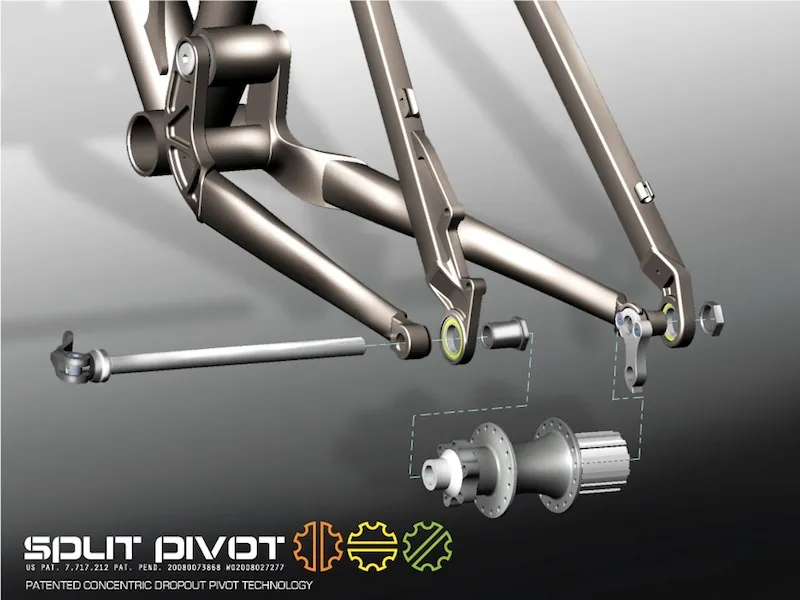
A CAD rendering of the Split Pivot design
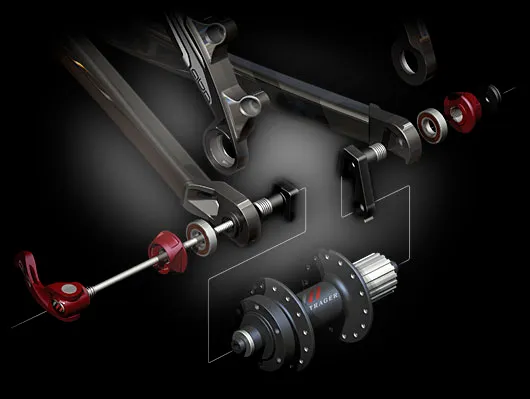
A CAD rendering of Trek's APB design
Testing times
For the immediate future, however, Weagle is too busy to worry about what other companies are doing.
He is in the final stages of development with most of his licensee. The bike designs are done and now they’re dialing in the tunes of the shocks that will be used in production.
The New Englander has been so busy that he only just put out the press-release announcing the Split Pivot patent, which was officially awarded in the U.S. on 18 May; his European and Asian patents are still under review.
BikeRadar caught Weagle on his mobile phone in between downhill runs during a day of testing at Highland Mountain Bike Park in Northfield, New Hampshire.
“There are like a million things going on,” he said. “I knew I needed to get the press-release out there, but I’ve been more focused on riding prototypes and testing, it’s just been a lot of work.”
He just finished up work on two new downhill bikes that will be available in 2011. One model was Devinci’s 2011 Wilson downhill bike, which uses the Split Pivot design. The other was the much-hyped Pivot Phoenix, a DW-Link bike, which is now done and ready for production according to Weagle.
“This morning I finished two weeks of testing on the Pivot Phoenix with the 2011 [Fox] RC4,” he said. “So this afternoon I get to ride the new DW DHR [from Turner], the only one in the world right now, so I’m pretty psyched about that. The DHR has been in process for so long that it’s pretty exciting to have it, the final one that people are going to be able to buy, it’s a great feeling.”
Devinci's 2011 Wilson downhill bike will sport the Split Pivot design
What is Split Pivot?
Split Pivot is Weagle’s answer to a call for a suspension system that is simpler to design and produce that his acclaimed DW-Link design, but still offers comparable performance. At the heart of the design and what could cause conflict with Trek is the use of a rear pivot that rotates around the wheel’s axle concentrically.
The design serves to isolate braking force and allow Weagle more leeway in choosing a main pivot location that would have previously detrimentally affected the bike’s braking performance.
“I can choose a single pivot location that would be horrible for braking but it’s great for acceleration and I don’t have to worry about the braking because I can control it with the linkage,” he said. “It’s like the best parts of a single pivot and the best parts of a multi-pivot kind of melded together.”
The appeal of the design to manufacturers and consumers is that the design is less reliant on tight tolerances and machining spec, which in the end means a mechanically robust high-performance system that costs less.
Another, yet to be released, Split Pivot rear end
Split Pivot also offers flexibility with all of the industry’s current rear thru-axle standards, including standard quick releases and in many cases it proves stiffer than other faux bar single pivot suspension designs.
In the end, Weagle is clear in stating the design goal of Split Pivot — to build a good bike.
“These [Split Pivot] bikes ride phenomenally well, really, really great,” he said. “I would put them up next to anything else, side-by-side, and if the rider is smiling at the end of the day then hey — that’s all that matters.”
