Disc brakes for cyclo-cross: a pro’s opinion

By Matt Pacocha, US editor, from Boulder, CO | Saturday, Dec 10, 2011 1.00pm

Cannondale-cyclocrossworld.com rider, Tim Johnson, has had a trying year following up his phenomenal 2010 season. He and his teammates split wins at almost every major domestic race in the US last season, but this year he has only won twice. Interestingly, both of those wins came on his new Cannondale Super X disc prototype.

The courses Johnson won on couldn’t have been more different. His first win came at Jingle Cross on day 3, which was a UCI Category 1 event, making Johnson the first rider win on disc brakes at such a high UCI ranked level.  “Every lap or race I can do on these things is going to teach me more about how they work, how they can be used, and also what Cannondale and SRAM can do to make their products better,” said Johnson. “That’s not bull, it’s really not — they’re awesome.”

The race was muddy, and featured the feared ascents and descents of Mount Krumpet; in short, the conditions were perfectly tailored to reward a rider with high performance brakes and mud clearances, the two main attributes touted by disc brakes.

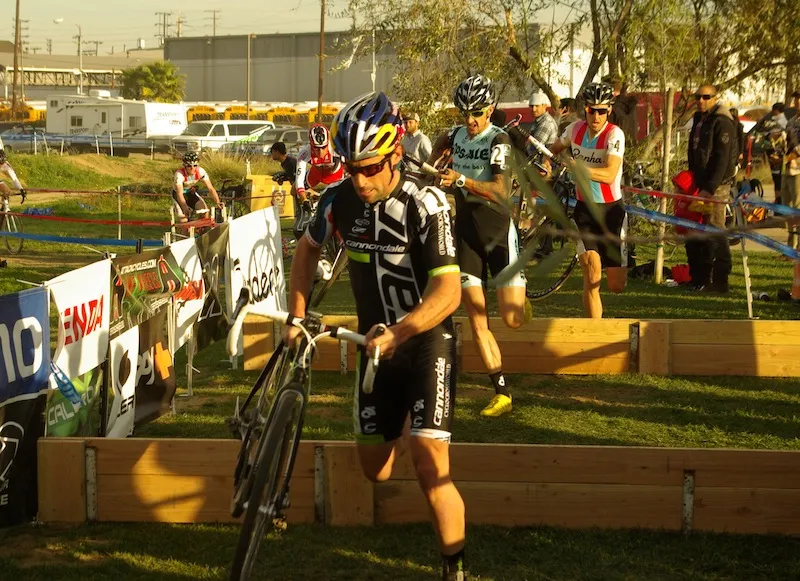
Johnson’s second win, however, is likely more interesting for those following the development and acceptance of discs for ‘cross, it came this past weekend at Cyclo-cross LA, a UCI Category 2 event in Los Angles, CA. “We’re taking the opportunity to pin a number onto something that’s still in testing,” said Johnson.

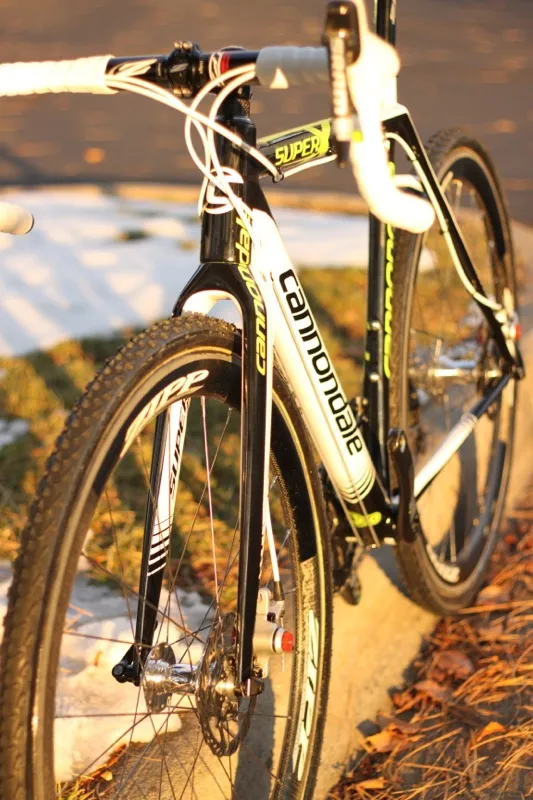
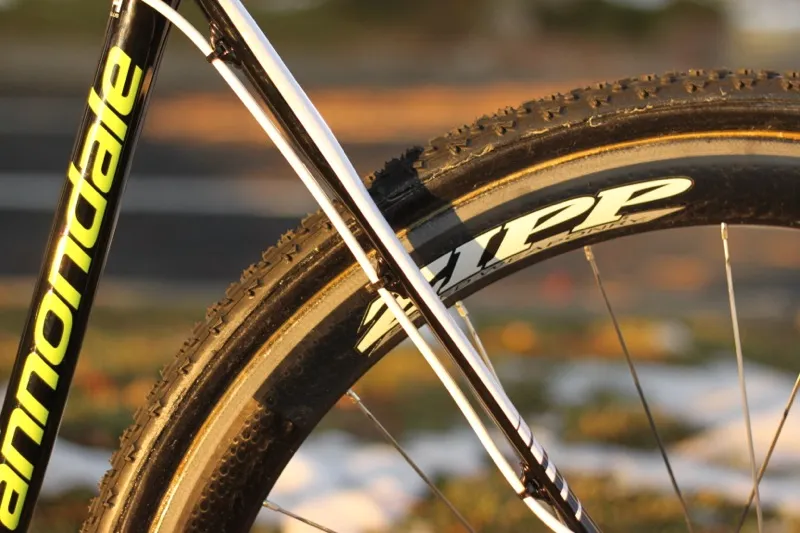
As well as more tire clearance:

Johnson's discs offer better braking performance and more mud clearance

What made this win more interesting were the course conditions: flat, with loose corners, and very fast with riders averaging over 30kph. “Changing something as big as the chassis and braking system is probably the biggest change [a rider can make],” said Johnson. “I was looking to this [past] weekend and week to get more time to try and figure out how it works, and whether or not it is really going to be the way to go. I’m trying to prove that now.”

For a course like this, conventional ‘pro’ wisdom would suggest a rider select for weight, but Johnson went with his slightly heavier disc bikes in an effort to continue to test how they affect his riding. “I wanted to spend more time on them, and even though it was going to be dry, probably flat, and extremely fast, I wanted to get a week on them,” said Johnson. “I decided to fly with them from Iowa to here [LA], and I’m glad I did, actually.”

Johnson said that the interest in the prototype bikes has been overwhelming. “The interest is just crazy,” said Johnson. “I was on a ride yesterday in the Hollywood hills and this guy rides up from behind and proceeded to talk my ear off for the next half hour. He was a moto guy, and was like, ‘whoa, discs on a road bike;’ because I had skinny [road] tires on for training. [Johnson has five pairs of Zipp 303s with disc hubs: two with Dugast Typhoon, two with Dugast Rhino, and one set of clinchers], and he said, ‘I can’t believe it has taken this long,’ this guy wanted to know exactly what was going on with the bike—it’s happening, and happening a lot."

The choice seemed to pay off with his second win of the season and for the disc-equipped bikes. And while, he admits that the brakes are impressive, but he doesn’t want to openly share more. “I can’t tell you much for publication, other than, I don’t think discs are just for muddy hilly courses,” said Johnson.

Johnson says he’ll still select the bikes on a case-by-case (or race-by-race) basis, for now, though we’ll surely see them on the course at the USGP in Bend, OR this weekend, 10-11 December. “I’m going to keep sampling,” he said.

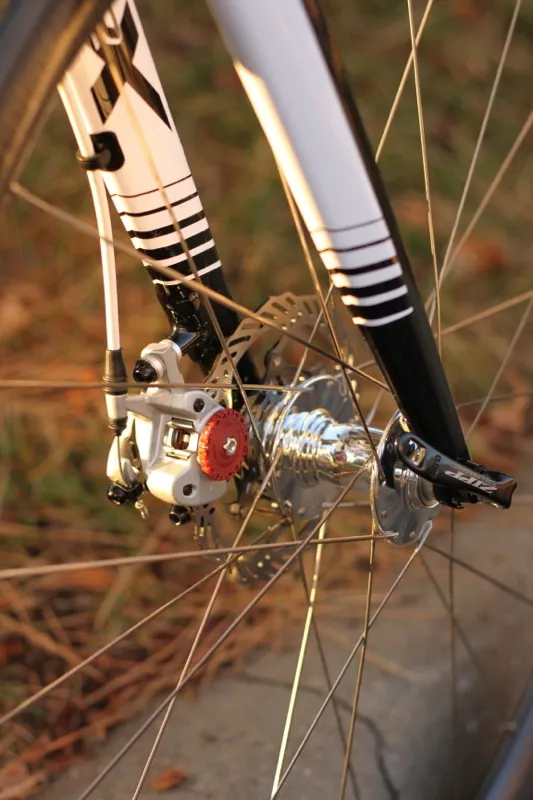
The bike uses 140mm rotors front and rear: the bike uses 140mm rotors front and rear

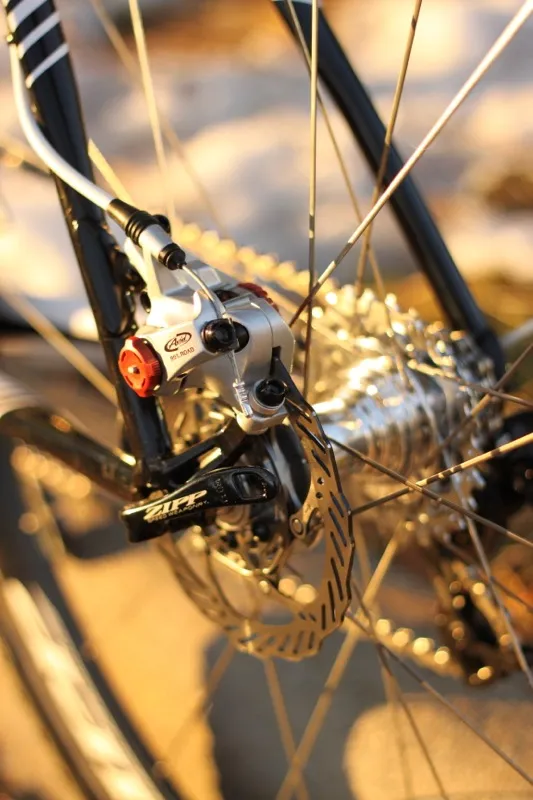
Johnson is using a hopped up pair of Avid BB7 mechanical calipers

You can follow BikeRadar on Twitter at twitter.com/bikeradar and on Facebook at facebook.com/BikeRadar.

User Comments

There are 9 comments on this post

Showing 1 - 9 of 9 comments

  • A bit short on 'pro opinion' and does nothing to move the debate on. The guy would probably still have won on cantis. I'm not anti-disk, but I am anti-hype. And this is just hype...

  • Part of being a professional is not biting the hand that feeds. So whatever he says can't be taken very seriously unless he would be complaining about the material. Anyway, I don't really care what the pros think, they have very different priorities than I have. As a mountain biker who can also frequently be found riding his road bike on wet roads I say: get on with it! Bring out the hydrauliic disc-equipped road bikes asap please!

  • +1 Bring on the discs asap...

  • -1 on disc brakes or at least this argument

    The issue isn't are "disc brakes better a better braking system?" Yes they are. There is a reason that cars don't have cantilever brakes. But more to the point there is a reason that mountain bike have discs. Before disc brakes were ever available there were times coming off the back of mountains in the rain which were probably 30% grades or steeper, no matter how much I grabbed the brakes my wheels would never stop. Add in various mud and the ability to steer the back end with brakes, and disc brakes make sense.

    So yes disc brakes are better, or are they? In cross the issue isn't brakes its traction. Even the Super Prestige and WC races average slightly over 30km/h which is fast for turns, dismounts and sand but hardly in the relm of speeds where you can't modulate or lock wheels on wet grass. i'm not convinced that braking is the issue in cross.

    So how about on the road. Well as David Bernstein put it, sometimes you want to descend slowly. Does anyone running modern dual pivot caliper brakes actually not have enough braking power at the rim? At 70km/h on a down hill on any road tire I guarantee that anyone can lock the wheels unless your brakes and pads are worn out and or wildly out of adjustment. The issue isn't braking, again it is traction.

    So, Davis asked "what would you have your kids ride?" Well as a father of two, I would have them ride appropriate bikes that are in good repair with working brakes. Do I think that cantilever or dual pivot brakes are inadequate for a sub 100 or even 120 lb combined rider/equipment youth? I don't.

    David Bernstein is an intelligent commentator but he often argues from an emotional point of view not a rational one. In typical David fashion he attempts to strengthen his argument by applying guilt to both the listeners and his fellow hosts.

    Cycling is safe. The equipment widely available is safe and at the enthusiast to competitive levels it is extremely safe. Keep it in good repair and ride it as it is intended and you will enjoy tens of thousands of kilometres of relative safe riding pleasure and so will your children.

    Applying a technological solution to a problem that is either il-defined (ie braking vs traction) or non-existent (ie current brakes are inadequate) will improve nothing.

  • There are loads of recreational riders that would buy cross bikes for general non-competitive use and for those riders discs would be better/safer, particularly in the wet. Cross bikes take fatter tyres than road bikes so traction isn't an issue.

  • @trustnoone

    It's been said many times, and I agree from personal experience, that the main reasons for disk brakes on cross or road bikes is modulation and consistent performance in the wet, not maximum power. Yes, traction is often limiting for maximum braking power. But I've ridden on wet roads with a road bike (Shimano 105 brakes) and a 29-er with 23 mm slicks mounted (Avid Juicy brakes). The difference is huge, especially for light braking before you enter a turn. Hardly any reduced performance compared to dry situations, and no waiting for the grime to come of your rims before the pads start gripping. Even dry I think the difference still is large enough to justify a weight penalty. I also train on my mountain bike on my club's cyclo-cross course together with others on cross bikes. Despite tires that are not exactly great for mud (Geax Saguaro 29x.2.2) I gain distance on most of the crossers at sharp turns because I can brake later without loosing control.

    Anyway, I don't care what the pros think. At least get these things out there for regular people ASAP.

  • Yeah I think trustnoon misses the point, some of us ride in the wet, downhill in the wet or don't have perfectly maintained brakes. when that car door gets flung open as i'm riding up to it at 30kmh I'd personally prefer for my brakes to start braking right then and there, rather than wait a few hundreds of a second for my rims to dry. As for modulation, well not sure what it means exactly but i know I much prefer the feel of my discs to my rim brakes.

    I'd take the weight penalty for better braking performance.

  • i ride road and MTB. cantilevers are ok provided it doesn't rain nor it gets muddy or gritty. just sucks when all you're doing sometimes is pray that your brakes work. key word is consistency. though disk brakes are not perfect, it is just way more consistent than cantis.

  • Cross bikes maybe, but the last thing I want on my road bike is squeeky/rubbing disc brakes. I've not had a set yet which hasn't rubbed or squeeked whereas my road bike brakes do neither, and are easily adjusted if they did.

    Ultegra callipers with stock pads have proved enough braking, three winters commuting in Edinburgh and this year's Bealach Na Ba in the pouring rain have convinced me of that.

    Just hope I'm not forced to use them by the time I want to upgrade frame/forks.

Post a Comment:

You need to login or register to post comments.