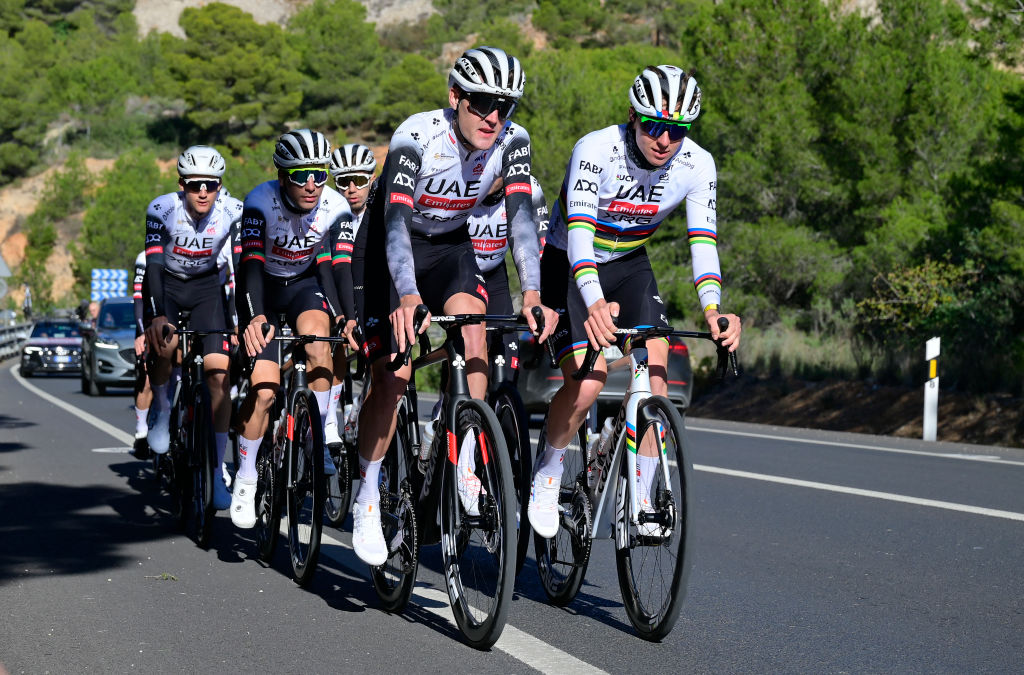
The path to building strength and speed by riding slower is a path well-trodden by cycling stars such as five-time Tour de France winner Tadej Pogačar, who spends much of his training at chatting pace (albeit still at wattages that would boggle the mind).
Such elite athletes possess sub-10% body fat and power oozes from every muscle.
So, what gives? And what can you take from this more relaxed approach?
The 80/20 split
Have you heard the phrase ‘junk miles’? It’s a term that scientists applied to slow training, with the view that simply plodding along wasted time and energy with no discernible gains.
Then along came Stephen Seiler, an American exercise physiologist based in Norway, whose instinct told him that the training methods used by the world’s best athletes would be a more accurate gauge of what works than restricted lab tests.
When he analysed the training programmes of world-class rowers and cross-country skiers, he discovered athletes in both sports did a whopping 80% of their training at low intensity.
Seiler and co-author Espen Tønnessen’s paper ‘Intervals, Thresholds and Long Slow Distance: the Role of Intensity and Duration in Endurance Training’ featured in a 2009 edition of the journal Sport Science. In subsequent research, Seiler found elite cyclists, swimmers and triathletes did the same thing.
It’s certainly the experience of Stephen Barrett, head coach at WorldTour cycling team Decathlon-AG2R La Mondiale. “We use a variety of training models, one of which is polarised training,” he says. “This involves splitting training into three zones – easy, moderate and hard. It works by removing the mid-zone.
“We tend to follow it when riders are subsequently exposed to a lot of middle-intensity efforts, which happens at the one-day classics and on Tour de France stages, plus altitude camps. In the build-up to these events, our riders undertake a high percentage of long, low-intensity sessions topped up by very hard efforts that really elevate the heart rate. In other words, polarised training."
How long is long and how short are those harder sessions? Barrett says top riders such as Felix Gall and Oliver Naesen will ride ‘easy’ for up to seven hours, with higher-intensity sessions lasting from two to four hours.
Those are pretty hefty figures, although it’s perhaps not surprising when a race such as the Tour de France covers more than 3,500km over three weeks, racking up 50,000m of climbing along the way. But what’s even more compelling about this 80/20 split is it’s not designed solely for longer distances.
Research by one of the world’s leading exercise physiologists, Iñigo Mujika, quantified the training-intensity distribution of world-class 100m and 200m swimmers, who’d be racing for no more than 60 to 120 seconds at a time. Mujika concluded they were swimming 77% of their annual 1,150km total at a low intensity.
Not only for the pros
This is all well and good, you might say, but these are elite athletes who have the luxury of plenty of time to train, rest and eat. What about those who have only a few hours to ride each week?
Well, that’s the real win of polarised training – it’s equally applicable to recreational exercisers. Seiler and his team undertook further research that revealed this form of training works whether you’re ticking off four sessions a week or 14.
In his landmark paper, Seiler showed that many recreational runners feel they must ‘red-line’ in every session, so they do a lot of training in what’s called the ‘threshold’ area. That’s around 80-87% of maximum heart rate. They might run for around 45 minutes, improve but then plateau soon after. The problem is, they’re then too fatigued to do the high-intensity sessions effectively.
In fact, studies show that recreational runners naturally run around 50% of sessions at moderate to low intensity, and then run the remaining 50% at high intensity.
Take research by Dr Jonathan Esteve-Lanao, who had experienced members of his club follow a 50/50 or 80/20 split of 10km training, and found that the latter group improved their time by 5% compared to 3.5% for the 50/50 group.
However, it’s the 50/50 split that most of us naturally gravitate to, because the level of suffering we’re prepared to encounter is limited by motivation. There must be a strong enough reason to dig really deep. It’s why you probably ride or run harder for longer during a race than in a cold, wet training session.
How ‘training easy’ works

How does this type of training work? The key is improving your aerobic potential. This is how proficiently you can grab oxygen from the air and feed working muscles, which will burn it for fuel.
By training long and slow, you stimulate a swathe of aerobic adaptions that are conducive to a fitter, stronger you. These include your heart and lungs functioning more proficiently, resulting in your heart pumping out more blood with every beat and your lungs enabling larger amounts of air to be inhaled and exhaled with every breath, as well as improving oxygen uptake.
You also boost the number of mitochondria and their quality. That’s a boon because these are the energy powerhouses in your cells.
But, says top coach Matt Fitzgerald in his book, 80/20 Running, the real win of low-intensity training is its fatigue-busting attributes. “Studies have shown that during prolonged running at low intensity, the muscles release large amounts of a cell-signalling compound called interleukin-6 (IL-6), which contributes to fatigue,” writes Fitzgerald. “Well-trained runners produce less IL-6, and this is one reason why they are more fatigue resistant.”
Stimulating aerobic adaptations requires raising your heart rate to at least 60% of its maximum, so if your maximum is 180bpm, you’re looking at around 104bpm. At the other end of the intensity spectrum, spend 20% of your efforts working hard. This improves your anaerobic capacity (ability to generate energy without the presence of oxygen), which cranks up your speed and muscle power.
How do you find your zones? Ideally, you’ll have a heart-rate monitor or optical heart-rate reading on your smartwatch. You then undertake a 30-minute time trial where, after a brief warm-up, you run or ride as far as you can in 30 minutes. Your average heart rate during the last 10 minutes is your maximum.
The three zones are then split into Zone 1 – around 60 to 75% of maximum; Zone 2 – 76 to 85% of maximum; and Zone 3 – anything above 86%. As Barrett revealed, Zone 1 tends to be longer, easy sessions, while Zone 3 will be tough efforts that often feature intervals. Try to avoid Zone 2 where possible.
This 80/20 split is also applicable to five-zone training, which is what the likes of Pogačar use. In this case, he spends the majority of time training at Zone 2 or below.
The rise of Jeffing

It’s not only polarised training that promises easy, big gains. The increasingly popular activity of Jeffing is another low-sweat option. Jeffing involves mixing up walking and running, and is the idea of former US marathon runner Jeff Galloway.
“We’ve shown that it cuts injury, meaning you exercise more consistently, resulting in many mental and physical benefits,” says Galloway.
“When you Jeff, you turn on three brain circuits. There’s the ‘good attitude’ circuit, where your stresses disappear. The ‘vitality’ circuit is where you might lack energy at the start but once you’ve got into it, you’re energised for the day. The ‘empowerment’ circuit is where you’ll usually find a solution to your problems.”
Running and walking can lead to better cardiovascular health and a leaner you.
If you’re a racer and worried that you’ll nestle at the back of the pack, think again. A 2016 study in the Journal of Science and Medicine in Sport found Jeffing helped participants reach the marathon finish line in roughly the same time as non-stop runners. The mixed-gender group of run-walkers finished in times between 4hrs 14mins and 4hrs 34mins, with the run only group’s times from 4hrs 7mins to 4hrs 34mins.

As for gym-goers, “You could certainly say that within a session, the 80/20 rule could be applied,” says strength and conditioning expert Chris Peden. “You could have 20% of a session as your heavy, high-intensity work and 80% as general strength and maintenance.”
General strength and maintenance work involves moderate loads, so around 50 to 70% of your one-rep maximum. You then do two to three sets of eight to 12 reps. This is more about form over weight and, in our example, covers the upper body and core, so you might include incline dumbbell press, pull-ups, sit-ups and side planks.
You’d then spend 20% of the session focused on your lower body in more explosive, high-intensity training (HIT), so you might do power cleans, box jumps, the deadlift and battle ropes for three sets of four or five reps (or four 30-second bursts for the battle ropes) and work at around 80% of your one-rep max with longer rest periods between efforts (up to two minutes).
“You could also add strength and conditioning work into the 20% HIT if you’re an endurance athlete,” adds Peden.
So, there you have it – conclusive evidence that spending the majority of your training time at chatting levels, punctuated by very hard efforts where you dig deep, produces greater gains than constant fatigue-inducing, mid-intensity efforts.