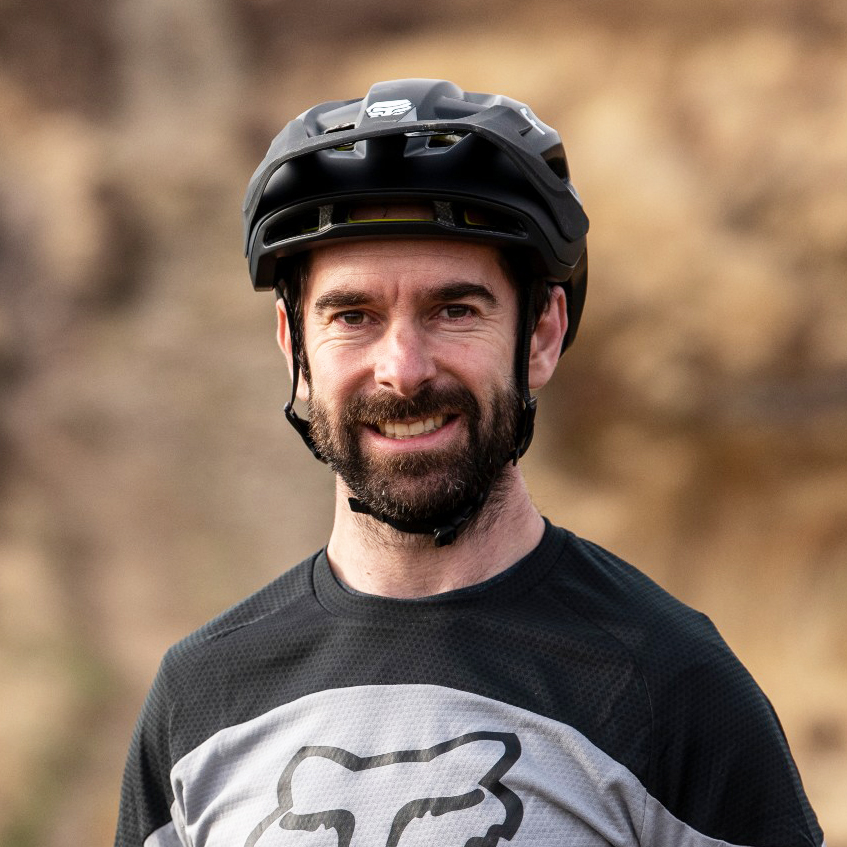
Steve Peat has achieved a hell of a lot in the mountain biking world. The 51-year-old has won the Downhill World Cup overall series title three times, the World Championships once and scooped 17 World Cup wins, along with eight National Championships victories and a handful of European titles on top of all that.
But there’s more – way more. Steve was a huge force in taking mountain biking to the masses, putting the sport on the UK map and helping to forge its image worldwide. It’s no wonder, then, that he won our Rider of the Year Lifetime Achievement Award in 2025.
Nowadays, the big man from Chapeltown, Sheffield, splits his time between his head coach role on the Santa Cruz Syndicate race team and running his own company, Peaty’s, which sells accessories, maintenance and cleaning products with an eco conscience.
We decided it was time for a proper catch-up with the fun-loving, down-to-earth legend once his post-awards hangover had worn off. So, in early December, I jumped in the MBUK van with our videographer Max Wilman and headed up north to Sheffield to chat racing and look back at some of Peaty’s favourite bikes from over the years. Oh, and maybe even ride a bit too…
Collectors’ paradise

After almost three hours of driving, we rumble along a farm track and pull up outside Peaty’s ‘man shed’, where Steve greets us and welcomes us in. This place is impressive – he’s got a fully stocked workshop, kitchen, office, lounge and, of course, lots of bikes, helmets and other memorabilia. It’s a mountain biker’s dream.
Before any cameras are taken out and the real work begins, we get chatting. Steve may not be racing World Cups any more, but as head coach of one of the world’s most successful teams, he still lives and breathes it. His winning ways were no fluke, and the knowledge and experience he gained from decades on the circuit are now being transferred onto the next generation.
It’s funny, though. Peaty’s laidback take on life and calm demeanour are somewhat misleading. Even now, it’s clear he hasn’t lost his competitive spirit or his edge. He still knows what it takes to win at the highest level, and it’s interesting to hear his take on all the goings-on from the past season.
We also discuss the few national races he completed in 2025, with great success, although he assures me he doesn’t miss racing at the top level. He’s more than happy competing with his peers and with his youngest son George, who, Steve says, is yet to beat him. Not that there’s a family rivalry or anything...
Over coffee, we take a look around his workshop while Steve has a little tidy-up, ready for filming. Alongside the bikes that have made history – and that isn’t an exaggeration – there are all sorts of treasured trinkets, including Steve’s 2002 invite to Downing Street to meet then-Prime Minister Tony Blair. It’s easy to forget just how big an impact Peaty had on mountain biking in the UK.
As well as the lofty accolades, there are all sorts of other cool bits and pieces on display. Anyone remember Steve’s Troy Lee Designs ‘Thirsty Work’ D2 helmet, with two cans of Stella Artois mounted on top with tubes sticking out from them so he could stay ‘hydrated’? That was from Livigno, Italy, in 2004, where Peaty raced safe in the knowledge he’d already wrapped up the series title. It’s amazing to see all of this in the flesh.

Then, of course, there’s the 2018 Mountain Bike Hall of Fame award, hordes of medals and trophies, as well as his invite to the BBC Sports Personality of the Year in 2003. Just wild!
But nothing compares to the bikes. Steve’s not long mounted them on the wall and I feel bad asking him to get them down, but he kindly obliges so we can take a closer look. I’ve asked him to choose just three, but bear in mind that Peaty’s kept at least one bike from every year he’s competed, so there’s a lot to choose from.
The buzz

First up is the Bumblebee, or at least that’s what Steve affectionately calls it. This Orange 224 prototype was the bike that Steve piloted to his first and only Fort William World Cup victory in 2005. I was there, screaming as he crossed the line and watched him lift his bike over his head in celebration. Just thinking back gives me goosebumps. Seeing the bike here right in front of me is hard to fathom.
I quiz Steve about the sizing and if there was anything custom going on. “Every Orange I had was handbuilt in Halifax, so every one of them was custom,” he replies.
He also tells me that Orange continued to extend the front and rear triangles of the bike as their partnership continued but, despite this, “it was still really small to ride, but it was one of the bigger ones at the time”.
For those who know their Oranges, it’s clear this isn’t run-of-the-mill. The brand’s characteristic single pivot is positioned far lower than on the production 223 of the time, and tucked in just in front of the chainring.
As one of the few riders on the RockShox BlackBox programme, a product-development project reserved for the fastest racers on the planet, Steve was sometimes given kit that might not even make it into production.

“I think we started things off with brakes, then maybe bars, then they moved into suspension and things like that,” Steve explains.
Bolted to the front of the Bumblebee is one of the first RockShox BoXXer forks that used an air spring, since they’d been built around much heavier coil springs up until that point.
“It was always nice to get something that not many of the other riders had got. Always made you feel a bit better about yourself. And it was cool seeing what they’d come back with after your feedback and test sessions.”
It’s wild seeing just how spindly those 32mm BoXXer stanchions are compared to the upper legs on the far chunkier Fox 40 fork that Steve uses now.
Sticking with suspension, Steve was also one of the few riders using the Progressive 5th Element shock, which he had Tim Flooks, RockShox suspension tech and founder of TF Tuned suspension, tune for him.
Then there’s a host of mods you wouldn’t find anywhere else in the pits. As a Race Face-sponsored rider, Steve had to run what was available from the brand at the time. With no direct-mount stem, Steve used a regular one. But, to prevent it from twisting, his mechanic screwed cut-off, headless bolts into the fork’s top crown, tight against the stem.

On top of that, grease was stripped from his Hadley hubs and replaced with thinner oil to ensure they spun as fast as possible. Other little details include laser-etched reservoir caps on the Hope brakes, with one featuring the date of birth of his eldest son, Jake, which makes this bike even more special.
If ever a product was to date a bike, aside from the 26in wheels, it has to be the dual-plate, twin-roller MRP chain guide. While we take things like chain retention for granted now, back then, the MRP was one of the only foolproof chain devices going, and for the most part, it worked a treat. Well, it clearly did for Steve on that infamous day in 2005 when he pipped Greg Minnaar to the win.
Chasing rainbows

If you’ve followed Steve’s career, you’ll know all about his relationship with the World Championships. Up until 2009, Peaty had won four silver medals. And no one will forget that day in 2004, in Les Gets, when, after being up at the final split, he crashed out, handing the title to Fabien Barel.
The year 2009 marked Steve’s 17th World Championships. Despite winning World Cups in Andorra and France in the lead-up to the big race in Canberra, Australia, Steve felt like this might not be his year. Again.
“I’d had a bad back a couple of weeks before, didn’t feel good going out there and just thought I was [attending] to make up the numbers,” he says. But as we now know, that wasn’t the case.

The bike Peaty raced that weekend was similar to the one he’d been on throughout the 2009 season, but with the track in Canberra being so fast and relatively flat, Steve and his mechanic, Ricky Bobby, set about making some tweaks to make it as rapid as possible.
Officially speaking, the bike seen here would be the Santa Cruz V10 Mk3, though Steve’s actual bike would have been custom, which used an alloy frame with a carbon fibre upper link, 26in wheels, and offered up a massive 254mm of rear-wheel travel.
When it came to the frame, Steve says: “We’d gone a bit bigger and I felt like it was finally getting to a decent size where it fitted me a little bit better”.

The Syndicate were still sponsored by SRAM and RockShox at this point, with Steve continuing to be a key part of the BlackBox programme, which explains all the little, not-for-production touches you’ll see in the pictures.
While Steve generally preferred to stick with a suspension setting for the season, it was firmed up for this particular race, to help him carry as much speed as possible.
One particular area of focus for Steve was the tyres. “A semi-slick on the back, and I cut the tread down on the front tyre,” he says, referring to the Maxxis High Roller that’s seemingly been shaved, specifically for the race. This was all done to maximise rolling speed.
Onto the brakes and, unlike the rotors you’ll find on most downhill bikes now, Peaty’s 2009 V10 sports a pair so small you’d be unlikely even to see them on cross-country rigs these days. With a 160mm rotor up front and a 140mm at the rear, it’s clear Steve didn’t intend on slowing down much.
He knew he needed to pull some time in the more technical upper part of the track, because he’d be giving some away on the lower, more pedal-y stretch towards the end.

“I knew I wasn’t that fit, so I hammered the top of the track and put something like 1.25 seconds into everybody else there and luckily, managed to hold the lead all the way to the finish line,” Steve reminisces.
Weight was also something many racers took into account back then, and explains the three, rather than six, rotor bolts at either end, which is terrifying to consider.
The patriotic paint job needs mentioning, as do the hand-polished DT Swiss rims, the rear of which has some battle scars. The dings around the edge of this rim are so deep, Steve confesses, “I was lucky to make it down the track”.
Fortunately, he made it down, and what’s more, took the win, ahead of Greg Minnaar again, by just 0.05 seconds.
Name game

Our final piece of Peaty history is the Stella bike, affectionately named after one of Steve’s favourite drinks. This is the current, eighth-generation Santa Cruz V10, which sports 208mm of travel, 29in wheels in a size XL and far longer and slacker geometry than any of its predecessors.
As Steve looks at it adoringly, he confesses: “This is a bike that finally fits me really well. Everything has been refined a little bit and this bike is just bigger, better and faster.”
It’s the first of our three that includes the Santa Cruz Syndicate race team’s current sponsors, Fox and Shimano. The broad, chunky-tubed Fox 40 fork is the biggest contrast to the skinnier RockShox BoXXers bolted to the other two bikes, and no doubt a fair bit stiffer too.
While Steve’s drivetrain is from the Shimano Saint stable, he opts not to run the Saint brakes. “I’ve always preferred the XTR brakes,” he says. “It’s down to the way that I brake. I come into a corner, brake really late and get on the brakes really hard. And for me, a Saint on the front is a little too grabby.”
He’s used the Saint brakes in the past, but had to de-tune them in order to achieve his desired feel.
I quiz him on the suspension and ask him for his take on the evolution of this rather complex part of the puzzle. “Everything just gets refined and gets a little bit better every year – it’s just those small steps. It’s the same with suspension. Fox are constantly upgrading the dampers and chassis.”
Bringing Steve’s idea for the paint job to life was Ali from Fat Creations, and it’s fair to say those guys did a great job. Finally, I can’t not mention the fact that Steve has a colour-matched set of his Peaty’s-brand grips.
“I love the fact I can get on the bike and feel my grips. We spend a lot of time going backwards and forwards on [products Peaty’s develop] and won’t let the product out until we’re happy with it.”

We can’t wrap this one up without getting to the bottom of the Stella name, though. As a rider known for his partying antics, Steve enjoys a beer or two once the race is done, and Stella Artois was one of his preferred choices.
“We’d always drink Stella. When I used to drive back from Europe, we’d stop in EastEnders [the alcohol wholesaler, not the UK soap opera - ed] and fill whatever space we had in the van with crates of Stella. When you bought it from EastEnders, it was actually brewed in Belgium and it was nicer, so it didn’t give you the hangover as bad as the stuff brewed in the UK.”
Time for a ride

Before we wrap up the day, Steve kindly shows me the Steel City trails in Grenoside Woods. Well, strictly speaking, it’s his youngest son George who tows me down the Steel City downhill track. Just like Steve, George is a tall lad, and following him as he pumps the bike and uses his long limbs to maintain speed, it’s wild to see just how similar his riding style is to his dad’s. And man, can he jump.
While we grab some pictures, hit some jumps and rail some turns, it’s amazing to think just how much Peaty has achieved, and what mountain biking has meant to him and his family. What’s coolest of all, though, is seeing just how much fun Steve and George have chasing each other down the trail. It’s a great way to end an amazing day.