News that Chris King is launching a six-bolt version of its legendary hubs has re-raised the perennially controversial, yet trivial, topic that reliably raises blood pressure to disproportionate highs in the BikeRadar office: which is the superior standard, Center Lock or six-bolt?
Opinions are comically diametrically opposed on this point, with some adoring the simplicity of the six-bolt standard and others in favour of Center Lock.
Spilling out from a heated exchange on Teams, here, Jack Luke, who is strongly in favour of Center Lock does battle with Tom Marvin – who sits firmly in Team 6-Bolt.
But which is your preferred standard, and why? Vote for your pick at the bottom of this article, and let us know in the comments.
Don't know your Center Lock from your 6-bolt? Read our full guide to disc brake rotors.
Tom Marvin: Center Lock is the devil's work – 6 bolts are better than one

I’ve never understood people’s love for Center Lock rotors. They’re a smart, nicely integrated and neat solution on paper, for sure. But, in reality, they've never lived up to my expectations.
On top of that, the 6-bolt fixing system – an existing, long-established, nigh-on universal, genuine ‘standard’ – simply works.
The reasons for my preference for the little Torx bolts are myriad.
First up, there are six – rather than one – get out of jail free cards that ensure your rotor is attached safely and securely to your hub.
It’s unlikely, but I have seen Center Lock rotors come loose mid-ride. I’m not carrying around a few hundred grams worth of ruler-length tool in order to keep my braking surface attached to my bike.
In comparison, I will have a T25 tool on my multi-tool.
Next up is the workshop-based simplicity. There is not only one Center Lock lockring, there are multiple. They all require different tools, each with different pros and cons and varying costs.
On the other hand, there’s only one T25 bolt type, with one thread pitch – it’s foolproof.

The 6-bolt attachment is also – certainly in my mountain bike-bubble – far more common.
Yes, Shimano doggedly flogs the Center Lock standard, but almost everyone else, whether they build hubs or rotors, uses six little bolts to pair them together.
Rotor size aside, I know I can fit any rotor to any hub, with no compatibility issues, regardless of which brand has built them.
Then, finally, there’s the performance aspect – one that cannot be ignored.
Center Lock splines need to have a little wiggle room so the rotors can be fitted or removed easily.
But a little can turn into a lot, and before you know it, your rotors are rattling all over the place, while your bike rocks forward and back when the brake is clamped on, leading you to search frantically for the wobble that’s not coming from your headset.
Should this be noticed on the trail, you’ve no chance of nipping it up and locking it down, thanks to reason number one.
All in all, this is why I stand by the six small bolts that connect my rotors to my bike as being the ultimate choice. I will not be convinced otherwise.
Jack Luke: embrace the future – Center Lock is simply better

Center Lock is an improvement upon the 6-bolt standard. It's foolproof, a cleaner solution overall and much easier to use.
Had Center Lock been announced today, I would be sceptical.
But it is a well-established standard, which has been around since the turn of the millennium – and the widespread adoption of disc brakes as a whole – with the release of Shimano XTR M960.
With that in mind, I don’t think the points regarding universality stand up to scrutiny – all major players produce (superior) Center Lock rotors for all disciplines.
In terms of practical improvements over six-bolt, Center Lock rotors use a large lockring, which applies even pressure across the whole of the rotor/hub interface.
It doesn’t require a great deal of skill to tighten up the bolts of a six-bolt rotor in a star pattern, as you would with a car wheel. But you don’t even need to think about that with Center Lock – honk on that bloody lockring until you’re up to torque and you’re laughing.
I can’t say that I recognise Tom’s argument that Center Lock introduces a meaningfully detectable wobbly sensation in the bar.
In fact, I checked my bikes after reading his indefensible diatribe, and the movement in the pads – which is present regardless of which rotor standard you use – far exceeds any detectable wiggling on Center Lock rotors.
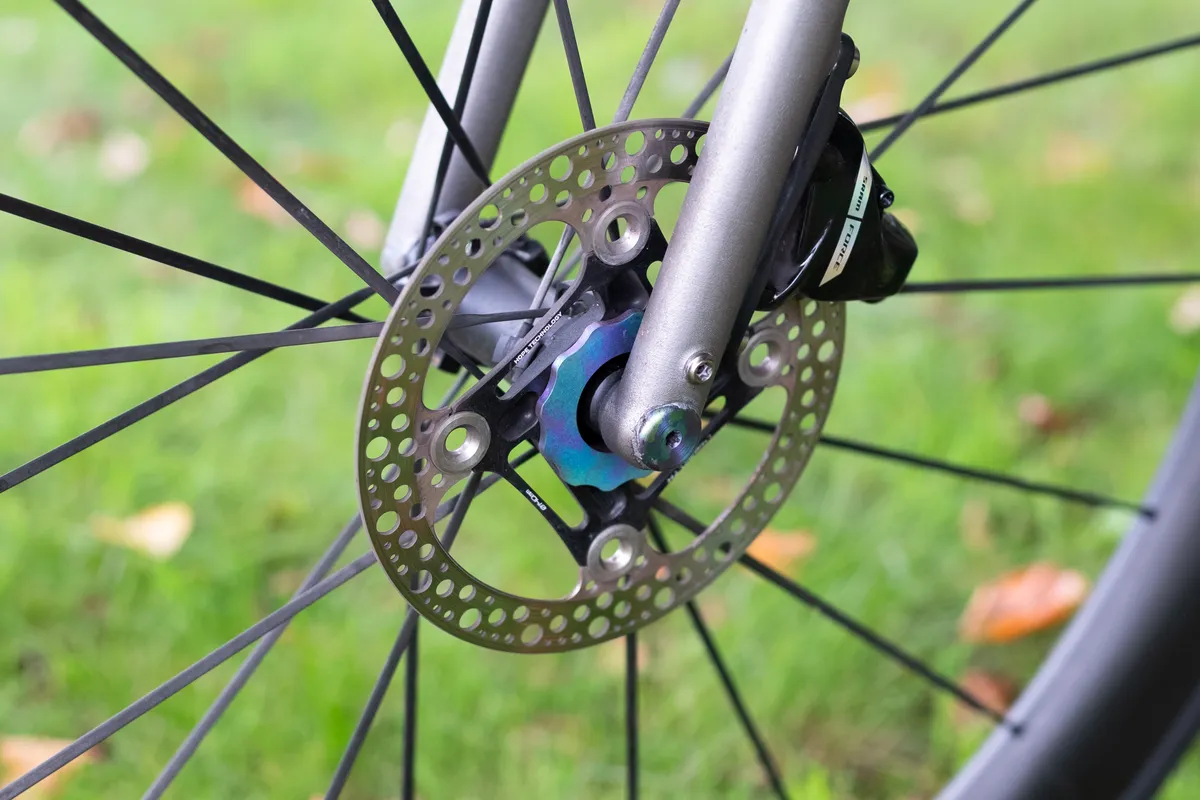
I will go in Tom’s favour on one point: there is a frustrating proliferation of Center Lock lockring standards, and some are better than others. While slightly less elegant, I preferred the original style, which used a cassette lockring tool to tighten, because it is easier to get a good engagement with the lockring.
However, none are truly difficult to use, despite our wonderful colleague Robin Weaver’s claims he has slipped tightening up Center Lock lockrings with external splines.
To the honourable gentleman, I say: get better tools, or work on your dexterity.
In comparison, it’s far easier to round out a Torx head, and removing one of those from a rotor is more of a pain in the bum than taking the time to use a lockring tool right.
Crucially, Center Lock hubs can be adapted to six-bolt using affordable adaptors – should you be so compelled to use the inferior standard.
The crux of the matter is that Center Lock is simply an easier standard to use and less prone to user error.
Where our benevolent bike industry overlords have provided us with meaningful improvements over an existing standard, I’m all in favour.