
Tubeless tyre inserts weigh around 45g, are undetectable while riding and could save your life – yet for some reason they haven’t yet caught on, at least not in road cycling.
Given they started appearing about five years ago, this might not be news to you, but given what’s at stake when we head out on the road, I’ve found myself questioning why more of us don’t use inserts.
Yet, even though I’ve known this for a long time, and use them on my gravel bike for exactly those reasons, I don’t use them on my road bike.
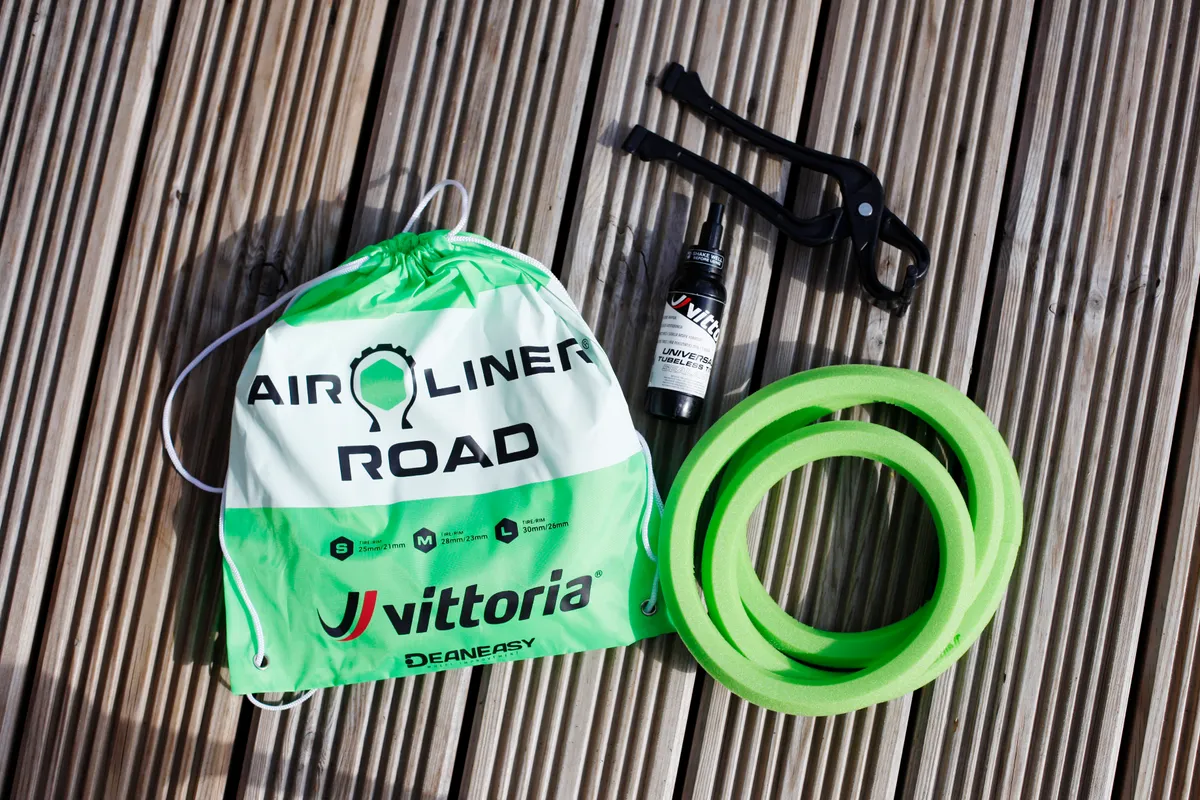
And it’s not because they’re too expensive – Vittoria’s Air-Liner inserts cost about £100 for the full kit, including inserts, tools and sealant, and you can get similar knock-offs from AliExpress for a fraction of the price.
The reason is that they’re a pain in the arse, and can make removing your tyres an absolute nightmare.
But I think it’s time more of us bite the bullet, put our safety first and learn how to live with them.
What are tubeless tyre inserts and how can they improve your safety?

In most cases, tyre inserts are simply big rings of foam that you put inside tubeless tyres.
There are other kinds of tubeless inserts for mountain bikes, such as Schwalbe’s discontinued Procore system or the Odyssey Pneumatic Tire Insert System.
However, for road and gravel bikes, it’s as if someone stole some pool noodles, packaged them up and tried to sell them to you as a bike accessory.
Having originated in mountain biking, where tubeless tyres also first gained popularity, the idea is they protect your tyres and rims from impacts, and help provide sidewall support at lower pressures.
Perhaps more importantly, though, foam inserts can help keep a tyre on the rim in the event of a puncture, and provide vital sidewall support that could help you come to a safe stop, rather than losing all of your grip immediately.
And given this, if you have a puncture at high speed, they might save you from a bad crash and serious injury.
After all, the fact tubular tyres (mostly) stayed attached to the rim in the event of a puncture was one of the key reasons they remained so popular in the pro peloton until recently.
To give a tragic example, Norwegian cyclist André Drege lost his life in the 2024 Tour Austria, following a high-speed crash on a descent.
According to reports, local investigators have since concluded that Drege lost control of his bike after his rear tyre “completely deflated, causing it to lose contact with the rim”, following an impact from a “hard object”.
Assuming Drege wasn’t using inserts, it’s impossible to say for certain whether having them would have made any difference in that specific situation.
However, if I were to have a puncture on a fast descent, I’d want every bit of help I could get with keeping the tyre on the rim and me in control of the bike. Especially when the evidence appears to show there’s little to no performance impact from using inserts.
Do tubeless tyre inserts affect performance?

Given what you put inside your tyres can affect how efficiently they roll (latex and TPU inner tubes tend to be more efficient than butyl ones, for example), it follows that adding inserts to your tubeless tyres might affect their rolling resistance.
Happily, though, the available evidence shows there’s no significant trade-off between safety and performance here.
Testing by AeroCoach, for example, showed a Tubolight Road insert increases the rolling resistance of a 25c Continental GP5000 TL by just over one watt at 45kph.
Likewise, testing by bicyclerollingresistance.com showed no increase in rolling resistance across three different tyres when using Vittoria’s Air-Liner Road inserts.
According to Vittoria, what makes the Air-Liner Road inserts different from competitor options is they compress under pressure. This means when you inflate your tyres, the foam inserts shrink down into the well of the rim and don’t contact the tyre sidewalls – thus not adding any rolling resistance.
When pressure in the tyre is lost because of a puncture, the Air-Liner Road inserts expand immediately back to their original size.

So, what’s the problem?

If tubeless tyre inserts might help you avoid crashes and don’t affect performance, why aren’t we all using them on our road bikes?
The problem is they’re a hassle – specifically when it comes to removing them.
Because the insert takes up space inside the rim and tyre, it becomes incredibly difficult to push the bead of a tight tubeless tyre back into the rim’s dropped central channel. Any time you try, the insert will simply push the bead back into place on the shoulders on the rim (as it’s designed to do).
Without this, you can’t get the slack required to lift a section of the tyre bead off the rim.
Vittoria’s Air-Liner Road kit provides tools, such as a set of plastic pliers to help muscle the tyre beads back off the rim shoulders, and bead clips to help hold them in the rim channel (and prevent the insert pushing them back out onto the rim’s shoulders).
But these are things to keep in your toolbox at home – not something you’ll want to carry with you on a ride – and removing tyres can still be an expletive-inducing job even with these tools at hand, especially if you happen to have a particularly tight rim and tyre combination.
Given this, you’ll need to be adept at repairing tubeless punctures with plugs, because you won’t be able to get the tyre off and put in a spare tube by the side of the road (and you wouldn’t want to carry home a sealant-covered foam insert anyway).
For punctures that can’t be fixed with plugs, the inserts themselves can provide enough tyre support to enable you to limp home or to a nearby bike shop.
It’s also fair to say they’re not completely foolproof.
As we’ve seen with recent tyre-dismounting incidents in the pro peloton (such as Thomas De Gendt’s crash at the 2023 UAE Tour and, more recently, Amaury Capiot’s exploded wheel at Omloop het Nieuwsblad), a tubeless tyre can still blow off if the rim itself is damaged badly enough, even if you’re using inserts, as both riders were.
Do as I say, not as I’ve done

Given I’ve known of the theoretical benefits of tubeless inserts for a long time, you might reasonably ask why, if they’re so amazing, haven’t I been running them?
As noted earlier, I use them on my gravel bike, because it seemed a no-brainer to have a little extra rim protection when unskilfully bashing through rocky trails.
I’ve been using Tubolight’s EVO gravel inserts (which don’t shrink under pressure as Vittoria’s Air-Liner Road inserts do), for just over two years, and they’ve essentially been ‘fit and forget’.
They’re also much easier to remove than with road tyres, because the insert can be tucked up into the air cavity of a substantially larger gravel tyre, so it doesn’t stop the tyre beads from dropping into the centre of the rim.
With my road bike, though, I’ve simply been making excuses, reasoning that since I test road bike tyres (and therefore swap tyres fairly frequently), it didn’t make sense to add all that extra hassle into my workflow.
For here on out, though, I’m going to practise what I preach and put up with the extra hassle of tubeless inserts on my road bike – and I’d advise you to do the same. They might just save your life one day.


