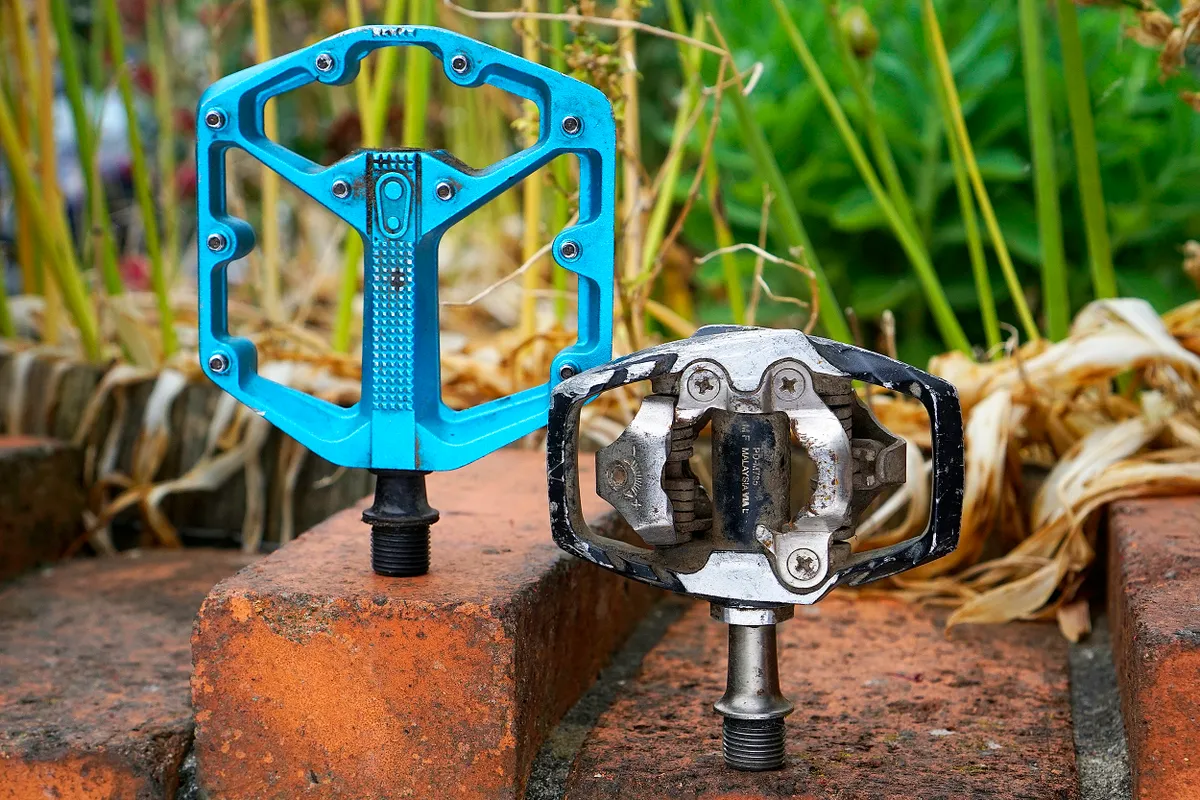
Clipless pedals are used across the mountain biking spectrum, with different styles designed to suit each discipline – cross-country riders look for low weight and pared-down construction, while downhillers need plenty of support, and trail and enduro riders want something that sits in the middle.
I've tested three SPD-compatible pedals that span this gap, head to head: Wolf Tooth’s CTRL Trail pedals, Renthal’s Revo-DHC downhill model and Shimano’s latest XTR Trail design.
While there are subtle differences in the mechanisms, the interaction between them and the cleat is pretty much identical, so I haven’t focused on that. They all have similar levels of adjustability, five degrees of float and a 12-degree release angle.
Not only have I tested each pedal, but I’ve also delved into which shoe and pedal combinations work the best. I tested each set with three pairs of MTB shoes aimed at different sub-genres, to help you decide which will work best for your riding.
Wolf Tooth CTRL Trail

Wolf Tooth has opted to only provide support on either side of the shoe’s cleat – there's no platform on the front or rear of the clipless mechanism. The brand say this is to prevent your foot from twisting from side to side as you pedal, while still giving a solid base to push against.
I found these pedals worked best with slightly stiffer shoes, because the lack of fore-and-aft support meant softer soles flexed over the top. At the same time, the additional lateral support was noticeable.
When wearing medium- to stiff-soled shoes, the connection felt solid and my feet well-supported when rocking and rolling with the bike on rough descents.
Not only do the CTRL Trails have a smaller platform than the other pedals on test, they also don’t have any pins for additional foot security, despite being a trail-focused design (and Wolf Tooth also offering XC and gravel pedals).
As a result of this and the lack of fore-aft platform, they were the easiest to engage the cleat with, out of the three pedals on test.
The lack of pins also means you can access the cleat’s 5-degree float more readily, plus you can run a little more spring tension for extra security. With the other pedals here, the pins binding on the sole made the release feel relatively stiffer.
Although these pedals didn’t excel with my flexible Shimano test shoes, they worked well with the Leatt trail footwear I used and exceptionally with the Specialized XC shoes.

While it’s not obvious from the outside, you can adjust the stance width of the pedals, and thus the effective Q-factor of the bike. This is done by moving the spacers and bearings inside the pedal body. The distance between the mechanism and the crank arm can be altered from the stock 55mm to either 51mm or 59mm.
XC racers might like to run the pedals more inboard for a slightly more efficient pedalling position, while more aggressive riders may prefer the wider stance offered.
I sometimes find the toebox on gravity-oriented shoes (particularly those with a rearward cleat position) can interfere with the cranks when I’m trying to release my rearward foot, and a wider-stance pedal could mitigate against this.
At 15mm thick, and extending 35mm from the centre of the mechanism, the low-profile body of the pedal helps it stay out of the way of rocks, and there are few areas where mud can collect thanks to the minimalist design.
Specs
- Price: £189
- Weight: 327g/pair
- Length: 68mm
- Cage depth: 15mm
- Crank to outer edge: 91mm (55mm Q-factor)
- Adjustable stance width: 51/55/59mm
- Extras: Fully rebuildable design, with all parts available as spares
SQUIRREL_13946720
How we tested | Clipless MTB pedals
Back-to-back testing is the gold standard when it comes to reviewing products, and a bike needs two pedals to work. As such, I ran one brand of pedal on one side, another on the other side, and then swapped in the third to make comparisons.
I also wanted to see how the pedals performed with different styles of footwear. Each pedal was therefore tested with three shoes: Shimano’s gravity-focused GE9, Leatt’s ProClip 6.0 trail shoe and Specialized’s Recon XC race slipper.
This process was designed to help me work out the intricacies of each pedal’s performance, as well as establish which shoes work best with different pedal designs.
Renthal Revo-DHC
SQUIRREL_TEXT_13946723

Although the mechanism looks off-centre, the Revo-DHC pedals have the same 55mm stance width as virtually every set of clipless MTB pedals out there. However, the outboard side of the platform has been extended to give more foot support.
Elsewhere, Renthal has effectively taken its Revo-F flat pedals, pins and all, and added a clip mechanism to give more downhill security.
On the trail, the support on offer is next level. The additional platform under the side of the foot is particularly noticeable, especially if you set the cleat more inboard to make the most of the extra width.
This results in lots of confidence when loading the bike in turns or rattling over the rough stuff. Foot fatigue is almost non-existent, and if you miss the mechanism after a dab, it barely matters because the shoe will still grip on the platform and pins.
You must take care with the pin setup, though. Four lengths are offered, from 1.5 to 5.5mm, via two pin options plus a set of washers, along with cleat spacers. Renthal recommends setting the pins so the shoe just ‘kisses’ the top of them. When you load the pedal, the sole should flex down and grip on them.
Get this wrong and releasing from the pedals can be difficult. I ran the mechanism with less tension to compensate, even when running low pin heights. The pins also impact pedal entry a little. Scuffing my foot forward over the platform to engage the cleat could cause the shoe to snag and the pedal to rotate a touch.

That said, the mechanism enables easy stamping in, especially when using Shimano’s MT001 multi-entry cleats. I had the highest missed clip-in rate on test with these pedals, though.
The Revo-DHC’s aluminium body sits on a chromoly axle, and spins on a wider-than-usual Igus bushing on the inboard side, with three outboard bearings that sit almost at the edge of the pedal body for maximum load-spreading. You can access these easily if you need to do a spot of home maintenance.
They’re heavy, at 637g a pair. That’s around 150g weightier than Crankbrothers’ Mallet DH pedals. A lighter DHC-TRC option is also available, though.
The pedals’ chamfered edges glance well over rocks, although their large size makes them more prone to strikes. Thanks to the big holes between the front and rear edges and the mechanism, mud collection is minimal, although you will find that sticky stuff does eventually fill the gaps.
SQUIRREL_13946723
Specs
- Price: £189.95
- Weight: 637g/pair
- Length: 111mm
- Cage depth: 18mm
- Crank to outer edge: 114mm
- Stance width: 55mm
- Extras: 8 pins per side, per pedal
Shimano XTR M9220

Shimano’s latest top-end trail and enduro-focused pedals have a squarer cage than their M9120 predecessors, along with four adjustable-length pins per side. They offer good foot stability and security, backed up by the brand’s legendary durability (which, in my experience, bears out).
The pins are all of equal length and protrude either 2mm or 1mm from the platform, depending on whether you fit the supplied washers. Spare pins are included. While the pins’ impact on the pedal feel isn’t as obvious as it is on the Revo-DHCs, they help to keep your foot planted, resisting unwanted twist, especially when you load the pedal and your shoe flexes and engages fully with them.
As such, the XTR pedals have a more secure feel with a wider range of shoes than the Wolf Tooth CTRL Trails. Unlike with the Renthal pedals, I never had any issues when it came to twisting my foot to release, because there are fewer pins and their length is relatively short.
The generous cage offers a good platform for more flexible shoes, although it was noticeable that the Revo-DHCs provided more support at the side of the foot when riding the pedals back to back. Still, for riders outside of the DH world, and certainly those with reasonably stiff shoes, the Shimano pedals offer more than ample control and feel.
While I had no issues with the pedals catching rocks, they’re bearing a few scars, suggesting they could slide over obstacles better. The cage is more angular than the others on test. The design is also more susceptible to mud collection than some. Weight-wise, they’re on a par with similarly sized competitors.

Shimano’s new MT001 multi-direction engagement cleats, which are supplied with the pedals, are an improvement on a classic. Rather than needing to toe into the mechanism, additional profiling on the cleat enables more of a vertical or even rearward entry.
This is especially useful if you have to deploy a sketchy safety dab, making it easy to stamp your foot back into the pedal. These were some of the easiest and most consistent pedals to engage and disengage with.
I usually find Shimano’s pedals reliable (the generation-before-last XTR M9020s being a notable exception, where pedal-body float was an issue), and these ones have served me well so far. Improved seals are said to further enhance durability, although it’s too early to tell if this is true.
Accessing the cartridge bearings requires spanners rather than hex keys, annoyingly, so on-trail fixes may be less feasible than with the other pedals here.
Specs
- Price: £179.99
- Weight: 469g/pair
- Length: 98mm
- Cage depth: 19mm
- Crank to outer edge: 92mm
- Stance width: 55mm
- Extras: Come with new multi-entry cleats
SQUIRREL_13946732
Clipless MTB pedals bottom line
The result of this test is perhaps as you'd expect, with the three pedals serving different purposes.
The Wolf Tooth pedals have more of an XC focus, working better with stiffer-soled shoes, while the XTRs are all-rounders with a bias towards trail riding. They feel good under shoes of any stiffness level and give a more locked-in feel than the Wolf Tooth pedals, without being as aggressive as the Renthals.
The Revo-DHC pedals are targeted primarily at DH riders with softer-soled shoes.
You need to get the pin length just right (and for me, that's as low as they go), but once set up, they're comfortable, performance-enhancing pedals that are worth the small downsides. Oh, and they look great, too.
All three pedals have minor drawbacks, but work very well overall. You wouldn't regret buying any of the three, but it's the Renthals that have remained on my bike after testing.