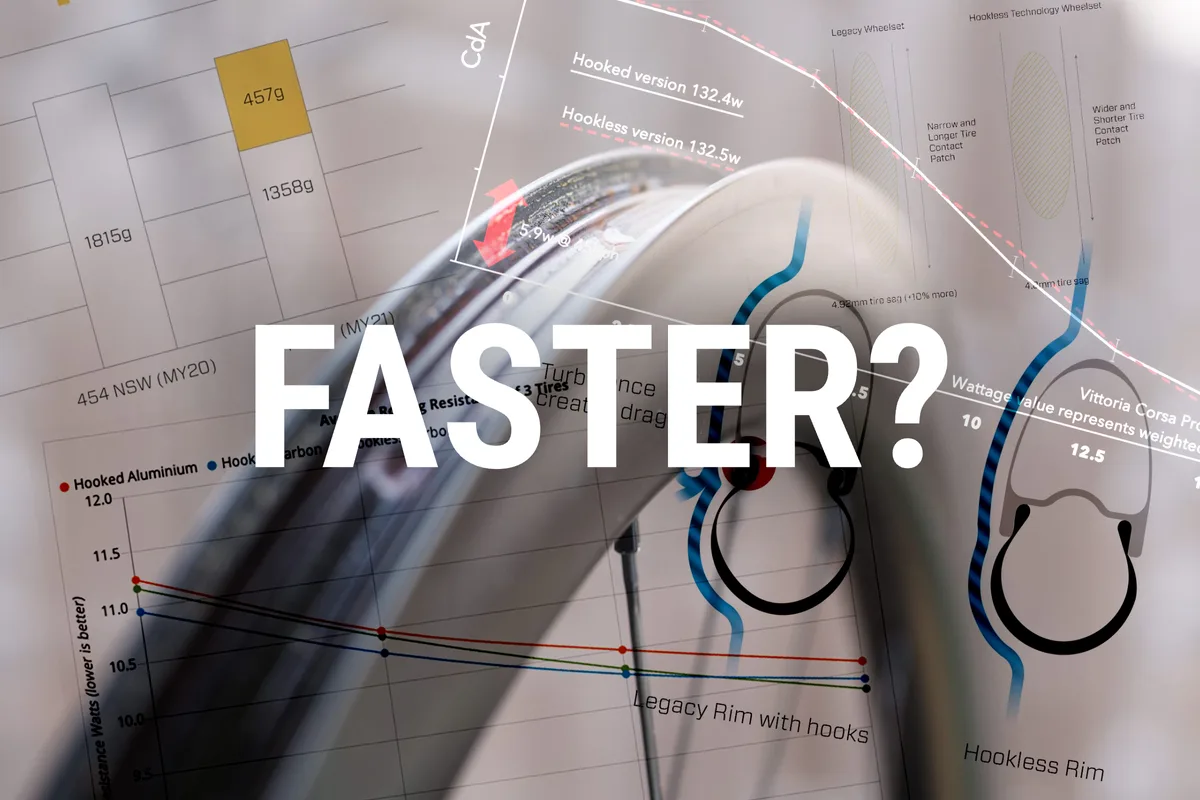
In recent years, road cycling rim designs have fallen into two camps – hooked and hookless.
The former is the traditional rim profile that most cyclists will have experienced. Universal among inner tube clincher setups, certain tubeless-ready hooked rims can also be set up tubeless with the right rim tape, valve, sealant and tyre combination.
The hookless alternative forgoes the bead hook at the edge of the rim, adopting a straight-sided inner wall, and is only compatible with tubeless tyres.
Its claimed performance benefits – improved aerodynamics, better tyre shaping and lower weight – have seen it growing steadily in popularity since its move into the road cycling mainstream at the start of the decade.
But high-profile incidents of tyres blowing off hookless rims and comments from industry experts against the design’s use in road cycling have seen brands and professional cycling teams remain divided about the tech.
But is there now a third way? A small number of manufacturers, including ENVE, Orbea’s components arm Oquo, and Reserve, have released rims featuring what are being described as ‘mini’ or ‘semi-hooks’.
With all three of 2025’s Grand Tours won using wheelsets incorporating the tech, they’re clearly no slouches. But what are mini-hook rims, and do we really need them?
What are mini-hook rims?
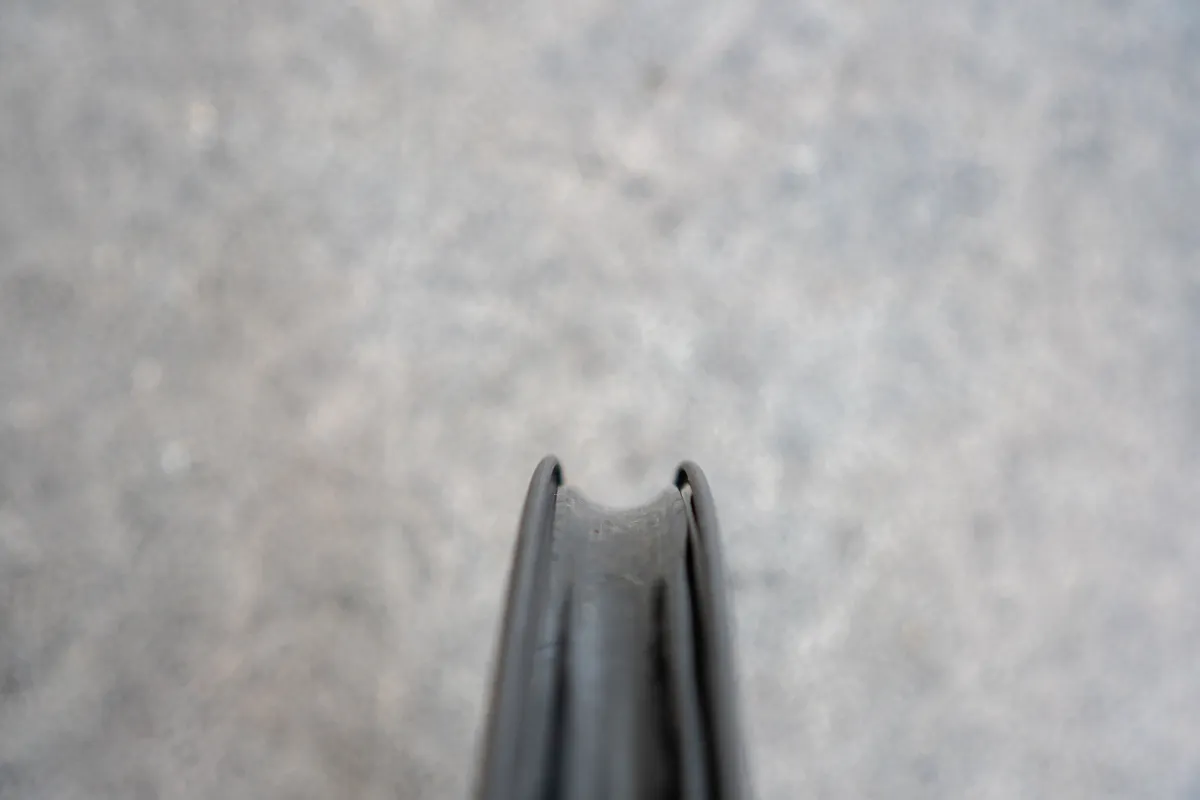
Whatever the adjective preceding the word hooked, mini-, micro- and semi-hooked rims are just that – hooked rims.
Just like a hooked tubeless design, the rim bed features a rim bead lock and seat, straight sidewalls and a bead hook at the exposed edge of the rim. The difference is the depth of this bead hook – the width of the inward-facing protrusion at the top of the rim flange.
When it comes to European Tyre and Rim Technical Organisation (ETRTO) and ISO (International Organisation for Standardisation) standards – the rules that set the parameters of rim dimensions and their associated tyre recommendations – a hooked rim has to have a bead hook of at least 0.5mm depth.
“It defines a bunch of dimensions around the rim shape at the interface with the tyre, and what it specifies, as far as hooks go, are a depth of the hook of greater than or equal to 0.5 millimetres,” says Kevin Nelson, a design engineer at ENVE.

“Our new [SES 4.5] Pro wheel meets that, so from our perspective, it's a hooked wheel. Where it’s different from what we've made in the past is that the hook depth is shallower.”
ENVE isn’t the only manufacturer sailing close to the limit of the ETRTO standards. Oquo also adopts a 0.5mm-deep mini hook on its MCR32 mountain bike wheels, although the Spanish brand declined to share the depth of the mini hooks on its road and gravel offerings.
Reserve’s ‘semi-hook’ rims are 1.25mm deep and 1.5mm tall. “We’ve found you can’t get the strength you need out of the hook if you go any smaller,” explains Reserve’s managing director, Joel Smith.
But not all industry experts are convinced it’s worthy of its own sub-category. “As far as we're concerned, the ETRTO only has two standards – TSS, which is ‘tubeless straight side’, or TC, which is ‘tubeless crochet’,” says Hunt’s senior development engineer, Paddy Brown.
“These mini hook designs that we've seen out there are all compliant within the ETRTO TC standard. It's a branding piece.”
Do these rims adhere to ETRTO standards?

All of the current crop of mini-hook rim manufacturers interviewed for this feature say their rims adhere to ETRTO standards centred on a hooked rim design – meeting that 0.5mm minimum depth.
“The mini-hook rims used in Oquo wheels are designed to adhere with current ETRTO guidelines,” says Oquo’s Álvaro Mañe.
“Additionally, we take advantage of the tolerances allowed by the regulations to optimise the rim design. Each rim is adjusted within the permitted limits. The mini-hook allows tyres to seat better, have more tyre compatibility and can handle more pressure.”
Why do mini-hook rims exist?

The rise of mini-hook rims has been driven by improvements in carbon fibre rim manufacturing tooling and the accuracy that comes as a result – essential for designing a tubeless setup that doesn’t leak air (or sealant).
ENVE’s Nelson explains that, previously, the manufacture of an undercut (such as a rim hook) required soft materials to be extracted from the carbon mould. The process made the system’s dimensions hard to control and ENVE was limited to making hooks that were 1.5mm deep.
“We have since come up with another idea that allows us to maintain the dimensional control of the sealing surfaces – those are the critical components of any tubeless system,” he adds.
The 'why' is less clear, though, with each manufacturer touting its own reason.

For ENVE, the development of the SES 4.5 Pro and its mini-hook rim was two-fold. “We were developing this wheel specifically for UAE [Team Emirates],” says VP of product Jake Pantone.
“The UCI has communicated that it’s going to follow ETRTO or ISO, so part of that is also the tyre volume spec that is allowed for hookless. In certain instances, the team likes to run smaller than a 28mm tyre and in [higher] pressures that you run for time trials.”
Under ETRTO guidelines, the brand’s hookless SES 4.5 rim’s 25mm internal width requires at least a 29mm-wide tyre, while the maximum permitted tyre pressure for the hookless rims’ internal width is 72.5psi / 5 BAR.
But Pantone claims the development of the Pro also has performance advantages. “We wanted to keep the leading edge as wide as possible, because that delivers more pinch flat protection in events like Paris-Roubaix.

“By carving the material out from under [the leading edge], we save weight and we also get the hooked bead back in the rim.
"We get all the things – we get the hook bead, we save weight, and we are able to maintain that dimension of the bead seat diameter that ensures that the tyre bead and the rim interface stay connected, which is the most important factor to tyre and rim compatibility and retention – the hook isn’t really a relevant component of a tubeless system.”
Smith, meanwhile, states that for Reserve, it’s about “providing the benefits of a hooked design without the tyre installation issues” that come with traditional hooked rims and that the brand “doesn’t have to limit the tyres our customers use on their rims”.
For Oquo, it’s about creating a system that combines the benefits of hooked and hookless designs by improving tyre retention at the bead, especially at higher pressures; maintaining hookless manufacturing advantages such as greater uniformity and reduced weight, and compatibility with wider tyres and higher pressures, “which is useful for road and even in some situations of gravel racing”.

Hunt’s head of product and engineering, Rob Fields, suggests a mini hook could also solve the issue of customers fitting the wrong type of tyres to wheels aftermarket.
“There are a lot of people out there buying Giant bikes with Cadex wheels (to name one hookless brand), and they probably don't really understand the details as much as they should do around what they can and should fit.
“We see people fitting the wrong tyres to wheels all the time. I think the move back to hooks, or mini hooks, is partly driven by that to a certain degree,” he says.
What are the advantages and disadvantages of mini-hook rims?

Compared to ‘bigger’ hooked rims, the advantages of shrinking down the hook bead – if structural integrity is maintained – is clear.
Oquo’s Mane highlights a lower weight, better uniformity of the tyre with the rim and easier manufacturing practices, while adding that the design can also lead to stronger and more consistent sidewalls, “allowing the rim to better withstand pressure, impacts, and tyre forces, while maintaining its shape and performance consistently”.
ENVE’s Nelson adds that bigger hooks can disrupt a tubeless seal, too. “One of the reasons we went away from hooked systems in the first place was that the seal between the tyre and the rim – which is the thing that makes the whole tubeless system work – happens at the bead seat and not at the hook.
“The hook is there to keep the tyre centred on a non-tubeless system, but on a tubeless system, its relevance to what's going on is pretty minimal. If the hooks are too deep, they can actually push the tyre up off of the sealing surface.”
The hooks Nelson's referring to were 1.5mm deep – three times deeper than its ‘mini-hook’ innovation.
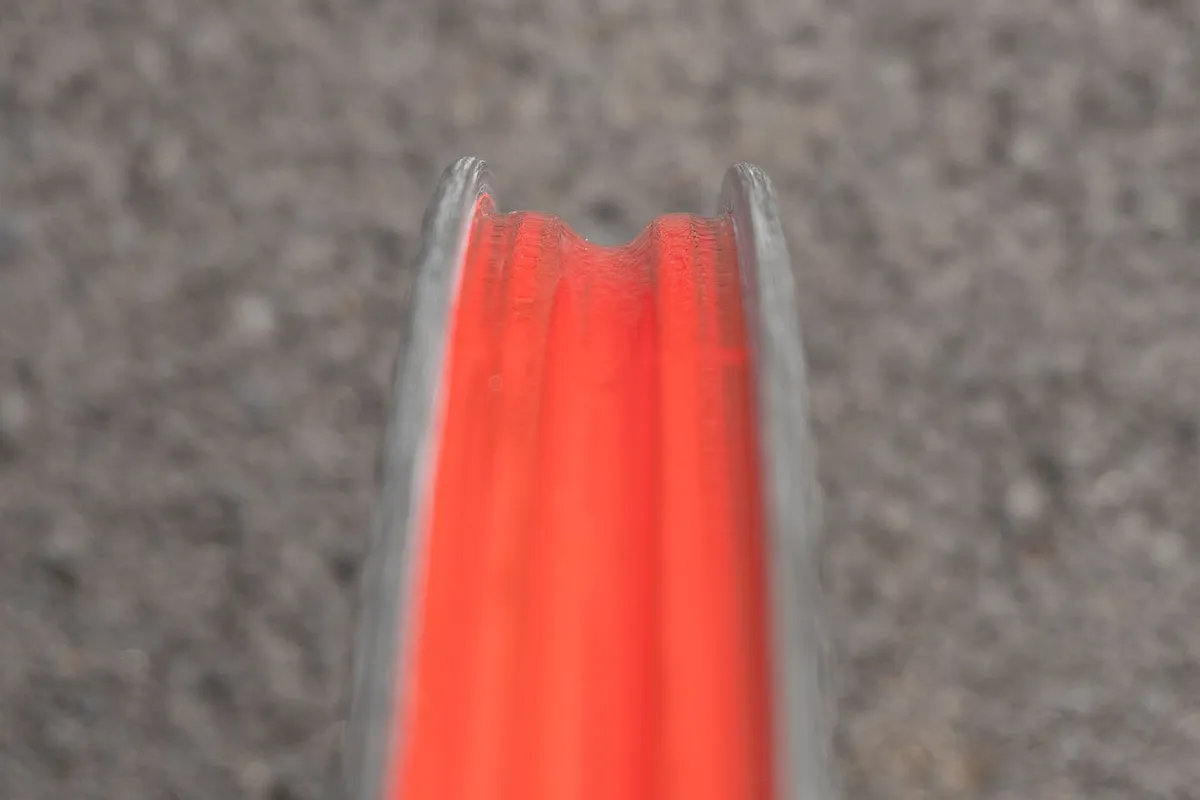
When it comes to advantages compared to hookless rims, though, it’s less clear-cut. As previously stated, ENVE’s SES 4.5 Pro is both lighter (50g per rim) and able to run higher pressures under ETRTO guidelines than its non-Pro equivalent because of the presence of a hook.
But it comes at a higher cost, and part of this is because of the added complexity of its creation compared to a hookless design.
For Oquo, the mini-hook rims come out heavier than hookless, but Mañe adds that “for the same internal width, you can have a wider external width [with mini hooks]” and this creates a purported aerodynamic benefit.
Not everyone is convinced, though. “I'm not sure why you need a mini hook, I don't see the advantage,” says Cadex’s global head of product and business development, Jeff Schneider. “If you look at ENVE’s, they have about a half-millimetre bead. It's nominal. The bigger question is, if you get rapid deflation – if you slice your tyre, or hit an object in the road – is that enough to hold that tyre on the rim?
“I don't know if micro hooks are fixing the problem or if they're just putting the word hook into this story to make people feel more comfortable.”

In response, ENVE’s Pantone says: “There's been some very high visibility cases where tyres are blown off rims, and nine times out of 10, it happens because the rim is cracked. As you lose that [tyre bead seat] dimension, it doesn't really matter if it's hooked or hookless – the interface is compromised, and the tyre can come off because it's under pressure.”
"In controlled burst-pressure testing, traditional hooked rims generally achieve higher safety margins than semi-hooked designs, which in turn perform better than hookless rims, all other conditions being equal,” adds Samuele Bressan, global marketing manager at Pirelli Cycling Division.
“This is simply a reflection of how the different rim interfaces mechanically retain the tyre bead."
Which tyres are compatible with mini-hook rims?

The presence of a mini hook might suggest the rim can be used with tubeless and old-fashioned clincher tyres, but each manufacturer has its own recommendations.
“These rims are designed for tubeless,” says Nelson of ENVE’s SES 4.5 Pro. “The modern tubeless tyre is the pinnacle in performance, and so we communicate that a tubeless tyre is the only tyre you should run on either our hooked or hookless rims.”
For Oquo, its mini-hook rims are compatible with tubeless-ready tyres and standard clincher tyres “as long as [the tyres] comply with the current ETRTO standards”, while Smith says that “all” tyres are compatible with the brand’s semi-hooked road offering.

Bressan, meanwhile, says Pirelli designs tyres that fit tubeless crochet (hooked) rims, taking into account the minimum dimensions allowed by the ETRTO standard.
“It is important to underline that ETRTO does not define a 'mini-hook' category; this is essentially a commercial term,” he explains, before adding that “it is the rim manufacturer’s responsibility to ensure proper rim geometry and rigidity values to safely accommodate standard tyres available on the market.”
“There's already so much confusion and misunderstanding out there,” counters Hunt’s Fields. “You won't find a mini-hook tyre – you'll find TSS [Tubeless Straight Side] or TC [Tubeless Crochet] tyres and that's all that a customer should really have to worry about.
“We don't want to create a new, unofficial standard and confuse customers and riders around the world even more, if we can avoid it.”
Despite the widespread following of ETRTO standards, there is clearly a conflict between wheel and tyre brands when it comes to who is (or isn’t) following the guidelines to the letter, and ultimately bears responsibility if a system fails.
What is the maximum permitted tyre pressure for mini-hook rims?
There is no universal maximum permitted tyre pressure for mini-hooked rims, with each manufacturer having its own recommendation.
“The maximum permitted pressure depends on rim and tyre, and they are fixed by ETRTO,” says Mane.
For ENVE, the maximum tyre pressure listed is 100psi / 6.8 BAR, while Reserve recommends a maximum of 100psi / 6.8 BAR on road, 80psi / 5.5 BAR on gravel, “or the maximum pressure as listed on the tyre”.
In short, if you’re using a rim with a mini hook, it's worth considering this as you would a ‘normal’ hooked rim, and then also following tyre recommendations – whichever is most conservative.
Will mini hooks take over?

The new tech has an impressive palmares already, but is it a necessary innovation that will sweep the world of road bike rim design?
The enthusiasm towards hookless certainly seems to be cooling in the pro peloton, and although there has been no indication of regulation changes from the UCI, only Cadex, Zipp and Hunt are still fully pushing a hookless agenda at the top of the sport.
Hooked rims are therefore the mainstream pick, and the mini-hooks’ claimed advantages over a deeper hook – lighter, more uniform production processes and less interference with tubeless seal – are clear.
Oquo’s Mane suggests they might become “more common in categories where tyres are still relatively narrow, riders use higher pressures and tyre compatibility is a priority, such as road racing, or performance gravel.”

But there’s also a desire from certain sectors of the industry to make mini hooks the default option – Reserve’s Smith saying he “hopes” they take over in the future, citing their compatibility with all tyres and “a higher confidence in the security of the tyre on the rim with the design”.
He also concedes that the added complexity of manufacture compared to hookless could put some brands off. “Hookless rims are easier to make and lighter (because you don't have the hook), so I think most of the hookless brands will not want to make their lives more complicated by doing it.”
ENVE’s Nelson agrees that the advanced tooling required to make a mini hook could be the limiting factor in them becoming universal, even though hooked-rim tooling clearly exists already.
“Our manufacturing methods are pretty different in our experience,” he says. “This method is a little bit more difficult [than hookless], but at that high end, we think it's worth it. If other brands think so too, then we'll probably see some [more] stuff.”
The question of whether mini hooks will take over in the future, though, boils down to the heated hooked vs hookless debate. Over time, as manufacturing methods become more affordable and commonplace, a slimmed-down hook might replace a deeper, heavier bead hook, especially if hookless definitively falls from grace, or simply out of fashion.
But if the safety concerns around the use of hookless systems in road cycling subside, the framing of ETRTO-compliant hooked rims as ‘mini’, ‘micro’ or ‘semi’ could appear to be nothing more than a marketing exercise.