While most brands are pushing their full-power eMTBs – complete with massive batteries and enough torque to shift the earth momentarily on its axis – it’s refreshing to see something a little different from Orbea.
The new Rallon RS is based on Orbea's Rallon enduro bike – and let’s be honest, looks very much like it, too. It’s got plenty of travel and burly components, but despite being an eMTB, it doesn’t weigh much more than its non-powered counterpart.
It’s a modern take on a lightweight eMTB. Remember those? It was a nice idea but rarely, if ever, came to fruition.
However, the new Rallon RS takes that concept and harnesses the technological advancements to right the wrongs of the early ‘SL’ bikes.
Housed within the carbon tubes, you’ll find a motor – one of the smallest on the market – capable of only 200 watts of peak power, and the small 290Wh battery that powers it, along with a host of other electronics.
And that’s where things get really cool. Orbea has integrated every electronic component on the Rallon RS in a way we’ve not seen before.
Those low power and torque figures will no doubt put people off, but I'm here for it.
The dinky motor means you’ll get some help when you need it riding uphill, but you’ll still need to work on the climbs – no matter what mode you’re in. And I like that.
Orbea has taken a risk with the new Rallon RS and clearly ploughed a lot of cash into it, but I think it’s worth it. Here’s why…
A different kind of eMTB

With the Wild, Rise (SL and LT) and Urrun eMTBs already in Orbea's stable, you could argue the Rallon RS is less of a risk, and the lower-powered sibling complements the line-up.
But when you consider how the eMTB market has shifted since Amflow’s super-powerful DJI-motor equipped bikes arrived, launching a bike with power and torque stats at the opposite end of the spectrum might not make a lot of sense.
However, the Rallon RS has the potential to appeal to purists – riders looking for a bit of help on the climbs, but who value that regular-bike feel on the descents.
That might sound like a stretch. After all, who doesn’t want more power? But this bike is pretty special.
When we first started seeing SL eMTBs being launched, their promise of minimal assistance and a natural ride feel was extremely appealing.
Let’s not forget, Orbea was one of the first to the party with the Rise RS, which was a great bike.
The problem was, the motors were still quite hefty and took up a lot of space. The bikes were often quite heavy, and in a bid to keep weight down, generally used trail-bike parts, which were too fragile.
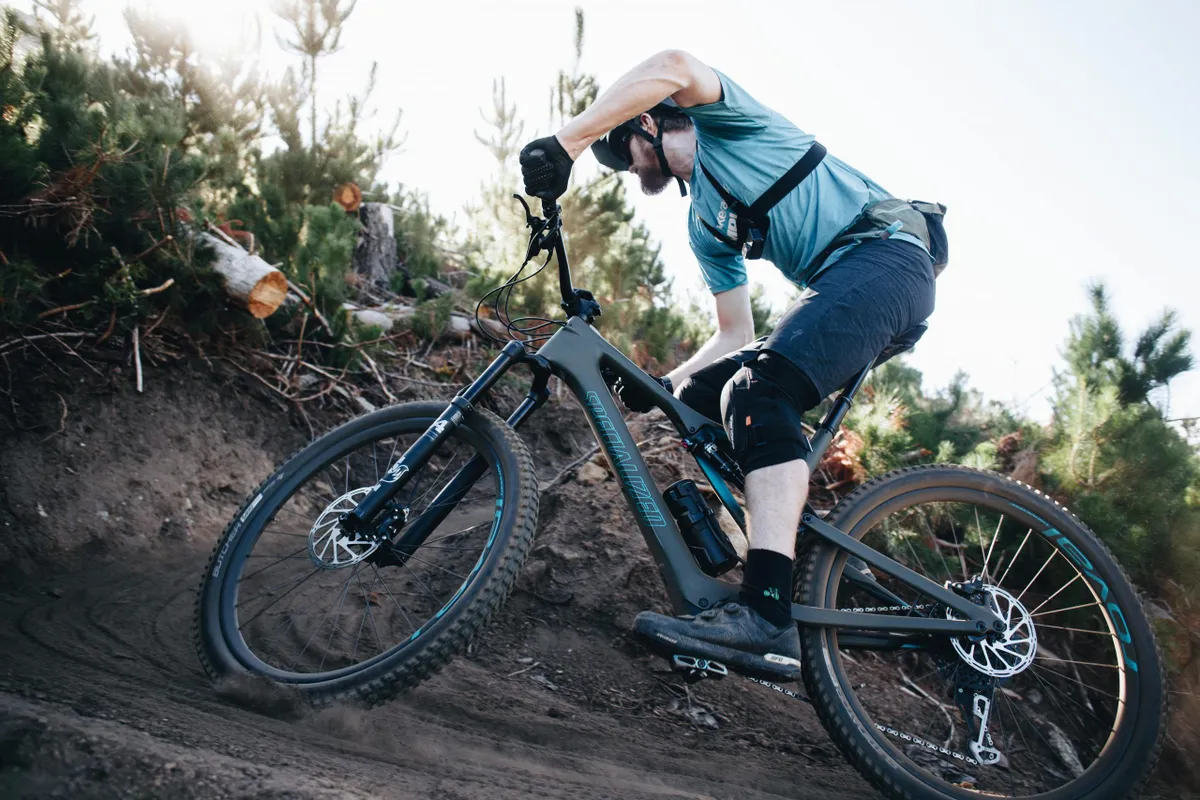
With only a few kilos between many SL models and their full-power counterparts, it’s easy to see why those (only slightly) lighter bikes were overlooked.
As ebike motors became smaller and more powerful, ‘SL’ bikes morphed into ‘mid-power’ bikes, with more power and torque, along with slightly tougher components.
But if you wanted to ride with mates on full-power bikes, you’d still struggle, making the whole ‘SL’ category something of a conundrum.
The new Rallon RS harks back to that original ‘SL’ concept in a lot of ways, but uses advances in tech to right many of the wrongs and offers something very different from the high-power, torque-tastic eMTBs that seem to be everywhere right now.
The 200 watts of peak power and 40Nm of torque mean the Rallon RS isn’t all about the motor feel. It’s not the dominant factor here by a long stretch.
The silent, compact TQ HPR40 motor and its low weight help, boosting your input and making the climbs feel easier, but this bike is way more than its drive unit. Its small form factor and unobtrusive feel have enabled Orbea’s engineers to create a bike with a very special ride.
Weighing a claimed 1,170g, the HPR40 doesn’t take up much real estate in the frame. At first glance, you’d probably be hard-pressed to realise this is an eMTB. Its compact size means, unlike bikes of old, the geometry and suspension layout aren't compromised.
Using the small motor limits packaging problems. This meant Orbea could create a long-travel enduro bike with tough parts to suit, rather than a shorter-travel trail bike with flimsy tyres. Yet it still weighs just over 17kg (claimed) in size medium.

Even considering all of the above, along with the impressive ride feel and almost silent motor, the sticking point for many riders will be the low power and torque figures.
But I think this bike needs to be considered slightly differently.
If you’re looking for a bike that’s super-fast up the climbs and aim to clock up as many laps as possible, this isn’t the machine for you. But, if you’re a bit of purist, who’d appreciate a little helping hand when riding with fitter friends on regular bikes – or are keen on riding a little further than usual – this could be the bike for you.
Integration stations

Orbea has gone beyond building a great bike with an intriguing motor – that’s only half of what makes the Rallon RS interesting.
It takes component integration to the next level and could be a sign of where eMTB tech is going next.
Orbea has designed the bike to be used with an electronic, auto-adjusting rear shock, its own electronic dropper post and electronic gears.
These components are hard-wired into the main 290Wh battery via a central control unit.
What’s more, they communicate with one another, in a bid to enhance the ride.
Having partnered with Fox suspension and TQ motors for this project, Orbea says enabling the shock to receive data from the motor, its algorithm is able to use power, cadence and speed to help optimise shock settings more effectively and efficiently.
The dropper post plays its part here, too. When the post is fully compressed, the shock knows it needs to keep its damping circuits open to maximise downhill bump absorption.

If the post is dropped and the motor sensors detect the bike is on a descent, it can lower assistance modes to avoid any unwanted or untimely bursts of power.
That’s a lot of electronics, which generally means a lot of bar-mounted buttons and remotes. That’s not the case here, though.
While you lose the wireless capability of the Fox Live Valve NEO shock and Shimano XTR Di2 gearing because both are wired into the main battery, it has enabled Orbea to control everything (with the exception of the gears) using one remote.

The HMI (Human Machine Interface) remote enables you to tweak just about everything. That means altering motor modes, shock settings and the dropper post, which has a programmable ‘smart’ mode.
Enduro travel, geo and build

Orbea manufactures the new Rallon RS from its OMR (Orbea Monocoque Racing) carbon in what it claims was its most challenging project to date.
To reduce weight, compensating for the use of a motor and battery, the Rallon RS is equipped with a carbon rocker link. This saves a reported 200g, yet is as strong and stiff as its alloy equivalent.
Because Orbea designed the Rallon RS around a shock that was able to control damping levels automatically, there was less need to build in the ability to resist squatting or ‘bobbing’ as the pedals are being turned (often referred to ‘anti-squat’) into the suspension system.
Instead, leaving the automated shock to do the heavy lifting and keep the Rallon RS as efficient as possible, Orbea designed relatively low levels of anti-squat into the platform (just over 80 per cent at sag), with the aim of keeping the back end more sensitive and active.
As with the regular Rallon, the RS version also uses a linkage-driven single-pivot system, which places the rear pivot concentric to the rear axle. There’s 170mm of travel on tap at the rear, paired with a massive 180mm-travel fork up front.
Should you want to get a little rowdier, the frame is designed to handle a dual-crown fork, upping its versatility further – that’s not something many SL-style bikes can boast.
The enduro stats don’t stop there. Reach figures span 430mm on the small to 505mm on the XL. Seat tubes are short, with the medium coming in at 405mm. All frames use the same 445mm chainstay.
Orbea hasn’t shied away from geometry adjustment. There’s a flip chip on the lower shock mount, enabling you to alter the bottom-bracket height by 8mm and head tube angle by 0.5 degrees. You can also make use of the angled headset cups, which enable you to tweak the head angle further by +/- 0.75 degrees.
In the neutral position, the head angle is 64.25 degrees, while the seat tube angle is steep, at just over 79 degrees.
You can run a 29in or 27.5in rear wheel by swapping the rocker link, which ensures geometry remains the same between the two rear wheel sizes.
Fit for purpose

Orbea realises this bike won’t be for everyone. As well as being a fresh take on lighter-weight eMTBs, it’s also very expensive and only available in two models.
The top-end RS-LTD build features some drool-worthy kit. But, most importantly, that kit is fit for purpose and suits the Rallon RS’s intentions. There’s a burly fork, big brakes and suitably tough, grippy tyres that’ll take an absolute beasting.
All in, Orbea says the RS-LTD model weighs 17.45kg in size medium, which is impressive considering this is a big bike with some heavy parts bolted to it.
Who will buy it?

During the presentation, Orbea was very open about the risks involved in creating a bike like this.
While it’s clearly pushing boundaries in terms of integration, those motor stats go against where we’re seeing a lot of the interest in eMTBs.
But I love the idea of the Rallon RS and how it feels on the trails.
I was a big fan of SL eMTBs first time around and, although they had issues, always had fun riding them. The Rallon RS has taken that old blueprint and improved upon it – it offers something for those who aren’t keen on the big-motor eMTBs.
This isn’t a bike for everyone, but I’m sold.
Orbea Rallon RS range details
Orbea Rallon RS-LTD (29in or 29in/27.5in wheels)

- Frame: OMR carbon, 170mm travel
- Motor: TQ HPR40
- Battery: TQ 290Wh
- Fork: Fox 38 GRIP X2 Factory, 180mm
- Shock: Fox X2 Live Valve NEO Factory
- Brakes: Shimano XTR
- Drivetrain: e*thirteen Helix Race alloy crankset, Shimano XTR Di2 gearing
- Wheels: Oquo Mountain Control MC32 LTD (29in) / Oquo Mountain Control MC32 Team (27.5in)
- Price: £12,999 / $14,999 / €14,999 (29in) / £12,499 / $14,199 / €14,199
Orbea Rallon RS-Team (29in or 29in/27.5in wheels)

- Frame: OMR carbon, 170mm travel
- Motor: TQ HPR40
- Battery: TQ 290Wh
- Fork: Fox 38 GRIP X2 Factory, 180mm
- Shock: Fox X2 Factory
- Brakes: Shimano XT
- Drivetrain: e*thirteen Helix Race alloy crankset, Shimano XT Di2 gearing
- Wheels: Oquo Mountain Control MC32 Team (29in or MX)
- Price: £9,999 / $10,999 / €10,999 (29in) with Fox X2 NEO shock / £9,499 / $10,199 / €10,199