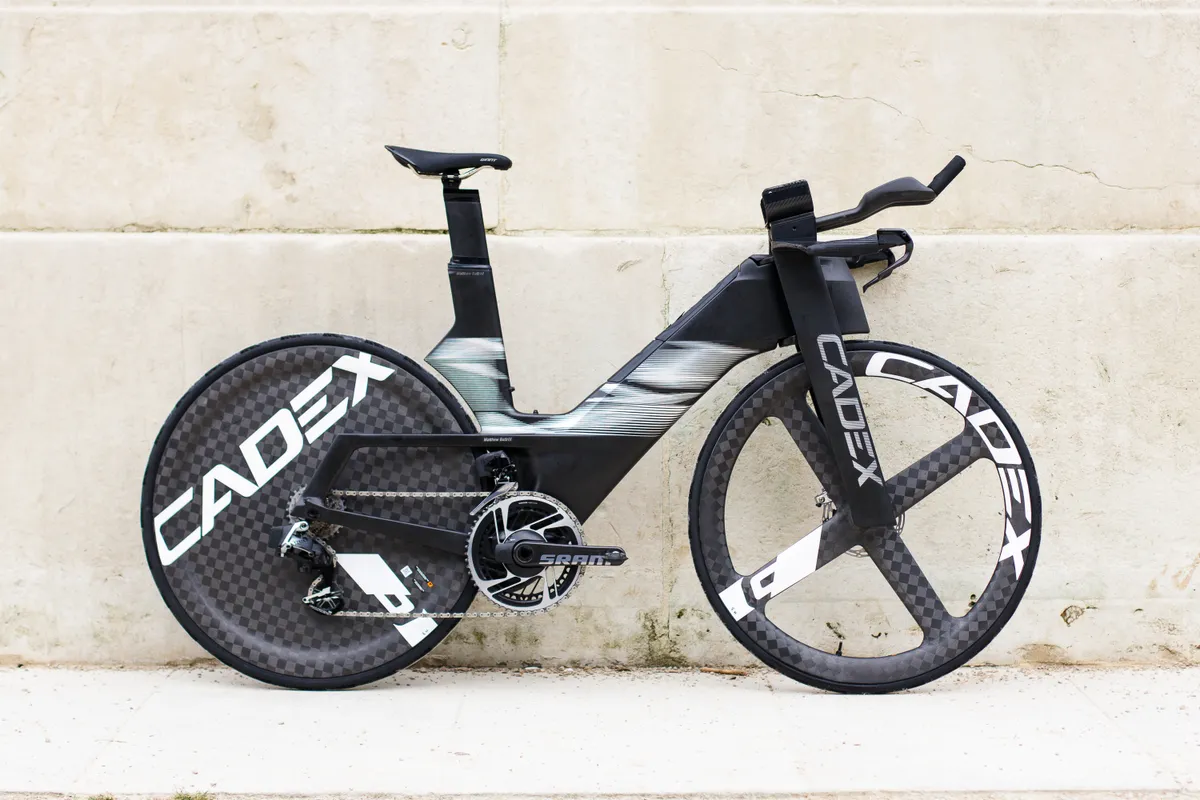
Cadex has announced its latest-generation Aero tyres and Max 50 wheels, promising low drag and weight in a single package.
According to the brand, the new Cadex Aero tyre features a new 240 TPI (threads per inch) casing that cuts rolling resistance by 2.8 watts per tyre, while a '64 micro-groove shoulder tread' cuts drag by 0.76 watts per wheel (at an unspecified speed).
A size 700x28c Cadex Aero tyre is also claimed to weigh only 220g – around 60g less than a 28c Continental GP5000 S TR.
The Cadex Aero tyre was designed in tandem with the new Max 50 wheelset, which cuts a claimed 2.18 watts of aero drag and 99g of weight from Cadex’s previous Ultra 50 wheelset.
As the name implies, the Max 50 wheels feature 50mm-deep carbon rims and have a claimed weight of 1,250g without tubeless tape or valves (or 1,290g with those things).
The Cadex Aero tyre is available in 700x28 and 30c sizes, and costs £69.99 / €77.50 per tyre.
The Max 50 wheels cost £1,499.99 / €1,650 for the front wheel and £1,999.99 / €2,300 for the rear.
Micro-groove tread

The new Aero tyre isn’t the first wind-tunnel optimised tyre Cadex has produced. It launched the previous, 25c version in 2022, alongside the Ultra 50 wheelset, and we spotted an Aero Cotton version at last year’s Omloop Het Nieuwsblad.
This latest model uses a new tread design, which shares a notable similarity to Continental’s Aero 111 tyre – which was developed in partnership with aero-specialist Swiss Side.
According to Swiss Side, the notches in the Conti tyres work in a similar manner to the dimples on a golf ball, by ‘tripping’ the airflow from laminar to turbulent. This is said to create a turbulent boundary layer of airflow that helps it stay attached to the rim for longer, reducing drag and improving handling at higher wind angles.

Cadex’s press materials don’t go into the same level of detail, but we imagine the intended effects are similar.
The brand says these gains are supplemented by a new 240 TPI ’Supple Race Casing’ design – up from 170 TPI on the previous Aero 25 tyre – that reduces weight by “up to 55g per tyre” and cuts rolling resistance from 13.7 watts to 10.9 watts per tyre.
30c versions of the Aero tyre carry a claimed weight of 280g per tyre. Both sizes are compatible with hookless rims and include a puncture protection belt underneath the tread to help prevent flats.
System-level design

According to Cadex, the gains over the previous-generation Ultra 50 wheels came from designing the Max 50 rims, spokes and hubs as a single system, rather than distinct parts.
The Max 50 rims use a 50mm-deep, 30mm-wide rim, with a 22.4mm internal width.
Jeff Schneider, head of product and marketing at Cadex, previously told BikeRadar, Cadex is “committed to hookless rim technology for both road and gravel applications”, so it’s no surprise to see the Max 50 wheels using a hookless design.
The brand says it opts for hookless because it creates a more durable rim, and helps to optimise tyre shape for better aerodynamics and handling, without compromising on weight.

The rims are connected to aero-optimised hubs via deep bladed carbon spokes and hidden titanium spoke nipples.
Despite the drop in weight from the Ultra 50, Cadex claims the Max 50 wheels have improved lateral and transmission stiffness-to-weight ratios, by 3.2 and 14.3 per cent, respectively.
In plain English, this simply means they’re less flexible under pedalling and handling loads, which Cadex says translates to improved handling and efficiency while riding.
The Max 50 wheels appear to use the same construction techniques as the brand’s existing Max 40 wheels, which were praised by BikeRadar’s tester, Warren Rossiter, for their “hugely impressive” ride feel.
In terms of aerodynamics, Cadex claims the Max 50 wheels save 2.18 watts of drag compared to the Ultra 50 wheels at an unspecified speed (when both wheelsets are fitted with the new Aero 28c tyres).