Lactate was long considered the enemy of cyclists, blamed for the burning sensation in our legs and a loss of power. But lactate is really a fuel source for muscles, and Tadej Pogačar has been drinking it as he dominates the 2026 Tour de France.
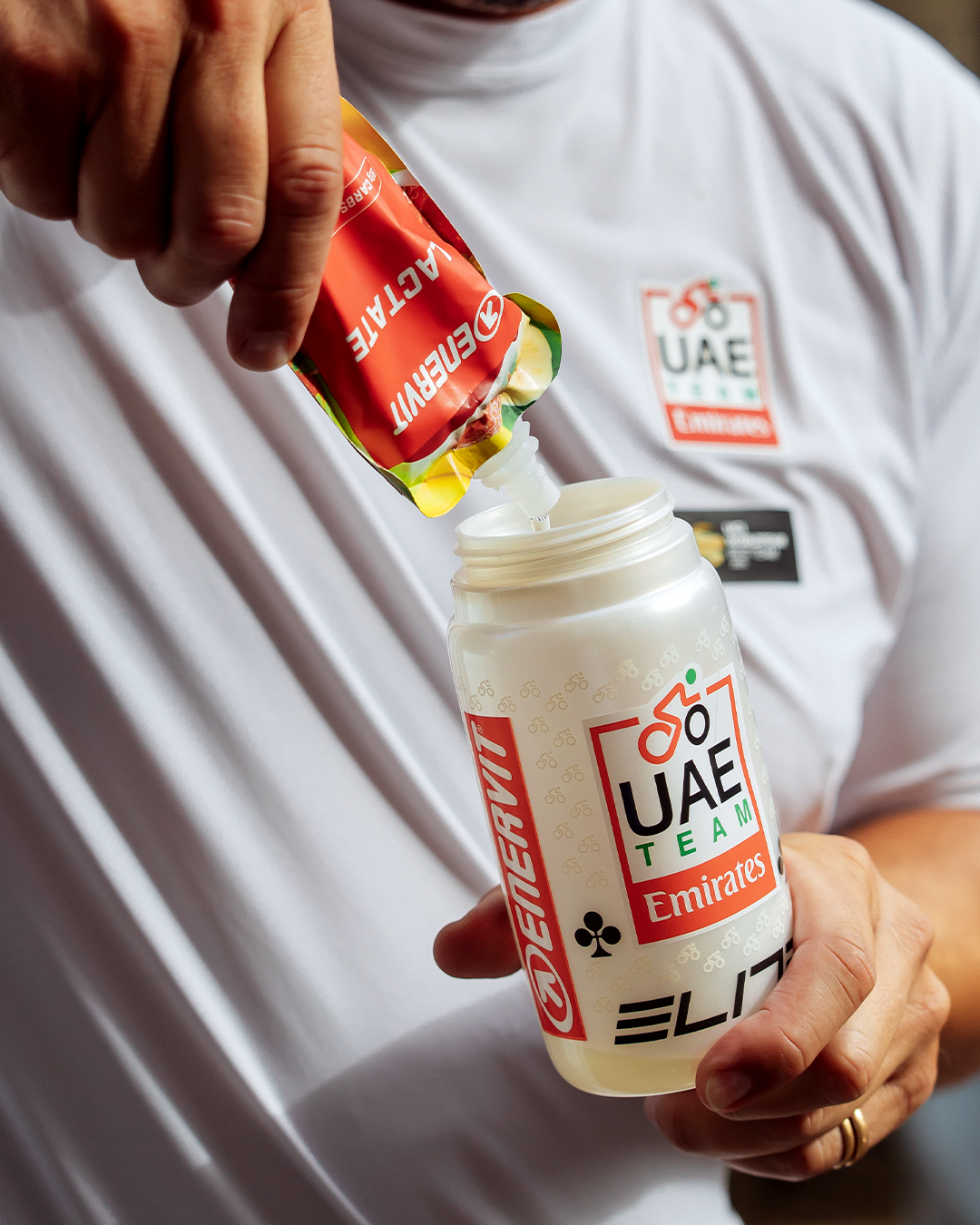
Pogačar and his UAE Team Emirates XRG teammates have been exclusively using a new lactate gel mix from Enervit in this year’s race, while another team is using ExoLactate, a similar product developed by Aitor Viribay, a former physiologist at Netcompany-Ineos.
Enervit says its C2:1PRO Lactate Gel Mix is built on decades of research led by Professor George A. Brooks of the University of California.
“Once regarded simply as a by-product of fatigue, Brooks’ research demonstrated that lactate is in fact one of the body’s natural energy sources, continuously produced and used by the muscles, heart and brain during exercise,” Enervit says.
The new product combines 90g of carbohydrate, using a 2:1 ratio of glucose to fructose, with 10g of lactate. This is said to provide riders such as Pogačar with an additional energy source in the final and most demanding phases of a race.
The project to develop the lactate gel mix has been years in the making, according to Enervit, with testing conducted throughout the 2024 and 2025 cycling seasons. It’s now almost ready for release, and should be available to buy after La Vuelta España in September.
How do lactate gels work?
In extreme endurance tests such as the Tour de France, the cyclists use more energy than they can feasibly take on. And despite cyclists consuming up to 120g of carbohydrate per hour at the Tour, the race is on to make energy absorption as effective as possible.
According to Enervit, modern sports nutrition can be described as “the progressive opening of successive absorption pathways”.
Athletes have long relied on glucose, but the benefits of this fuel increase up to roughly 60g per hour. After this point, additional intake provides no extra benefit because, according to Enervit, “the intestine has a single transporter that allows only a limited amount of glucose into the bloodstream”.
The addition of fructose can increase your energy intake because it uses a separate intestinal transporter.
Enervit says that by combining glucose and fructose in a 2:1 ratio, as in the company’s C2:1 Pro range, absorption can reach 90g of carbohydrates per hour or beyond, depending on the individual.
This is where lactate comes in. Brooks' work revealed the body uses lactate as a fuel that is oxidised quickly. It is also absorbed through its own transport, independently of the glucose and fructose pathways.
An athlete can effectively increase their carbohydrate ceiling and get an energy boost by consuming lactate directly rather than waiting for their body to produce it as it breaks down carbohydrates for energy.
Enervit adds that alongside this energy boost, lactate reduces acidity rather than increasing it, as commonly assumed. It adds that researchers are investigating whether lactate may reduce perception of fatigue.
‘A new era’, or is it?
If lactate gels are giving pro cyclists an extra energy boost, it might not come as a surprise that they’re being heralded as groundbreaking.
Brooks says: “This new product, the new Enervit C2:1PRO Lactate Gel Mix, is a breakthrough that initiates a new era in sports nutrition.” However, others are less certain.
The sports nutrition company Styrkr highlighted several studies into lactate consumption. One from 2024 looked at the effects of lactate and revealed a 4% increase in watts and a lower perceived effort at the same power output.
A 2025 study showed the body does use exogenous (meaning, from outside the body) lactate, but that it “stopped short of demonstrating a performance breakthrough".
“Put together, the most consistent finding across this small body of research is that exogenous lactate behaves like a mild acid-base buffer: it can lower how hard an effort feels and shift blood chemistry, similar in character to sodium bicarbonate loading, without reliably making athletes faster,” Styrkr said.
Meanwhile, Uno-X Mobility’s head of performance, Olav Bu, told Cyclist he is sceptical of ingesting lactate. According to Bu, lactate produces less energy than glucose for the same energy cost. Added to that, Bu said lactate can increase the complexity of absorption in the gut.
Bu said that in the team’s research, they haven’t found a ‘hard ceiling’ for exogenous carbohydrate oxidation. Until that’s established, lactate will remain a less efficient fuel source.
So, for now, the jury might be out on lactate gels. But considering how the Tour de France is often decided by seconds, we’re sure this development in nutrition will remain in the spotlight.