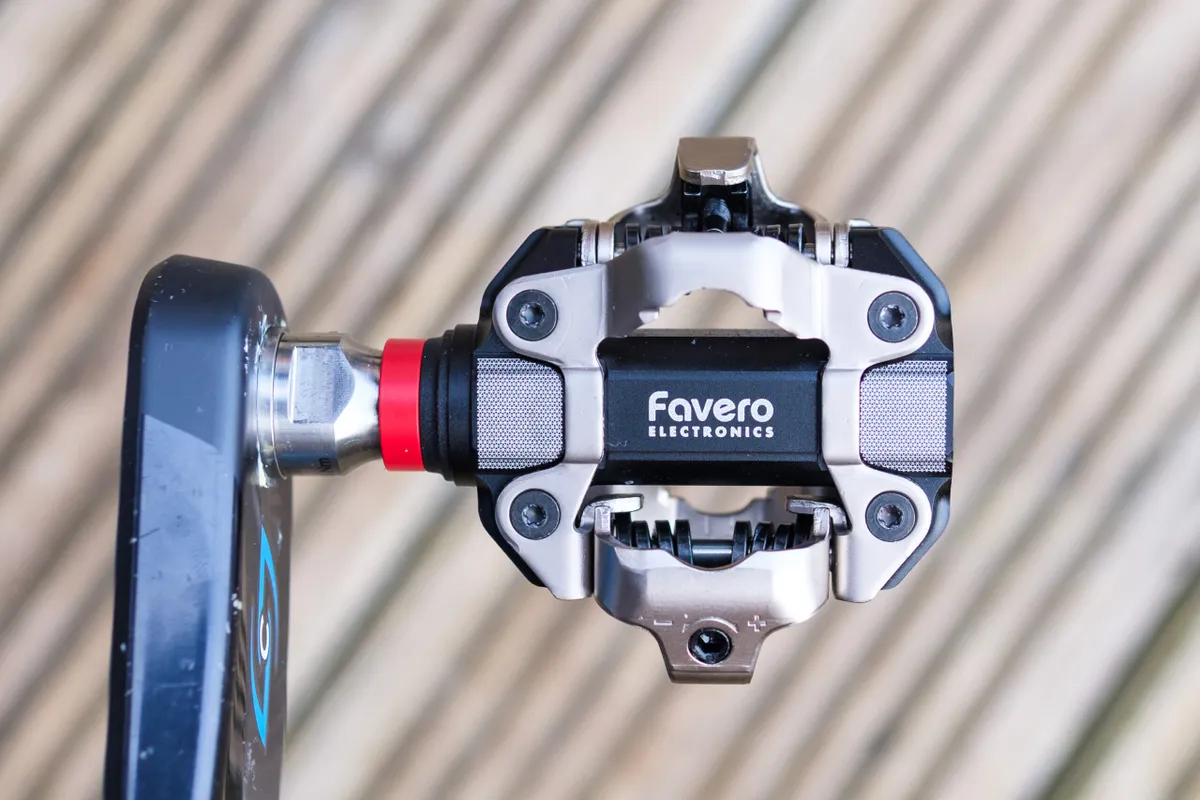
Despite being around for 40 years and having a revolutionary impact on cycling training and performance, power meters have yet to become as ubiquitous as other fitness-focused tech such as GPS head units or heart rate monitors.
Historically, this has been down to cost, and many models still push close to four figures. Their designs have also been a limiting factor, particularly if you want to train on two or more bikes. A power meter mounted on a crank arm, crank spider or bottom bracket may mean you need to invest in multiple units if you have multiple bikes in your collection.
A power meter pedal solves this issue. By locating all of the strain gauges and electronics in the pedal, it’s not limited to one bike, meaning moving a power meter between bikes is as simple as swapping a set of pedals.
Favero has been promoting the benefits of a pedal-based system since 2015, and has been manufacturing competitively priced, Italian-made power meter pedals for more than a decade.
Enter the Favero Assioma PRO
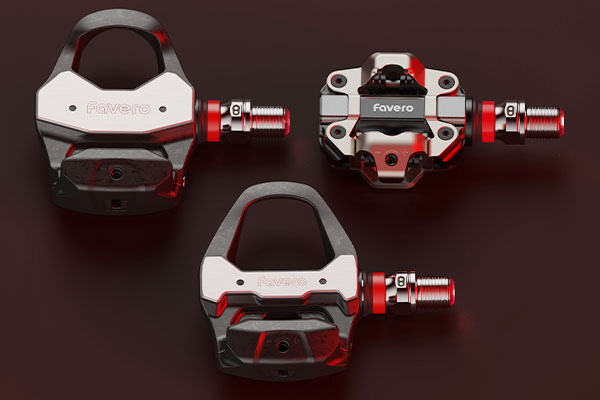
But now, in the Assioma PRO range, Favero has taken things even further, designing a modular system centred around smart spindle technology and swappable pedal bodies. This means you can buy one power meter and unlock three distinct possibilities by using the same spindle across different pedal setups.
First released in 2024 with the Assioma PRO MX SPD and updated with the PRO RS (Shimano SPD-SL) last year, the PRO portfolio was completed in March 2026 with the launch of the PRO RL (Look Keo-compatible version).
With three interchangeable pedal bodies now available – Shimano SPD, Shimano SPD-SL and Look Keo – riders can simply swap Favero’s power-reading spindle across different systems. That effectively gives you three power meters in one, while also futureproofing themselves against changes in trends, interests or simply what they want from their riding – whether that’s on the road or off it.
Smart spindle
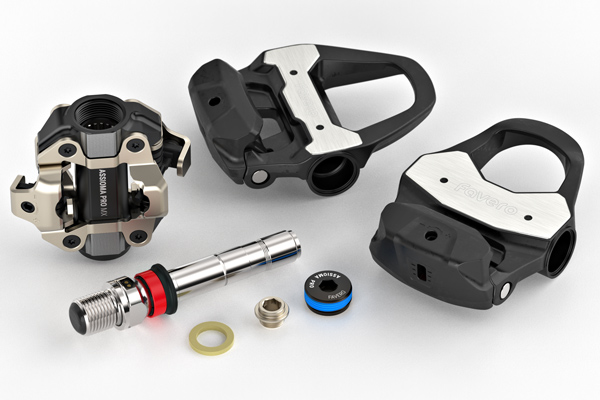
The spindle is at the heart of the Favero Assioma PRO range, and not just because it’s the only component shared by all three models.
The patented design houses the power meter pedals’ key innovations, including the rechargeable batteries, electronic components and strain gauges.
This sealed approach protects all of the key components against mud, dust, moisture and general wear and tear, minimising the risks of power dropouts mid-ride, while also prolonging the life of the power meter in the long-term.
Combined with Active Temperature Compensation, the spindle’s design ensures consistency, ride after ride, and ±1% accuracy.
And that is, ultimately, what you need for a power meter – reliable, uninterrupted data, so you can focus on hitting the power numbers needed in training, with spike- and interference-free readings to analyse after your ride.
Proprietary power system
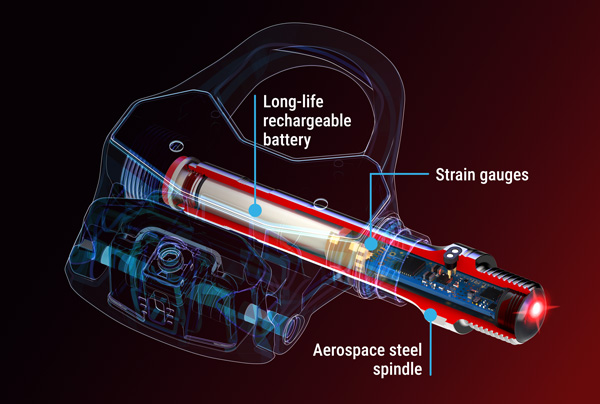
The Favero Assioma PRO range doesn’t simply broadcast the strain gauge’s reading. Instead, it uses an internal gyroscope also positioned within the spindle, and combines the readings as part of Favero’s Instant Angular Velocity (IAV) Power System.
While measuring force and angular velocity aren’t novel, Favero’s approach is. Some power meters use an average of the angular velocity in their calculations, but this assumes that each pedal stroke is perfectly smooth and uniform – an approach that Favero found can lead to errors in actual power output accuracy of up to 4.5%.
Instead, by using the instantaneous angular velocity measured by its three-axis gyroscope, Favero is able to claim accuracy of ±1%, whatever the conditions or riding style – from the irregular pedal strokes typical when tackling steep slopes, through to riding on a turbo trainer.
Industry-beating battery
All of the above would count for nothing if it wasn’t also backed by a battery that can go the distance, and the Assioma PRO’s rechargeable Lithium-ion battery packs 160 hours of riding into each full charge – the longest life on the market.
If you’re short on time and only realise that your battery level is low as you’re about to head out of the door for a ride, a 15-minute blast will provide up to 15 hours of use.
What’s more, charging is as simple as clipping the dual-headed magnetic USB-C cables onto the ports on the spindle, enabling you to charge both pedals simultaneously without removing them from the crank arms.
Modular mastery
The stainless-steel spindle’s smart features don’t end at its internals, because it forms part of the modular system that is compatible with three different pedal bodies.
The Assioma PRO RL is the Look-KEO compatible setup in the range, and features adjustable release tension and the KEO’s signature ‘snap’ when clipping in. Each pedal weighs a claimed 130g.
The PRO RS, meanwhile, is another road-focused offering, albeit aimed at those who prefer Shimano’s SPD-SL system. It’s also the lightest road power meter pedal on the market.
Finally, the PRO MX SPD adds an off-road capability to the equation and is designed for disciplines such as cross-country mountain biking, gravel and cyclocross.
Advanced metrics
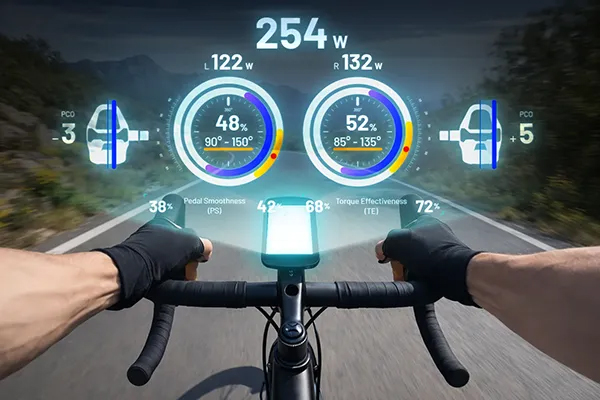
Beyond overall power, the Favero Assioma PRO range opens up a whole host of other metrics to drill into, target and refine.
The L/R Power Balance enables you to monitor the dominant/non-dominant leg ratio and observe how this varies in relation to different racing and fitness conditions. This can be particularly useful to work on your imbalances, also in post-traumatic rehabilitation programmes.
Torque effectiveness highlights how much of the power generated during the pedal stroke contributes to the propulsion of the rider – the higher, the better – while pedal smoothness shows how evenly power is distributed throughout the whole pedal stroke.
In addition to these standard metrics, Favero also has a number of proprietary metrics that are captured as part of its IAV Cycling Dynamics.
PCO (Platform Center Offset) shows where force is applied relative to the centre of the pedal platform, enabling you to fine-tune your positioning and prevent injuries; Power Phase documents where the power is produced during a single pedal stroke; while Rider Position shows when you were seated or standing during a ride, and can be combined with a course profile to see how your position impacted performance.