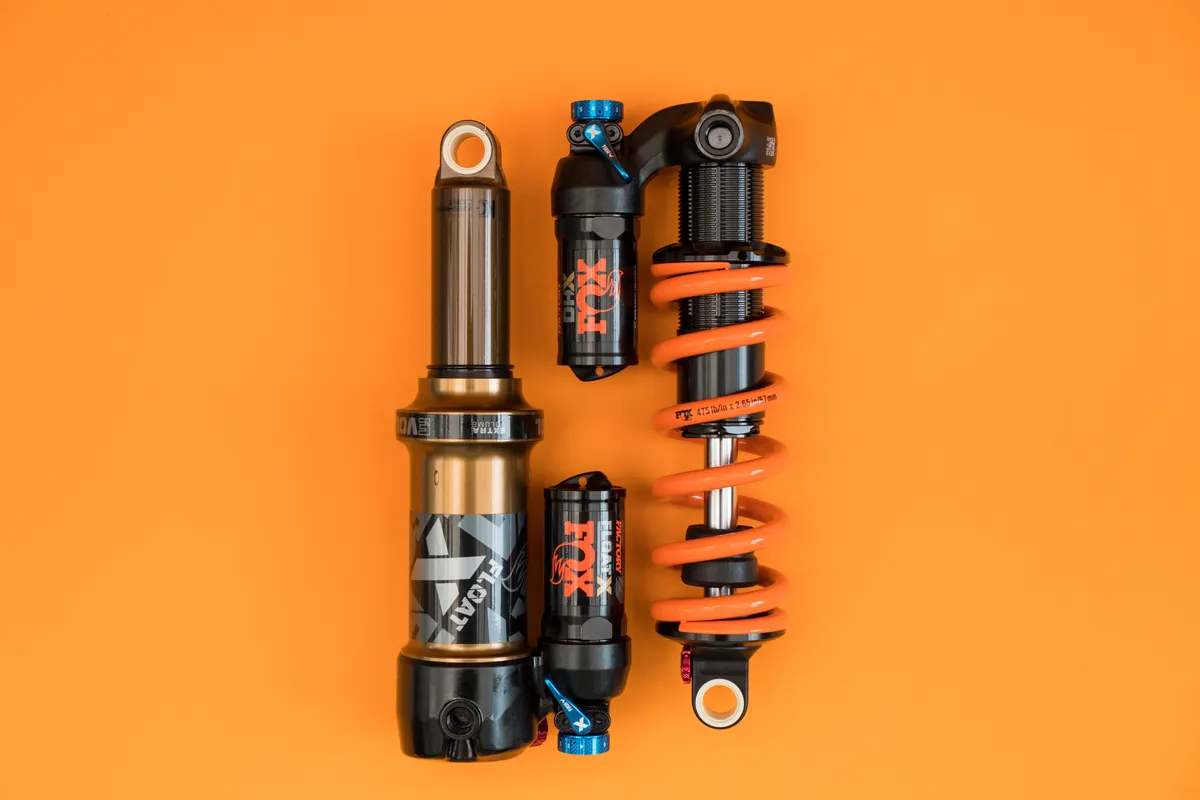
RockShox has overhauled its Vivid Air and Super Deluxe rear shocks for the 2027 model year.
Both have had a reduction in friction, with all-new reservoirs and a host of other internal changes that promise to make them more sensitive, capable and better at absorbing bumps.
They should also be easier to set up and tune, in order for riders to get the most out of their bikes.
Mountain bike shocks tend to be overlooked, but they form a key part of any suspension system.
While a fork can deliver feedback that's easy to pick up on through the hands, working out the ins and outs of a rear shock's performance can be a little more complex, largely down to the fact that they’re part of a more complex suspension system (the frame).
However, the control required from shocks helps to dictate the all-important balance of a mountain bike.
Having ridden the Vivid Air for a while now, I can confirm it's impressively supple, yet still delivers support when needed, with plenty of control deeper into the stroke.
Critically, the adjustments make a notable difference on the trail.
Super-slippery

In a bid to create the supplest shocks possible, RockShox took both the Vivid Air and Super Deluxe back to the drawing board and completely reworked them.
One area that got a lot of attention was the reservoir. RockShox revised the oil-flow paths extensively within the reservoir, making it easier for oil to flow in and out of the shock, with a particular focus on the rebound refill.
Making these changes, coupled with the switch to a new base valve, enabled RockShox to lower the internal floating piston (IFP) pressure. This results in shocks that have a lower breakaway and that could, in theory, be more effective when it comes to finding rear-wheel traction.
Both shocks also get new main piston compression tunes, designed to better match the new Charger 3.2 damper found in the updated Lyrik and ZEB forks. These, according to RockShox, should help boost mid-stroke support.
They also now use the new LinearXL air spring, said to help smooth the progression curve at the end of the stroke to deliver a more consistent feel.
In the case of the Super Deluxe, the air spring can now accommodate higher pressures to better suit a wider range of rider weights.
Super Deluxe details

While both shocks share a number of details, the Super Deluxe differs in several ways.
To help simplify tuning the tail end of the Super Deluxe’s spring curve, RockShox has reworked its token system. It now uses an O-ring, which can be shifted between the five positions within the positive air chamber, beneath the air sleeve.
By moving the O-ring up and over one of the ribs on the shock body, you effectively close off (or open up) some of that positive air volume, creating a change to the tail end of the spring curve.

If, like me, you weren’t a huge fan of the rebound-damping adjustment bezel, it’s nice to see RockShox going back to a more traditional dial, which should be easier to tweak. This can be removed to tweak the high-speed compression-damping adjuster. It's a sleek little touch and saves reaching for the multi-tool.
The Super Deluxe also gets a new bottom-out bumper to boost end-stroke control and hopefully prevent any harshness if and when you make the most of all that rear-wheel travel.
Although the Super Deluxe forgoes the adjustable bottom-out feature found on the Vivid Air, it offers hydraulic bottom-out control (this is optional and will vary on bike design as to whether it's required or not).
Dialled in

Like the updated fork and Vivid coil rear shock, the Vivid Air and Super Deluxe also gain damper dials with numbers on.
And, like those other units, the damping adjustments are designed to work independently of one another.
As ever, though, rear shocks can often be squeezed into awkward spots on the frame, making adjustments tricky.
The Vivid Air – which is a chunky unit – features a rebound and low-speed compression dial, but requires a tool to tweak its adjustable bottom-out feature and high-speed compression. Cleverly, the rebound dial can pop out of the shock and be used to adjust both of these if you need to.
While the Vivid Air doesn’t get the same tweaks when it comes to how it accepts volume spacers, they can still be added should you need to change the spring curve.
Once I've had more time aboard the Vivid Air Ultimate, I'll write a full review, so stay tuned.
RockShox Vivid Air and Super Deluxe range overview
While RockShox includes Select+, Select and base-model shocks for both the Vivid Air and Super Deluxe rear shocks, because they’re not available aftermarket, they're not included here.
RockShox Vivid Air Ultimate

- Damper: RC2T with Adjustable Bottom Out
- Air spring: LinearXL
- Price: £760 / $779 / €850
RockShox Vivid Air Ultimate DH

- Damper: RC2T with Adjustable Bottom Out
- Air spring: LinearXL
- Price: £760 / $779 / €850
RockShox Super Deluxe Ultimate Flight Attendant

- Damper: RC3 / RC3 Hydraulic Bottom Out
- Air spring: LinearXL
- Price: £1,020 / $1,049 / €1,145
RockShox Super Deluxe Ultimate

- Damper: RC3 / RC3 Hydraulic Bottom Out
- Air spring: LinearXL
- Price: £680 / $699 / €765