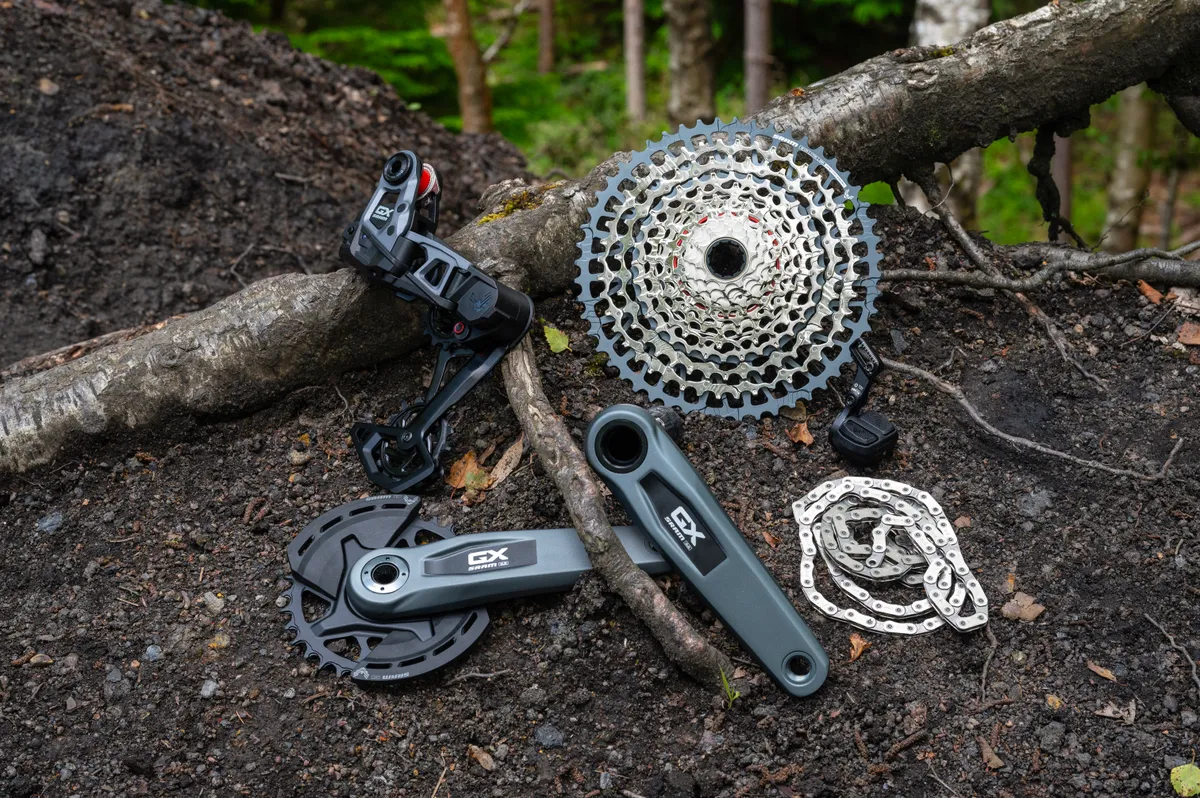
SRAM's new XX DH AXS Transmission is aimed squarely at downhill racers and riders, and is claimed to offer time savings over traditional, cabled gearing.
With the ability to shift under load, SRAM claims riders can accelerate faster over the first 15 metres of track, saving a claimed 1/20th of a second (0.05 secs), which could make a massive difference to race results.
SRAM says that’s because there’s no need to lift off the power while punching through wireless gears.On top of that, the DH-specific, direct-mount derailleur is said to be SRAM's toughest yet, and its quietest, too.
The drivetrain has been teased extensively since we first spotted hanging from the rear of Troy Brosnan’s Canyon Sender at the UCI Mountain Bike World Series in Lenzerheide in September 2025.
So, how is SRAM saving racers time? And what does it feel like on the trail? I flew to New Zealand for the launch of XX DH AXS Transmission to find out.
Start-gate gains

SRAM says the new XX DH AXS Transmission drivetrain enables you to shift under load.
This means racers don’t need to ease off as they hammer the shifter pod as the wireless derailleur transitions from cog to cog when they sprint from the start hut.
As a result, SRAM says riders were able to cover the first 15 metres of track 0.05 seconds faster using the new gear system compared to the traditional cable-operated X01 DH drivetrain it replaces (assuming the power output is the same).
SRAM claims when racers hit that 15-metre mark, they’re travelling 2.7kph faster.
SRAM’s Transmission drivetrains are known for the ability to shift under heavy load, which is why they work so well on eMTBs, which can be brutally unforgiving when it comes to gear changes.
Thanks to the X-Sync tooth profile used across the seven cogs, shift ramps and the shift lanes these create across the seven-speed cassette (10-24t), when you hit the shifter pod to change gear, the chain will only move from one cog to the next when it’s safe to do so.
That’s because the cassette profiling, combined with the clever firmware cassette mapping tech found in the derailleur, means the shift ramps and derailleur’s shift sequence need to sync perfectly before the chain will move, helping to keep it in continuous contact with the cassette, enabling you to shift gears without letting off the gas.

This controlling of shift speeds is what caused some to criticise the original Transmission, saying it was slow to change gear compared to the first-generation AXS Eagle gearing. However, a recent firmware update has helped to rectify this.
According to SRAM, when using its previous DH-specific drivetrain, riders would need to ease off the power momentarily for each shift to ensure the chain moved safely onto the next sprocket. Now, this shouldn’t be an issue, and riders can keep the power down while smashing through the gears.
Clearance counts

I’ll admit, I was a little sceptical about the shift to a wireless rear derailleur. That's not only because of the weight implications, but also because of their size.
If you’ve seen an Eagle AXS Transmission derailleur, you’ll know it’s considerably chunkier than cable-operated equivalents, and even bulkier than the Eagle AXS unit it replaced.
Having destroyed and replaced countless derailleurs in downhill racing, it’s an issue I’m well aware of.
Thankfully, the new XX DH Transmission derailleur sits more inboard than those that mount to derailleur hangers. That’s down partly to the direct-mount interface (it employs SRAM’s Full-Mount system, so doesn’t use a traditional hanger) of this new bit of kit, bolting it straight onto the frame. SRAM says that makes it incredibly robust, although I didn't see any of the staff standing on it during the launch, as they did when Transmission first launched.
If you end up belting your derailleur into a rock, it’s good to know the outer-parallelogram link, thread-on cage assembly and skid plates are all replaceable.
With clearance in mind, SRAM has designed XX DH Transmission around 148mm axle spacing rather than 150mm or 157mm. It will work with these, you’ll just need to be mindful when it comes to the bottom bracket and cranks – something many bike brands are embracing for DH.
The move to wider rear axles was in order to help create stiffer rear wheels, so shifting to a narrower back end may sound counterintuitive.
To balance things out, SRAM developed a new ‘XD SLIM Driver’ body.

This is shorter than the standard XD Driver and, according to SRAM, enables hubs with wider flanges to be used, creating a symmetrical spoke bracing angle (not dished), which should be strong but also quicker for mechanics to build up – a concern for World Cup teams.
Alloy only

There’s no longer a carbon crankset option for DH, with all XX DH Transmission crank arms made from alloy only.
These purpose-built, DH-specific cranks are said to be SRAM’s most robust crankset yet, and feature machined surfaces on any potentially high-wear area (whether that’s on the face, where they’re likely to be rubbed by shoes, or at the ends where they’ll potentially be bouncing off rocks and roots). This should help keep them looking fresher for longer.
SRAM is offering sizes ranging from 150-165mm, jumping up in 5mm increments.
Bolted to the new cranks is an updated alloy chainring, which has also been beefed up to handle the rigours of modern DH.
This has been designed to work with the Ochain (the suspension-kickback taming chainring-mounted device, recently acquired by SRAM) and is eMTB-compatible, too. Sizes range from 32-36t.
Sound of silence

Like the existing Transmission derailleurs, the new XX DH unit uses the same Type 4 roller bearing clutch damper to help keep chain slap to a minimum.
SRAM says that due to the shorter cage found here, and therefore the lower leverage, the DH derailleur’s clutch feels stiffer to move.
The result is a very quiet ride, which I can attest to.
During three days of pummelling down Queenstown’s roughest DH runs, my test bike was freakishly quiet throughout.

When questioned about how the clutch impacts suspension performance, SRAM told me the impact is minimal.
In fact, according to its testing, SRAM says the lack of noise and vibration from the drivetrain had the biggest impact when it came to rider experience over any suspension performance concerns.
Weight concerns?

Bolting on a wireless derailleur, complete with a 50g battery, adds weight to back end of the bike, exactly where you don’t want it. You’re adding to the unsprung mass of the bike, which can in turn negatively impact suspension performance.
According to SRAM, although heavier than a standard derailleur, when you pair the new wireless unit with the new XX DH Transmission cassette and look at the system as a whole (cassette, XD SLIM Driver and XD SLIM cassette) the overall weight difference is around 100g.
What’s it like to ride?

My three days aboard a bike equipped with the new XX DH Transmission drivetrain was by no means a full test of the kit, but did highlight a couple of points.
First, as promised, you can indeed shift under load. Those shifts felt responsive enough while putting the power down and getting up to speed, and never felt harsh or made any of those potential chain-breaking sounds we all fear.
Whether it helped me save time when starting out is hard to say. But I could keep my effort constant as I hit the shifter.
Second, it’s incredibly quiet. Even over washboard braking bumps that had my eyes rattling around my head, the Canyon Sender I was on didn’t make a noise. There was no chain slap, no skipped gears and I experienced nothing but accurate shifting throughout.
I’ll keep riding the bike now I’m home and get a full review done in the not too distant future, so keep an eye out for that.
SRAM XX DH Transmission pricing

- Derailluer: £660 / $700 / €765
- Cassette: £485 / $500 / €545
- Crankset: £440 / $450 / €490
- Chainring: £100 / $120 / €112
- Chain: £135 / $155 / €150
- Shifter: £215 / $220 / €240