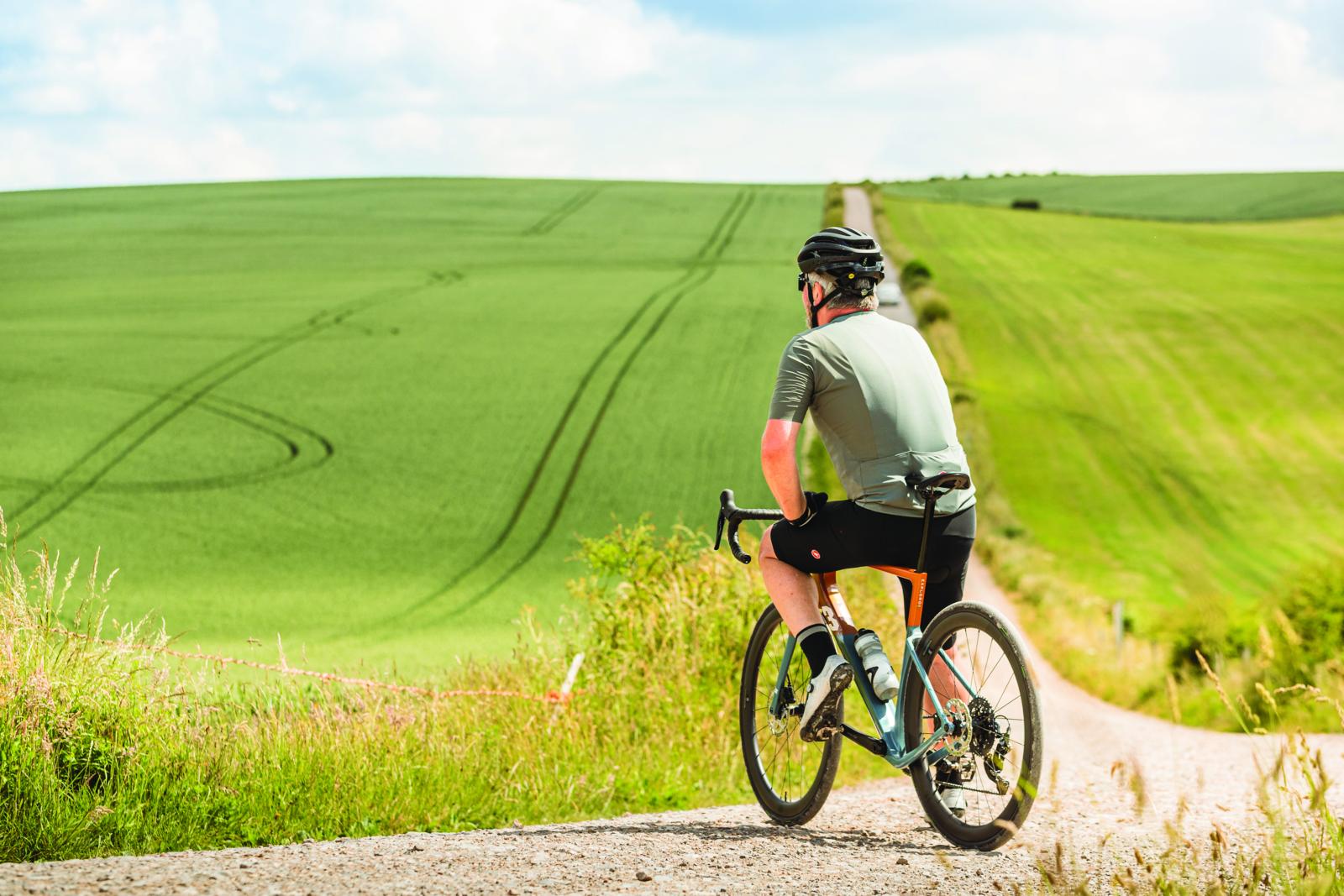
I took the new Ridley RSS aero-gravel prototype on a day ride on prime Belgian gravel roads, woodland singletrack and classics cobbles. I came away a convert to aero-gravel race bikes, and hugely impressed by the new Ridley’s speed, handling and even comfort.
I’ve had issues with aero gravel racers in the past because they weighted aerodynamics too heavily. That meant limited tyre clearances, no concessions to comfort and poor handling.
Ridley’s design gets the balance right. It feels as fast as as any gravel race bike I’ve ridden, yet it's comfortable over distance, and most importantly handles confidently on tough terrain.
As a first look at a next generation of gravel race bikes from the Belgian Cycling Factory, it's got me very excited, and with a projected launch date of September, I can’t wait to try out the full production models.
- Read more: Ridley ‘RS2’ prototype gravel race bike leans heavily into aero optimisation with massive head tube
What is it?

Ridley’s new aero gravel race bike was spotted at The Traka earlier this month. It was wrongly identified as the RS2 by pretty much everyone in the cycling media, with the logo in fact reading 'RSS'. The Ridley Speed Shop is the special projects arm of Ridley’s research and development department.
While Ridley wouldn’t confirm the name of the bike, it wouldn’t take Sherlock Holmes levels of deduction to see it as the successor to 2020’s Kanzo Fast.
Whereas Ridley’s other gravel models focus either on aggressive terrain (Kanzo Adventure) or a balance of light weight and performance (ASTR RS), the idea behind this bike is out-and-out aero performance combined with gravel-bike handling.
It’s clear from the design that the Noah Fast 3.0 road bike has been a big influence. Ridley has its own CFD department within the Speed Shop, not to mention a state-of-the-art wind tunnel on-site, so it’s no wonder aerodynamic development is a big part of any design theory.
The details from the horse’s mouth

The first thing you notice about the new prototype Ridley is the huge tyre clearances of up to 58mm, but look deeper and you'll see not only the aerodynamic shape, but also the shift in geometry – much like the Noah’s more progressive shaping. That means a longer reach, taller stack and a much steeper seat angle.

Ridley's lead on the gravel project is three-times Traka veteran Pieter Potters. He told me that in recent editions of the event, of the numerous pro teams and riders who've visited Ridley's wind tunnel, he’d noticed lots of riders using negative-setback seatpost setups and saddles pushed forward as far as they would go on the rails.
He said: “Bike geometry hasn’t changed in decades, whereas the technology has, and our understanding of biometrics, too.”
Potters raised the last raft of UCI rule clarifications around the ‘5cm rule’, where the tip of the nose of a saddle must be 50mm behind the bottom-bracket centre. He thinks this is the reason for short-nose saddles becoming popular, serving as a workaround of the rule, enabling a more forward position by shortening the saddle in front of the rails.

Now that’s no longer a factor, Ridley has steepened the seat angle to get an optimal position for power transfer. Then, by making the top tube longer, you can achieve reach figures without resorting to excessive stem lengths, which can influence handling.
It also means the steeper seat angle releases space for increased tyre clearance, without resorting to excessive chainstay length. The prototype has ‘only’ 425mm stays.
The prototype includes a set of proper mudguard eyelets, front and rear. Potter told me he’s run his prototype mule test bike with full-length metal mudguards and 50mm tyres – surely welcome news for winter gravel fans, and a feature I hope is retained.

There’s also generous down-tube storage, with twin bags stowed in a port below the bottle cage bosses. Potter says he moved the storage cover away from the bottle mounts because he’d heard plenty of reports of covers with bottles and cages mounted in them developing rattles after a time in use.
Near-ideal build and a rapid ride everywhere

The RSS prototype was set up for me with a SRAM Force AXS XPLR groupset (10-46t cassette, 46-tooth aero chainring). The wheelset is Forza's Skiron RS – Forza being the wheel and component stablemate of Ridley at BCF.
The Skiron RS is an unreleased wheel, which looks to have its own hubset, carbon spokes and a new wide aero-profile carbon rim. These wheels are shod with Schwalbe’s G-One RS Pro tyres in 55mm width.
The cockpit (which was my least favoured part of the build) is a Forza Nimbus Pro one-piece, as seen on Ridley’s ASTR RS.
It’s narrow at the hoods, at 36cm, although the flare in the drops pushes that out to 40cm. I get the aero benefit, and the fashion for narrow bars, but it’s not for me, especially on gravel.
The RSS prototype is an impressive bike. It felt impressively swift on a short few kilometres of smooth tarmac before we hit the trails. I can't recall riding a gravel bike that felt faster. The large-volume Schwalbe tyres, with their low-profile tread, buzzed along on the smooth stuff with barely a compromise from a large-volume slick.

The frame felt impressively stiff and responded to out-of-the-saddle sprint efforts in kind.
As soon as we hit the trails, the bike felt ‘right’. It's responsive and agile, with the short back end giving it a flickable feel. I was soon hunting out ruts and rises to launch from.
The big-volume tyres swallow up vibrations and buzz as well as many of the gravel suspension forks I’ve tested. They only reach their comfort limit if you hit a big pothole, or sharp-edged rock or root. Compared to suspension, it means you need to be slightly more careful with line choice on choppy technical descents, where I find suspension can bail you out of line errors a little better.
The steering response is quick, but doesn’t get nervy or twitchy when navigating rocky surfaces. The more progressive geometry gives the feel of sitting in the bike more. It’s easy to stay down in the drops for longer without feeling cramped.
It also feels much more balanced than those original aero gravel race bikes on rougher terrain; it’s confidence-inspiring to push your speed on descents and take the more aggressive line choice through corners. The Schwalbe tyres provided bags of grip on the dry, dusty Belgian backroads and singletrack woodland perimeter tracks.
Ridley RS prototype initial verdict

While I can’t commit to a full review based on a single (albeit long and enjoyable) ride on unfamiliar terrain, I came away hugely impressed by this prototype of Ridley’s next aero gravel bike.
It’s a huge leap on from the first generation of gravel racers, and on this evidence, as fast as – if not faster than – the best of the new generation of rapid off-roaders such as Wilier’s Rave SLR ID2.
I hope Ridley offers this bike with plenty of cockpit options through its online configurator, because my only niggle with the complete package was a narrow (for me) bar. If I had the option of a wider option, I can’t think of anything else about this test prototype I’d change.
Ridley RS prototype specification
- Frame: Carbon
- Size: Large
- Wheels: Forza Skiron RS carbon with carbon spokes
- Groupset: SRAM Force AXS XPLR (46, 10-46) with power meter
- Brakes: SRAM Force hydraulic
- Tyres: Schwalbe G-One RS Pro, 55mm
- Cockpit: Forza Nimbus Pro 36/40cm
- Saddle: Selle Italia SLR