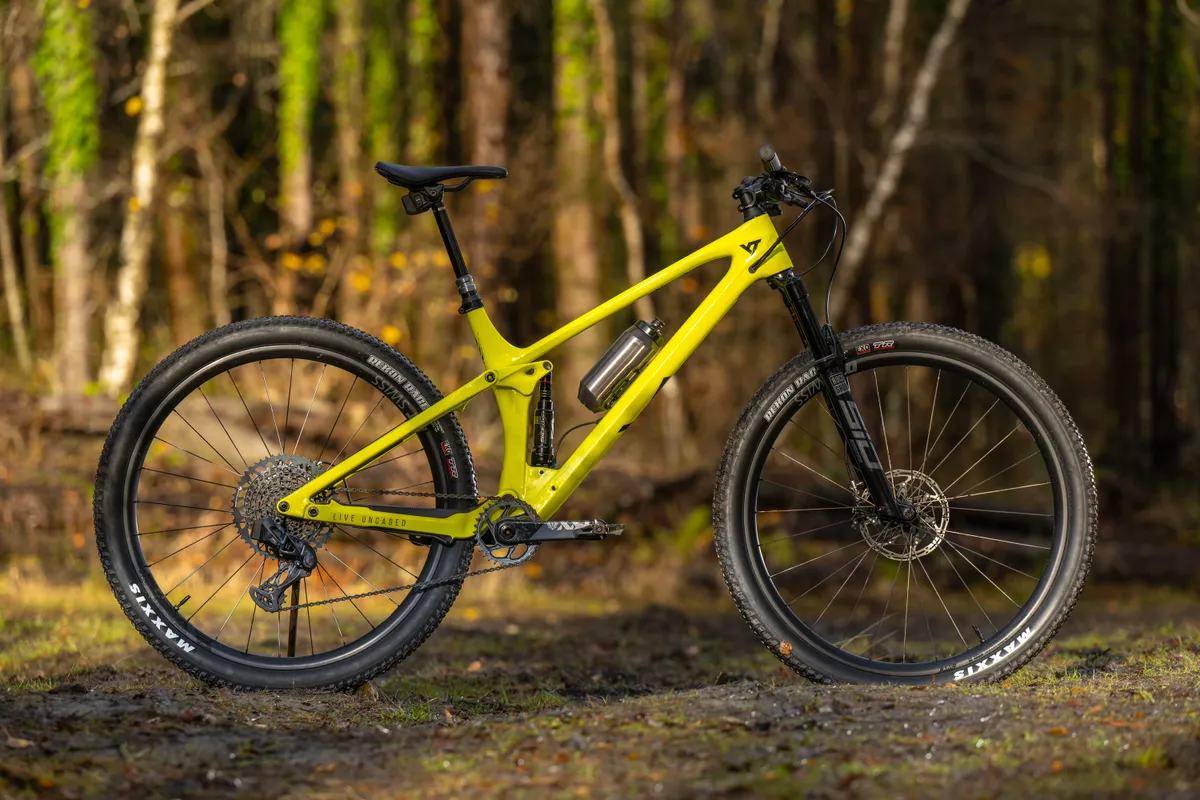
The Lauf Elja XC Ultimate Flight Attendant is a cross-country race bike hailing from the rocky outcrop that is Iceland. It features 120mm of travel at each end and a top-spec parts list, all for under $9,000 (shipped worldwide).
The Elja is unique in the world of cross-country race bikes, as it features a two-bar single-pivot chassis. Most other contemporary XC race rigs rely on a linkage-actuated single-pivot design with flex stays.
Lauf might be a new name to mountain bikers (unless you remember its Trail Racer leaf-sprung forks), but in the gravel and road world, the brand has been making a name for itself, thanks partly to its drive for wider tyres.
The Elja is no exception – it rolls on 2.6in rubber as stock, and you can squeeze 3in tyres in there – remember, this bike is built for cross-country racing.
Lauf Elja XC Ultimate Flight Attendant frame and suspension

While high-modulus carbon fibres save weight, Lauf claims the standard-modulus fibres it uses improve impact resistance, and its frame comes in at only around 100g heavier than competitor bikes, a fair trade-off.
Likewise, the brand eschews in-tube storage, which it says adds weight and impacts frame integrity.
The forward part of the swingarm, near the pivot, is boxy and stiff, designed to resist the twisting of the frame when riding through technical terrain.
Further back, the construction is slimmed down to save weight.
The organic-looking swingarm is asymmetric, with the raised driveside there to enable the chain to run without interference, and the non-driveside’s lower stance built for stiffness.
A SRAM DUB bottom bracket provides a super-wide and easy-to-replace main pivot.

Shocks can suffer excess wear via side-loading on two-bar single pivots, so Lauf drives the shock via thin, laterally flexible arms to take such loads away.
This design is dubbed ‘LSP’ – Lauf Single Pivot.
Lauf believes the rear wheel path’s centre of rotation is the key factor in determining suspension performance, with the shock offering fine-tuning via the air spring and damping circuits.
Lauf’s engineers looked at the instant centre of many suspension designs, and believe that the ‘average’ position of them, across the designs and through suspension travel, is roughly above and ahead of the chainring.
They then moved their pivot location a touch higher and further forward than this point, which Lauf claims offers increased resistance to pedal bob and improved sensitivity under braking.
The finishing touches

Elsewhere, there’s (just) space for two water bottles in the frame, if you're using Fidlock mounts, and a third pair of bosses under the down tube.
Damped bearings sit in the headset to filter out trail chatter, and complete front-to-rear brake hose routing runs inside the frame for easy maintenance.
The frame is compatible only with wireless drivetrains, with all models shipping with a RockShox Reverb AXS dropper. There’s a hole for dropper cable routing next to the brake-hose entry, but no internal guides, should you wish to ditch the Reverb.
Finally, there’s no routing option for cable shock lockouts – it’s RockShox Flight Attendant (as seen here) or on-shock lever-operated only.
Lauf Elja XC Ultimate Flight Attendant specifications

Lauf is offering the Elja in three build families, with two fork options in each – a downcountry 130mm RockShox Pike and a 120mm XC-racer RockShox SID, as ridden here.
SRAM XX SL Transmission drivetrains and Flight Attendant wireless control of the fork and shock’s compression damping circuits are featured at the top end.
Flight Attendant relies on an XX SL dual-sided power meter crankset, with the chainring’s spider holding the power-measuring gubbins.
The brakes are SRAM's four-piston Level Ultimates, the Fizik saddle is held by an AXS Reverb dropper and the Zipp 1Zero Hitop S wheels finish off a SRAM-packed build.
Elsewhere, the 120mm version gets a 50mm FSA stem and Lauf’s own 780mm flat bar.
Custom rubber

If you’re convinced wide tyres are the future of XC racing, where do you go? While there are a few options from Maxxis and Schwalbe, Lauf asked Goodyear to produce its own bespoke rubber – almost unheard of in cycling.
The Peak tyres come in at 2.6in wide and weighed 808g on my scales. They have a low profile, closely packed tread pattern for low rolling resistance and are fairly rounded in cross-profile. They feature a 120 TPI carcass.
In comparison, the Maxxis Rekon Race 29x2.4WT, with a 120 TPI carcass, comes in at 827g.
At $8,990 for a fully loaded carbon race bike, I’d venture that this represents amazing value for money – similar-spec bikes from Specialized and Trek cost north of $14,000 at RRP.
My test bike weighed 11.9kg in a size Large, so while it’s not fly-weight, it’s no heavyweight either.
Lauf Elja XC Ultimate Flight Attendant geometry

Lauf looked at a range of current XC bikes and decided to follow modern trends when it came to the bike's geometry, rather than try anything wild.
On this Large-sized 120mm XC build, there’s a 480mm reach in a Large, along with a 66-degree head angle. Add in 435mm chainstays and you get a moderately lengthy 1,218mm wheelbase.
The seat angle isn’t particularly steep, at 76.2 degrees, while the stack sits at 614mm – not slammed, but not high, either.
| Size | S | M | L | XL | |
|---|---|---|---|---|---|
| Reach (mm) | 420 | 450 | 480 | 507 | |
| Stack (mm) | 595 | 605 | 615 | 625 | |
| Head tube angle (degrees) | 66 | 66 | 66 | 66 | |
| Seat tube angle (degrees) | 77.5 | 76.8 | 76.2 | 75.7 | |
| Seat tube length (mm) | 406 | 443 | 453 | 463 | |
| BB drop (mm) | 40 | 40 | 40 | 40 | |
| Wheelbase (mm) | 1149 | 1183 | 1218 | 1249 | |
| Chainstay (mm) | 435 | 435 | 435 | 435 | |
| Standover (mm) | 724 | 747 | 756 | 765 | |
Lauf Elja XC Ultimate Flight Attendant ride impressions

I’ve been riding the Elja for around a year now, with everything from short local blasts to long rides into the hills and racing the five-day The Rift MTB event in Iceland.
I tended to run 30 per cent sag, as recommended by Lauf, in the SIDLuxe shock, with the stock compression damping set by RockShox and the rebound damping fairly fast, as per my preference. A small Allen key is required to alter the rebound on the shock.
Up front, I ran the SID with around 20 per cent sag.
SRAM’s Flight Attendant system enables you to alter the bias of the system. From neutral, it can be run more aggressively, which is ideal for smoother courses or for those who like to maximise pedalling efficiency.
It can also be run with a negative bias, whereby the suspension will open up under smaller bump forces and will require higher pedalling power to shift it to the Pedal or Lock modes.
Given the adjustability, I changed the biases via the AXS app or the buttons on the fork, depending on my ride situation. Overall, though, its neutral state was the one most frequently used.

The system works by aggregating a range of data – power input from the power meter, bumps detected by the fork and shock, and trail-inclination data from the sensors.
Merging all this information together enables the system to decide which of three low-speed compression modes the fork and shock should be in, and switches between them automatically.
It’s a complex system, which I won’t go into too much here because it would comfortably fill its own review.
The 2.6in tyres also need a little more thought during setup than a more regular tyre might. Wider tyres, in my experience, have a narrower performance band than narrower ones, and as such, getting the pressures just right may take a little more time.
While the tyres aren’t drastically wider than a 2.4in tyre on the rim, I was able to run lower pressures than I have on other XC race bikes. I tended to run 17psi at the front and 18psi at the rear, for my 82kg weight.
There were times, such as on smoother courses, when I’d add 1 or 2psi for a touch more support, and in wet and muddy conditions, I occasionally dropped them a psi.
As with any tyre pressure, though, different riders will have different preferences, weights and riding styles. However, I would suggest that you should be able to drop 2-4psi from your regular pressures.
Lauf Elja XC Ultimate Flight Attendant climbing impressions

I’ll start with the basics – the seated position on the Elja is good. The seat angle isn’t super-steep, but it’s comfortable, and with the rear shock controlled electronically and almost always being in the right compression mode, the bike rarely seemed to sag and wallow, slackening the seat angle.
The front end is long enough to feel roomy and comfortable, rather than cramped and awkward. There’s ample space to move fore and aft to alter weight distribution between the tyre contact points, and my knees never felt threatened by the shifter pods hanging off each side of the bar.
It’s roomy enough that resting your forearms on the top of the bars gives you a good aero position on fireroad drags.
The 780mm bar is about as wide as you'd expect on a bike built for XC, and can be cut down should you want something narrower.

With an 808g weight, the broad tyres aren’t heavy, and so acceleration isn’t sluggish per se. However, on tarmac and smoother surfaces, it feels as though the larger contact patch of the tyre dulls snappiness slightly when launching a sprint.
Although their tread blocks are low and closely spaced, as you’d expect from rubber that can be inflated to low pressures, grip is impressive in all but the sloppiest or dustiest conditions.
The 120 TPI carcass is supple, moulding easily over imperfections in the trail and ensuring you need a real stab at the pedals to get them spitting dirt behind.
At the pressures I tended to run, I didn’t notice them squirming under power, either, until I dropped them right to the lowest I tried, at only 13psi out back.
Rubber-side down

The tyres also roll well. This may seem counterintuitive, but as we see in the gravel world, there’s a growing body of evidence that tyres that iron out chatter without involving suspension or disrupting the frame chassis roll fast.
When locked, Flight Attendant firms up the SIDLuxe, but despite the shock giving little away, the ride is still comfortable, with the high air volume in the tyres offering impressive isolation from bumps and edges.
With the Pedal mode engaged on rougher climbs, the Elja really is a mountain goat. The shock is free enough to take the sting out of rocky steps and lumpy roots, while the tyres grip well between obstacles.
With the Flight Attendant shifting quickly between modes, it’s almost always in an appropriate low-speed compression setting for the type of climbing you’re doing.
I had no complaints riding up steep technical tracks, or long smooth drags, whether in or out of the saddle - the platform, when assisted by Flight Attendant, works – the Elja is a very competent climber.
Lauf Elja XC Ultimate Flight Attendant descending impressions

Once you tip into a descent, the suspension unlocks, unleashing the Elja onto the trail.
At the front, the RockShox SID is a fine fork. Its 120mm of travel is well-supported and plush, working with the tyre to ensure there’s ample grip and comfort.
The 35mm chassis gives a reassuring feel to the front of the bike on chunkier tracks, too.
It’s a bike that’s not shy to rip down the trail, with a confident swagger that encourages you to let off the brakes at every instant.
The tyres help the bike pick up speed quickly thanks to their low rolling resistance, and as with climbing, mould to the ground easily, ironing out chatter impressively.

The low pressures and sensitive suspension help the bike hold speed well, too.
The low tread does, as you’d expect, come unstuck a little in the mud, because the blocks can’t dig in and the volume of the tyre surfs over the top a little.
As such, in winter conditions, I would swap to a narrower, knobblier tyre to get the best performance.
At higher pressures – say 18-19psi – the fairly rounded profile means that at speed the tyres can glance off rocks and roots, pinging more than I would like. Dropping pressures a touch helps prevent this.
Likewise, that rounded profile means to get the most out of their grippy performance in corners, you have to trust the bike and get it leaned further over than you might with a slightly squarer-profiled tyre.
Though inflated to only low pressures, I rarely felt the tyres bottoming out when tackling rocky trails, and despite being less than sympathetic, I’ve suffered only one puncture this year.
Letting it rip

The frame’s shape works with, rather than against, you on descents. The head angle is fairly slack for an XC race bike, with the front centre long enough to give confidence at speed.
Further back, the fairly short chainstays won’t suit everyone – longer stays (on a Large or X-Large bike for example) would boost high-speed stability – but they help keep the bike feeling nippy and agile when negotiating tight tech.
Leaning the bike over onto the tyre’s shoulder, I noticed no undue flex – clearly, the boxy construction of the forward part of the swingarm keeps everything in check.
However, the broad stance of the swingarm means heel scuffing and calf rub will be an issue for some.
Likewise, once past my experiments with pressures as low as I could go, the tyres remained resolutely stable through loaded corners – they seem well-matched to the 30mm-wide Zipp carbon rims.

I’ve found the rear suspension more than capable of dealing with trails – smooth or chunky.
It’s smooth, responsive and progressive, helping it deal well with hits of varying size.
The shock does occasionally bind when landing a drop on the skwiff, but this was a rare occurrence in my experience. While I’ve had other ‘true’ single-pivot bikes bind in aggressive corners, I didn’t find the Elja did so – those LSP wings help protect the shock.
Of note is a running change to Lauf’s assembly process. Rather than running a 1mm rigid spacer and a wave washer on each side of the DUB bottom bracket main suspension pivot, bikes will now be assembled with two rigid spacers on one side and two stacked wave washers on the other.
Lauf says that this eliminates any lateral float in the swingarm pivot, making it a more robust setup.
The rear shock’s ramp-up ensures the absolute depths of its travel are rarely found. When they are, it doesn’t clunk or clank. I’ve ridden the Elja down black-graded tracks at BikePark Wales, without feeling I was pushing the bike’s limits.
Get on the power on a smooth traverse and the Elja jumps forward as quickly as you’d expect from an XC-focused bike.

There’s a little pedal bob if you stand and sprint, but the Flight Attendant system quickly pops you into Pedal mode if conditions and bias level allow.
Under braking, I failed to notice any significant loss of sensitivity from the rear end.
Again, the voluminous tyres almost certainly help keep the rubber well-connected to the ground, both improving braking performance and filtering out much of any noticeable harshness.
On surfaces peppered with fine grit or dust, or mud, the Peak tyres don’t have the best braking performance, so plan your braking points with this in mind.
Lauf Elja bottom line

As we’ve come to expect from Lauf, the brand has taken its own direction, with some unique tech touches, to make a bike that’s distinctive in its class.
The Elja is a uniquely simple bike in many respects, but that doesn’t hamper its performance.
The suspension platform might not be flashy, but with RockShox’s Flight Attendant system fully integrated into the bike’s DNA, it’s one that simply works as it should – up and down hill.
Product
| Brand | Lauf |
| Price | $8990.00 |
| Weight | 11.90kg |
Features
| Fork | RockShox SID Ultimate Flight Attendant |
| Stem | FSA Comet 50mm |
| Chain | SRAM Eagle Transmission XX SL Flat-Top |
| Frame | Lauf IRM Elja Carbon Frame, 120mm |
| Tyres | Goodyear Peak 29x2.6 |
| Brakes | SRAM Level Ultimate Stealth 4-piston |
| Cranks | SRAM XX SL Eagle AXS Transmission Power Meter 32t |
| Saddle | Fizik Vento Argo X5 140mm |
| Wheels | Zipp 1Zero HiTop S |
| Headset | FSA Orbit IS 42/52 damped Honey Bearings |
| Shifter | SRAM AXS Pod |
| Cassette | SRAM XC-1299 |
| Seatpost | SRAM Reverb AXS |
| Grips/tape | Lauf bolt-on grips |
| Handlebar | Lauf Mtn Bar (780mm) |
| Rear shock | RockShox SIDLuxe Ultimate Flight Attendant |
| Available sizes | S, M, L, XL |
| Rear derailleur | SRAM XX SL |