SQUIRREL_13122566
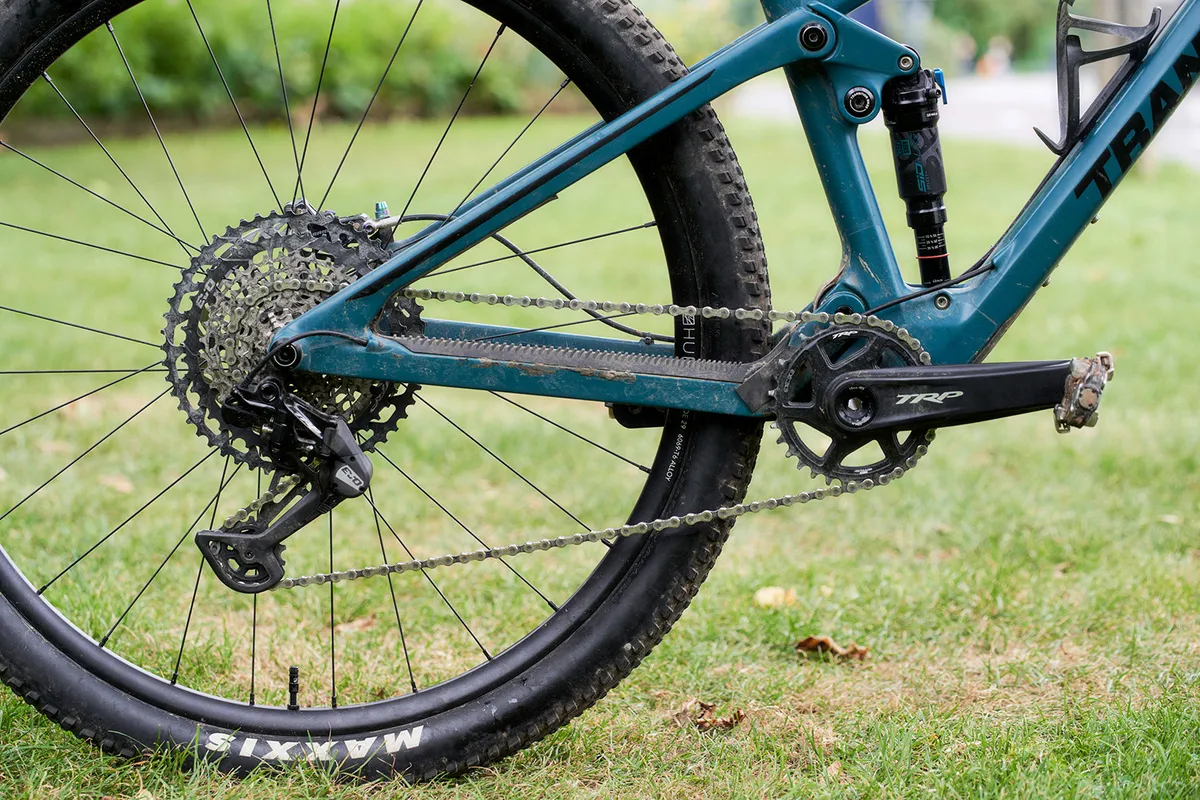
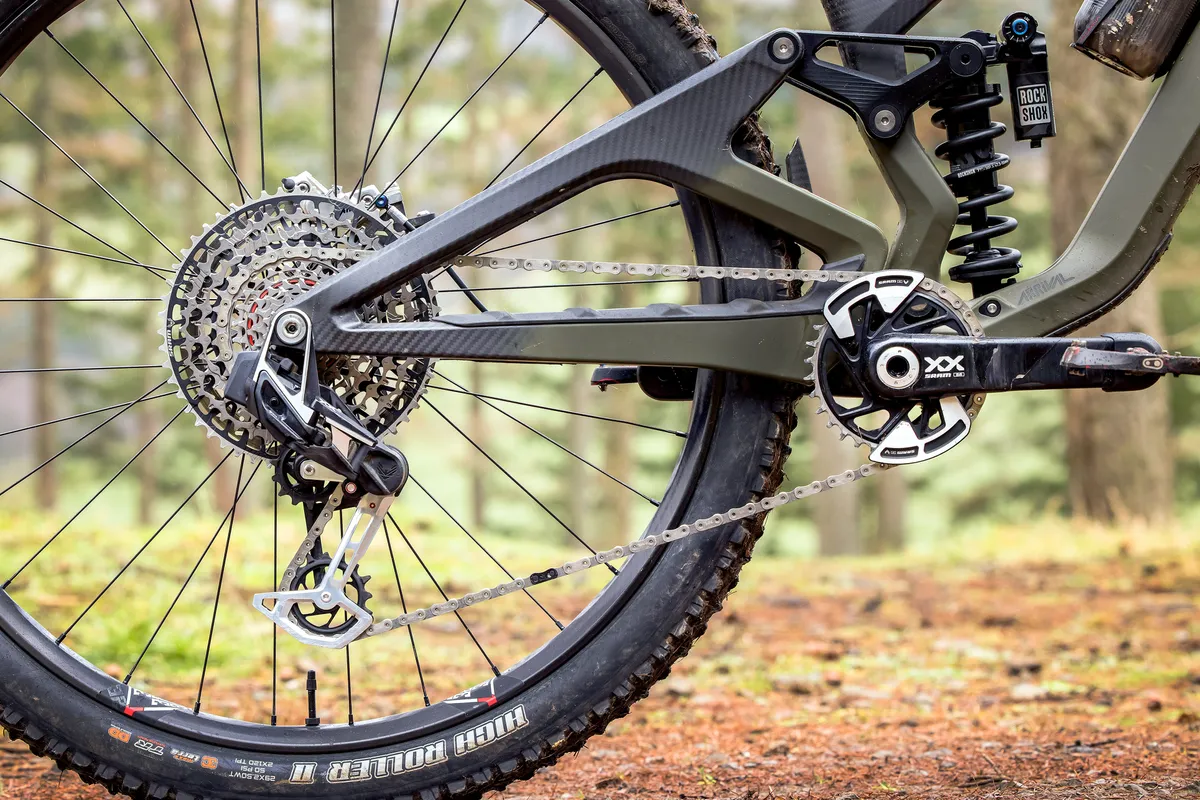
SRAM’s XX SL Eagle AXS Transmission is the brand’s ultra-high-spec, lightweight cross-country racing groupset that’s also tough enough for enduro use.
It sets the benchmark for long-term reliable shifting, even when maintenance schedules are far from ideal.
It is, however, eye-wateringly expensive at £2,890 / $2,699 / €3,250, and you'll need to spend extra cash on a bolt-on accessory to get the best out of it.
While many features are shared with the XX groupset, the SL sees a couple of weight-saving measures, plus the addition of power meter crank options.
SRAM XX SL Eagle Transmission spec details

SRAM XX SL Eagle AXS Transmission derailleur
Starting at the rear, the XX SL derailleur follows the form of SRAM’s X0 derailleur, with a rear-mounted battery, rather than the inboard battery of the GX and S1000 versions.
As with all Transmission derailleurs, it attaches to the frame via the Full Mount standard, bolting in place of a Universal Derailleur Hanger (UDH).
The body of the derailleur’s parallelogram is pared down marginally compared to the XX version derailleur, with SRAM claiming a 10g weight saving overall.
This is also helped by using a carbon cage, which holds the two large jockey wheels.
These feature SRAM’s ‘Magic Wheel’ system in the lower jockey wheel – the outer teeth can spin over the top of the jockey wheel’s splines if a stick gets jammed in there.
The overload clutch is there to save the system if it gets knocked while riding.
- Price: £695 / $650 / €700
- Weight: 445g
SRAM XX SL Eagle AXS Transmission crankset

The stock crankset for the XX SL groupset features a Quarq dual-sided power meter 34t chainring that mounts directly to the carbon arms via a proprietary Thread Mount system.
The crank arms come in 165mm, 170mm and 175mm options, giving a 55mm chainline via the DUB Wide spindle.
While 34t is the stock chainring size, there are options for 32t to 38t.
The power meter has a reported +/- 1.5% accuracy rating and IPX7 waterproofing – it’s good for submersion under one metre of water for half an hour – that’s one damp ride.
The power meter uses a CR2032 battery with a reported battery life of 200 hours of riding.
Data is transferred via low-power Bluetooth and ANT+. There’s MagicZero calibration – automatic calibration checking – and temperature compensation (10K for those who need to know).
As part of a larger ecosystem, the power meter is a central part of the Flight Attendant suspension system you may be running.
A non-power meter crank is also available, called the XX Eagle SL crankset. It features hollow-core carbon crank arms and comes in at a claimed 475g. It costs €660.
- Price: £1,125 / $1050 / €1,260
- Weight: 545g (175mm / 34t)
SRAM AXS Pod Ultimate Controller details
It’s not only the derailleur that enjoyed a shift in form when Transmission groups were launched.
SRAM ditched the traditional lever-shifter form, and replaced it with simple buttons held in the Shift Pod.
The two buttons can be customised in their function via the AXS app, offering single shifts or multi-shift when held down.
Both concave and convex button options are sent with the shifter to fine-tune the feel under your thumb.
The pods are held either via the integrated MatchMaker X mount, bolting the pods to your SRAM brake levers, or via the Infinite Shifter Clamp – a separate bar-clamp system.
- Price: £215 / $200 / €240
- Weight: 51g
SRAM XS-1299 XX SL cassette

Much of Transmission’s shifting performance comes from the cassette, and the XS-1299 (XX SL Transmission) cassette is the lightest SRAM makes. It comes in 2g lighter than claimed on my scales, at 348g.
It comes with a 10-52t range, with smaller, smoother jumps in teeth ratios in gears 10 and 11 compared to the previous-generation cassettes.
SRAM’s X-SYNC technology is the name of the game here, with teeth profiling and ramps aiding the chain’s journey between sprockets.
These are mapped to work with the chain and the derailleur’s shift speed to help performance under load.
The cassette is constructed from steel and alloy, with the hardened-steel X-Dome gears 1-9 backed up by aluminium cogs at gears 10 to 12.
This one-piece cassette mounts to an XD driver freehub and includes a red plastic Setup Cog marker, to aid installation of the Transmission groupset.
- Price: £645 / $600 / €720
- Weight: 348g
SRAM XX SL Eagle AXS Transmission Flattop chain
This is the specific chain for the groupset, featuring hollow pins and cut-out outer plates to help shave a little weight.
The Flattop design, whereby the top edge of the plates are flat in form, while the lower edge has the traditional curved form, is said to improve shift performance and durability, and "contemporizes the look of your bike".
Inner links are chrome-hardened, while the outer plates have a nickel finish.
The roller on the Transmission-compatible chains is larger in diameter than a traditional bike chain, so you must use a Transmission chain with the groupset to ensure longevity and performance.
This chain is not eMTB-compatible. It comes in 126- or 128-link lengths, with a Powerlock connector.
- Price: £160 / $150 / €180
- Weight: 251g (116 links)
SRAM XX SL Eagle AXS Transmission weight and price details
How I tested SRAM XX SL Eagle AXS Transmission AXS
How easy is it to set up SRAM Transmission groupsets?
SRAM XX SL Eagle AXS Transmission performance
SRAM XX SL Eagle AXS Transmission derailleur, cassette and chain performance

The derailleur, cassette and chain work together to ensure power is transferred reliably to the rear wheel, while shifting gears smoothly across the block.
For this to work, the teeth on the cassette are heavily profiled, and the chain is shaped in a manner to enable this smooth transition between sprockets.
The derailleur’s movement is determined by when the shift is best placed to happen, rather than exactly when it is initiated at the bar.
This enables the chain to move while it’s over the correct shift gates on the cassette.
The result is shifting that really is as good as the hype.
Shifting supreme

When moving to a larger sprocket, the chain is picked up by the teeth’s profiles, hooking it onto the new sprocket with minimal complaint.
Exert all your watts, and there’s an occasional small grumble as the chain pops and pings off the leading sprocket tooth, but overall, the shifting experience is pretty much silent, other than the derailleur’s servo motor buzzing as the chain shifts across.
I’ve found the shifting is a touch better under more power, too.
Want to put a full-gas sprint in halfway up a steep ascent? A quick punch of the shifter’s button will get the chain onto a smaller sprocket as you’re unleashing your power.
Need to dump a load of gears when transitioning from a descent into a climb? The orderly procession of the chain over the cassette, as defined by the derailleur’s regimented shift movement, ensures this is almost always done without the usual grouchy crunching and clicking that can accompany such a move elsewhere.
Strong and durable
Durability is something that’s hard to judge here – but it seems impressive.
My maintenance regime is poor – the groupset has rarely been cleaned properly, often run far dryer than it should be, and with no consistency in terms of which chain lube has been used.
Despite this, the chain has remained rust- and corrosion-free, and those shifts, even when the chain is crying out for attention, have always been like butter.
This experience is also true of the derailleur.
It’s had its fair share of bangs, with plenty of scuffs to show, but the pivots in the mechanism are all without play, the pulley wheels still spin smoothly and the clutch is as strong as ever.
SRAM XX SL Eagle AXS Transmission power meter crankset performance

Despite rattling various bikes down many thousands of metres of descent, I’m yet to drop a chain with this groupset.
The derailleur’s clutch will play a part here, but it’s clear the X-Sync narrow/wide system does an impressive job of keeping the chain in place.
Wear levels on the chainring are also acceptable, with little dulling or noticeable shark-toothing.
The cranks have stood up well, too. However, I would recommend keeping the supplied crank boots in place. These help ward off scuffs when traversing technical terrain – mine have certainly seen some action.
They make fitting and removing pedals a slightly fiddlier process, because they can move on the crank arms a touch, but there's no reason to remove them.
There’s also some scuffing to the crank arms, from my shoes. However, it's far less visible on these carbon cranks than on alloy cranks. Overall, they stand up to aesthetic wear and tear well.
The power meter has performed well. I’ve had no issues with it connecting to my Garmin computer, and there’s a full suite of training data available from its dual-sided strain gauges.
In training terms, having a dual-sided system is preferable to a single-sided option, which uses estimations to provide a full set of data. Lower-tier Transmission groupsets forgo this dual-sided power meter, a plus point here for XX SL.
Battery life on the power meter has been fine – I’ve replaced the battery (an easy process) twice so far and had no reconnection issues after doing so.
The only issue I’ve had with the whole system has come from the integration with SRAM’s Flight Attendant, whereby swapping power meters linked to a Flight Attendant fork has caused some computational confusion.
That’s a story for a Flight Attendant review, though, and isn’t a fault of the power meters.
Being fussy, the proprietary Thread Mount crankset / chainring interface means if you want to put a non-power meter chainring on the cranks, you’re going to struggle to find many options.
SRAM AXS Pod Ultimate Controller performance

As shifters go, the Pod Ultimate Controller is as simple as they come. Two buttons make the gears either harder or easier. There’s a touch more to them than that, though.
Two sets of buttons are provided – a convex set and a concave set. I preferred the concave pair because my thumb sat easier between them, and I tend to press the upper edge of the top button or the lower edge of the bottom button.
In my experience, this makes it easy to feel what’s going on with the shifter.
There’s a subtle, but noticeable click when you press them, with more feedback than the AXS Pod Controller Rocker Paddle shifter of old – although you’ll get more feedback into cold, numb fingers from a cable shifter.
I struggled to get the AXS Pod Ultimate Controller into my ideal position under the brake levers.
Using MatchMaker clamps with SRAM brakes in my relatively flat lever position meant I struggled to get the Pods far enough towards me under the bar – perhaps I have small thumbs.
And, with the Infinity Mount, where a bar clamp connects the shifter to the bar, I still struggled with the ergonomics.
Although this is personal preference, I like the feel of a pushed lever on a mechanical setup. I also prefer their more slimline form, sitting closer to the bar, rather than hanging low underneath.
The Rocker Paddle version of the shifter improves things, though.
I've found it more intuitive to use, enabling more of a flick of the shift lever, rather than a press, and I found my thumb sat more naturally in its concave form.
The Rocker Paddle is also more solidly attached to the Shift Pod than the buttons are. On a couple of occasions, a brushing knee knocked the pads off the Pod, lost forever to the undergrowth, and leaving me shifting with a minuscule button for the rest of my ride.
SRAM XX SL Eagle AXS Transmission bottom line
With a number of other Eagle Transmission groupsets already having been extensively reviewed at BikeRadar, it is no surprise that this lightweight version also has benchmark performance levels.
SRAM will market it at the XC race crowd, but my experience of the groupset on bikes with more gravity intentions shows it doesn't shy away from the gnarlier end of things.
Comparisons will obviously be made to Shimano's new XTR Di2 groupset, however, the breadth of options with XTR means we haven't been able to complete a truly like-for-like review here.
XTR comes in at a very similar weight, but it costs considerably less, at around £1,400 / $1,800.
My colleague Alex tested the trail-orientated version of Shimano's XTR groupset here.
SRAM's XX SL Transmission performs almost faultlessly in almost every manner, with low weight, impressive durability, excellent shift performance and great looks.
SQUIRREL_13122566
Product
| Brand | Sram |
| Price | €3250.00, £2890.00, $2699.00 |
| Weight | 1640g |