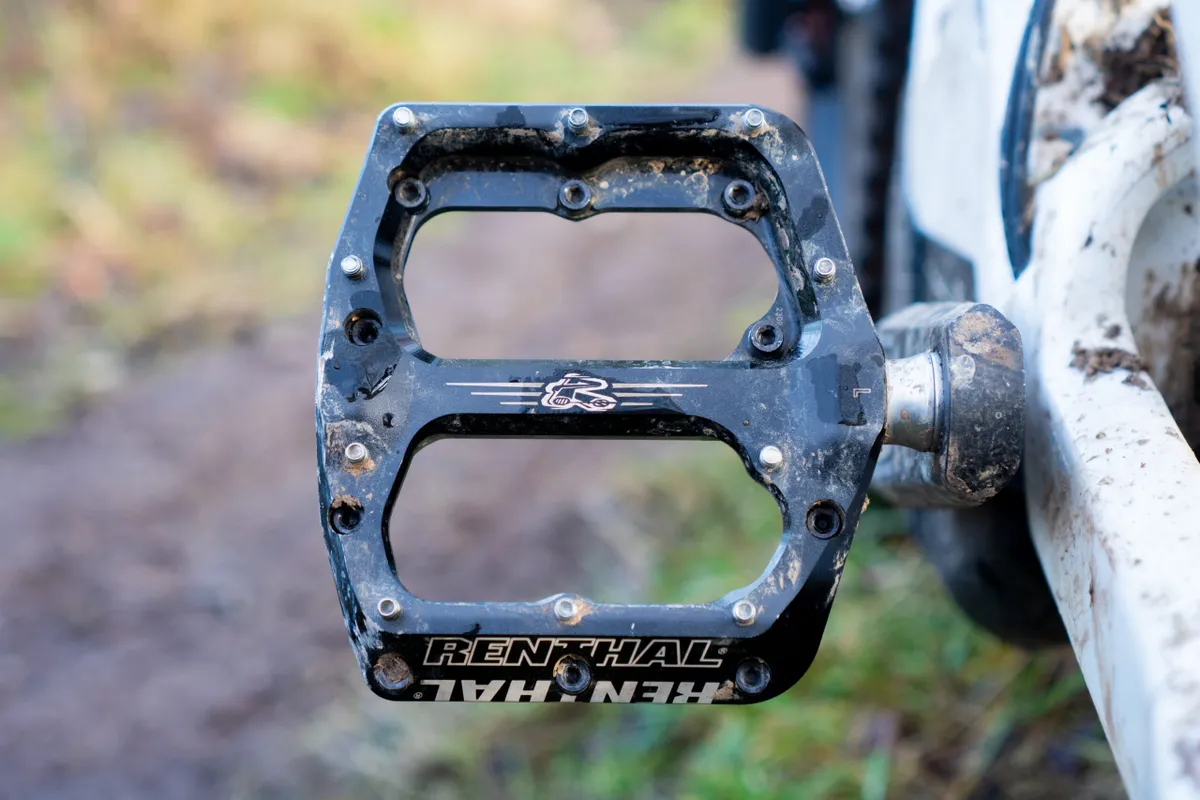
Outlier’s Pendulum flat pedals are nearly a home run thanks to their excellent grip and incredible stability – two of the key ingredients for top performance.
But the challenges presented by the novel-looking design – that gives it those two key things in bucket loads – are ultimately their biggest downfall.
The large inboard bearing housing makes it impossible to get your feet close to the cranks, widening your stance beyond what’s comfortable.
Riders who like their feet to butt up against the crank arms, or ones who prefer a narrower stance, will struggle with the Pendulum.
This issue won’t apply to all – some riders are happy with a wide stance – but for the ones it affects, it’s a dealbreaker.
Outlier Pendulum flat pedals specifications and details

Outlier's axle-free Pendulum pedals have a novel design – there's no central axle spanning their length, leaving a frame-like exoskeleton to put your feet on.
Their body is offset from the pedal's axle, making it sit beneath the axle’s centre point compared to a conventional pedal.
They're one-sided as a result and self-right when your foot is no longer on them, swinging to their resting, neutral point like a pendulum.
According to Outlier, the Pendulum design solves several issues flat pedal riders are regularly blighted with, and the first is grip.
Normal pedals need a deep axle and central body to support it spanning their width. To make them concave – a crucial part of any good flat pedal that helps keep your feet on the pedal's body – means the leading, trailing and outer edges of the platform need to be thicker than the central section.
This can give some flat pedals a boxy, chunky and tall design.
Outlier has removed the centre of the pedal. The outer frame-like shape is flat, but with no centre, your foot and shoe sink into the void, creating much-desired concavity, resulting in masses of grip.

Next is stability.
Sitting on a traditional pedal's platform, your feet are around 6mm above the centre of the axle, according to Outlier. By removing the pedal’s centre section, your feet are lowered compared to a traditional model, even when you don’t account for the Pendulum's offset design.
Factor in the design – the body sits 7mm lower than the centre of the axle – and your feet are closer to 13mm lower than they would usually be.
This lowers your centre of gravity, which is a massive positive. Manufacturers such as Whyte go to great lengths to do the same thing, so doing it for your body is a noble pursuit.
The pendulum design is claimed to “swing forward”, according to Outlier, during braking or deceleration events (think hitting a large, unexpected bump), automatically pointing your toes up and heels down. This is the desired foot position for flat-pedal riders, and having your pedals help is only a good thing. When you remove your feet from them, they automatically self-right to the pin-side up, thanks to the offset axle.
Rock, root and floor strikes should be glanced off because of the one-sided, self-righting design, which means there are only pins on a single side. The downward face is smooth with a convex profile and thin 7mm (measured) tapered edges. It has no pins on it.

However, the design has reduced the number of places bearings and bushings can be located. Outlier has placed its bearings between the body's inner edge and the crank arm, creating a large 19mm, bulbous section housing two 7902 sealed bearings.
The pedal's pivot point, and bearing and axle housing, moves the functioning portion of the platform away from the cranks, increasing your bike's stance significantly. Compared to Deity's T-MAC – one of the best flat pedals on the market – the Pendulum's platform is 23mm further away from the cranks per side.
The design has a 120x97x13mm platform, but this tapers down to 7mm at its thinnest point. There are nine rear-loading pins – removable with a 3mm hex key – which protrude by 5mm from the pedal’s body.
Outlier Pendulum flat pedals performance

Grip is phenomenal on the trails. My feet remained absolutely stuck with zero movement.
Even if you try to twist or move, it's impossible – these are by far and away the grippiest pedals I’ve ever used.
There’s not a lack of support from the missing central portion and my feet didn’t become excessively tired from ‘bananaing’ or sinking into the hollowed-out middle.
The self-righting feature worked as intended during my testing. Take a foot off to dab and the pedals will face the correct way, with the grippiest side up.
Thanks to the pendulum design, the locked-in toes-up, heels-down feel has never been easier to access. This connects you to the bike, doling out confidence in bucket loads. Swapping back to regular pedals feels as though you're balancing on a much smaller platform – the pedals want to pitch, so your toes angle down, feeling way less stable.

That’s all good for me so far, but there’s one big problem – the large inboard bearing bulge.
I like my feet to butt up against the cranks when descending and naturally position them well in-board when pedalling.
On both climbs and descents, I was continually shuffling my feet closer to the cranks, only for my soles to contact the bearing bulge, stopping any additional movement. This proved to be distracting and tiring, and I couldn’t ride them with the intensity of a pedal where I wasn’t trying to shift my feet outboard.
My colleague Max Wilman – who also has a pair of the Pendulums – didn’t notice this issue, indicating riders who like wider stances will get along with Outlier’s design.
Cutting up my shoes

When I previewed these pedals in a recent First Look Friday, I mentioned I was going to cut up my shoes to help reduce the bike's stance width that was widened thanks to the pedal's bearing bulge.
The reality of doing so meant I would need to cut away so much of my shoes that wearing them would be untenable – the insole and my foot would be in direct contact with the pedal's bearing.
Unfortunately, there are currently no 'hacks' to make the pedals narrower or bring your feet further inboard. If this is an issue for you, I could not recommend the Pendulum.
Outlier Pendulum flat pedals bottom line

While the Pendulum pedals looks promising on paper, touting benefits all of us want from our flat pedals, the design will throw up one major problem for certain riders.
The large inboard bearing bulge will be hard for many to overlook, especially because it significantly widens your bike’s stance. If you like to ride with your feet close to the cranks, you’ll constantly be shuffling and wanting to reposition them to get comfortable. The bulge puts a stop to that, physically limiting how far your feet can move inboard.
If you don’t run your feet close to the cranks or a long way inboard on your pedals, this is less likely to be an issue for you, and the Pendulums will make total sense.
But for everyone else, if my experience is anything to go by, I can’t recommend them despite plenty of positives.
Product
| Brand | Outlier |
| Price | $299.00 |
| Weight | 457g |
| br_whatWeTested | Outlier Pendulum flat pedals |