It’s tempting to think that the environmental friendliness of not driving a car is a given. Our laps of the woods don’t involve chugging out exhaust fumes or chewing through electricity. Mountain biking is about exploring the countryside and escaping the city and its damaging cycle of blind overconsumption. Isn’t it? But how ‘green’ is mountain biking really and what is the environmental impact of mountain biking?
- How your old, punctured inner tubes could transform lives in Malawi
- 10 things you should never do on a trail
- Islabikes develops ‘ride-to-school’ rental bikes
There isn’t any proper research about the environmental impact of mountain biking so we have to make a few leaps. A British research study from 2008 attempted to compare public transport, car usage and cycling in terms of the total C02 emissions from direct and indirect causes. Including the exhalations of exhausted commuter cyclists and the manufacturing emissions of creating bicycles, cycling is about as environmentally friendly as “an electrically propelled train at full occupancy during peak service times”. So pretty good.
A similar US study (from MIT) in 2010 also looked at greenhouse gas emissions “per passenger mile travelled, factoring in the CO2 from heavier respiration by cyclists and walkers”. The author found that bicycles and ebikes were the clear winners at 20 and 21 grams each. This compares with pickup trucks at a whopping 549. However, both sets of figures are for commuter cycling, described as ‘standard bikes’ and not mountain biking. But even factoring in non-standard levels of panting and non-standard (more complicated) manufacturing, things don’t look too bad for us in the environmental impact stakes.
Trail of destruction
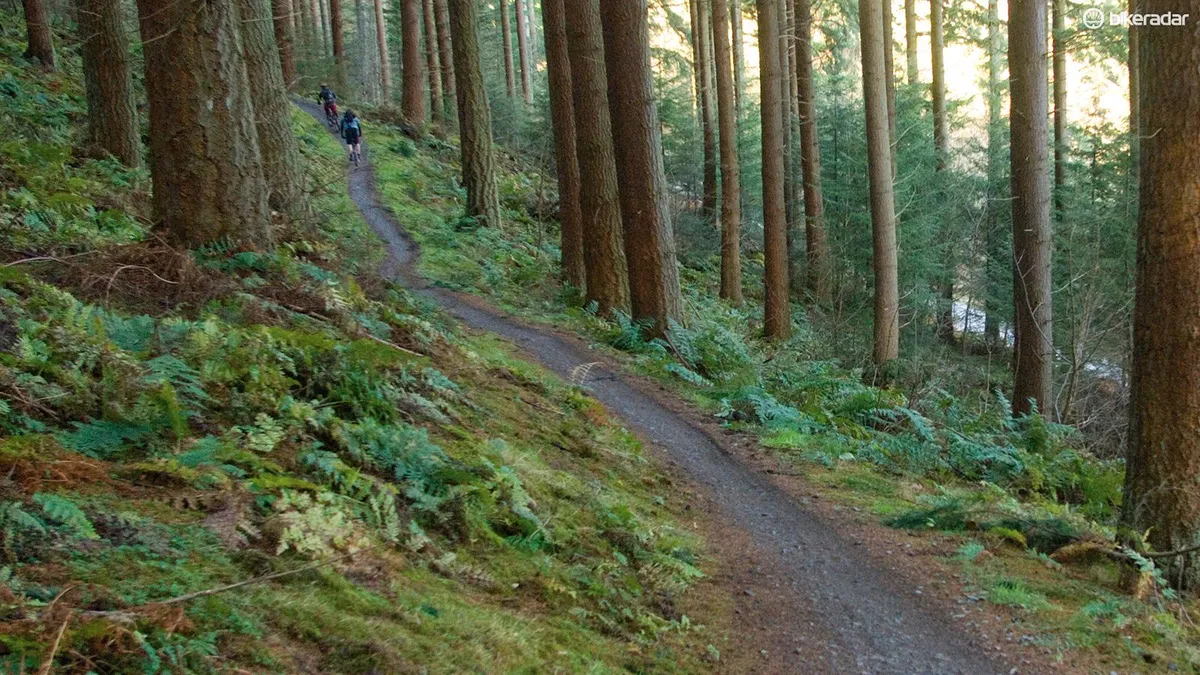
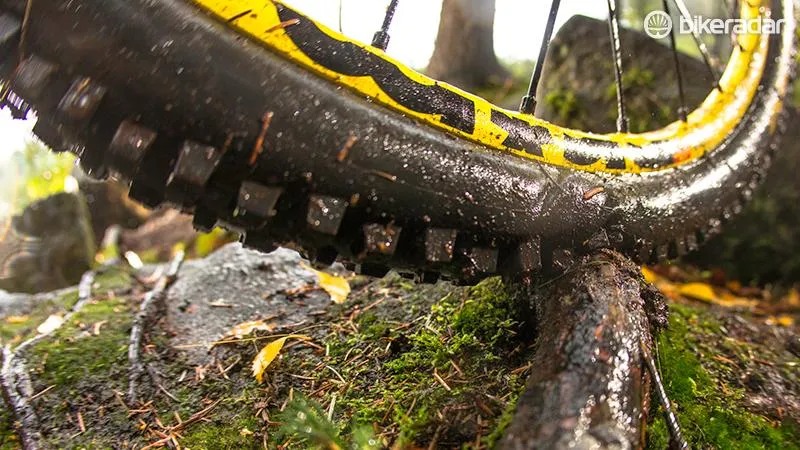
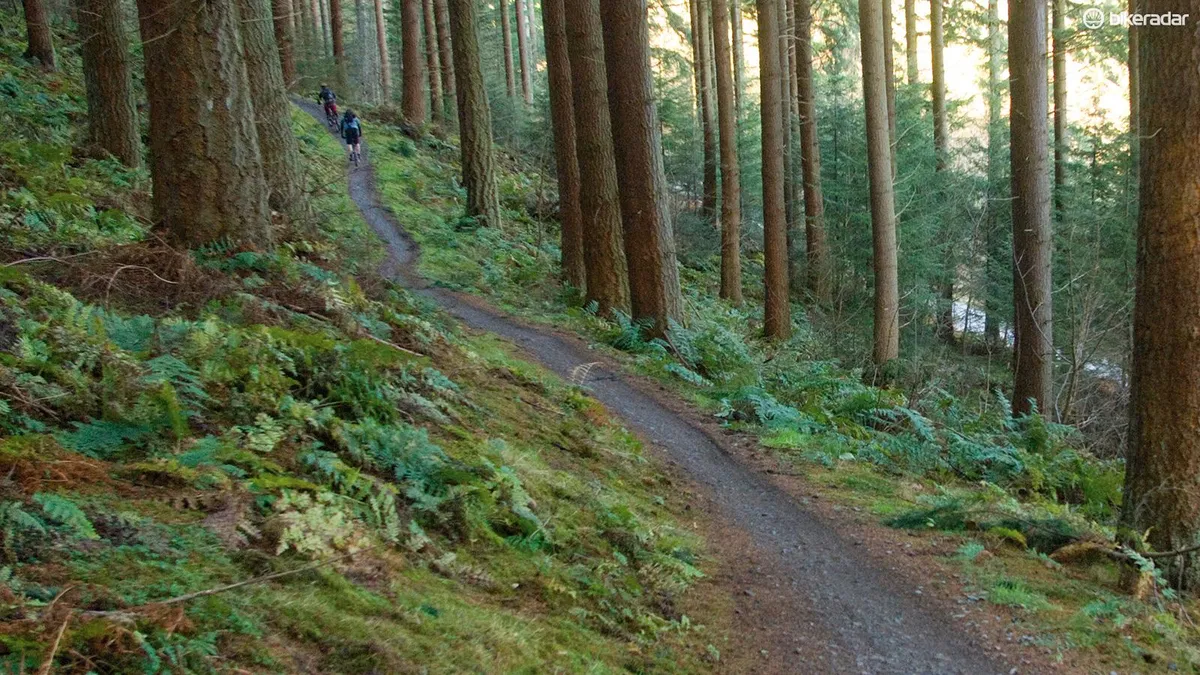
Ask some other users of trails and tracks whether mountain biking is environmentally friendly and they’ll argue (loudly) that it chews up the landscape and damages the environment in a very direct, tyre-slicing-through-mud kind of way. Ruts and exposed tree roots left by mountain bikers are a very obvious by-product of our sport and one we can’t shrug off, particularly now that the numbers heading out into the hills has boomed.
Recycling and reducing impact cost dearly and would mean more expensive products for smaller companies. Consumers need to think about where their bikes are coming from
“Strava has a lot to answer for,” explains Jim from One Planet Adventure at Llandegla, “and so do the trail centres. Riders have increased in confidence on the man-made stuff and are seeking new challenges, so they download other people’s routes, organise large group rides and off they go.” The boom is great for the sport, but can cause damage to the land.
Trail designer Phil Saxena from Architrail has built his business around protecting the natural environment by enticing riders onto fun man-made trails. “Our combination of soil and climate means that without protection, natural trails don’t survive a winter of constant riding. We all want to ride ‘natural’, but investing in built trails is a good way of reducing the traffic and associated damage.”
In Bristol’s Ashton Court, the purpose built Nova Trail has given the ancient beech trees a chance to recover their previously exposed and damaged roots. That said, the berms Architrail builds often have to be made from materials imported by dumper truck, so it’s a trade-off. “True,” admits Saxena, “but with only natural trails to ride, land managers would reduce access and we’d have a lot less riding.”
Bike provenance
“Mountain bikers aren’t always aware of the damage they might be doing and need some education,” admits Jim from One Planet Adventure. And the same might be said of their shopping habits. “People don’t always think about where their bikes and parts come from,” explains Jez Loftus from Trek.
Neil Wilkinson (CEO of Superstar Components) agrees: “Customers aren’t really interested in how the products are made or distributed. They just care about price. I’ve increased the spec of our hub bearings to massively extend the life of the product and eliminate returns, and I’ve brought a lot of our manufacturing to the UK, thanks to huge investment. But I can’t up the price because our products won’t sell. We actually do a lot for the environment, but I don’t use that in our marketing. It’s all about price.”
In 2010, Trek teamed up with ‘discontinuous carbon composites’ firm Carbon Conversions to start recycling broken, old or unsold prototype frames
Trek takes a different view, as Loftus explains: “Trek is really proud of its sustainable ethos and we shout from the rooftops about it.” It’s the smaller companies, Loftus says, that are unlikely to be investing in programmes to reduce their environmental impact. “Recycling and reducing impact cost dearly and would mean more expensive products for smaller companies. Consumers need to think about where their bikes are coming from.”
It’s unsurprising that mountain bikers, like a lot of customers, think with their wallets. When there’s a bargain to be had, principles can fly out the window. That said, if you shop carefully, you can limit your environmental impact. Specialized, Giant and Trek, for example, have made impressive efforts at sustainability, and take their commitment way beyond just profit and planet, and also invest in looking after people.
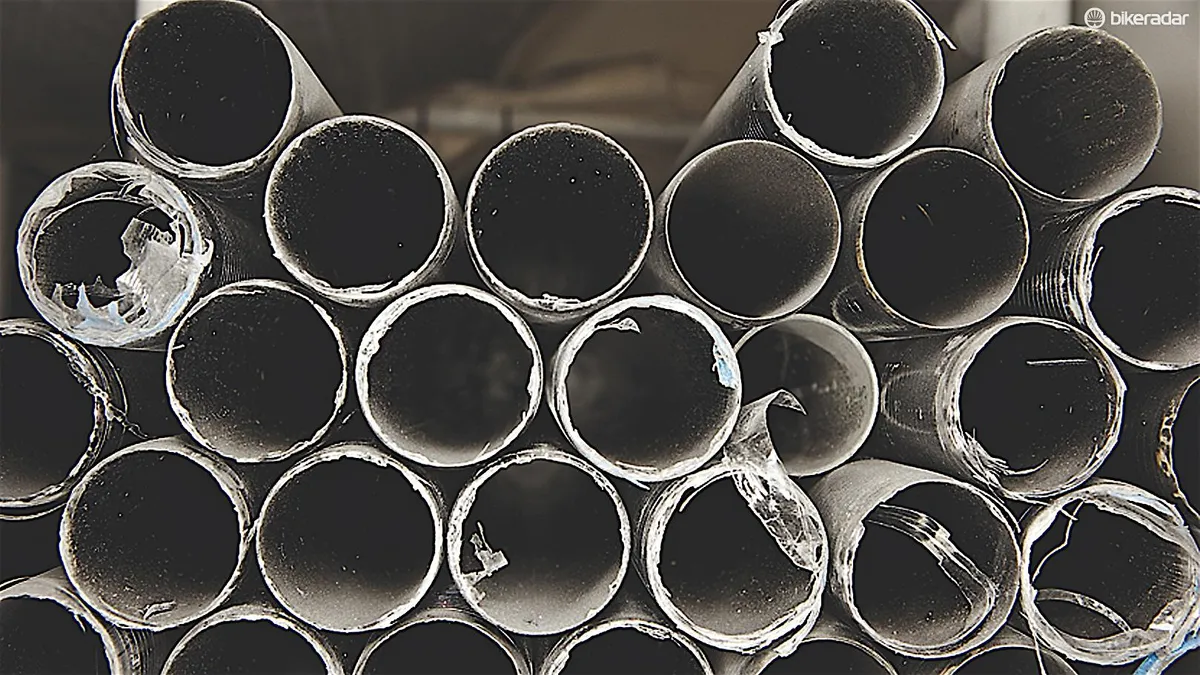
Specialized was the first major bike business to join the Outdoor Industry Association (OIA) Eco Index (a system for evaluating and improving the environmental footprint of products during the design stage), and Trek was the first to launch a carbon recycling programme. The prevailing use of carbon fibre in bike building has been a major environmental sore point for the industry. Carbon is a composite, multi-layered product, which simply doesn’t degrade. As one report puts it, “By its very nature carbon fibre is neither biodegradable nor photodegradable. It’s simply a product designed to last and last.” That’s reassuring for the new owner of a boxfresh Superfly but when they move on to next year’s model it’s a potential landfill-shaped problem for the planet.
In 2010, Trek teamed up with ‘discontinuous carbon composites’ firm Carbon Conversions to start recycling broken, old or unsold prototype frames. Trek now recycles much of the 60,000lb of scrap material produced each year. The reclaimed carbon can’t be made back into bikes because that carbon needs to be in long, continuous stands for structural integrity, but making smaller parts — for the bicycle industry and beyond — is perfectly possible. However, this is a very expensive process; one that Trek is happy to invest in, but that smaller companies can’t justify. For carbon, it costs $0.02 per lb for landfill versus $0.13 to recycle.
A global industry: Where does your bike come from?
- Components: Some, like Superstar and Hope, are manufactured in the UK (Lincoln and Barnoldswick respectively). Shimano has factories across China and Taiwan. SRAM, which also owns Avid, RockShox, Truvativ, Quarq and Zipp, manufactures in Portugal, Taiwan, China and the US.
- Tyres: For 20 years Schwalbe has made its tyres in Indonesia, while Continental makes a big noise about its German technology centre. Actually, some Conti tyres are outsourced but others are ‘handmade’ in Korbach. Maxxis is actually a subsidiary of Cheng Shin Rubber Industry Co and manufactures in China, Taiwan, Thailand and Vietnam before shipping its wares to 170 countries.
- Frames: As a rule of thumb, most low- to mid-level bikes are made in China and mid- to high-level bikes in Taiwan. More recently, Vietnam and Thailand also acquired a stake in the industry. Most top brands design at their HQ but manufacture elsewhere. Some companies make their own carbon frames (like Trek in Wisconsin, along with its high-end Bontrager wheelsets), but many are made by OEM’s (original equipment manufacturers) in the Far East in accordance with the designers’ specifications.
A bike's life cycle
The glossy marketing of these big bike manufacturers paints a rosy picture of their environmental impact, but it’s hard to ignore the fact that most big brand bikes are at least in part manufactured in Taiwan and then shipped all over the world. Neil Wilkinson defends container shipping as cheap and fuel efficient. “It’s trucking parts the other end that chews through the fuel,” he says, and this is supported by other evidence. Nonetheless, distributing from across the planet is a different world to Chris King’s local-sourcing supply chain model, but it does mean manufacturers can meet the cost and quality-targets customers are looking for. “We do what the customer wants,” says Wilkinson.
You can’t get away from the environmental impact created by manufacturing, whether bicycles or anything else. The mining of metals and manufacturing using aluminium, titanium, or carbon fibre is heavy on resource. Steel and titanium production has C02 as a direct by-product. A US report even states that “aluminium production consumes five percent of the electricity produced in the US each year and accounts for almost two percent of the world’s annual greenhouse gas emissions, though bicycle production accounts for only a small fraction of that total.” The good news is that recycled aluminium only uses five percent as much energy as mining and producing new metal, and as Jez from Trek discloses, “I don’t know any company that doesn’t recycle its swarf these days,” even if some go further than others.
In fact, according to the MIT study mentioned earlier, the carbon footprint of manufacturing “a standard bicycle” (eight grams per passenger miles travelled (PMT)) came out to less than operation and maintenance — 12 (remember that these figures aren’t for mountain biking, and they’re a bit old now — there’s a research gap here). The author also looked at the life cycle energy use of various modes of transport and calculated a bicycle to use 60 kilojoules per PMT split into 51 for manufacturing and nine for maintenance over an estimated 15-year life span.
This compares favourably with an average car (4027 KJ/PMT), but more interesting is that her calculation is based on a 15-year ownership. She writes, “Bicycles are more likely to be stolen or sold than scrapped by the user who bought it new. Bike shops routinely reuse parts or refurbish bikes for resale. In actuality the lifetime of a bicycle may be even longer…” Really? This might be the case with commuters but mountain bikers switch their bikes more regularly. I recently dusted off a four-year-old short-travel 29er and was laughed at for riding a ‘vintage’ bike.
MTB technology changes rapidly and consumers don’t want the same bike for 15 years. Fuelled by heavy investment in R&D and fast-paced brand marketing activities, we desire faster, lighter and stronger, and only want to pay reasonable prices. Neil from Superstar argues that what drives the decisions of many businesses in the bike industry isn’t environmental impact but rather survival and profit; meeting customer needs as profitably as possible. “Most things companies say are ‘green’ are just a by-product of regulation or cost saving.”
Superstar has brought much of its supply chain to Lincoln to cut costs and reduce lead times to its UK market. “You can fit 500 pairs of wheels in a container, but you can get 3,000 pairs of rims, so we assemble the wheels in the UK as that means we ship six times fewer containers than our competitors. We have a lead time of one day on our wheels, compared with six months for our competitors. The real reason is storage space, cost and flexibility. Green is just a benefit.”
More for less
So there’s a tension here between consumers wanting quality at a good price and manufacturers being able to meet those needs in a sustainable way, and it’s a tension faced by every industry on the planet. Reputable brands want to build products that last, but that costs. Rachel Walker from Hope says, “We see people bringing in brakes that are 15 years old. We want our products to last and not get chucked away. It’s common sense.” But the brands also have to meet the consumer need for newer and better, which infiltrates every area of our lives.
If you’re riding a bike more than a few years old you’re probably on the wrong wheel size, geometry, handlebar width or gearing. Your brakes might still be working but they’ve been superseded by a newer version with better stopping power. Magazines, blogs and websites fuel the need for more stuff, and manufacturers meet this demand with a constant array of technologically advanced, heavily marketed products, which will, they promise, change your life. And so it goes on...