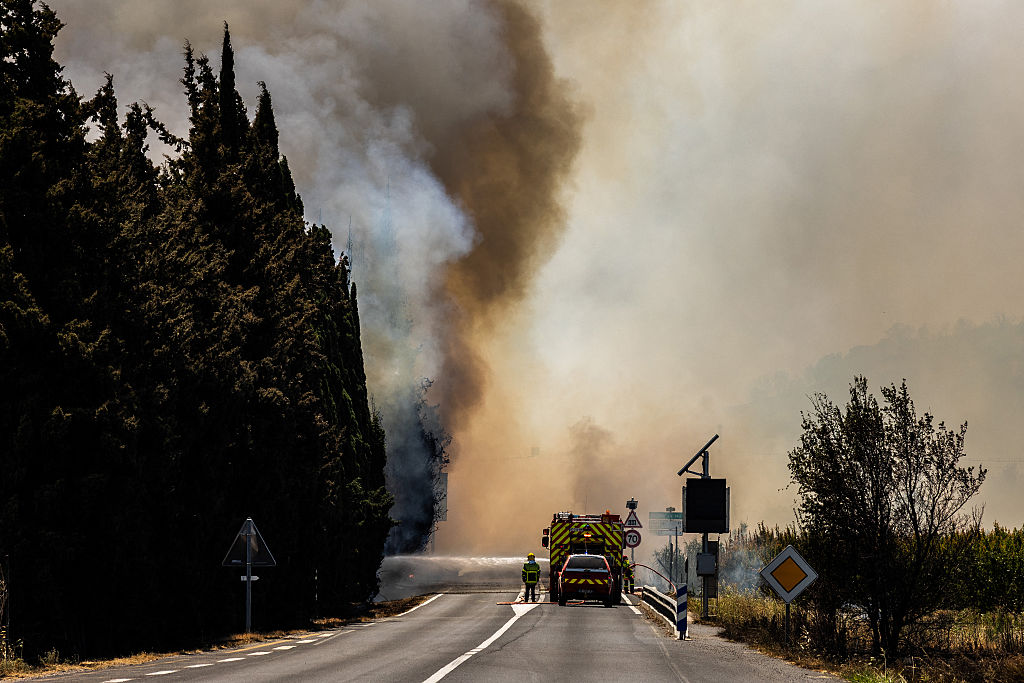
This feature was originally published in January 2025 but, given the wildfires currently hitting southern France, and the record-breaking heatwaves hitting Europe, it's a timely opportunity to resurface this piece.
Groupama-FDJ’s top-10 Tour de France finisher, Guillaume Martin-Guyonne, knows what it’s like to be a rider competing on the frontline of the climate crisis.
“At the Vuelta [in 2024] the first week was over 40°C, and for three or four consecutive days, there was a rider that finished the race in an ambulance. I was close to being endangered and having health issues, but I never went to the point where it was too much or that I had to go to hospital,” he says.
It’s an image that fans have become used to in recent years, as the mercury soars and performances wilt during the professional calendar’s blockbuster races.
But it’s not limited to the heat, with races hit year-round by landslides, freak snow storms and gale-force winds. Extreme weather could change professional road cycling as we know and love it, posing challenges for riders and race organisers.
In the firing line
The UCI WorldTour and Women’s WorldTour calendar kicks off with the Tour Down Under in January and runs for the next 10 months – visiting four of the planet’s continents in that time. The peloton covers some serious miles – both on and off their bikes – through the course of a season.
This globe-trotting schedule increases the sport’s contribution to the climate crisis in terms of its carbon footprint – particularly when you factor in the caravan of promotional vehicles, team buses and cars that join the riders each day on the road. Meanwhile, pro cyclists are repeatedly exposed to the effects of a changing climate.
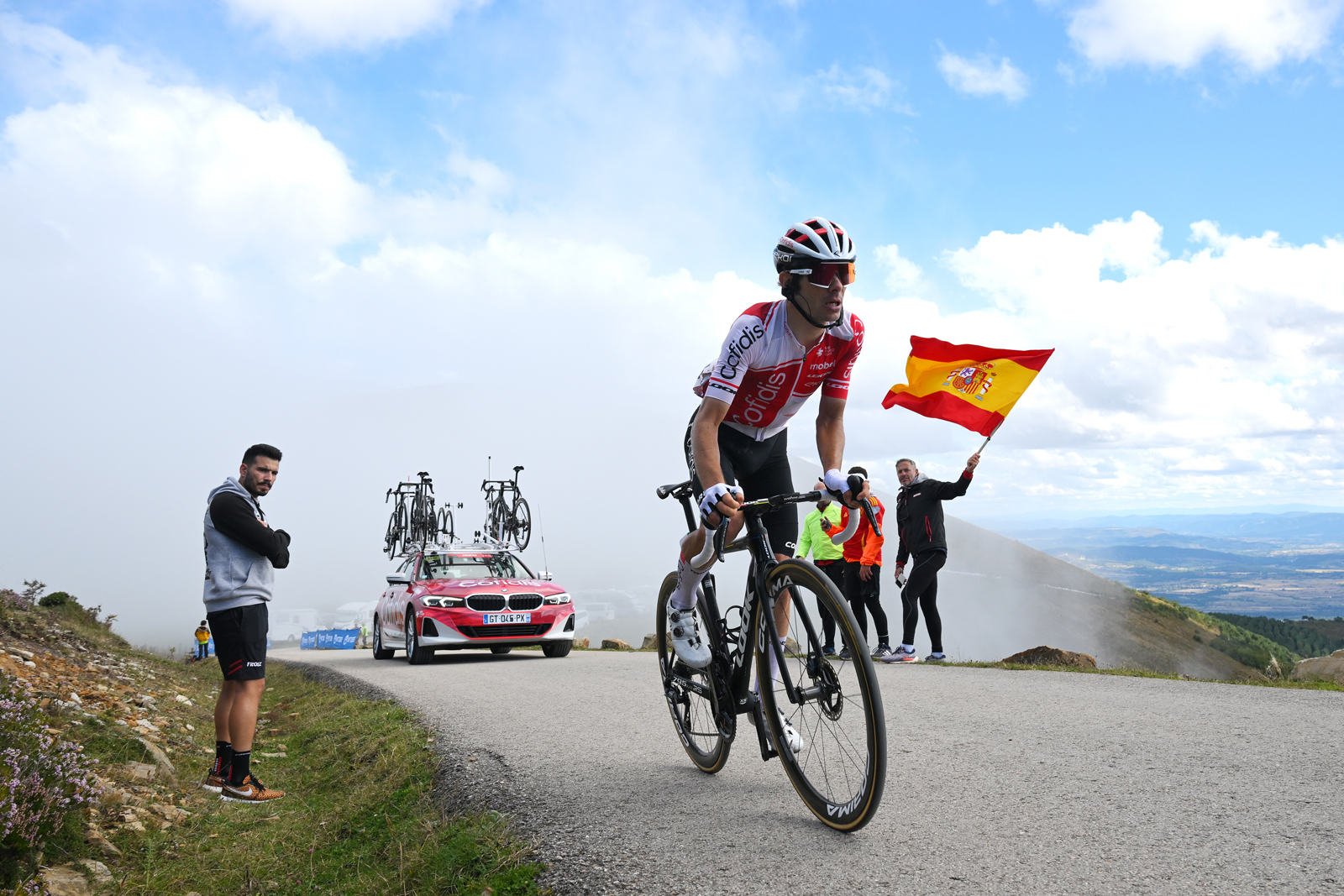
“The sport goes all over the world and each place where they compete has a different set of environmental challenges,” says sports ecologist Dr Walker Ross. “Athletes are having to adapt and respond from 'it's very hot and humid here' to 'it's very cold and dry and windy there' – that's not easy on the human body. As temperatures rise, it will get hotter, it will become more dangerous for athletes to compete.”
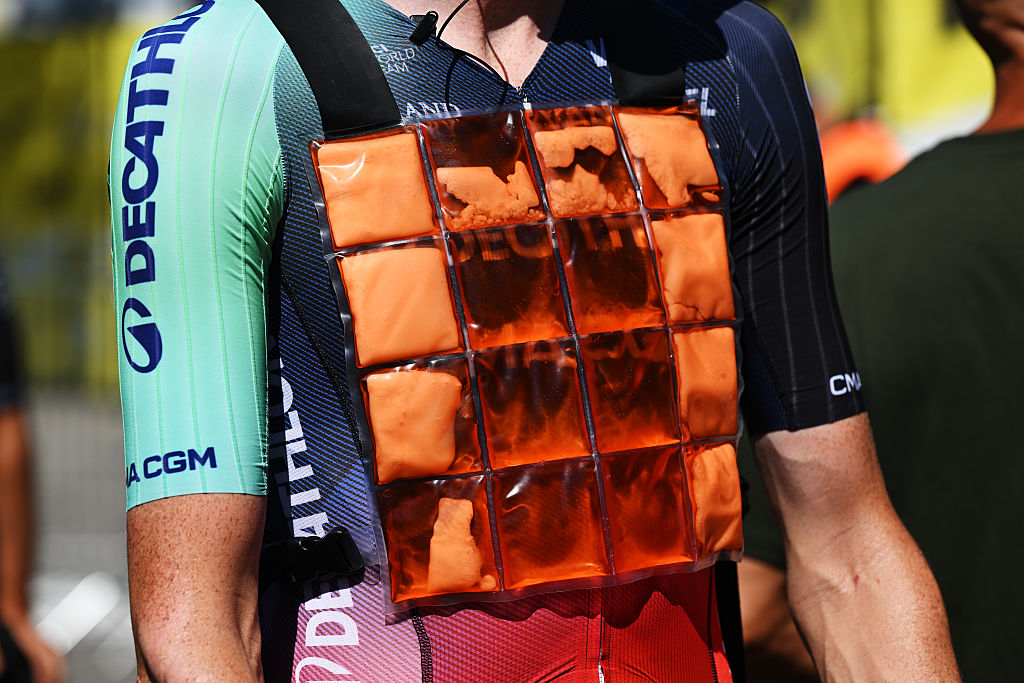
Martin-Guyonne undergoes heat training sessions inside on the turbo trainer during the season to help him acclimatise, uses ice vests pre-race, and takes on extra hydration and salty food while competing to limit losses of performance. But the 31-year-old explains “it’s always a challenge” for his body.
“I live in the north of France, so I'm not used to it," says Martin-Guyonne. "Even with good preparation and good clothes, it's just too much.” It’s not only the hot conditions either, and he points to difficulties during a snow-hit edition of La Flèche Wallonne, and Tre Valli Varesine’s mid-race cancellation because of torrential rain.
“I think those conditions will repeat more and more often [in the] future. It's also the responsibility of the [race] organiser or the UCI to decide when the race is not possible to start.”
An extreme weather protocol covering conditions such as freezing rain, poor visibility and air pollution has been in place since 2015 that can propose – but, importantly, not enforce – that races are neutralised, shortened or ultimately cancelled. A high-temperature protocol was added in 2023, focusing specifically on extreme heat.
In essence, when certain conditions are met, representatives from the teams, riders and race organisers convene to “agree on an action plan to mitigate the risks to riders’ health and safety”. Altering or cancelling the race is the most extreme outcome, with other recommendations including moving start zones to shaded areas, supplying teams with cold drinks and crushed ice during the race, and increasing the number of refuelling motorbikes on the road.
Martin-Guyonne, however, doesn’t believe they’re being enforced properly. “During the Vuelta, we were really at the limit of what the human body could do," he says. "I think if there is a real problem, or someone dies because of conditions, then things will change. But I hope we can find a solution before.”
Trouble at the Tour Down Under
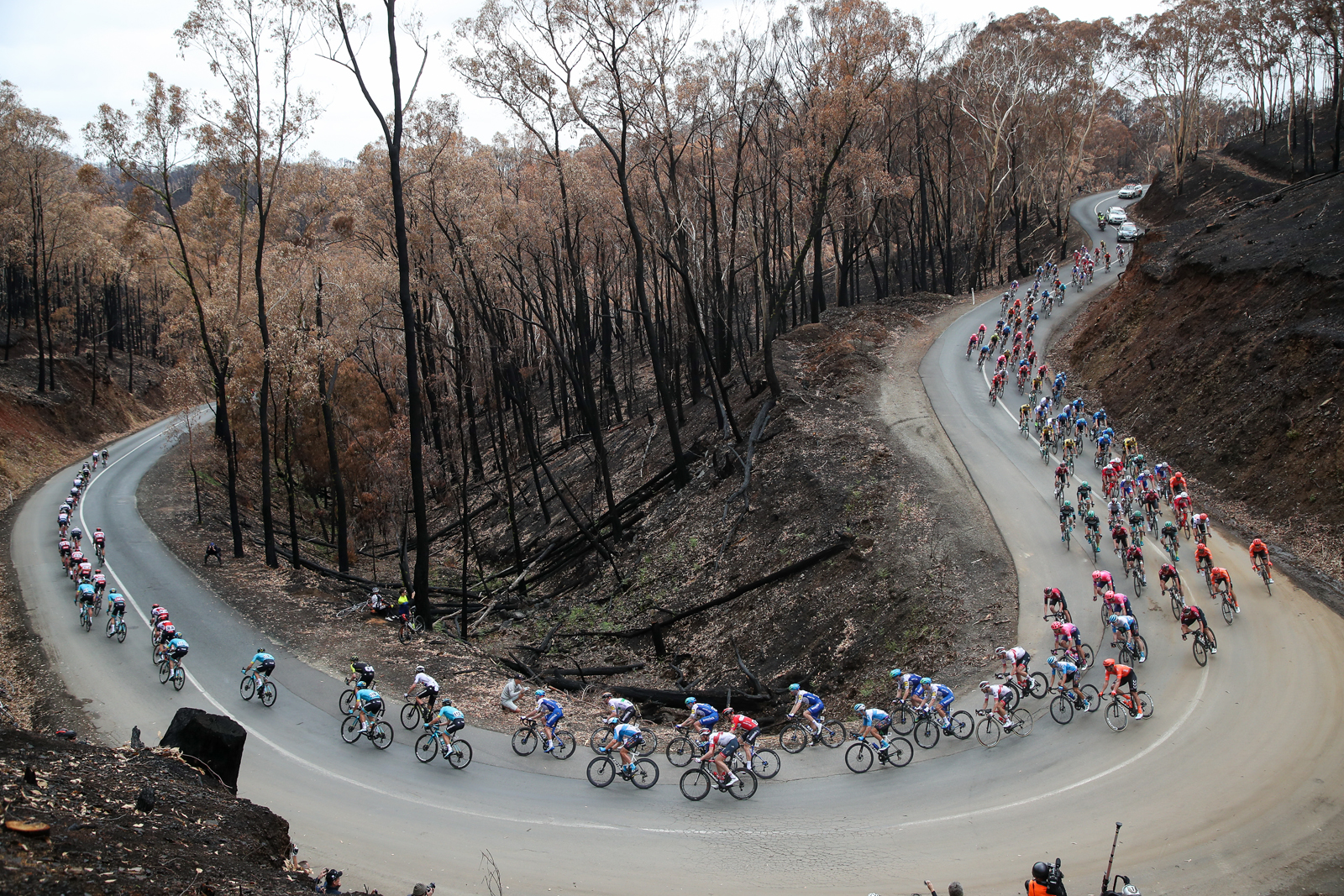
The issues aren’t limited to Europe, and Australia’s premier cycling races have faced their own climate battles in recent years.
Their January date means they open the UCI WorldTour and Women’s WorldTour, but they also fall in the height of the Australian summer – their timing arguably having a direct impact on recent editions. In 2019, the first two days of the men’s race were cut short due to strong winds and extreme heat, while the 2020 men’s race passed through areas recently devastated by wildfires – highlighting cycling’s susceptibility to risks caused by natural disasters.
(Update: In January 2026, stage four of the Tour Down Under was shortened and modified due to fire danger and temperatures forecast to hit 43°C. In June, Elisa Borghini lost 10 minutes on the final stage of the Tour de Suisse after suffering from heat stroke. Following the incident, XDS Astana’s Dr Emilio Magni said, "There are protocols for extreme weather, but in some places extreme conditions are becoming normal". A scientific study has also suggested the Tour de France faces an increased risk of extreme heat.)
“What makes cycling particularly exposed compared to other sports is the amount of space that you need,” explains Ross. “It's not like you're on one pitch playing football in one location – you're covering miles and miles of territory where lots of things can go wrong.”
A Tour Down Under spokesperson said event management works closely with external agencies to prepare for the risk posed by natural disasters and extreme weather events.
The race has also become a heated battleground for climate crisis-related protests in recent years, with Extinction Rebellion organising opposition to the race’s sponsorship by the Australian oil and gas company Santos.
“Extinction Rebellion is focused on the fossil fuel industry,” says Extinction Rebellion South Australia’s Cathy Cox. “We think the race is a good event. It's not particularly environmentally friendly. People say it's about bicycles, and bicycles are good, but really, it's an event that's a bit like motor racing – there's all the champagne spewing and there's a lot of cars involved. But we respect the sport of it, and we think it's a terrific thing to showcase bicycles.”
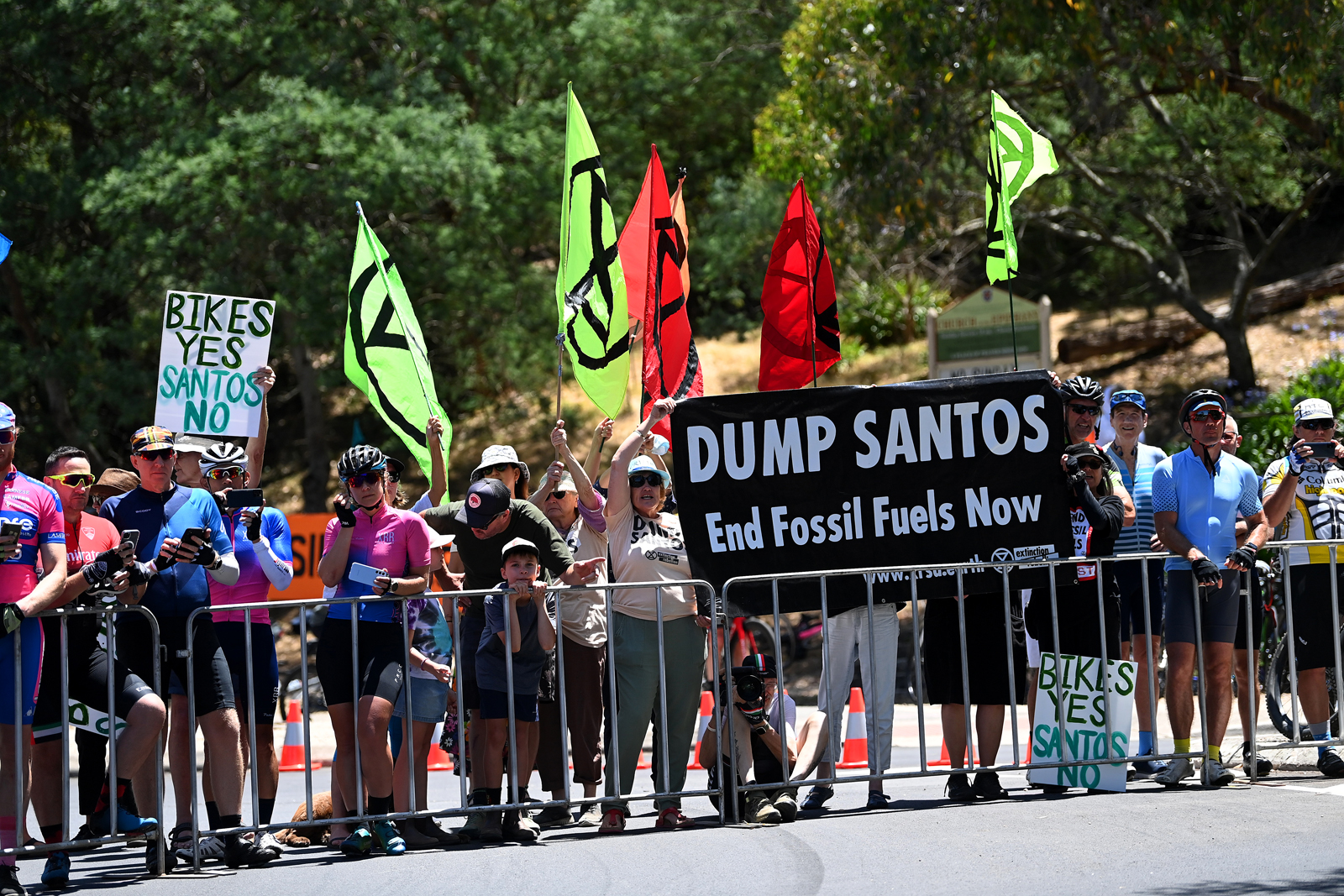
Protests to date have included a group of women bearing their breasts at the side of the road while wearing clothing bearing the words “Santos sux” and activists setting up a roadblock outside Santos’ Adelaide headquarters by glueing themselves to the floor and a pile of old bikes.
“Every year, we bombard the state tourist organisation with all sorts of polite and impolite letters,” says Cox. “We haven't been able to secure a meeting with them. The environment minister is very silent on these matters and says it's a matter for tourism. Tourism isn't interested. We just can't make any headway.”
Success for Extinction Rebellion would see Santos dropping its sponsorship. While she can’t imagine that happening any time soon, Cox says there have been some green shoots, including the Adelaide suburb of Mitcham preventing Santos from parking a caravan covered in its logos on a section of the course. “One of the councillors pointed out ‘We passed a resolution quite recently that said there should be no fossil fuel advertising in our council area, and this is fossil fuel advertising'," says Cox.
In response, the Tour Down Under press officer said it was “proud” to partner with Santos, and that without its support “it would be impossible to put on successful world-class events”, adding that its sponsorship has helped with the expansion of the women’s race and its domestic television broadcast.
Adapting to an uncertain future

The Tour Down Under spokesperson also said there were no plans to move the race from its January date in the height of the Australian summer, but that decision might be taken out of race organisers’ hands.
Aside from updates to the extreme weather protocol, the UCI also announced in its 2023 Sustainability Report that it will develop and implement a climate change adaptation strategy for the sport of cycling from 2025. Part of this includes reviewing and communicating the latest scientific analysis to assess the UCI event calendar for climate risk, which would involve a bi-annual review of expected future climate impacts on events by location.
For Martin-Guyonne, change can't come soon enough.
“We have to adapt, especially the calendar," he says. "Think about the Tour de France in another month than July – there shouldn't be any taboo and we should consider all options. The calendar should be more logical. When you race Portugal, you should do another one in the south of Spain just after to avoid long travel for the buses – [currently], the bus is at the race in Portugal and the week after in Belgium and the week after in the south of Italy. It's a big problem, but it’s improving.”
Even if there isn’t a big shake-up in the road race schedule to host races in more manageable conditions, Ross concludes that riders, fans, organisers and broadcasters might have to become more flexible.
“In some ways, sport has always had this attitude that when it's a little hot, that's the point – you have to find out who's more tough and who can deal with these variables. But I think it's also okay to ask the question ‘At what point is this extreme and a little bit dangerous, and you are no longer just being tough, you're actually being silly?’”
He suggests that schedule flexibility to accommodate better conditions – delaying by hours or even days – is an obvious solution already being used by other sports.
“Snow skiing, for example, has to pivot at a moment's notice – they always give a date for their World Championships, but the reality is that it's around that date because you don't know what the conditions will be on the mountain that day.”
This sort of flexibility and level-headed approach to dealing with the worst impacts of the climate crisis would be music to Martin-Guyonne's ears.
But with a power struggle between riders, teams and organisers to decide whether a race goes ahead or not, expect vested interests and treating the climate crisis as just another variable to win out for the foreseeable future.