Britain is renowned for its manufacturing heritage. Birthplace of the Industrial Revolution, it was known as the ‘workshop of the world’ during the 19th century and Brits have been responsible for numerous era-defining inventions, from the steam engine to the World Wide Web.
Its place in cycling’s history is no different. Scottish blacksmith Kirkpatrick Macmillan is credited with inventing the bicycle in 1839. Britain’s most iconic manufacturer, Raleigh, was founded in Nottingham in 1888 and, almost a century later, Joop Zoetemelk piloted a bike made in the Midlands to the 1980 Tour de France yellow jersey.
Today, British brands such as Factor can still be found in the Women’s World Tour and men’s Pro Road Tour, while companies including Ribble, Condor Cycles and Fairlight fly the flag at home and abroad.
But none of these are manufactured in Britain. Raleigh last produced a frame in the UK in 1999, while many modern brands design and assemble bikes in Britain, with the manufacturing taking place thousands of miles away in Europe or Asia.
There are a few exceptions. Pashley and Brompton bikes are still hand-built in Britain at their Stratford-upon-Avon and London factories respectively, while there are numerous smaller, bespoke manufacturers who will happily construct a custom ride for you out of steel, aluminium or titanium.
When it comes to performance-focused carbon fibre frame production, though, there are only a handful.
Meet the makers

The most established of Britain’s high-performance manufacturers is Hope Technology. Born out of a Lancashire-based engineering company that was machining parts for the aerospace industry in the late 1980s, Hope’s founders started a small sideline in bike components and became iconic for introducing disc brakes to mountain bikes in 1991.
Hope started focusing solely on bike parts from 2000 and has built a reputation for high-quality steel and aluminium components since, but it began experimenting with carbon fibre “roughly 10 years ago”, says head of sales and marketing Alan Weatherall.
“Carbon became more prominent in the bike industry, [so] it was a case that we needed to do something in carbon to keep up with the times,” he explains.
Its first component was a seatpost, but within less than a decade, the company was manufacturing a four-time Olympic gold-medal winning track bike in collaboration with British Cycling: the Hope HB.T.
“When you're making closed moulds with a sheet of aluminium, manufacturing the mould is quite complex,” says Weatherall. “That's the easiest part for us because that's what we do, so it didn't hold us back at all. We've learned the other processes as we’ve gone along and got more and more efficient at them.”
Quality control

Weatherall says Hope’s focus on keeping things in-house at its Barnoldswick factory helps guarantee each bike and component's build quality – a key driving force for the privately owned company.
“If you subcontract things, you have to put so many things in place to be able to check your suppliers to make sure they're correct, whereas if you do it yourself, you're not having to double check things; it's all done once,” says Weatherall. He adds that involving fewer third parties, who want to make a margin, also keeps the final costs lower.
Hope’s confidence in its build quality is exemplified by its warranty department, where one person is employed to deal with returns and issues.
“We pride ourselves on the fact that everyone involved knows what's going on – we're not some big corporate thing with hundreds of departments that are all disconnected,” says Weatherall.

Although on a smaller scale, it’s a similar inspiration for Atherton Bikes’ decision to manufacture locally in Machynlleth, Wales. The company was founded by downhill mountain biking’s most famous siblings, Gee, Rachel and Dan Atherton, who have eight world titles and 48 World Cup wins between them. The trio wanted to create a platform that tapped into the boundary-pushing approach to the sport that had seen them dominate on the world stage.
“There was a lot of material defects in the industry, and it was something we were mindful of having pushed the product so hard on the race circuit, and also how many consumers were echoing those kind of concerns – that was something we didn't want to even entertain,” says Dan Brown, Atherton Bikes’ CEO and co-founder. “Holding on to our own quality control and processes was essential.”
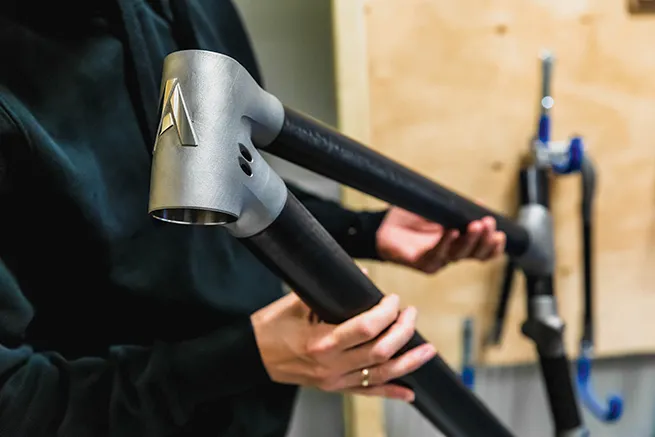
The company launched a novel approach to bike design in 2019, tapping into a technique pioneered in aerospace and Formula One. When applied to a bike, carbon fibre tubing is bonded to 3D-printed titanium lugs, creating a strong and durable build with almost-infinite modifications in size and fit without the need for bespoke molds for each build.

Today, Atherton has two build approaches across its downhill, enduro and electric mountain bike platforms – the S (subtractive) and A (additive) ranges. The A is its more premium offering, with titanium lugs printed and bonded to British-made carbon tubes in-house.
While certain aspects of its construction, such as the lugs’ heat treatment and machining, are done off-site, it’s all conducted at local third-party specialists, and a bike takes between 10 and 14 weeks from start to finish.
Its more cost-effective aluminium S-range is still bonded in-house, but the lugs and links are CNC’d for Atherton by engineering companies in the UK, Germany and Asia, shaving the manufacturing process in Machynlleth to two days.
“The main reason for manufacturing locally was to keep control of quality,” adds Brown. “We're pushing hard to have a near-zero return issues rate. One of our biggest drivers is to make durable, reliable products, and quality control is key in all of that.”
Keeping down costs

Quality control aside, manufacturing in Britain can also be significantly more cost-effective for brands.
While anyone looking at a British-manufactured bike might disagree – prices tend to gravitate towards the more premium end – commissioning a factory in Asia to construct a batch of carbon fibre frames requires an eye-watering up-front investment.
For Reap Bikes, it would have been prohibitively expensive. Initially, the passion project of founder Martin Meir, an engineer and triathlete, the Stoke-on-Trent-based brand was started in 2014 as a way of combining his experience and expertise to create the world’s fastest triathlon bike.
“Dad was keen to do something for himself and take control of his own destiny,” says Reap Bikes' design lead, Ben Meir. “But it also really irked him that the best cycling team in the world [at the time], a British team – Team Sky – was winning the biggest races in the world with British riders on Italian bikes.”
He says producing in Asia “comes with a significant cost”, whereas when his dad was starting out, “[he] had a factory at the time that he thought had all the gear that was required to do it, so he said, ‘it's going to cost me significantly less to at least try here’.”

While Ben admits a lot of the early iterations could be considered failures at the time, they were all part of a process that is coming to fruition now with its Type 300 gravel bike and new road platform, Code, which he believes will transition the brand from being an R&D project to a commercially viable product.
Manufacturing in-house has enabled Reap to grow organically without the demands of having to hit unrealistic sales targets. Everything is made to order in four-to-six weeks and it has goals to double sales from 60 to 100 bikes in 2026.
“In speaking to people, I think they'd be a little bit underwhelmed if it just sort of arrived. It's not just one that's been plucked off a shelf because they happened to click on the website at the right time. It's a bit more special that way.”
This made-to-order, zero-stock approach is shared by Hope and Atherton Bikes, and has another added benefit: minimal storage requirements.
When producing something such as the £25,000 HB.T, it means Hope has only had to construct the 150 or so bikes it had orders for, with none sitting unsold in a warehouse.
Faster processes
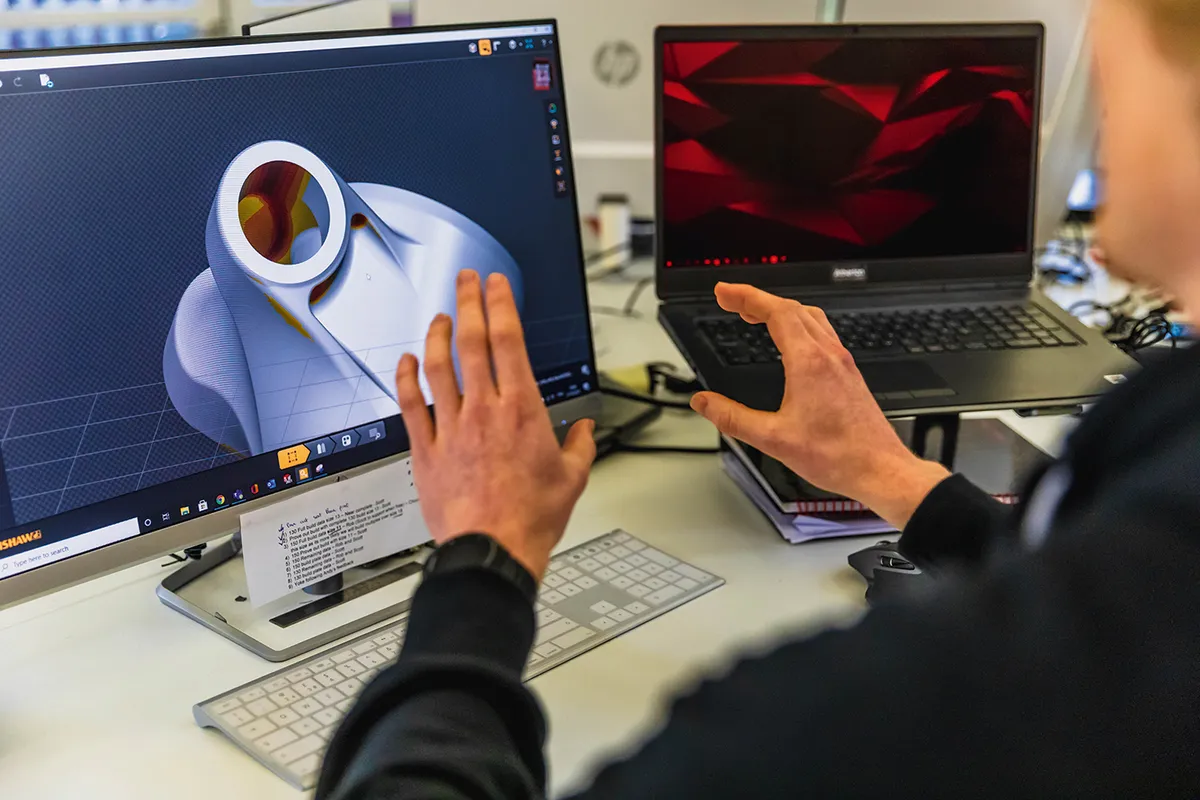
This method of demand-led, in-house production has another plus point when it comes to the development side of products.
“Because we are the factory, manufacturer, the research and development, it becomes a lot quicker and easier to go from, ‘I've got this idea’ to ‘let's make a bike out of it’,” says Meir.
Time is saved by removing communication and feedback rounds between the brand and the factory at all stages of development. These companies that make in Britain don’t have to wait in line behind other companies that a factory might be manufacturing for, or get charged exorbitantly for doing small-batch, experimental R&D projects.
This also enables brands to be more reactive and nimble – either by meeting a new industry demand or trend, or changing tack on a design to prevent it being out of date before it’s even released.
“At the beginning of 2024, Dylan Johnson started posting videos about using mountain bike tyres on his gravel bikes, and within three months, the industry has gone ‘Everybody needs 50mm tyre clearance on a bike,” says Meir. “Later that year, Trek came out with a bike that had 48mm tyre clearance, and people started slating a bike that had been in development for two years. Speed is of the essence in this industry.”
For Atherton, which is 1.5 miles from the Dyfi Bike Park’s enduro and downhill trails, it means the feedback loop is near-instant. “If you've got a prototype or any product, someone rides it, the feedback comes in straight to the designers and we can make changes quite quickly,” says Brown.
“A good example is our approach to the ebike. We didn't make the motor choice until the very last minute and even now, we can potentially jump on to the next biggest, greatest thing. That technology is moving so fast that you need to be able to move quickly.”
Barriers to entry

This all makes manufacturing in Britain sound like a great choice, so why isn’t everyone doing it? The biggest barrier is cost, and the impact this has on the end product.
“Our manufacturing costs are significantly higher than even Pinarello,” says Meir. “I think they pay something like $450 for a landed frame. It costs us nearly five times that to manufacture a frame.”
He points to the UK’s national living wage as a reality that British-made brands have to face compared to those in Asia, where wages are significantly lower. Weatherall adds that there are also greater overheads, and health and safety considerations, which “massively” increase the costs. But he adds that by producing in-house, there are fewer margins for different suppliers, which keeps Hope competitive.
Reap, Hope and Atherton’s bikes are all at the high end of the market, but they aren’t significantly more expensive than other brands, such as Giant, Specialized and Trek’s top-tier models, which are all made in Asia.
The other disadvantage that brands face is the lack of bike-specific carbon-composite expertise in Britain.
“We've been going for a long time, and it’s only the past year that we've really got our feet underneath us to actually be able to do this properly,” says Meir. “The Asian factories have been making bikes since the 90s – they're 30 years ahead.”
Hope sped up this process by employing a carbon composites expert, who did the original UK Sport EIS track bikes used by Team GB at the London 2012 Olympics for a sub-contractor. They have since disseminated his expertise and experience by training other operatives in-house.
Weatherall doesn’t see this approach as a disadvantage, either. “We look at things differently sometimes [compared to] if you've been in the industry doing it a certain way. If you step back and go, ‘If you start from scratch, how would you do it?’ We might do it a different way to what the industry would do because we've got different capacity and capabilities.”
A British seal of approval

Britain’s heyday as a bike-producing powerhouse is unlikely to return and today’s performance-focused manufacturers will never be able to compete at the lower end of the market with brands that have shipped production to countries such as Taiwan.
But at the premium end of the market that Atherton, Hope and Reap occupy, their made-in-Britain stamp and focus on quality help them stand out from the competition.
“At that budget end of the market, there's going to be brands that currently compete on price that are going to be really struggling against Chinese factory-owned self brands,” says Brown. “I'm glad that we're not trying to compete in that area, but I'm hoping that people see the value in what we bring and what we do, and will spend a touch more to get a product that will last them a lot longer.”