The first job most people learn on a bike is how to fix a puncture or change a tyre, and the most important tool in this process is the humble tyre lever.
I’ve changed hundreds of tyres on everything from downhill bikes to TT bikes, using many different tyre levers.
Although a tyre lever is a simple tool with no moving parts, there is more to tyre levers than first meets the eye.
Big or small, stiff or flexible, many come with gadgets galore, designed to make changing tyres as easy as possible – the variety of options is impressive.
So, which should you choose?
Here's the lowdown on why there are so many different designs and materials available.
- Read more: Best tyre levers in 2026
What is the best shape of tyre lever?

Shape is critical when it comes to tyre-lever performance, and it’s therefore surprising that the shape of tyre levers varies wildly between models.
From small, stubby tyre levers with aggressively angled hooks, such as Lezyne’s aluminium levers, all the way to wedge-shaped levers without much of a hook, there are many profiles and widths available.
Spoon-shaped tyre levers (those that are wider at the base and have a thinner shaft) can be useful for getting under the edge of the bead, but aren't as comfortable on the fingers.

Longer tyre levers give more leverage, but for most people with healthy wrists and fingers, the average tyre-lever length of around four inches is usually ample.
Decathlon’s tyre levers have two distinct ends – one for fitting and one for removal.
Tru-Tension’s Tyre Monkey has a hooked end shape to secure it to the bead for extra security. This works well when using a hook-and-slide method, capturing the tyre lever on the edge of the rim and chasing the tyre around.
Flexible vs stiff tyre lever: which is best for you?
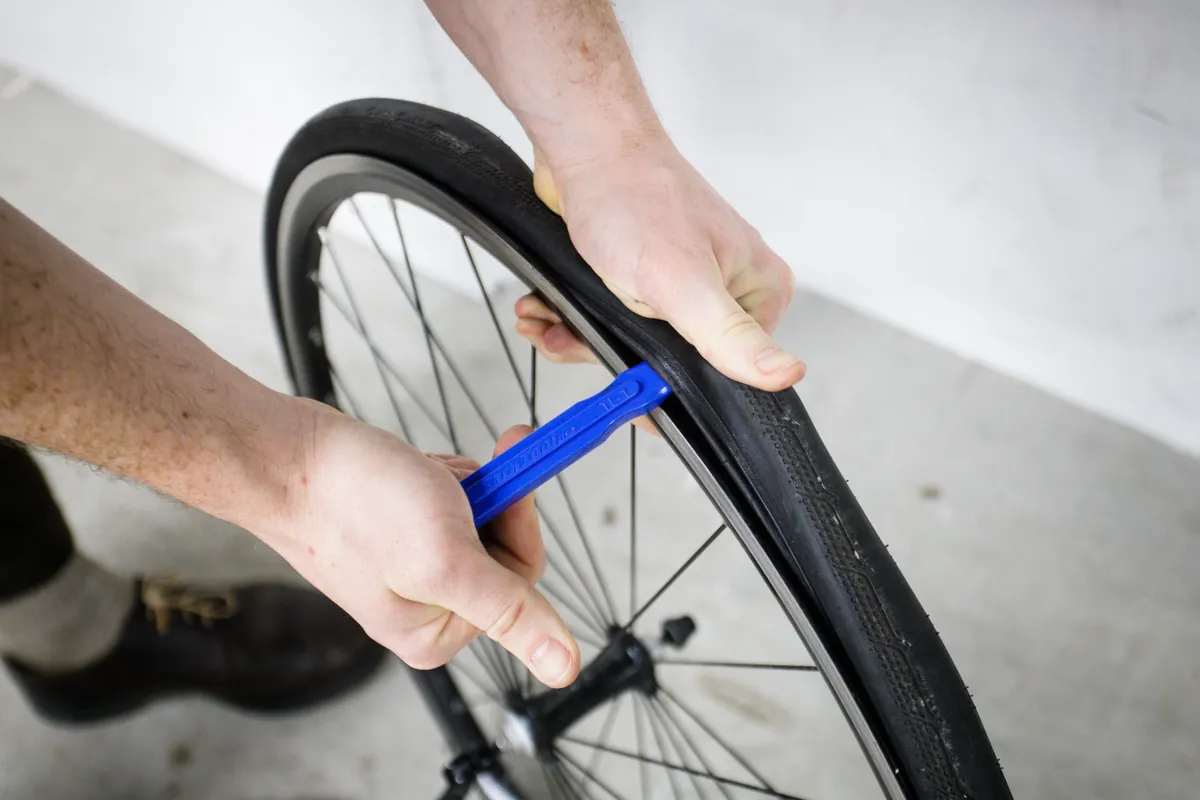
Tyre levers range from ultra-stiff plastic, or even metal, to ultra-flexible plastic designs.
Flexible tyre levers have more feedback, a bit like modulation through a brake lever. This enables you to feel what’s going on. Go too stiff, and they feel unforgiving and harsh; too flexible, and they can bend without applying much force to the tyre.
Metal tyre levers are widely regarded as unnecessary for bicycle tyres, and more suitable for heavy-duty automotive applications, such as off-road motorcycles.

Some plastic levers are moulded with a metal core. These offer most of the strength and stiffness of a metal tyre lever without the drawback of metal tyre levers, which risk scratching your rims.
PVC and plastic composite tyre levers seem ideal for the level of compliance in a bicycle tyre bead.
Crankbrothers released the Speedier tyre lever, which included some knuckle protection. This was a great idea, but the plastic chosen was very flexible.
My preference is for a stiff-plastic or composite lever, offering more flex (and therefore feel) than a metal or metal-core lever, but enough stiffness for even the most stubborn bicycle tyres.
Which extra features do you need?

One of the most common bonus features to be included in a tyre lever is an indent or hook designed for gripping onto a spoke.
The theory is this will hold the bead in place where you’ve begun to slip it over the rim, so you can get a second lever in play. In practice, I usually find it stretches the bead so tightly that it makes it harder to get the next lever in and the tyre off, so it isn’t something I’d look for in a tyre lever.
Other tyre levers bring more advanced gadgetry.
The Smart Lever is one of the cleverest and most high-tech tyre levers I’ve used – and it works.
A hinged plastic slider and a roller create a low-friction lip to follow the bead and roll it over the edge of the rim. However, it takes a bit of getting used to if you’ve never used one before.
The Smart Lever comes at a relatively high price, but offers a real mechanical advantage over traditional designs. If you struggle to use regular tyre levers, or just want to take some of the effort out of fitting and removing tyres, it's a great choice.

The ProForm Tyre Tool is another feature-filled tyre lever. It’s sizable compared to the average tyre lever and includes a rim hook with a wedge shape designed to slide the tyre over the edge of the rim by running the lever around the rim under the tyre.
I haven’t found much need for the clip, but the size and shape of this lever could make it a good choice for use on tight tyres.
Crankbrothers’ latest contribution is called the Slider, with the pair of levers including a handy rim clip to prevent you chasing a tyre bead around a rim as you try to get the final third in place.
Are singles, pairs or trios best?

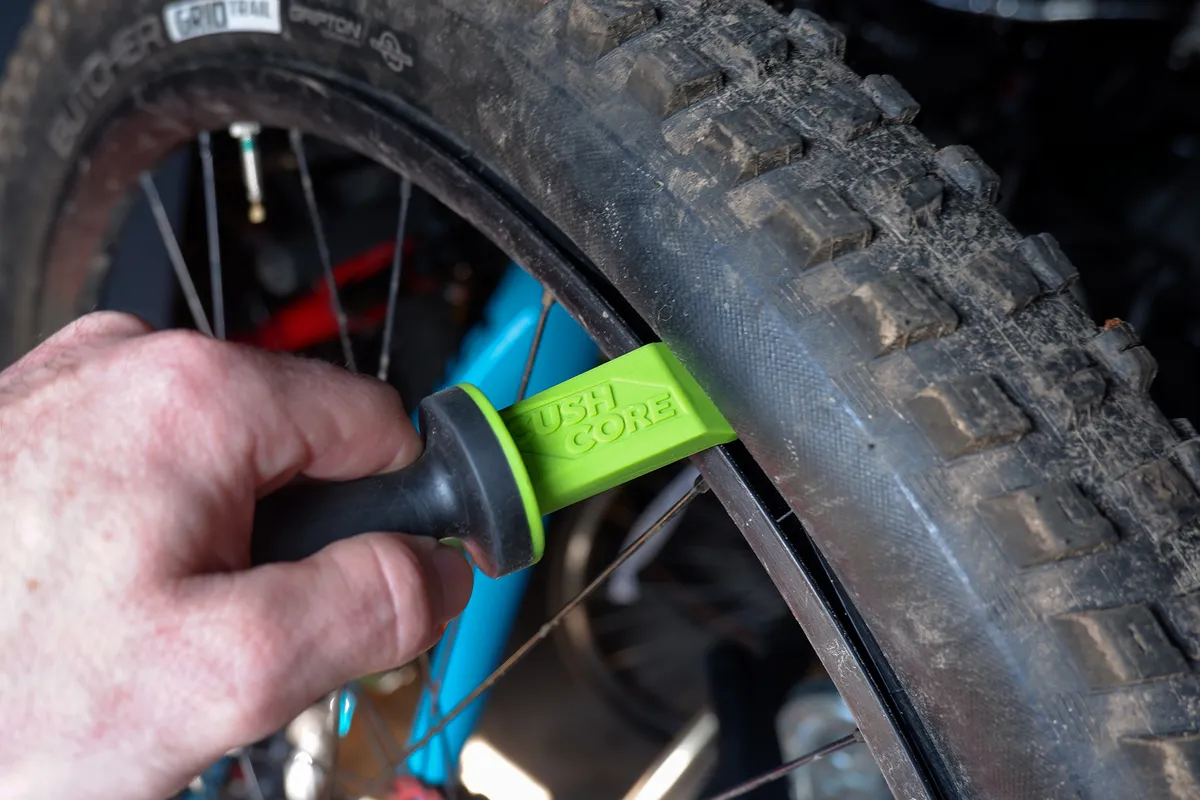
Some tyre levers, such as the ergonomically handled CushCore Bead Dropper, come as singles. The aim is to use one lever to get the tyre bead over the edge of the rim and then use your hands. These have a large, grippy handle and a stiff body, and are good for working with inserts or tight tyres.
Other tyre levers, such as Muc-Off’s Rim Stix, are supplied as a pair. This is to enable you to put two levers underneath the bead together, levering them both up, and then sliding one along to slip the bead over the edge of the rim as it moves.
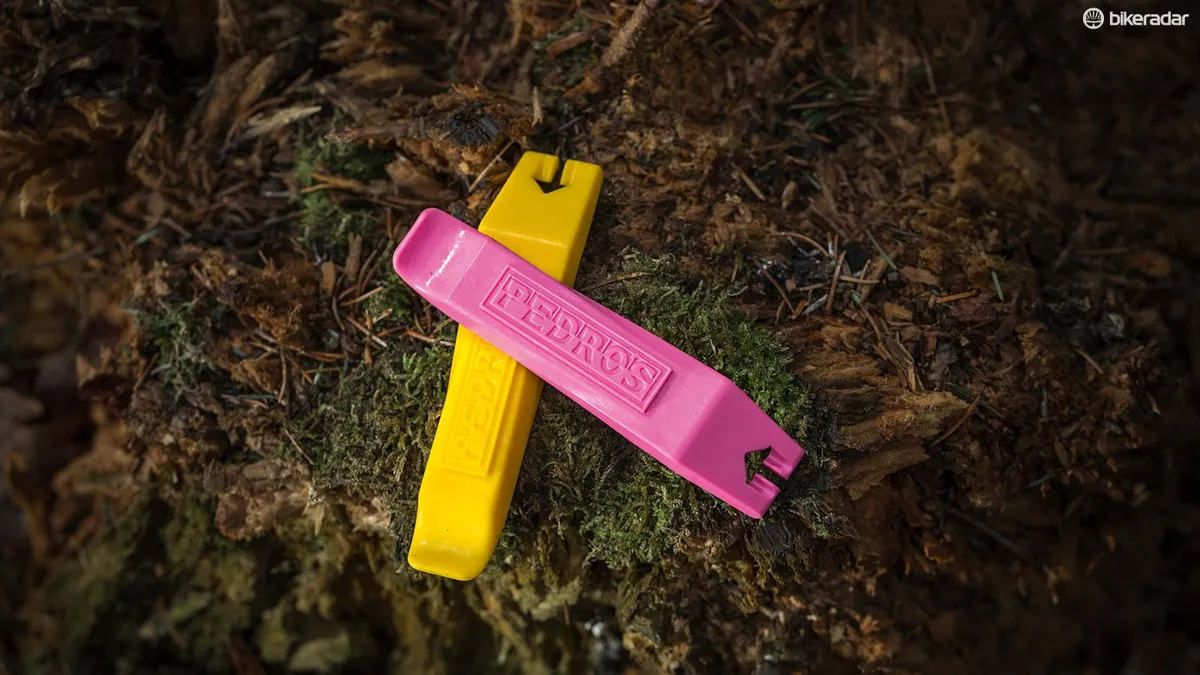
These levers have a similar shape to Pedro’s tyre levers and are made of stiff plastic. Park Tool’s TL-4.2 tyre levers have a similar shape to the Pedro’s design, and snap together for storage in a similar way. They’re popular all-rounders, with a generous width and a good radius on the end.
Park Tool’s TL1.2 levers come as a trio. The logic is that two tyre levers can be used to lever the bead over the edge of the rim, and when removing the tyre, two of the levers can be locked onto spokes. The TL1.2s are good for a trail pack, but aren’t the most stable to use because they are quite tall and thin.
A third lever can then be employed to lift the next section of bead, and the middle tyre lever of the three can be removed and used to lever the next section of bead. This swapping can be repeated until the tyre is removed.
If you like the feeling of locking your tyre lever to your spokes and working your way round the rim, these could be good for you.

There is no right or wrong approach here, just different preferences for different mechanics.
My preference is for no tyre levers, using thumb strength alone to get the tyre over the rim. If the rim is really tight, I like the one-lever method to get the bead over the rim, aiming to then chase it around with my fingers, or with the one lever until the bead is off completely.