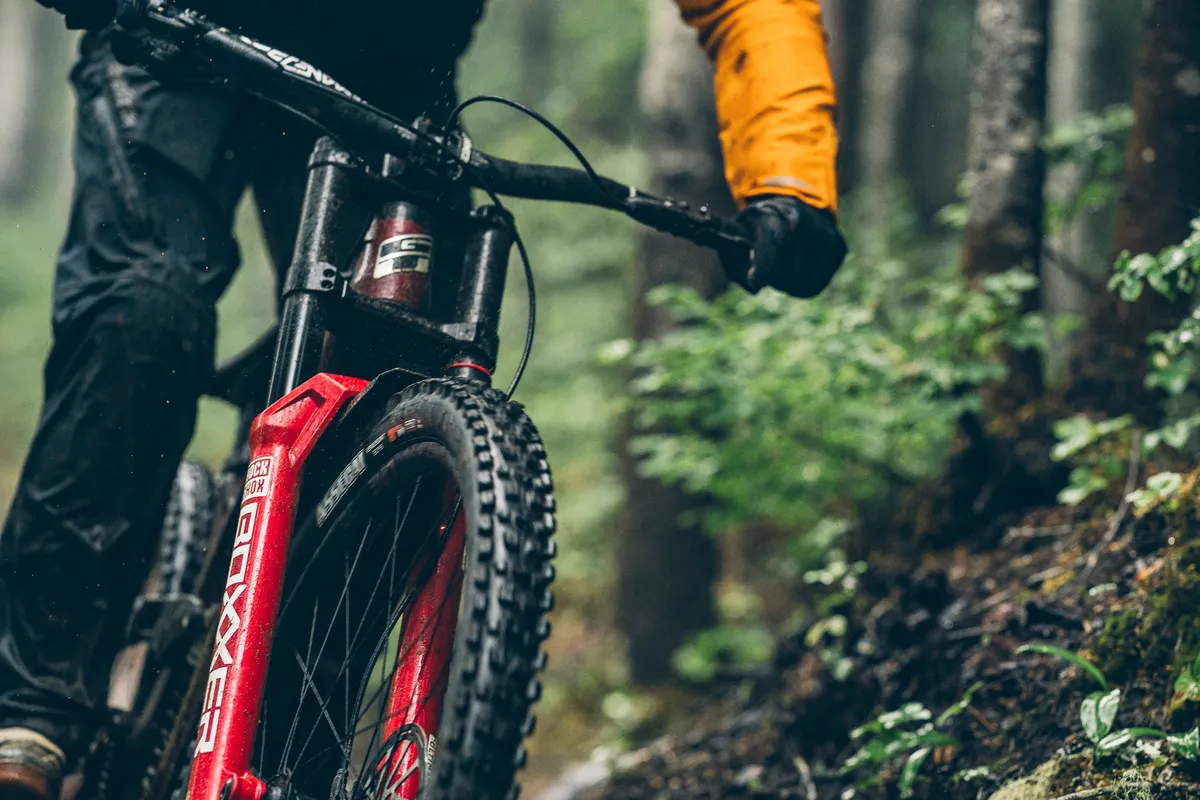
As I rolled into the steep, off-camber trail, littered with roots and rocks, I could clearly see the line I needed to hold. Just a few inches off and I’d be into the trees and cartwheeling down the side of a Welsh mountain.
Letting off the brakes, I managed to slide the bike into position and committed.
And then the revelation. As the speed picked up, I couldn’t quite comprehend how well my front wheel was tracking the ground. There was grip and control like I’d never felt. I could hold the line and ride it faster than ever before.
As my front wheel fluttered over the chunky root spread, I knew the fork I’d invested in was well worth the money.
This was back in 1999. I’d worked for hours on end in a supermarket, saving up to buy the latest RockShox Boxxer 151 and it was already changing how I was riding my bike.
Now, 27 years on, RockShox has unveiled the latest, updated Boxxer. It's better than ever, dripping in cool tech and I was at the launch in New Zealand to see whether it could match the revelatory experience I had with the original fork.
A brief history lesson

RockShox unveiled the first Boxxer downhill fork way back in 1996. Back then, it was a prototype and only a handful of top racers had access to the tech. It had 32mm stanchions, 150mm of travel and posts for rim-brake calipers.
Then, in 1998, RockShox released the Boxxer to the masses, who could make the most of the open bath damping and mounts for disc brakes, which were slowly gathering momentum.
In the early 2000s, coil springs were replaced with a single-sided air spring and the first Motion Control damper.
Slowly, travel figures crept up to 200mm, different stanchion treatments were applied to reduce friction and damping adjustment, and tunability started to increase.

As I’m sure you can remember, it wasn’t all about damper development. Once into the 2010s, the mountain bike industry decided to up wheel size from 26in to 27.5in, then 29in hoops. As a result, the Boxxer had to change, too.
Before long, the stanchions were beefed up to 38mm and the Boxxer housed the latest DebonAir+ air spring and Charger 3 RC2 damper.

When it comes to success, the Boxxer must be one of, if not the most successful mountain bike forks of all time. It helped the likes of Steve Peat, Nico Vouilloz, Rachel Atherton, Sabrina Jonnier and Sam Hill (to name a few) win multiple World Cup races, overalls and World Championships between them.
The revelation

I was one of the early customers. Although I’d missed out on the early 1998 fork, I managed to secure the 1999 151.
This replaced the RST Hi-5 I’d been running up until that point. The lack of control it offered, along with the elastomers that drastically altered in performance depending on the temperature, meant it was rubbish.
While I knew it couldn't turn me into Steve Peat or Nico Vouilloz overnight, the 151 felt incredible. On my first ride on a Welsh mountainside, I couldn’t believe how well it kept my front wheel tracking the ground.
Root spreads were swallowed, I was finding grip where I never knew it existed and my confidence was sky high as a result. Swapping to this new fork transformed my bike and how I could ride it.
Spring in its step

That was close to 30 years ago, though, and a lot has changed. The 2027 fork I’m just back from riding in New Zealand's Queenstown Bike Park is a far cry from the coil-sprung, skinny-legged Boxxer I started out on.
Let’s start with the new, position-sensitive LinearXL air spring (stiffness varies depending on how far the fork is compressed) and the sticky-out bit at the bottom of the lowers, dubbed the AirAnnex.
The LinearXL AirAnnex creates additional volume on the spring side of the lower legs (which looks a lot like a brake reservoir). This helps produce a more linear spring curve, reducing harsh ramp-up that can result from the air inside the lower legs compressing.
Because there’s less volume on the air-spring side (due to the difference in air-spring cartridge versus damper design), the lowers only needed the extra space on one side to achieve this.
A more linear, less progressive spring curve helps produce more comfort and control deeper in the stroke.
To achieve this, RockShox moved to a twin-tube design, with the resulting changes (decrease in piston diameter, etc) requiring higher spring pressures as a result.
On top of this lot, breather holes placed strategically on the upper tubes (stanchions) further reduce pressure build by balancing pressures in the lower legs as the fork moves through its travel, boosting the overall effect and, according to RockShox, improving sensitivity and reducing any kind of harshness.
RockShox says it has created a very predictable, supportive and controlled new air spring that’s extremely supple.
Slick and slippery

Some of that suppleness and sensitivity can be attributed to divots dotted around the stanchions.
These dimples are found below the wiper seals. As the fork cycles through its travel, lower-leg lubrication oil can get trapped in these shallow pits before being transported to the bushings (and foam rings), ensuring things stay as slippery and friction-free as possible. This, in turn, helps create a consistent and very predictable feel, as well as upping the service interval to 50 hours.
Inverted forks don’t struggle with this issue because gravity helps keep the oil where it needs to be for maximum lubrication, so the RockShox ‘ButterWagonTech’, as the team refer to these divots, could be a real step forward for improved sensitivity over a longer period of time.
To help further, RockShox has switched to a new Maxima 15wt lower-leg oil and helped develop new SG920 grease, in a bid to rid the Boxxer of as much friction as possible.
It also worked with SKF to develop new wiper seals, which are said to 'grab' less on the stanchions as the fork switches between compression and rebound.
Damping duties

With less friction in the fork, RockShox had to reconfigure the Charger 3.2 damper, adding more damping force to help compensate for the lack of stiction.
The updated speed-sensitive damper (which regulates oil flow and damping force depending on the shaft speed) is designed to be incredibly easy to set up – a trait many appreciate with RockShox suspension units.
Adjustments include rebound damping, along with low- and high-speed compression, which are claimed to be fully independent of one another.
The updated rebound and compression tunes are said to still feel similar at the extreme ends (fully open or fully closed), with each click in between offering a tangible difference in feel.
On top of that, you’ll still find ButterCups at the end of the spring and damping shafts. These little golden assemblies are designed to help eliminate high-frequency vibrations and reduce rider fatigue.
Vivid imagination

It’s not all about the fork, though, with RockShox also unveiling the new Vivid Coil rear shock.
According to the brand, it has tidied up the oil paths in the reservoir, reducing the IFP pressure as a result (which lowers the breakaway force and ups sensitivity), reduced friction and updated the damper extensively, claiming to have made the low- and high-speed compression adjusters more usable, without any harshness when you need to wind them on.
As with the Boxxer, it has also numbered the adjuster dials to help riders keep tabs on their settings more easily.
Bringing back memories

So, did riding the new Boxxer conjure up the same feeling I had back in 1999 when I first tried the fork?
I spent three days lapping Coronet Peak and the Queenstown Bike Park to get a feel for for the new Boxxer.
While I don’t think my experience of the new fork could be as transformative as my first time on a Boxxer – remember, I’d switched from a fork with elastomers and springs over to the coil-sprung Boxxer 151, which was a massive leap – I was still extremely impressed.
It's sensitive and smooth, but my biggest takeaway was how well it could handle big impacts late in its travel.
Riding the rough, fast trails of Queenstown Bike Park, I couldn’t believe what I could get away with when stoving the new Boxxer into the ugliest, steepest sections of track.
There were times when I felt as if my arms were going to crumple and leave my chest slammed on the bar, yet the fork soaked up the hardest hits, supporting my weight without feeling harsh and recovering in an instant, to keep my front wheel tracking the trail.

This was seriously impressive stuff.
The adjustments were noticeable and dialling it in didn’t take long, as promised.
Because my time with the new fork was limited to only a few days, I’ll leave a full review until I’ve spent more time on it, so stay tuned.
Range overview
The forks and shocks below are available for aftermarket purchase. RockShox will also have various Select+ and base models on complete bikes, so keep an eye on bike brand websites for specs.
Boxxer Ultimate

- Damper: Charger 3.2 RC2 with ButterCups
- Spring: DebonAir+ Linear XL with ButterCups
- Travel: 180, 190 and 200mm
- Wheel size: 27.5in or 29in
- Offset: 44mm (27.5in), 48mm (27.5in), 48mm (29in), 52mm (29in)
- Price: £1,945 / $1,999 / €2,180
Boxxer Select

- Damper: Charger 3.2 RC
- Spring: DebonAir+ LinearXL
- Travel: 180, 190 and 200mm
- Wheel size: 27.5in or 29in
- Offset: 44mm (27.5in), 48mm (27.5in), 48mm (29in), 52mm (29in)
- Price: £1,460 / $1,499 / €1,635
Vivid Coil Ultimate

- Damper: RC2T with ABO (adjustable bottom out)
- Price: £690 / $709 / €775
Vivid Coil Ultimate DH

- Damper: RC2 with ABO
- Price: £700 / $719 / €785