Throughout the build-up to Paris-Roubaix 2026, we’ll be answering common, quirky and unexpected questions about the Queen of the Classics – not the headline debates such as who’ll conquer the cobbles this year, but the juicy nuggets and details that make this incredible race unlike any other.
This time, we cast our minds back to the last time Paris-Roubaix was won on alloy wheels.
The last edition of Paris-Roubaix won using alloy wheels was in 2009, when Quick-Step's Belgian star Tom Boonen rode solo to the third of his four wins (Filippo Pozzato, also in the shot above, was a lap of the velodrome behind him).
Boonen was still on alloy rims in 2010, when Fabian Cancellara won, the first victory on aero carbon wheels, which have dominated the race since.
For many years, the go-to rim for Paris-Roubaix was the alloy box-section Ambrosio Nemesis, with riders abandoning their wheel sponsors for wheels built up with the rims, complete with spokes that were wired and soldered together where they crossed.
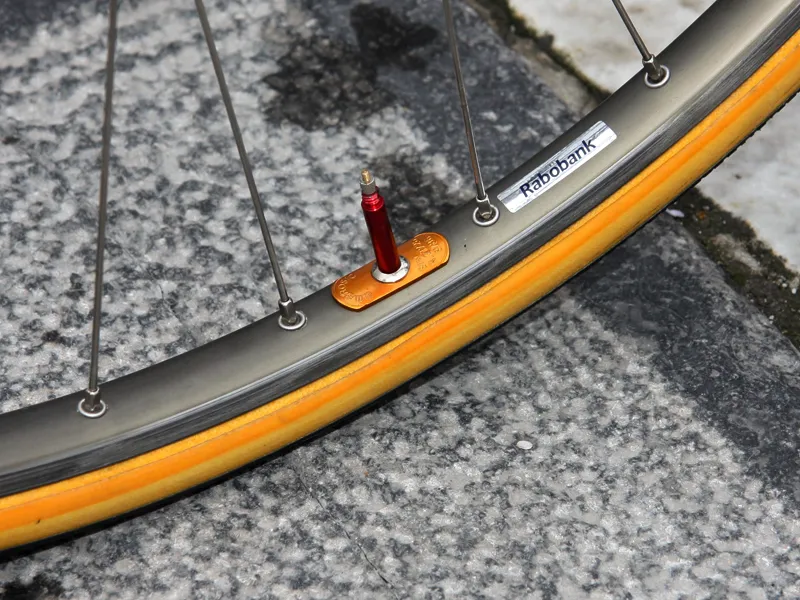
The Italian-made Nemesis rims were heavy at 430g each, but considered robust enough to handle the Paris-Roubaix pavé, long after aero carbon tubular rims had taken over for races on tarmac.
Back in 2014, when BikeRadar interviewed Scott Sunderland, the Australian former CSC sports director and ex-pro, he narrated how in the early 2000s the team had broken around $30,000 worth of Zipp carbon wheels in 45 minutes of testing in the Arenberg sector of Paris-Roubaix and on the Koppenberg climb used in the Tour of Flanders.
Sunderland says Zipp upped its wheels’ robustness, but they were then too stiff for the pros to race on, even on tarmac.

By 2006, when Cancellara won for the first time, the CSC team still wasn't satisfied with the carbon wheels, he says. It wasn’t until the following year, when Stuart O’Grady won, that the team was convinced they were up to the task, although O’Grady didn’t risk carbon on the cobbles and stuck to alloy rims.
As we reported last year, teams generally considered alloy wheels to be more comfortable.

Cancellara’s 2010 solo win on a set of 45mm-deep Zipp 303 wheels turned the tide at Roubaix, though. According to Zipp’s then technical director, Josh Poertner, the 303s could be up to 20 watts faster than a non-aero wheelset. At 1,152g, they were lighter too.
By 2011, the majority of the top-10 finishers in the Roubaix velodrome were riding on carbon wheels in a year when conditions were dry.

There’s also the small matter of braking. Back when race bikes were all rim-braked, carbon rims were notoriously prone to lack of brake bite, particularly if it was wet.
According to Bernie Eisel, then riding for HTC-Highroad: “I'd use normal aluminium rims if there were a lot of headwinds or really bad weather, because the braking is better, but with [dry] weather like this, I’ll try it again with carbon wheels.”
Despite this, we found in 2011 that almost every team had sets of wheels with Nemesis alloy rims on the team cars as a back-up in case a carbon wheel failed.