Throughout the build-up to Paris-Roubaix 2026, we’ll be answering common, quirky and unexpected questions about the Queen of the Classics – not the headline debates such as who’ll conquer the cobbles this year, but the juicy nuggets and details that make this incredible race unlike any other.
Today's question is, why do riders choose 1x groupsets for Paris-Roubaix?
Heading out of Compiègne, the main challenge in the 258.3km of the 2026 Paris-Roubaix course is the 30 cobbled sections. The route through Northern France to the Roubaix velodrome is undulating, rather than including any longer climbs.
That’s despite 1,442m of elevation gain in the 2025 route, according to Pro Cycling Stats. The 2026 route is slightly different, because sector 26 of the 30 on the parcours is a cobbled climb of 800m in length. Nevertheless, neither the climb’s length nor the gradient are likely to worry the pros who choose to tackle the race on a 1x groupset.
There are distinct advantages to running a single chainring over a double.

First, there’s a chunk of weight saved by binning the second chainring and the front derailleur. Add to that a smaller frontal profile and less equipment to create turbulence, and there’s also an aero gain. That will be accentuated by the high speeds at which the race is ridden – close to 47km/h for the three most recent editions.
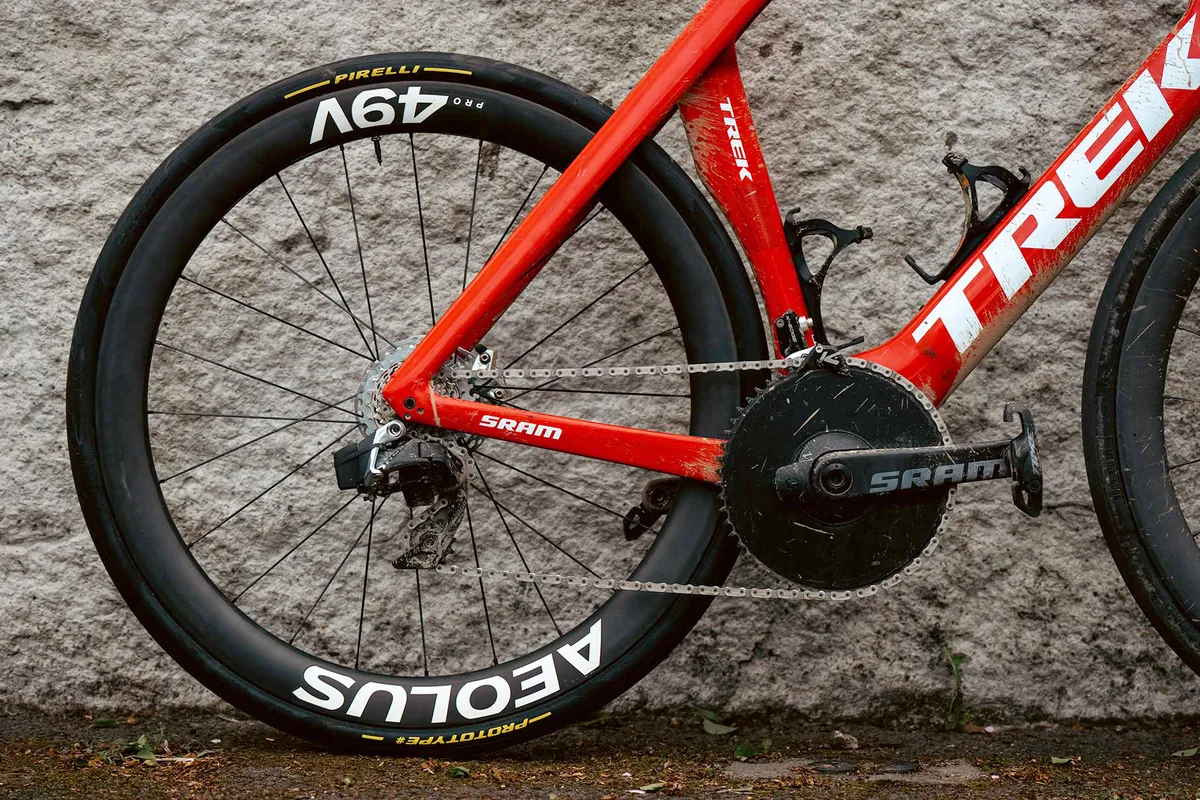
A single chainring usually has a filled-in spider rather than a cut-out one, which is also claimed to improve aerodynamics. Plus, it’s typically carbon, so yet more weight saved.

1x groupsets are engineered to improve chain retention, with a clutched rear derailleur to help keep the chain in place. Since the chain doesn't need to swap to the smaller ring, the chainring can have deeper teeth, which also helps improve retention.
A 1x setup enables riders to run a chain catcher as well, which can further lower the risk of the chain dropping off the chainring on the cobbles.
If the race is muddy, there are fewer places where mud can collect and stop the groupset from working.

Then there’s the matter of drivetrain efficiency. You’ll typically see 1x groupsets, such as that used by Mads Pedersen throughout the 2025 Classic races, with extra-large chainrings. This enables him to ride mid-cassette, so the chainline may be straighter than with a double chainring. The cassette sprockets used most are larger, too.
Both can result in increased drivetrain efficiency. The chain doesn’t need to bend through an angle between the crankset and cassette, and the individual links don’t need to articulate through such a large angle, reducing link-to-link friction.

Not all teams can easily swap to 1x, however. SRAM, whose groupsets are used by seven teams, has a 1x setup as part of its Red AXS groupset, while Red XPLR AXS is 1x only, so they're designed to be used with 1x (as are some configurations of Campagnolo Super Record).
In contrast, Shimano Dura-Ace, which is the groupset used by the majority of WorldTour pro teams, is designed around 2x and doesn’t have a native 1x option.
On their time trial bikes, some Shimano-equipped teams will swap to third-party chainrings for an aero 1x groupset, while others ride even time trials with a 2x setup with standard chainrings. For Paris-Roubaix, many will ride a regular 2x Dura-Ace groupset, possibly fitted with larger chainrings.