Mountain bike suspension is built on some of the most advanced technology in the whole sport of cycling – and some of these innovations bear the names of the technological pioneers who created them.
Rear suspension first appeared in the late 1980s as pioneering MTB designers and engineers came up with innovative solutions to riding bicycles off-road.
The Horst-link remains one of the most successful linkage designs despite being invented decades ago, while Dave Weagle's DW-link has been used on some of the fastest MTBs ever made.
Here, we look back at four suspension designs that have made a huge impact on mountain biking – and celebrate the influential figures who conceived them.
Lawwill Link and Lawwill Leader fork
Motocross legend and star of iconic movie On Any Sunday, Mert Lawwill recently passed away at the age of 85, so the technological innovations named after him had to be top of this list.
After years of top-flight motorcycle racing in the 1960s and 70s, Lawwill indulged his passion for mountain bikes.
He invented the Lawwill link rear-suspension design in the 1990s. It comprised pivots on the mainframe for the chainstays and the seatstays, with the rear axle on a short floating link between the two. Iconic bikes such as the Yeti DH6 and Schwinn Straight 8 used this system back in the 1990s.
Lawwill also worked on a leading-link suspension fork using links activating a single shock instead of a telescopic design. The fork was called the Leader and used a vertically placed air shock in front of the crown to provide the travel.
The design enabled brake dive (anti-rise) to be controlled depending on where the designer placed the pivots, which is not possible on a telescopic fork.
Horst-link

Perhaps the most used and widely recognised rear-suspension linkage is the Horst-link.
Horst Leitner was a Grand Prix motocross racer in the 1960s. He emigrated to the USA in the 1980s, and in 1985 built a prototype mountain bike frame with a four-bar linkage rear suspension.
Leitner evolved his suspension design away from a traditional single-pivot axle path by placing another pivot on the chainstay between the rear axle and the main pivot point. This enabled the amount of anti-rise from the rear braking force to be tuned according to where the chainstay pivot was placed.
Leitner formed a company, AMP Research, building bikes with his Horst-link suspension, later licensing the design to brands such as Rocky Mountain, Turner, Mongoose and Titus. Specialized later purchased Leitner's patented design, which it used on its full-suspension FSR frames and continues to do so to this day.
Specialized’s patent on the Horst-link expired in 2014, opening up its legal use by any bike manufacturer.
Leitner was inducted into the Mountain Bike Hall Of Fame in 2015, in recognition of the innovations he had introduced to the sport of mountain biking.
DW4 and DW6-link

Dave Weagle is a prolific bike technology designer and the man behind the DW4 and DW6 rear-suspension linkage design, as well as many other incredible innovations.
The DW-link (renamed DW4) was seen on Turners, Pivots and Ibis bikes, but was perhaps most famous for its use on the Iron Horse Sunday ridden by Sam Hill and Brendan Fairclough.
DW4 enabled Weagle to tune anti-squat and shock progression finely as well as the bike's instant-centre (the theoretical pivot point the rear suspension follows).
Weagle continued to develop the design, eventually releasing the DW6 six-bar linkage system, which added an extra link around the bottom bracket (BB) shell and a seatstay pivot over the DW4.
Bikes such as the Pivot Phoenix use a flex-stay arrangement on the DW6 suspension, whereas others use a true pivot around a ball-bearing.
High-end brands such as Atherton Bikes license the DW6 suspension for some of their top-end full-suspension MTBs.
DELTA Link
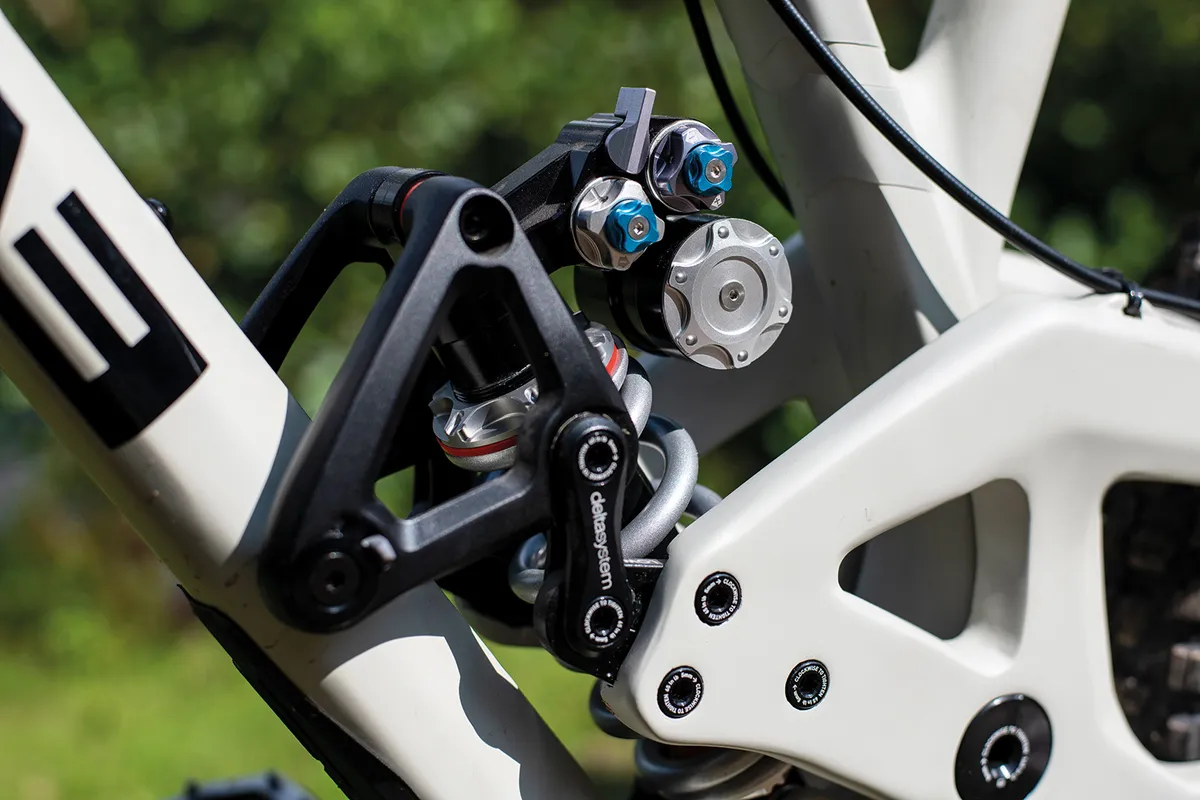
Dave’s Extra Legitimate Travel Apparatus (DELTA) is another platform designed by suspension genius Dave Weagle and used by Evil Bikes.
The design is based around a rocker that actuates the shock and is joined to the bike’s swingarm by a pair of short links. Evil says this enables “very complex leverage rate curves that can be used to tune for varying track conditions, spring and damper parameters”.
The design has been featured on most of Evil’s frames, from the inception of the company to the present day.