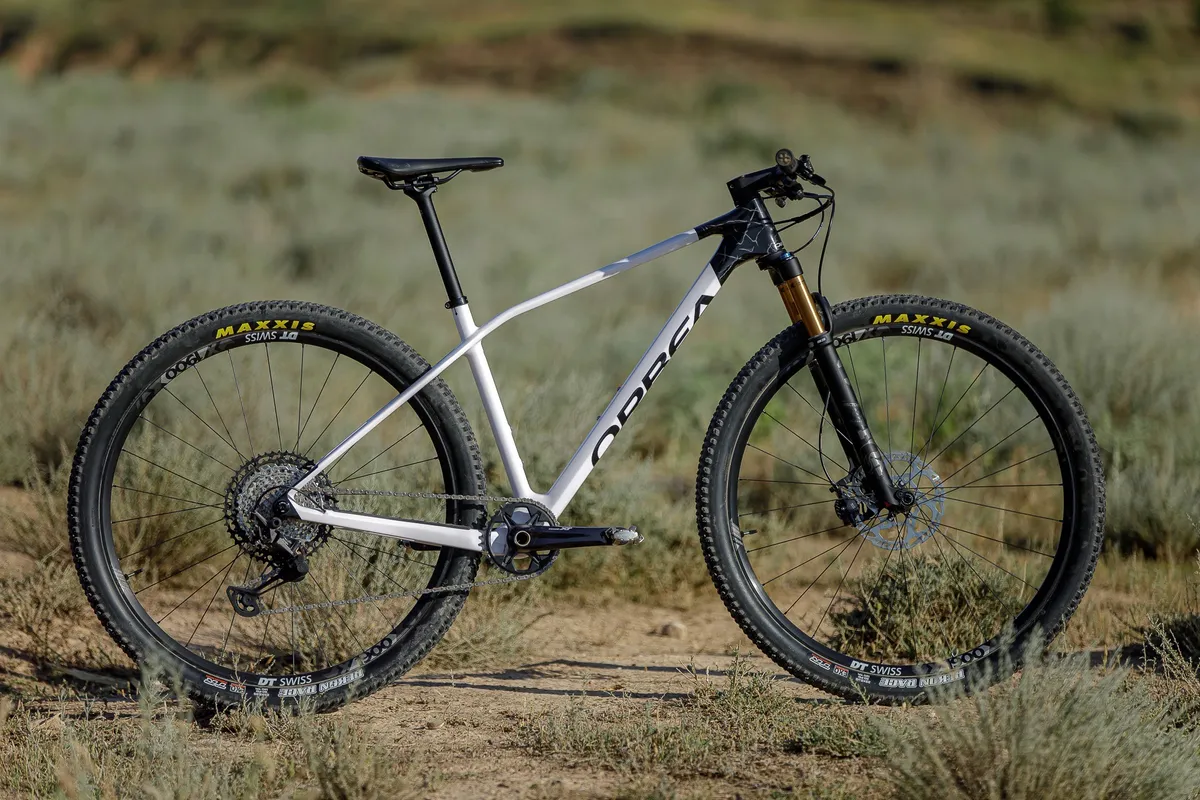
Orbea’s Oiz cross-country bike has been revamped, with the 2026 version claimed to be stiffer, lighter and better-performing than ever.
The geometry has been updated to make the bike more stable at high speed and construction techniques have been optimised, enabling a claimed frame weight of only 1,700g according to Orbea.
Orbea is aiming the bike at racers looking for the best weapon to take on the latest generation of XC race courses. On paper, the new Oiz looks to have all the ingredients of a modern XC bike capable of winning a World Cup round.
Stiffer frame

The first Oiz was released in 2005 and over the past 21 years has seen considerable evolution. We saw an Oiz prototype in Nove Mesto at the World Cup XCO, which team rider Simon Andreassen used to finish in 16th place.
Orbea says the new version of the Oiz prioritises stiffness after extensive testing. It claims that in a blind test its team riders preferred a stiffer version with more carbon in the layup over a more flexible prototype that was 50g lighter.
The new frame has a differently shaped ‘winged’ top tube and a ‘Powerspine’ running from the head tube to the bottom bracket (BB) to increase stiffness, while the production methods use more carbon fibres and less resin in the frame’s construction to reduce excess weight.
However, the new frame isn’t heavy by any means, with Orbea claiming the new Oiz OMX frame weighs only 1,700g for a medium size, including the shock. That's still 111g heavier than the claimed weight of the latest Specialized Epic 9.
This weight has been achieved thanks partly to the aforementioned modification to the carbon layup and a lighter suspension link.
Interestingly, the new, lighter-weight link is made of aluminium rather than the carbon of the previous generation. However, with multiple reliefs and clever engineering, the aluminium link is a considerable 30% lighter.
The Oiz is available with two levels of carbon construction – the top-spec OMR and cheaper OMX, much like Santa Cruz with its C and more expensive CC options.
The top-spec material is the OMX carbon frame, which Orbea says is both lighter and stiffer than the cheaper OMR carbon version. Orbea says OMR carbon delivers the same level of strength and structural performance, but will not be as light as the OMX.
Geometry updates

XC bikes have become noticeably more aggressive in the past couple of years, including in the geometry department.
Orbea has followed this trend, slackening the head angle of the new Oiz, taking the new bike to 66.8 degrees – 0.2 degrees slacker than the previous generation.
The latest Specialized Epic 9 is much slacker and more progressive than this, though, with its head angle sitting at 66.3 degrees in the high setting and 65.9 degrees in the low setting.
Slacker bikes have more stable handling, suiting the latest generation of XC race tracks, which are steeper, rougher and faster than ever before.
Reach on the new bike is similar to the outgoing Oiz – 425mm for a small, increasing in roughly 25mm increments up to 495mm for the XL bike.
The chainstay length has also been reduced, which Orbea says improves responsiveness and acceleration, but with only a 2mm reduction over the previous model, this seems unlikely to make a profound difference to handling.
Suspension evolution not revolution

The new Oiz keeps the 120mm front and rear travel of the previous version in line with the majority of modern XC bikes. It also sees a continuation of Orbea’s choice of regressive suspension kinematics.
Unsurprisingly for an XC bike, Orbea has aimed to make a bike that pedals efficiently, explaining that it chose a shock-actuation ratio that prioritises support in the initial part of the stroke. Orbea says the shock uses a small air can, which creates a progressive air spring to provide support at the end of the stroke.
The frame is compatible with up to a 130mm front fork if you want to increase the travel slightly after purchase.
The bike uses Orbea’s Spinblock to prevent the handlebar clouting the frame in a crash.
Custom configurator

The Oiz is configurable using Orbea’s MyOrbea Custom online programme. This enables you to choose custom colours and graphics combinations to make your bike stand out from the stock versions.
Pricing and availability

There are four OMR builds and four OMX builds to cater for different budgets.
The new Oiz is available at Orbea dealers now.
- Oiz OMX M-Ltd: £9,999 / $12,127 / €10,999
- Oiz OMX M-Team Factory: £8,359 / $10,473 / €9,499
- Oiz OMX M-Team AXS: £6,599 / $8,268 / €7,499
- Oiz OMX M-Pro: £6,399 / $8,048 / €7,299
- Oiz OMR M10 AXS: £6,199 / $7,717 / €6,999
- Oiz OMR M10: £5,299 / $6,614 / €5,999
- Oiz OMR M20: £4,199 / $5,291 / €4,799
- Oiz OMR M30: £3,349 / $4,189