The International Testing Agency (ITA) has fired back at criticisms of its power-data monitoring trial, telling BikeRadar that “a majority of the comments and ‘unanswered questions’ surrounding the project have actually been addressed from the start”.
The scheme, which was announced by cycling’s international governing body, the UCI, last year, was revealed to be in progress by the president of the professional riders' union, Adam Hansen, in an interview with Domestique in January.
Speaking on the Domestique Hotseat podcast, Hansen said that while the trial was being conducted on a voluntary basis, there were a number of outstanding concerns surrounding how the data would be interpreted, and what would happen in instances where riders were unable to submit their data for analysis.
According to the ITA, however, the trial “aims at finding out whether the power data can be used as a potential indicator for doping or not”, and that “these tools would only be used if they prove to be reliable”.
Why monitor power data?

Concerns around feasibility aside, a core tenet of Hansen’s argument against the collection and monitoring of rider’s power data was that it would represent an additional stress on athletes who are already subject to a number of anti-doping tools (such as post-race controls, the Whereabouts system and the athlete biological passport).
The ITA, however, says “power data is at the core of professional road cycling”, and is already “scrutinised" by riders and teams to monitor and improve riders' performance.
It says the power data of professional riders is discussed routinely by riders themselves, their teams, the media and fans of the sport, but that “paradoxically, the ITA does not have access to it”.
The trial, the ITA says, is therefore designed to study the feasibility of collecting and analysing rider data as “a supplementary tool to help identify potential indicators of doping”.
Counter to Hansen’s claim that irregularities in a rider’s power data could one day lead to them being sanctioned for a doping violation, the ITA says the power-profiling scheme is intended to act as “a supplementary anti-doping tool only.”
The ITA said riders “would not be sanctioned for potential anti-doping rule violations through an unexpected excess performance as determined by the modelling”.
How would the ITA’s power-data passport work?
To make a power passport that would work, the ITA says it is working with the University of Kent and University College London on a “2-year feasibility and pilot study” for the scheme, with a view to using it to “inform anti-doping strategies as a supplementary intelligence tool”.
Before it is implemented as a mandatory scheme for all professional cycling teams, though, the ITA says the trial must clear the following hurdles:
- Establishing typical levels of variability within training and race data, taking into account power-meter systematic and random error.
- Understanding the relationship between training data and race performance.
- Developing longitudinal training and race profiles for riders within UCI Professional Road Cycling Teams.
- Development of a plausible approach for the implementation of performance monitoring in professional road cycling using power data, built on the concept of excess performance that is informed by longitudinal analysis of training data, past race history and relative race performance.
The ITA says it’s important to collect data from both training and racing, in order to “define what constitutes “normal variation” and identify typical rates of progression throughout a rider’s career in comparison to age matched counterparts“.
It says race data alone may not fully represent a rider’s capabilities, if tactical considerations “limit their maximal effort”.
Nevertheless, the ITA says “longitudinal profiles will be built on race performance, not training data considering its reliability”.
Training data will instead be used to “help estimate each rider’s likely maximal performance capacity” and “to review suspicious profiles that present unexpected excess performance”.
What happens when riders can’t submit data?

Directly addressing Hansen’s claim that it was unclear what would happen if a rider’s power meter ran out of battery mid-ride, or if they lost their bike computer, the ITA told BikeRadar that this is “exactly why the feasibility study is being conducted”.
The trial aims to establish “what level of performance change can be systematically detected, and how did this relate to actual race performances?” the ITA says.
“The focus is on changes over time, not the impact of individual training sessions.”
As for factors that may affect a rider’s power output on a day-to-day basis, such as sleep quality, fatigue, their training plan and so on, the ITA says simply “If a rider’s performance changes, whether positively or negatively, we are concerned only with the outcome, the change in performance itself. It does not matter to us how the change came about, because we do not have the data to explain the underlying cause”.
“The analysis is simply intended to highlight performance progressions or gains that fall outside the statistically expected “normal” range for that rider and compared with their peers.”
The ITA says that if a rider were “flagged” by the system, it would “follow up by reviewing additional data (e.g. training calendar, whereabouts) to determine whether there is an obvious explanation, such as an altitude camp or other influencing factors.”
Nevertheless, it says the tool would be used “only to inform and refine the testing strategy”, and that the system flagging a rider for further analysis “does not imply wrongdoing” because “there may be entirely legitimate reasons for their performance change”.
“In such cases, even if they are tested, they would not be expected to produce an adverse analytical finding (AAF),” the ITA adds.
On power-meter accuracy and variability
One potential issue we raised with the ITA is the potential for errors due to issues with the power meters used by professional cyclists.
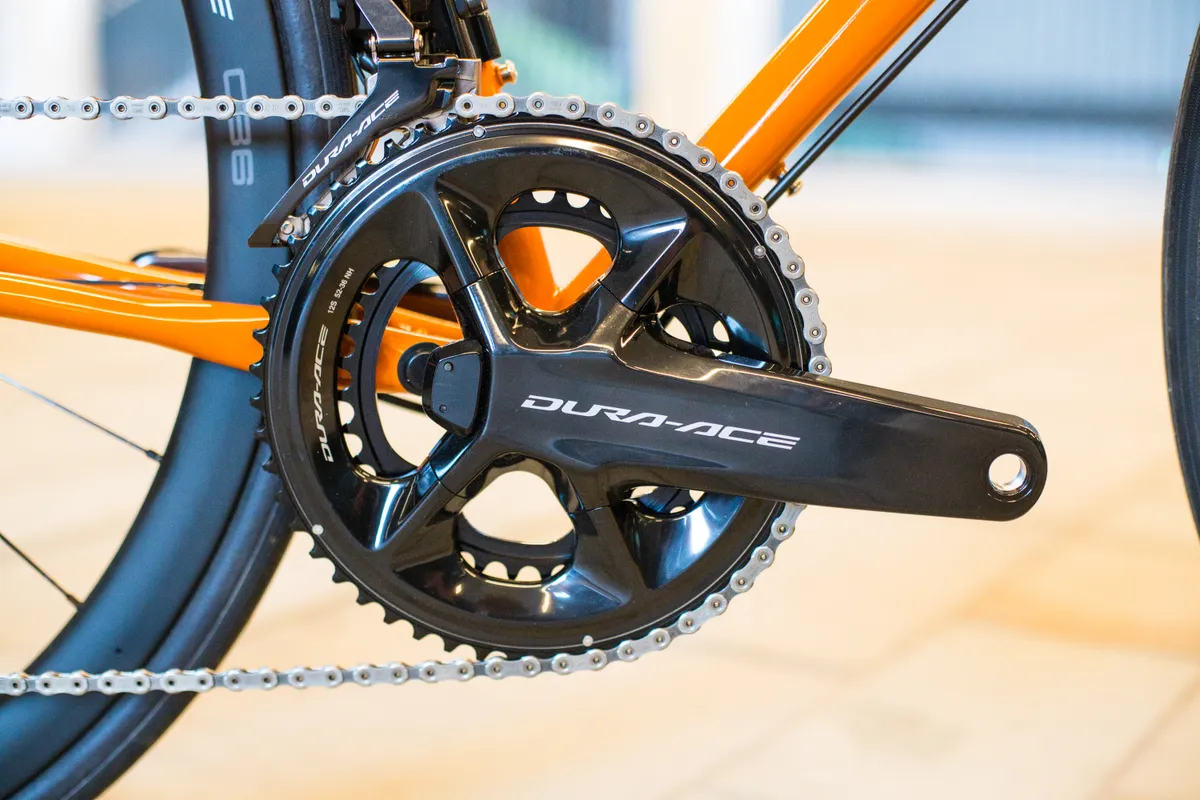
Shimano’s current Dura-Ace FC-R9200-P power meter crankset, which is used by several professional teams, is widely believed to suffer from accuracy issues, with one respected tester labelling it “astonishingly inaccurate” in 2023.
On this point, the ITA said: “There is no doubt that the inter- and intra-device precision and reliability of commercially used power meters, calibration methods and standards is variable across manufacturers.
“We need to understand the accuracy of power meters and the reliability of devices used by professional cyclists to capture data, and variables that can affect these things.”
Nevertheless, it says these issues are “precisely the reason why we are conducting the feasibility study and results will be shared at the end of the study – to see whether implementing power monitoring is feasible given these, and other challenges”.
Voluntary, for now
The ITA confirmed Hansen’s claim that four pro teams are involved with the trial, and said “around 50 riders have signed up with the project and consented to share their historical power data”.
It said that riders were given “information notice explaining the purpose and legal basis of the project, data collection and processing methods, data sharing protocols and rights of the riders”, before they consented to participate in the study.
Nevertheless, it did also say that “Depending on the development and outcomes of the feasibility study, it is anticipated that the sharing of power data will be integrated into UCI regulations. Therefore, data collection will shift from voluntary consent to a regulatory mandate.”


