Honda has returned to mountain biking with the RN0, an electric mountain bike that takes inspiration from the brand's World Cup-winning downhill bike and its contemporary electric mobility products.
The Japanese manufacturer has an impressive, albeit short, history in mountain biking. Its RN01 G-Cross downhill bike, which featured an unconventional internal gearbox, carried Greg Minnaar to the overall Downhill World Cup title in 2005.
Two decades later, Honda is looking to make its mark once again, this time with the help of German manufacturer Rotwild.
The RN0 combines a carbon monocoque frame with a motorcycle-inspired design philosophy and Shimano's new ebike motor, which produces a claimed 100Nm of torque and 750W of peak power.
Honda says the bike has been designed by engineers with experience developing motorcycles, with the aim of bringing some of their characteristics to the mountain bike world.
I headed to Santa Coloma de Farners, near Girona in Spain, to find out whether Honda's engineering expertise could give it an edge over established electric mountain bike manufacturers.
While the RN0 proved more capable than its unusual appearance might suggest, I came away feeling there's still work to be done.
Honda RN0 frame and geometry
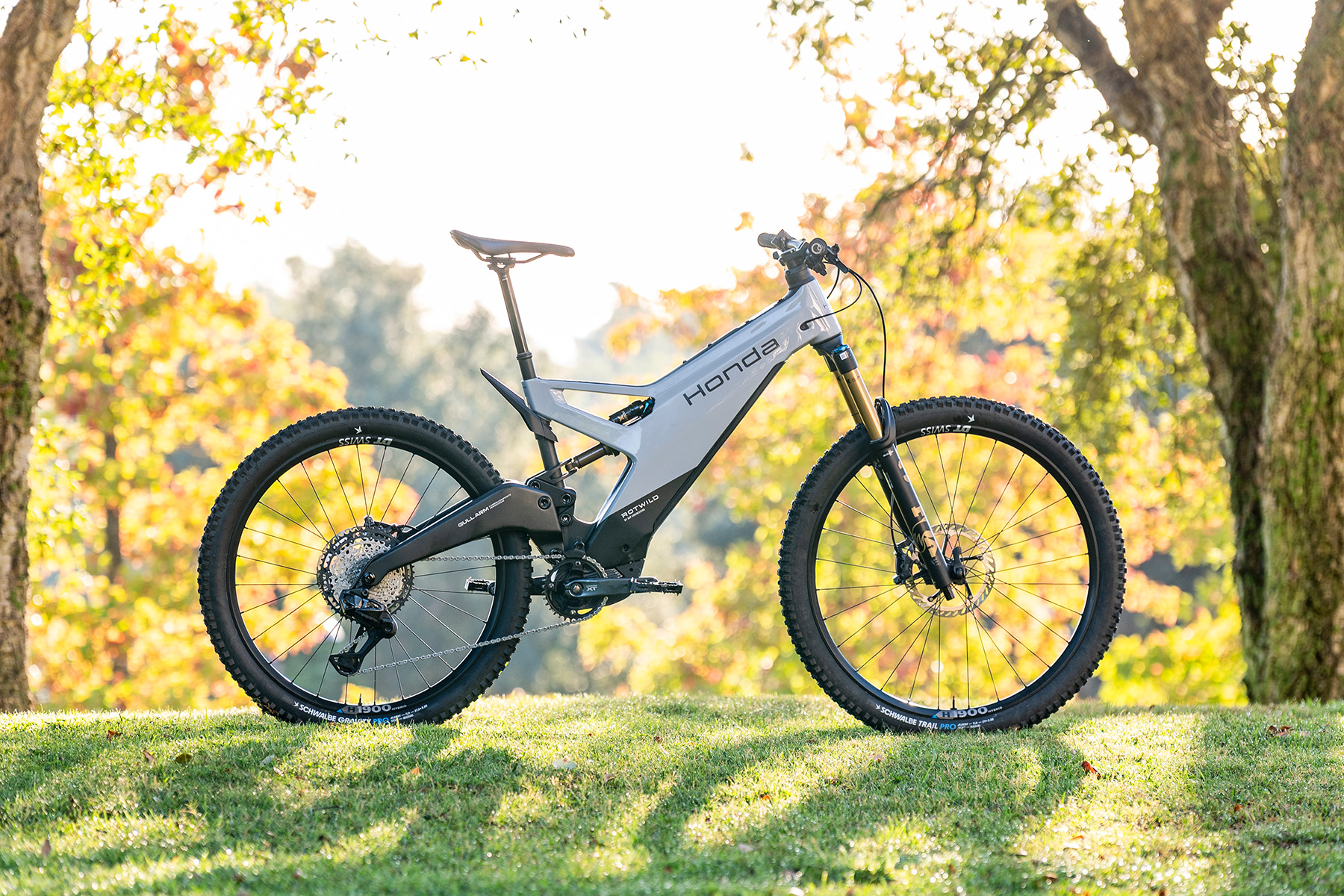
The RN0's most distinctive feature is its carbon monocoque frame, which draws inspiration from Honda's experience developing motorcycles.
Rather than following a conventional arrangement of individual tubes, the front triangle features a substantial hollow carbon structure that gives the bike its unusual appearance.
Honda says the design is intended to replicate some of the characteristics of riding a motorcycle, with the frame flexing more cohesively as a single structure rather than concentrating movement around individual areas, such as the head tube and rear-suspension linkage.
The brand believes this creates a more consistent connection between rider and machine, although determining whether it provides a tangible advantage over conventional carbon frames would require further testing.
The RN0 has been developed in collaboration with Rotwild, a German manufacturer with experience producing high-performance mountain bikes.
Rotwild is no stranger to automotive collaborations, having worked previously with Porsche and Mercedes-Benz on bicycle development projects.
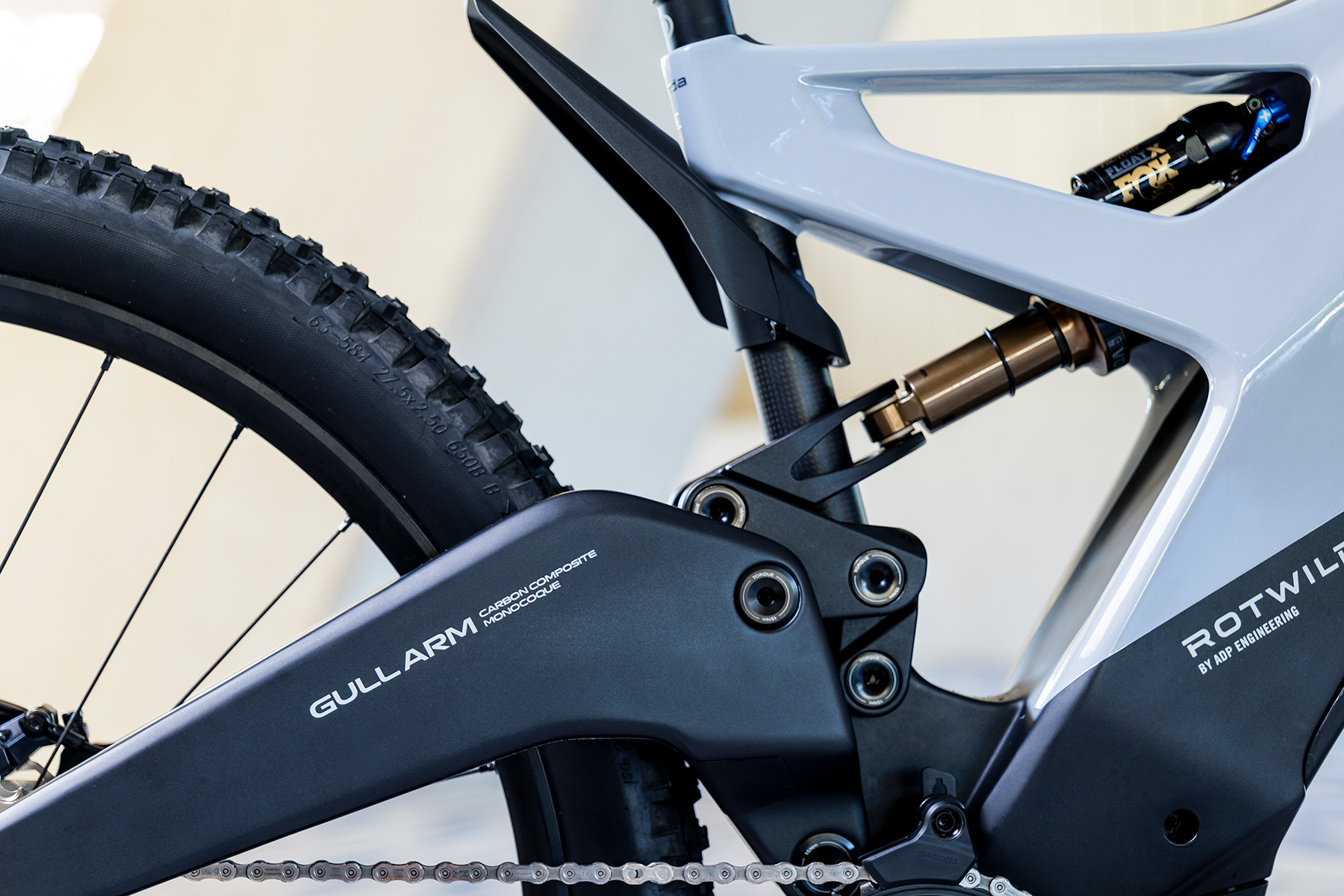
However, Honda says the RN0's design has been led by its own engineers, drawing on expertise from the company's motorcycle division.
The RN0 also takes inspiration from the legendary RN01 downhill bike, combining elements of its racing heritage with Honda's contemporary electric mobility products.
Honda RN0 geometry
The RN0 features relatively moderate geometry, with a 65-degree head angle and 76.5-degree effective seat tube angle across the three sizes.
I rode a medium, which has a 455mm reach, 640mm stack and 1,230mm wheelbase.
The 442mm chainstays are relatively short for a full-power electric mountain bike, while a 345mm bottom bracket height and mixed-wheel configuration complete the geometry.
With 160mm of front travel and 145mm at the rear, the RN0 sits firmly in the all-mountain category, rather than pursuing the increasingly aggressive geometry of some electric enduro bikes.
Delivering the rear wheel travel is a linkage actuated single pivot design - a system that's commonplace in the motocross world.
Honda RN0 motor and specification
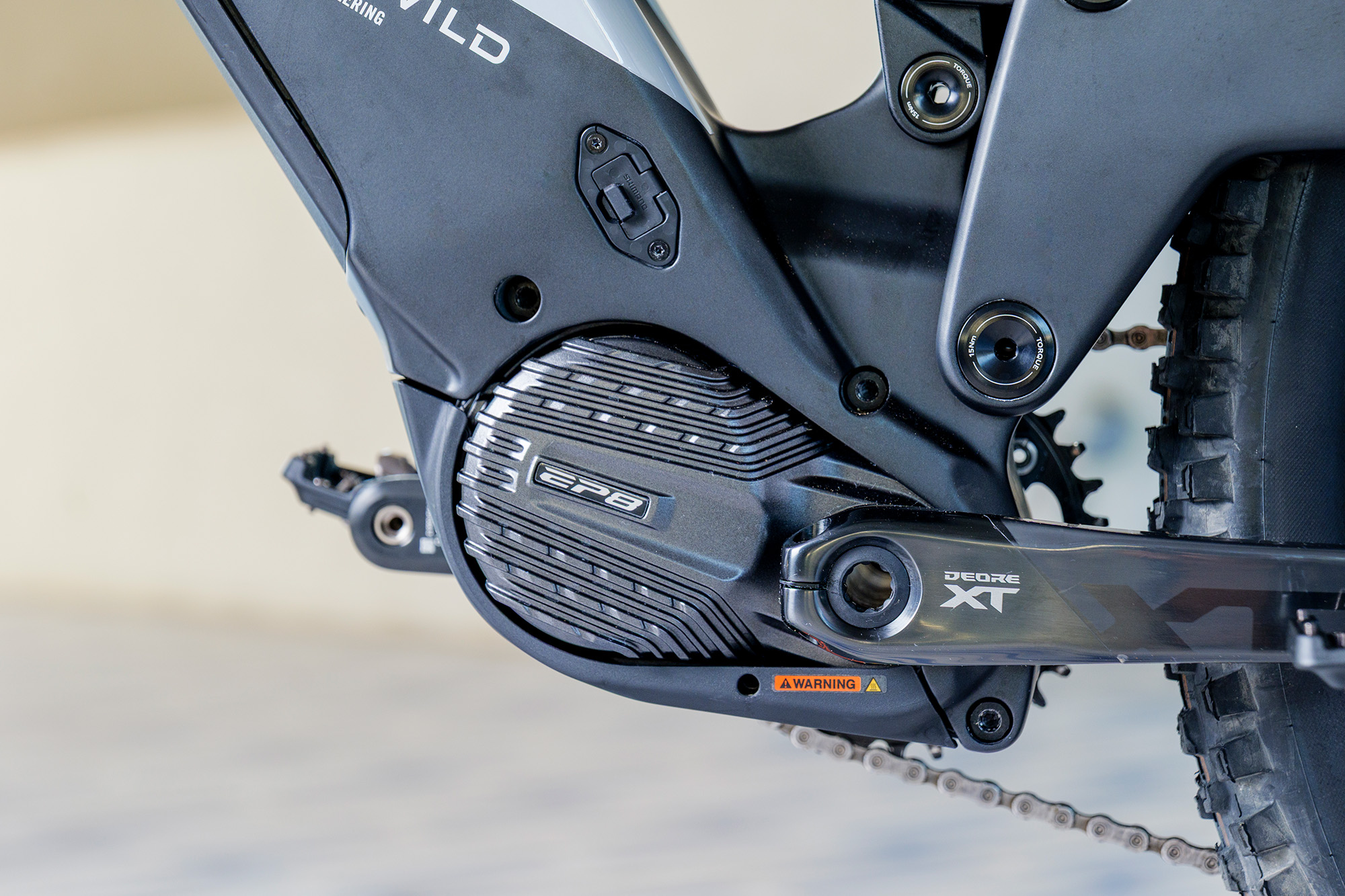
The RN0 features Shimano's new ebike motor which is due to launched this Friday, and delivers a claimed 100Nm of torque and 750W of peak power, while weighing only 2.3kg.
It's paired with a 720Wh Shimano battery, housed within the substantial down tube.
The bike features a high-end build kit, with a Fox 36 Factory Grip X fork providing 160mm of travel and a Float X Factory shock controlling the 145mm rear end.
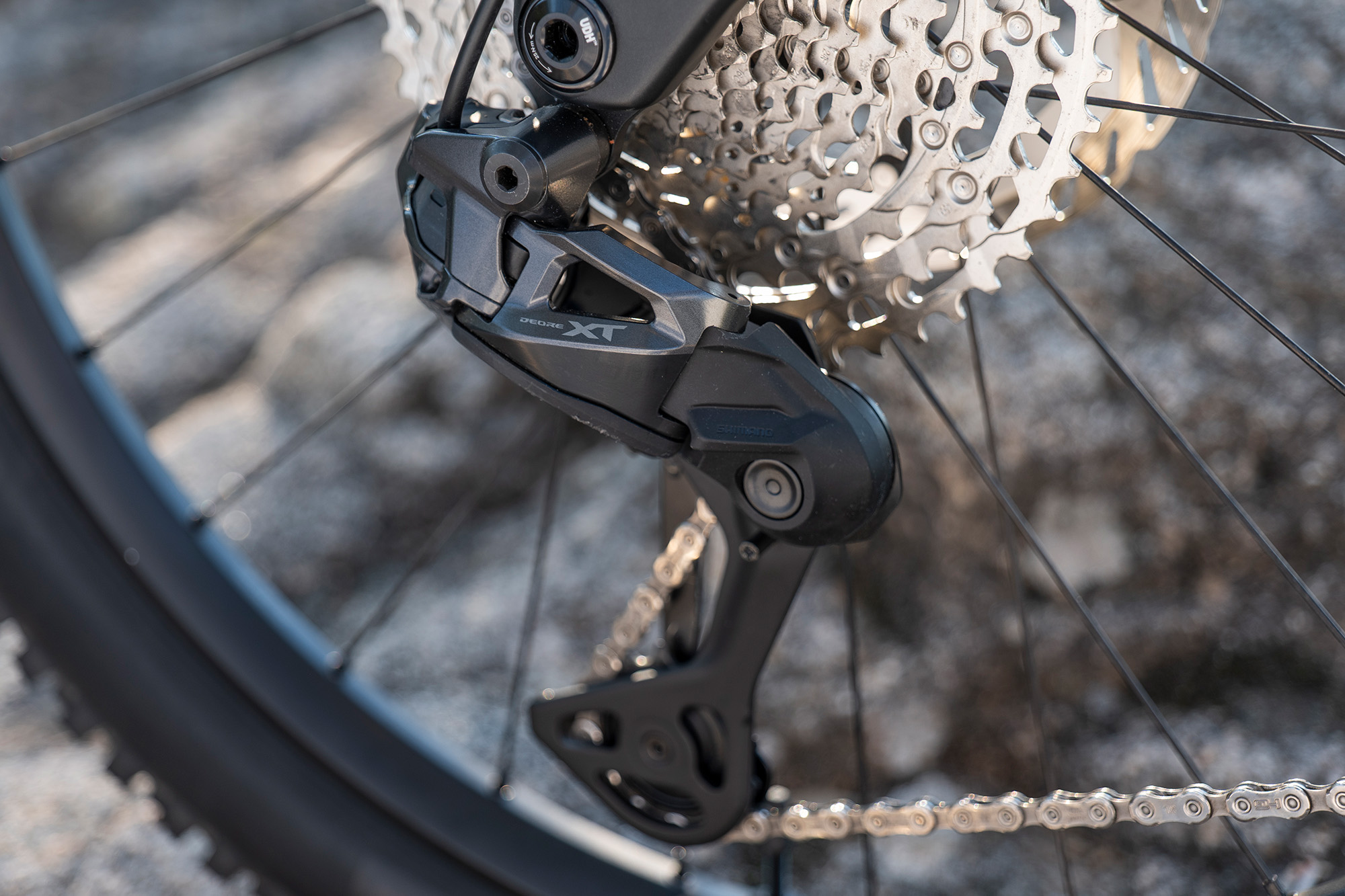
A Shimano XT Di2 12-speed drivetrain handles shifting, while Shimano XT M8220 brakes provide the stopping power.
DT Swiss M1900 wheels are wrapped in Schwalbe Albert rubber, with a 29×2.5in front tyre and 27.5×2.5in at the rear.
Rotwild supplies the cockpit, while a Crankbrothers Highline dropper and Ergon finishing kit complete the build.
Honda RN0 first-ride impressions
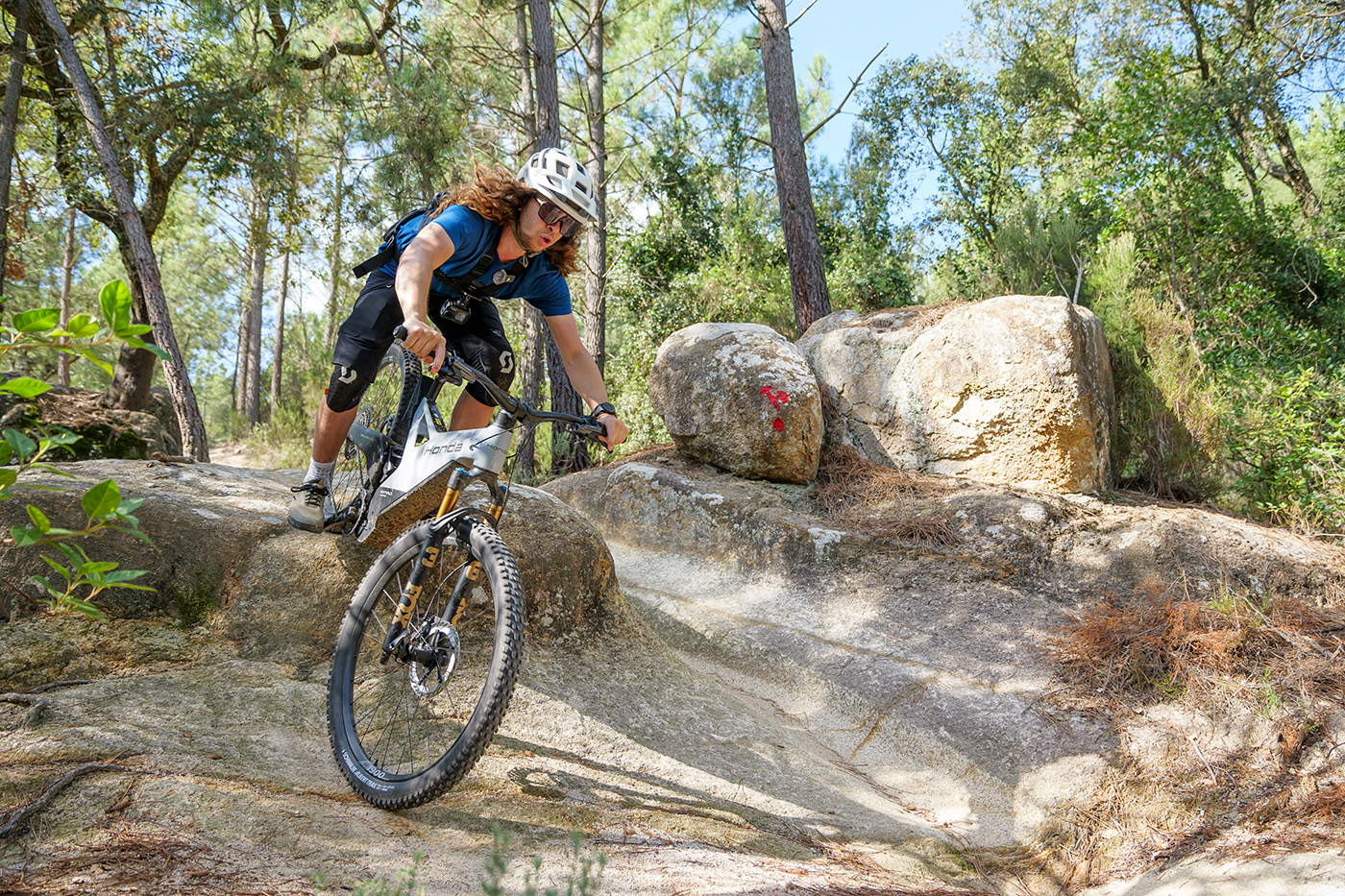
Honda invited me to Santa Coloma de Farners to put the RN0 through its paces on the area's dry, dusty trails.
Given the brand's motorcycle background and the unconventional frame design, I wasn't entirely sure what to expect.
However, once moving, the RN0 felt surprisingly familiar.
Its relatively conservative geometry gives it a playful character, making it easy to change direction and manoeuvre through tighter sections of trail.
The 442mm chainstays and mixed-wheel setup contribute to this lively handling, and the bike felt more agile than its substantial carbon frame might suggest.
Surprisingly capable suspension
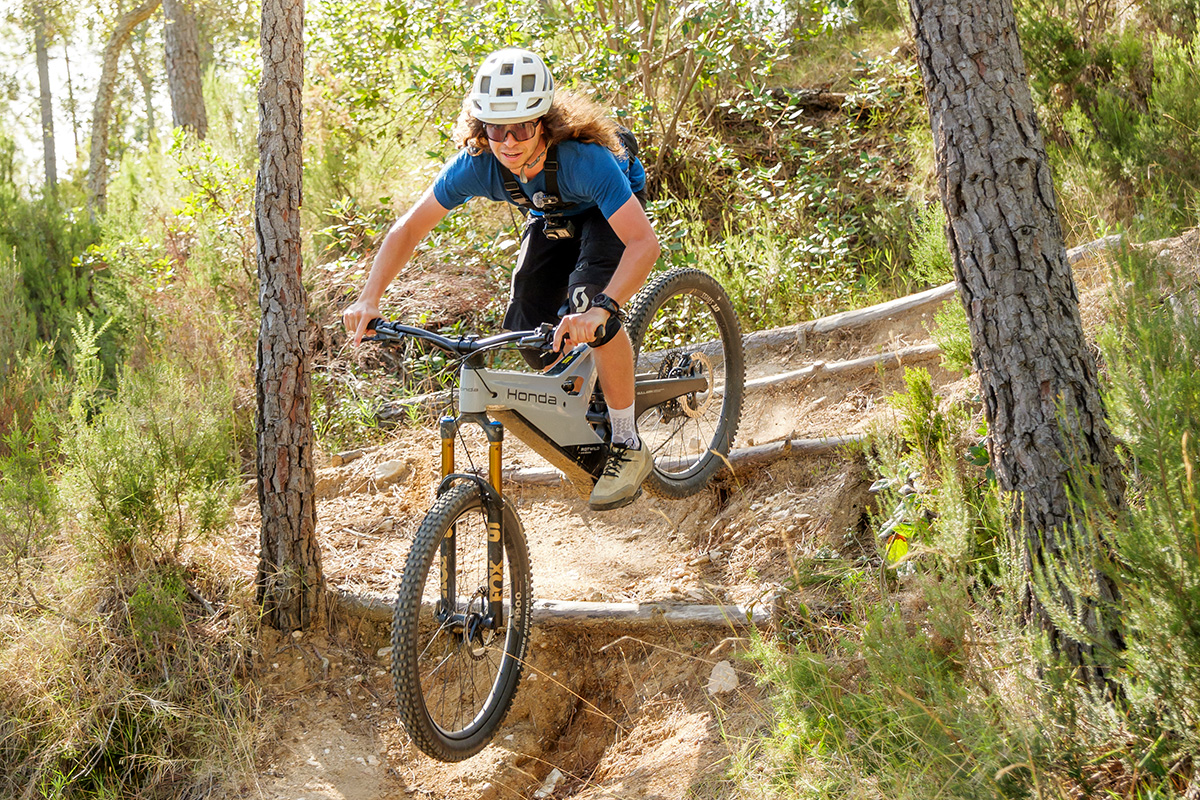
One of the biggest surprises was the performance of the rear suspension.
I was initially sceptical about Honda's unconventional approach, but the suspension performed considerably better than I had anticipated.
It remained composed through rougher sections, absorbing successive impacts effectively and providing a reassuring level of traction.
The Fox Factory suspension undoubtedly contributes to this, giving the RN0 a capable platform when descending.
I was also impressed by the Schwalbe Albert Trail Radial tyres, which provided excellent grip on the loose, dusty terrain.
Their predictable traction inspired confidence when leaning into corners, while the Shimano XT brakes delivered dependable stopping performance.
Together, these components make for a capable descending package.
However, while the RN0 is enjoyable to ride, I wouldn't describe its handling or suspension as a revelation compared to established electric mountain bikes.
An acoustic guitar on wheels

Unfortunately, the RN0 is also one of the noisiest electric mountain bikes I've ridden.
Its enormous hollow front triangle appears to act like the body of an acoustic guitar, amplifying almost every vibration passing through the frame.
Gear changes, harsh landings and rocks striking the frame all reverberate through the carbon structure, creating an extraordinary amount of clattering.
The problem is made worse by Shimano's XT Di2 rear derailleur.
Its clutchless design is already known for producing considerable drivetrain noise, with the chain and derailleur bouncing around over rough terrain.
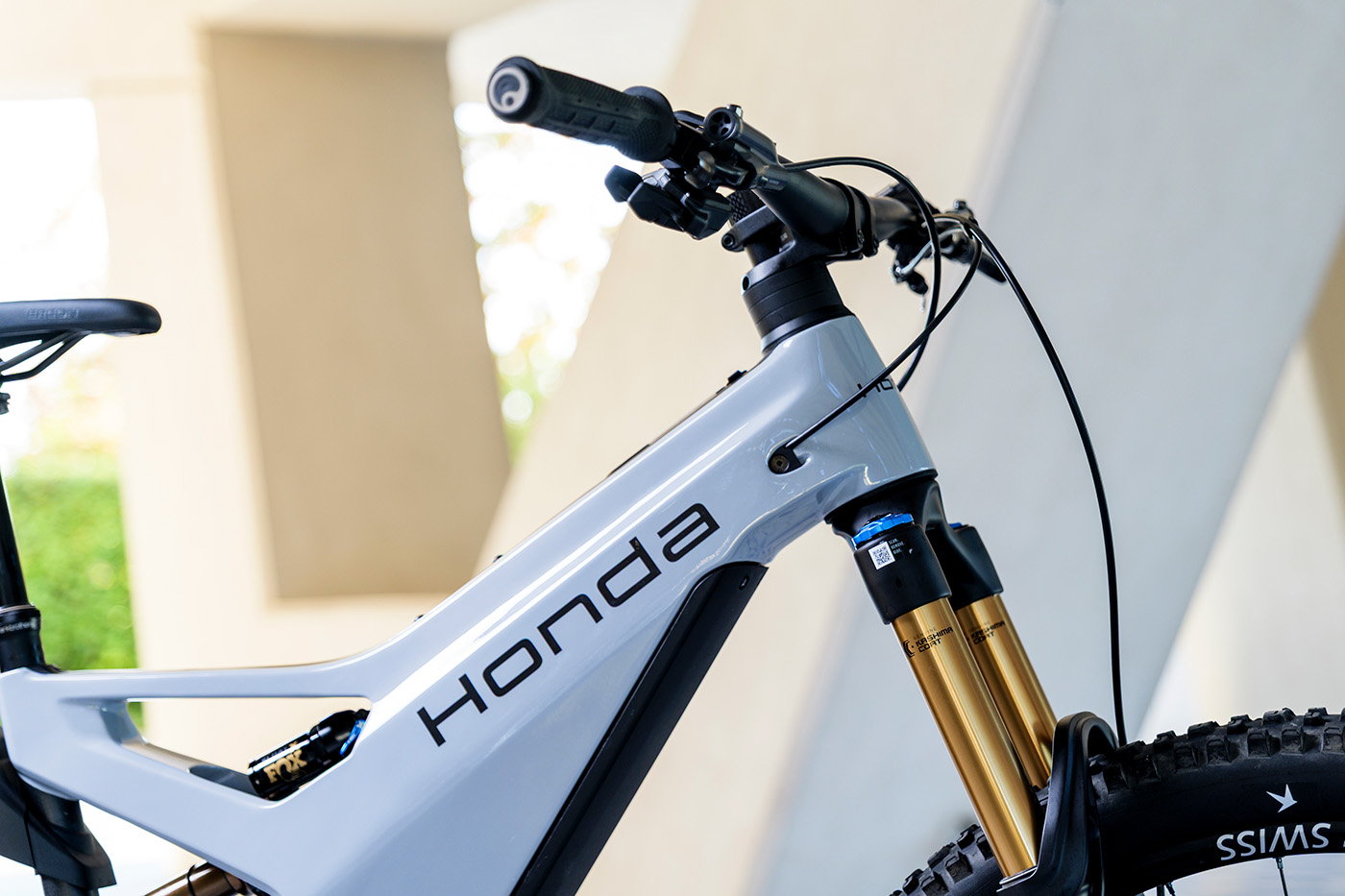
On the Honda, these sounds appear to be amplified by the hollow frame, turning what might otherwise be ordinary drivetrain clatter into something much more intrusive.
Although the noise doesn't affect the RN0's ability to negotiate demanding terrain, it significantly detracts from the riding experience.
It's particularly disappointing given Honda's emphasis on creating a more cohesive connection between rider and machine.
Shimano's new motor has room for improvement
While the RN0's descending performance exceeded my expectations, I was considerably less impressed when the trail pointed uphill.
After quizzing Shimano about the motor, they were quick to point out that the unit fitted to my bike was pre-production, with changes potentially coming before the system reaches customers.
However, the extent of any changes has yet to be confirmed, so it's difficult to know whether the production version will address my concerns.
On the trail, despite its competitive headline figures, Shimano's new motor felt a couple of generations behind newer ebike motors such as the Avinox M2S and even Bosch's latest Performance Line CX.
My biggest complaint wasn't the amount of assistance available, but rather the sensitivity of its delivery.
On technical climbs, I found myself reverting to an eMTB riding technique I thought I'd largely forgotten: dragging the rear brake to control the motor's assistance.
Using the brake almost like a clutch enabled me to moderate the bike's forward momentum and negotiate awkward sections without surging ahead.
It's a technique that used to be relatively common on electric mountain bikes, but newer systems have become considerably better at responding to subtle changes in pedal pressure.
On the Honda, I found myself doing this on relatively tame climbs that I would expect the Avinox M2S or Bosch Performance Line CX to tackle with considerably less rear-brake intervention.
The motor I tested also surged on and off the speed limiter, stopping harshly and accelerating again with enough force to wobble my head.
Honda RN0 initial verdict
Honda deserves credit for bringing something genuinely different to the electric mountain bike market.
Its motorcycle-inspired carbon frame is unlike almost anything else currently available, while the collaboration with Rotwild brings considerable mountain bike development experience.
On the trails, the RN0 proved more capable than I had anticipated, with playful handling, surprisingly composed suspension and excellent grip from its Schwalbe tyres.
However, I came away feeling the bike was merely okay rather than exceptional.
The hollow carbon frame amplifies an extraordinary amount of drivetrain and impact noise, while Shimano's new motor feels inferior to the latest competition, particularly when tackling technical climbs.
It's worth remembering that the motor I tested was a pre-production unit and changes may be made before the bike reaches customers.
There's certainly potential in the RN0, but Honda hasn't yet convinced me that its motorcycle engineering expertise offers a meaningful advantage over the best electric mountain bikes.
For now, it feels like a promising first attempt rather than a new benchmark.
Honda RN0 key specifications
- Frame: Honda carbon monocoque
- Motor: Shimano, 100Nm, 750W
- Battery: Shimano, 720Wh
- Fork: Fox 36 Factory Grip X, 160mm
- Shock: Fox Float X Factory, 145mm rear travel
- Drivetrain: Shimano XT Di2, 12-speed
- Crankset: Shimano FC-M8200, 34t
- Cassette: Shimano XT CS-M6100, 10–51t
- Brakes: Shimano XT M8220
- Wheels: DT Swiss M1900
- Tyres: Schwalbe Albert, 29×2.5in front, 27.5×2.5in rear
- Handlebar: Rotwild B280, 780mm
- Stem: Rotwild S140
- Dropper: Crankbrothers Highline
- Saddle: Ergon SM
- Grips: Ergon GDH
- Display: Shimano SC-EN700