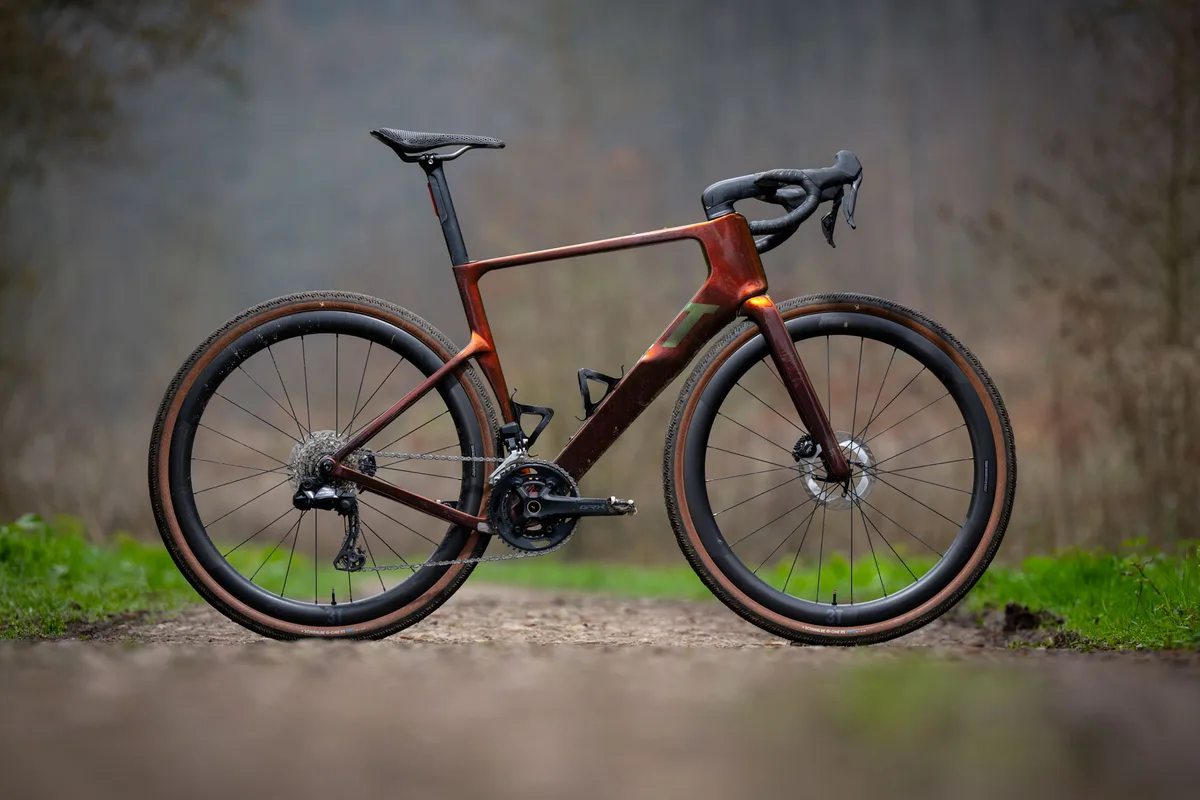
There’s been much talk in recent years about ‘the spirit of gravel’. Is it alive? Is it dead? Did it ever exist?
As gravel racing has exploded in popularity, the discipline that once focused on accessibility, community, participation and, above all else, fun, has become increasingly specialised and competitive.
Big brands have muscled their way into the scene, and are now using their considerable resources to produce gravel race bikes that are as carefully sculpted and optimised as the best aero road bikes.
Guava, though, wants to produce bikes where performance is measured by feel, not numbers, and at the year’s Traka, I got the chance to ride the Catalan brand’s new gravel race bike, the Ace.
Though ostensibly racier than Guava’s previous offering, the Spot, the Ace doesn’t come with a white paper detailing how many watts you’ll save at 45kph or similar.
Instead, Guava co-founder, David Álvarez, insists the Ace is designed to be “faster and more responsive, without losing the fun side”, and is open about having not employed tools such as CFD modelling or wind tunnels when designing it.
On top of this, Guava offers an impressive range of customisation options, from paint through to components. It also leverages a slick new sizing tool from a company called SCIMM to help riders select the right sized bike and parts.
At first impressions, Guava has achieved what it set out to do, though I can’t help but question whether vibes alone are enough to convince performance-conscious riders to part with their cash.
Guava Ace need to know
- The Ace is Guava’s new gravel race bike
- 900g claimed frame weight
- Complete bike claimed to weigh 8.4kg without pedals (in a size medium)
- Racier than Guava’s previous gravel bike, the Spot, thanks to a more aggressive riding position and tweaked frame shapes.
- On-trend clearance for 54mm tyres on 700c rims
- Available in 12 different colours and with a host of component customisation options
- £6,200 / €6,999 with a SRAM Force XPLR AXS groupset and Guava’s own carbon wheels
Guava Ace performance

Out on the road and trails, my first impressions of the Ace were positive, though it’s also fair to say it didn’t blow me away.
Paired with a longish stem, the steering responsiveness was fairly subdued, making it feel a little sluggish at slower speeds, but pleasingly stable and composed when picking up the pace.
It’s a gravel bike that wants to stay on course rather than diving in and out of gaps in a tight bunch.
The big, 50mm tyres play a role here too, and you could go narrower if desired (which would shorten the trail and make the steering a touch more reactive). For most riders, though, I suspect the stable handling will be a benefit, not a hindrance.


My test bike was specced with Vittoria Terreno T50s, mounted to Guava’s own 38mm-deep carbon gravel wheels.
Per my colleague, Oscar Huckle’s review, these felt perfectly competent without ever being notably impressive.
Nevertheless, I felt able to clip along at a good pace on the Ace during my test ride.
The Ace isn’t a wind tunnel-optimised aero bike, and it’s got fairly shallow rims with endurance gravel tyres, so it doesn’t ever feel like one, but equally it’s not slow – you just get out of it what you put in.

The cockpit is worth mentioning, because that feels like one of the most intentionally designed parts of the bike.
With a clean, angular design and an attractive, raw carbon finish, it features ‘hidden’, but not ‘integrated’ cable routing. This means stems and bars can be swapped out without needing to disconnect any brake hoses.
I did note the default shifter angle was fairly low on the drops, though, and that there isn’t much scope to bring them further up.


With the Ace setup per the SCIMM app’s recommendations, the riding position was as racy as promised, with a 100mm stem mounted atop a 10mm spacer on a size medium frame.
Based on my body scan and survey responses, SCIMM had recommended 165mm cranks.
This might seem on-trend at a glance, though I did wonder if it was a bug in the system. My listed hip mobility was high (which SCIMM determines as being ‘able to lift your knee all the way to your chest’), but my finished ‘fit profile’ noted this as ‘low’.

In any case, it didn’t matter as Guava didn’t have a 165mm crankset available, so I stuck with the 172.5mm cranks already on the bike, and got on just fine (for all the hype around short cranks, I can happily ride anything between 165 and 172.5mm – perhaps because I’m fairly tall, at 183cm).
Riders, though, will be able to choose their preferred stem length, bar width, crank length and chainring size, as well as 12 different paint colours for the frameset, at the point of purchase.


That’s a fantastic amount of choice, though it’s worth noting stems only come in 20mm steps between 60 and 120mm, and there are only two bar widths available – 400 and 420mm.
The Ace fork uses a 1 1/8in, round steerer, so you could swap in another cockpit if preferred.
Similarly, there’s no option for an inline seatpost instead of the stock 10mm setback one, but the round, 27.2mm spec means aftermarket options are plentiful.


Unlike the Guava’s Spot, the Ace forgoes internal frame storage and only has limited mounting points for frame bags and the like, in a bid to save a little weight.
Álvarez hinted an “adventure” version of the Ace is in the works, though, which would incorporate more of those features.

How I tested the Guava Ace
I tested the Ace on gravel tracks and roads on the outskirts of Girona, where the Traka gravel race takes place each year.
What our 25km test loop lacked in distance, it made up for in varied surface types, with a mixture of tarmac roads, muddy farm tracks, gravel trails and rocky sectors.
A brief smattering of rain during the ride also gave me an opportunity to see how the stock tyres fared in both wet and dry conditions.
Guava Ace bottom line

On first impressions, Guava has delivered on its promise of the Ace being a fun, customisable gravel race bike.
If you care about ensuring every detail has been CFD modelled, wind tunnel sculpted and so on, then this isn’t the bike for you – you’ll want something like the Cervélo Aspero 5 or one of the many new aero gravel bikes we spotted at the Traka.
It’s fair to say that isn’t what Guava is trying to achieve, though. Álvarez was candid about the fact the Ace wasn’t developed in a wind tunnel, and that counting watts isn’t something he's especially interested in.
Whether that feels like a legitimate, alternative design philosophy or something of a cop-out will depend on your perspective of how much these things matter. What’s more important to you, a choice of 12 different paint colours or knowing that every watt has been accounted for?
Some might question why riders can’t have both, but that would naturally hurt the value proposition, which, on the whole, is fairly good here. The Guava Ace isn’t cheap, but it is competitively priced compared to the competition, considering the customisation options on offer.
The SCIMM app integration was also impressive and should mean you’re more likely to get the right frame and component sizes up front – potentially saving you money from not needing to make further changes down the line.
Product
| Brand | Guava |
| Price | €6999.00, £6200.00 |
| Weight | 8.40kg |
Features
| Fork | Guava Ace |
| Stem | Guava Ace |
| Chain | SRAM Force AXS |
| Frame | Guava Ace |
| Tyres | Vittoria Terreno T50, 700x50c |
| Brakes | SRAM Force AXS |
| Cranks | SRAM Force XPLR AXS, 42t |
| Saddle | Selle Italia Model Y |
| Wheels | Guava Volte Level |
| Shifter | SRAM Force AXS |
| Cassette | SRAM Force XPLR AXS, 10-46t |
| Seatpost | Guava carbon seatpost, 27.2mm, 10mm setback |
| Handlebar | Guava Ace |
| Bottom bracket | T47 threaded |
| Available sizes | XS, S, M, L, XL |
| Rear derailleur | SRAM Force XPLR AXS |