SQUIRREL_13812428
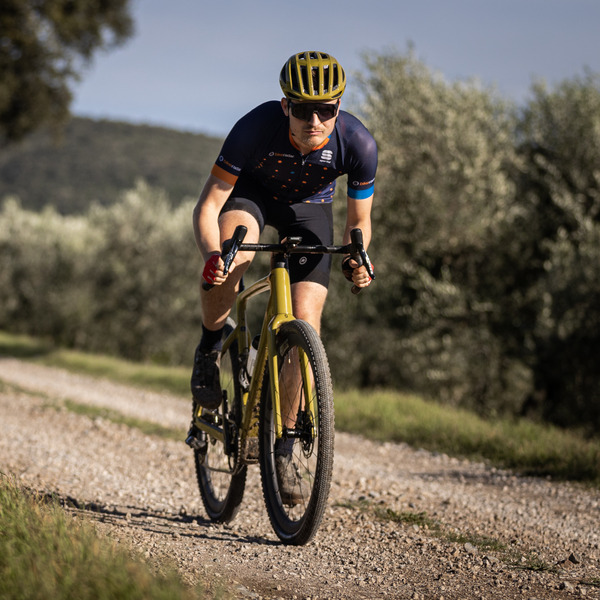
The Ignite GTX is a new model from Ridley designed for the most challenging terrain, bridging the gap between gravel riding and mountain biking.
It has exactly the same frameset as the brand’s Ignite SLX cross-country mountain bike, albeit with a drop handlebar and dedicated gravel componentry.
Ridley says you can look at this monster gravel bike from two perspectives – either it boosts a typical gravel bike’s capabilities or it makes a mountain bike more versatile on tamer terrain by adding a drop bar.
It’s a bike designed for the toughest events and ultra-distance races, where there’s an increasing trend for some riders to stick a drop handlebar on their MTB to have a more capable bike on technical terrain, while maintaining an aero and efficient position.
But professional athletes with sponsor commitments are forced to stick to either off-the-shelf gravel or mountain bikes, hence why Ridley is dipping its toe into the genre.
In testing, I’ve found the Ignite GTX satisfies the brief, but it’s certainly very niche and some questionable spec choices prevent the bike from reaching its full potential.
- Read more: Best gravel bikes in 2026 – top-rated carbon, aluminium, titanium and steel gravel bikes reviewed
Ridley Ignite GTX frame details

“A drop-bar mountain bike!” was the consensus of almost everyone who laid their eyes on the Ignite GTX during my testing.
That's not surprising, given Ridley has essentially re-purposed its cross-country mountain bike frame.
But there's a method to the madness. Ridley says it had noticed a shift towards some privateer riders using home-built drop-bar-equipped mountain bikes for more technical ultra-endurance races, such as the Atlas Mountain Race or the Tour Divide.
“We have developed the Ignite GTX starting from our Ignite SLX hardtail frame platform because we saw a growing number of consumers converting their mountain bikes to a gravel bike for more technical and rougher terrain,” says Bert Kenens, senior product manager at Ridley.
“Since there are very few bikes available on the market with this setup as standard specification, the Ignite GTX is an answer to this market demand, even if it might only be a niche segment.”

The Ignite GTX’s release means Ridley now has eight gravel bikes in its range, with the new bike sitting alongside the ASTR, Invenio, Kanzo Fast, Kanzo Adventure, Kalazy, Grifn RS and Grifn Gravel – and that’s before you factor in the brand’s electric gravel bikes.
The Ignite GTX stands out with its dramatically sloping top tube and longer-travel (for gravel) 100mm suspension fork.

The frame is constructed from Ridley’s second-tier Essential Series carbon – a mixture of Toray 24T and 30T carbon, with the brand claiming a 1,061g frame weight for an unpainted size-medium frame. This sits below the brand’s Elite-series frames, which use 50T and 60T carbon.
Ridley says the kinked top tube stiffens up the head tube area and results in a lower standover height, allowing for more exposed seatpost, which boosts compliance.
It has room for voluminous 29x2.3in (or 700c x 58mm) tyres – one of the largest clearances on a gravel bike to date.

On purchase, you can choose to have a rigid carbon fork or a suspension fork.
Most gravel bikes with suspension forks have 40mm travel, although RockShox’s recently announced Rudy XL fork has 60mm travel. The Ignite GTX takes things further and then some, with a 100mm-travel mountain bike fork – just like on the Ignite SLX mountain bike.
The brand says speccing a gravel suspension fork would negatively affect the bike’s handling because the geometry isn’t designed around the shorter travel.
Elsewhere, there are flexstays for increased rear-end compliance, and Ridley specs a BB92 bottom bracket standard to ensure a wide compatibility with a range of cranksets.

A curiosity is that Ridley specs a skinny 27.2mm-diameter seatpost rather than a 31.6mm from the mountain bike world, which would open up compatibility with a wider range of dropper posts. But Ridley says it specced a skinnier post for compliance purposes.
What’s more, there’s a larger 180mm disc brake rotor up front, paired with a standard 160mm out back.
Since this is a re-purposed frame, there aren’t many mounts for bikepacking, which is a shame – you’ll need bags that strap onto the frame.
Ridley Ignite GTX geometry

The bike is available in four sizes (S-XL) and shares the same geometry as the Ignite SLX, which Ridley calls its ‘pure mountain bike geometry’. I’m 5ft 11in / 180cm tall and tested a size medium.
The 70-degree head tube angle is on-trend for a gravel bike (but very steep for a cross-country mountain bike), although some gravel bikes at the more adventurous end of the spectrum go slacker still, such as the Kona Ouroboros and BMC URS at 69.5 degrees.
But Ridley says it “saw no need to go sub-70 [degrees] on a gravel bike” because it “wanted to keep the steering lively and active, with the wheelbase bringing the required stability”.
Elsewhere, there’s a 73.5-degree seat tube angle, paired with a reasonable but not especially long 418mm reach and a tall 614m stack.
Considering this is a bike at the extreme end of the gravel spectrum, the handlebar and stem are a little narrower and longer than I’d expect, with my test bike wearing a 70mm stem and 44cm-wide handlebar with a substantial 24-degree flare.
| Size | S | M | L | XL |
|---|---|---|---|---|
| Head tube angle (degrees) | 70 | 70 | 70 | 70 |
| Head tube length (mm) | 95 | 100 | 110 | 130 |
| Top tube length (mm) | 580 | 600 | 625 | 650 |
| Seat tube angle (degrees) | 73.5 | 73.5 | 73.5 | 73.5 |
| Seat tube length (mm) | 380 | 435 | 485 | 535 |
| Chainstay length (mm) | 430 | 430 | 430 | 430 |
| Bottom bracket drop (mm) | 58 | 58 | 58 | 58 |
| Wheelbase (mm) | 1,080 | 1,100 | 1,126 | 1,152 |
| Reach (mm) | 400 | 418 | 440 | 460 |
| Stack (mm) | 609 | 614 | 623 | 642 |
Ridley Ignite GTX build

This ‘SRAM Rival 1 with suspension’ build sits at the top of the four-model range, setting you back £3,199 / €3,499.
If you don’t want the suspension fork, the price drops to £2,699 / €2,999.
On suspension duty is RockShox’s Recon Gold – a mid-range 100mm-travel suspension fork that lacks some of the bells and whistles of the more premium Reba and SID / SID SL lines, such as their superior damping, air springs and lighter internals.
The fork is paired with a RockShox PopLoc handlebar-mounted remote lock-out lever.
You get a predominantly SRAM Rival 1 groupset – an interesting choice given the 1x11-speed groupset is the best part of a decade old. Ridley admits, “this choice was made due to practical reasons based on available inventory”.

Ridley deviates with the crankset by stepping down to an 32t NX Eagle-level chainring – more generous than the smallest 38t chainring offered for Rival – combined with an 11-42t cassette out back.
The vast majority of the spec is from 4ZA, Ridley’s in-house brand, including the unmemorably-named XCD-SL aluminium wheels, with a notably narrow 23mm internal rim width, as well as the 4ZA Stratos stem and Cirrus carbon seatpost.
The own-brand wheels are wrapped in Vittoria Barzo XCR tyres in a 29x2.25in width.

Ridley has specifically cherrypicked the 44cm Ritchey Venturemax XL handlebar, with its significant 24-degrees of flare and short 102mm drop that measures 43cm between the hoods and 57cm between the drops (outside to outside).
My size-medium test bike weighs 11.07kg – rather weighty for a gravel bike, with the suspension fork contributing almost 2kg of that figure.
Considering this is the top-of-the-range model designed for some of the world’s toughest ultra-endurance races, you’d be correct in thinking this is a fairly modest spec.
I asked Ridley if it planned to offer a higher-spec version for sponsored athletes or general riders and the brand replied “we are seeing how riders feel about the Ignite GTX because it will help us decide on the future of the platform”.
Ridley Ignite GTX ride impressions

I tested the Ignite GTX over 600km on the trails around Bristol, as well as day trips to the Forest of Dean and Salisbury Plain.
Testing culminated in using the bike for Traws Eryri – a 196km bikepacking route through North Wales with a smidge over 4,000m elevation. It’s recommended you use a mountain bike for this route rather than a gravel bike, so what better way to test the Ignite GTX’s credentials?
The Ignite GTX pedals just like a mountain bike, which is fine, but that means it feels rather lethargic on the road or tamer sections that link up the trails here in the UK. It’s not the most lively-feeling bike either, but some of the heavy componentry will be contributing to that – especially the fork.

As you’d expect, that means it’s not a fast climber and that suspension fork robs you of some of your effort, even when it’s locked out because it will still dive slightly.
The frame’s comfort is impressive, though. The 100mm-travel fork quashes trail obstacles just like a mountain bike, and the skinny 27.2mm seatpost and flexstays offer far more compliance than I was expecting, making the Ignite GTX an impressively balanced ride.
Unsurprisingly, the Ignite GTX is impressive when the going gets rough. The bike was at home on flowing singletrack and gave me more confidence than a traditional gravel bike on some of my usual Bristol technical descents.

But despite having fun on said descents, I felt pretty indifferent about the bike on most of my rides around Bristol because it’s not a mile muncher – is the roughly 10 minutes of excitement really worth it over the course of three hours?
I even took the Ignite GTX with me on a MBUK team mountain bike ride to the Forest of Dean (much to my colleagues’ bemusement!) – the type of ride where you drive your mountain bike to a trail centre for a concentrated dose of fun.
It handled the blue-graded trails with ease, but started to get stuck on some of the reds on tabletops and a slippery root-infested section. It wasn’t the frameset that got stuck – it was the drop handlebars, making the bike more difficult to handle where a mountain bike would be the more appropriate choice. The lack of a dropper post also meant I had to position my body rather awkwardly behind the saddle.

Despite its technical trail capability, I also thought the Ignite GTX lacked character. The bike does what you want it to within reason, but there’s nothing that defines the ride quality as that of a Ridley – it’s a bit soulless.
I think the Ignite GTX would be more exciting to ride if it had a gravel-specific frame that didn't bring the pedalling compromises on tamer sections inherently found on a mountain bike from its geometry and ride position. It never felt as efficient as a more conventional gravel bike.
While the 3T Extrema Italia and Kona Ouroboros gravel bikes, for example, aren’t as adept as the Ignite GTX on the most technical descents, both are far more versatile for more of the time when gravel riding. This isn’t a one-bike solution, at least for the trails I ride, and I struggle to think of an environment this bike would consistently excel in.
On the Traws Eryri, I was impressed by the Ridley but not blown away – the same trails could be ridden on a conventional gravel bike, albeit you’d have to concentrate a little more.
Yes, components such as the fork and wider tyres will be of benefit on some of the gnarlier terrain in the Atlas Mountain Race, but Alex McCormack won the 2025 edition on a hardtail mountain bike – go figure…

Moving onto the components, the Recon fork is serviceable, but quite heavy and not as plush as a more premium fork with more stiction and harsher damping.
A more premium fork with a stiffer chassis would elevate the bike and it’d be the first thing I’d upgrade if I was using the bike on an ultra-endurance race.
Ridley includes a RockShox PopLoc remote lockout – this is an ancillary lever that’s clamped to the handlebar, which I really didn’t get on with.

The plasticky lever isn’t very ergonomic and its girthy profile meant I could never quite get the switch in the right position. The extra gear cable that sprouts from it in front of the bars also deeply upsets my inner mechanic.
What’s more, when I got out of the saddle, I would occasionally brush the lever and it made fitting a handlebar bag tricky when I was bikepacking because I’d have to awkwardly tuck the cable in behind the bag.
If this were my bike, I’d do without a lockout lever entirely and use the dial on the fork instead – they’re easy to reach, especially on a drop-bar bike.
Although this is specific to my test bike and I haven’t factored it into the score, the lockout function failed on my fork towards the end of testing – likely a problem with one of the internal fork shims.

It’s been a while since I’ve seen a bike with SRAM Rival 1 but the decade-old groupset works very well and I particularly like the tall lever ergonomics with the hood’s grippy texturing.
However with modern groupsets being 12- or 13-speed, this 11-speed offering is rather dated, as is the 11-42t cassette ratio.
Cassettes with a 46t largest cog (or as high as 52t) are widespread now and for good reason – it’s an easier bailout gear for climbing, especially if you’re bikepacking.
While I appreciated Ridley speccing that smaller 32t chainring, I still regularly found myself in that 42t cog – and you can’t go any higher because the 42t cog is the maximum size the Rival 1 derailleur’s cage can accept.

The groupset also limits upgrade potential – you’d have to change everything if you wanted to switch to a SRAM 12- or 13-speed groupset.
Although a rung down SRAM’s hierarchy, the brand’s Apex Eagle would have been a better spec choice – it’s 12-speed, the derailleur is compatible with 50 and 52t largest cogs, and it’s fully compatible with SRAM’s higher electronic AXS groups.
While the brakes offer good modulation, they’re not as powerful as newer iterations of Rival, even with that larger 180mm disc brake rotor.

The wheelset is also unremarkable – I’d recommend upgrading when funds allow for something with a more generous internal width to make the most of that tyre clearance.
The bike comes with inner tubes out of the box, but I converted the bike to tubeless straightaway (you’ll need valves and sealant) so I could have more concrete ride impressions.
I also wasn’t wowed by the Vittoria Barzo tyres, lacking outright grip and never excelling in any scenario.

Finally, the Ritchey Venturemax handlebar is an odd beast – I found the ovalised hoods uncomfortable to wrap my hands around for extended periods of time, and the drops have an awkward shape, with a kink at their mid-point. This means when you hold the drops with your hand over the brake lever, the kink presses into your thumb, which is uncomfortable.
Despite some so-so components, the Ignite GTX represents reasonably good value.
Even if the frame geometry isn’t the most progressive, a carbon frameset at this price point is competitive and most of the components will see you well to start off with, but I’d recommend the aforementioned upgrades if you plan to take this racing.
Ridley Ignite GTX bottom line

There’s no denying the Ignite GTX is niche, but it satisfies the brief that Ridley set out for itself.
If you want to take on the roughest trails and don’t mind compromising everywhere else, the Ignite GTX could be a potent option – if you’re willing to make upgrades to some of the components.
But this will be overkill for most riders and if you’re looking for a bike to ride on technical terrain and still have fun on linking sections, an adventure-focused gravel bike with clearances in the region of 55mm will stand you in better stead. However, it’ll be a tough ask getting a good-quality suspension fork at that £3,199 / €3,499 price point.
Product
| Brand | Ridley_bikes |
| Price | €3499.00, £3199.00 |
| Weight | 11.07kg |
Features
| Fork | RockShox Recon Gold , 100mm |
| Stem | Forza Stratos, 70mm |
| Frame | Ignite GTX Essential Series carbon fibre, BB92, flatmount, TA 12x148 |
| Tyres | Vittoria Barzo XC G2.0, 29x2.25in |
| Brakes | SRAM Rival |
| Cranks | SRAM NX Eagle, 32t, 175mm |
| Saddle | Selle San Marco Shortfit 2.0 |
| Wheels | Forza XCD-SL, Clincher-TLR, 23mm internal width |
| Shifter | SRAM Rival |
| Cassette | SRAM PG-1130, 11-speed, 11-42t |
| Seatpost | 4ZA Cirrus, 27.2mm, 400mm, Zero offset |
| Handlebar | Ritchey VentureMax II, 440mm |
| Bottom bracket | BB92 |
| Available sizes | S, M, L, XL |
| Rear derailleur | SRAM Rival 1, 11-speed, Long Cage |
SQUIRREL_13812428