Rouvy and Zwift are designed to keep your indoor riding interesting, while enabling you to get as hard a workout as you want or need.
Both indoor cycling apps also give you the opportunity to race against other riders worldwide or follow a training plan that’s more visually stimulating than staring at a series of bars and numbers on a screen.
On the face of it, then, Rouvy and Zwift offer many of the same features, but there are significant differences in how they are delivered.
What is Rouvy?

Rouvy is an indoor cycling app that runs on various computing hardware and simulates riding in the real world.
It plays real-world video at a speed that matches your riding on a trainer. If you have a smart trainer, it will adjust the resistance you experience to mimic the gradient of the road you’re riding.
The app has more than 50,000 augmented reality routes that provide over 240,000km of riding.
Rouvy overlays the video with augmented reality avatars representing you and fellow riders or bots.
What is Zwift?

Zwift is the dominant player in indoor cycling apps, providing many of the same features as Rouvy.
Whereas Rouvy uses video of real roads, Zwift’s environments are entirely virtual. It includes numerous imaginary worlds, with Watopia being the most developed, as well as simulations of real places such as the Scottish roads used in the 2023 UCI Road World Championships.
Alongside the Zwift app, which manages the simulation, there’s a Zwift Companion App, which runs on a smartphone and provides schedules of races, group rides, messaging and more.
With a large user base and a packed calendar of races and events, at any time there will be plenty of opportunities to ride with or against others.
Rouvy vs Zwift
Rouvy and Zwift share many of the same features, designed to make your virtual rides more immersive and enjoyable. At the same time, they have slightly different emphases, with Zwift being more gamified than Rouvy at present.
Here’s a run-down of what each offers, how much they cost and what you need to use them.
Routes and worlds

A large difference between Rouvy and Zwift is in the routes that are available to ride.
Rouvy’s real-world video for its augmented routes covers more than 240,000km of real roads, including bucket-list rides such as Mont Ventoux, the Passo dello Stelvio and the Kona Ironman course.
Avatars and virtual riders are overlaid onto the video in 3D and, on some, you can spin your virtual camera round to admire the view.
There’s another huge library of video without the augmented-reality overlay, which Rouvy says totals almost 250,000km.
On these routes, you see video of the route ahead without an avatar, but you’ll still feel the gradient change in response to the video if you’re using a smart trainer.

In contrast, Zwift’s worlds are all virtual, although some simulate real-world places (albeit in Zwift’s own gamified style).
Within each Zwift world, there are numerous routes you can follow, with two in the Paris world and 76 in Watopia.
Not all the Zwift worlds are available every day, to help stop the number of riders in each becoming too sparse. Instead, Zwift rotates two ‘guest' worlds alongside Watopia, its ‘always on’ world.
Zwift publishes a calendar of when each world is available and events taking place on its companion app.
There are currently 10 worlds in regular use on Zwift:
- Watopia
- France
- Innsbruck
- London
- Makuri Islands
- New York
- Paris
- Richmond
- Yorkshire
- Scotland
Structured training and workouts
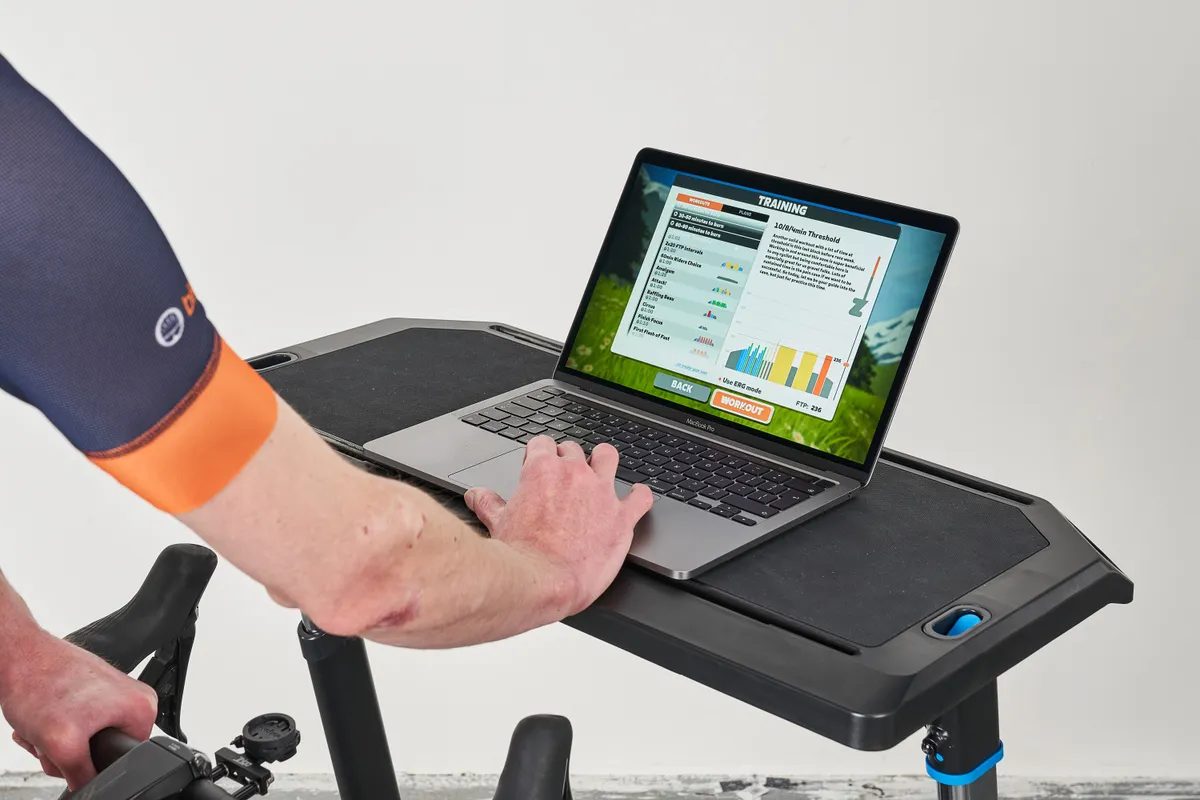
As well as free riding, both Rouvy and Zwift offer a range of structured workouts and training plans, which you can follow.
Rouvy says it has around 10,000 workouts in its library, created either by professional coaches or its users, and you can build your own workout, too.
In its growth, Rouvy has bought out BKOOL and FulGaz, meaning their functionality can be found within Rouvy. It also offers training by the pros, with plans by Andy Schleck and Lidl-Trek.
Zwift also has a range of workouts and structured training plans available, again including many from professional coaches. There are scheduled group workouts, which you complete alongside other riders using Zwift, or you can follow a pre-built workout alone, or build your own custom workouts.
Group rides and racing
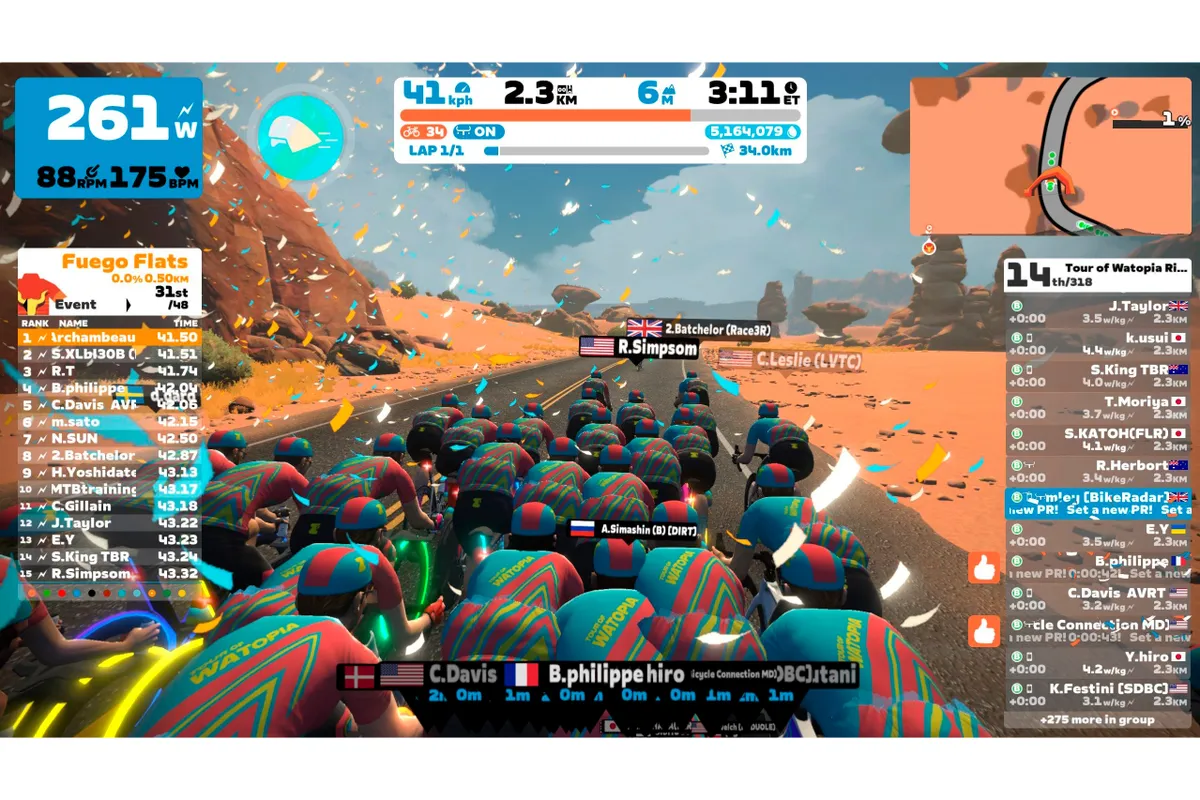
Both Rouvy and Zwift offer a schedule of group rides at set times. Both also enable you to invite others to join you on rides.
While how fast you rode on Rouvy used to just be a function of the power you put out, its physics simulation is now more sophisticated, with support for drafting and the effects of a rider’s height and weight.
A ‘reality level’ setting enables you to adjust the effort required to keep up with other riders, but this can only be used in the ‘Just Ride’ mode (Rouvy’s free ride mode) and not in events or races.
Zwift also supports drafting in its physics simulation, and takes into account a rider’s height and weight, encouraging you to stay with a group.
The Zwift companion app can be used to find and join races and rides, and communicate with other riders via text messaging.
Rouvy and Zwift also offer racing, enabling you to join or organise your own races on their platforms too.
Rewards
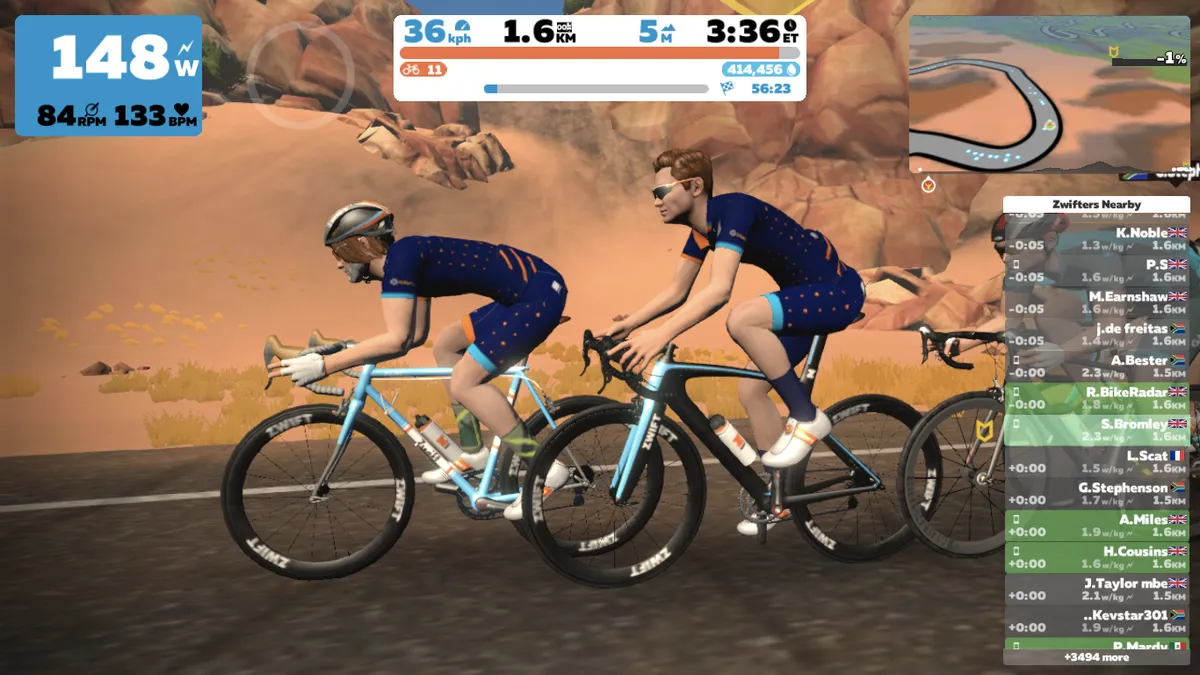
Rouvy and Zwift both give you the opportunity to collect rewards for your efforts on their platforms, enabling you to upgrade your avatar and buy other add-ons.
Rouvy has what it calls your Rouvy Career, which tracks your progression in the app, with a total of 80 levels. It also enables you to collect Coins for both outdoor and indoor riding, which you can swap for virtual and real rewards.
Links to both Strava and Garmin Connect are supported and other app connections are promised as part of future developments, enabling you to sync your outdoor rides to Rouvy.
Zwift, too, enables you to garner experience points and in-game currency (called Drops) as you ride.
These help you level up, and to unlock or buy different equipment for your avatar and new parts of Zwift's worlds.
Zwift also enables you to gain a range of different PowerUps as you ride, which can be used tactically to either boost your in-game speed or outfox your opponents.
Connectivity and computer hardware

Both Rouvy and Zwift require an internet connection to link you to their routes and connect you with other riders.
You’ll need something to run the apps on and an indoor trainer – for both Rouvy and Zwift, a smart trainer or smart bike will give you the best experience.
Rouvy will run on a range of systems: Android or iOS smartphones and tablets, Mac and Windows PCs and Apple TV, with trainer connection using BLE or ANT+ (if your device supports this protocol or you have an ANT+ dongle).
Zwift will run on the same range of hardware, including Apple TV, while the Zwift Companion App runs on Android and iOS smartphones.
Both apps require access to the internet to function, so a WiFi connection is required.
Trainer hardware

Rouvy is compatible with smart bikes and smart trainers, as well as other cycling hardware. It gives you a list of supported and semi-supported trainers, providing advice on connecting them up and how to solve potential problems.
Zwift is also compatible with a wide range of smart trainers and even offers its own hardware in the form of the Zwift Cog and Zwift Ride, which enables virtual shifting.
If you don’t have a smart trainer, you can instead use a non-smart trainer or rollers on both apps, as long as you have a compatible power meter or a speed and cadence sensor on your bike.
The major downside to using a non-smart trainer is you won’t feel the resistance change automatically in response to changes in the in-app gradient.
However, for getting started on a limited budget, it's a viable option.
For more information or inspiration on building an indoor cycling setup, check out our guide to the best Zwift setups.
Pricing
The base price of the two apps is very similar, which you’d expect since they’re competing in the same space. At the same time, there are subtle differences.
If you want to dip your toe in the water before committing, both Rouvy and Zwift offer a free 14-day trial period to try the app’s functionality.
Rouvy is priced at £17.99 / $19.99 per month, with a yearly membership priced at £159.99 / $179.99.
New Rouvy members can only subscribe via the brand’s website.
With Zwift, you get a free trial if you opt to pay monthly (which, as with Rouvy, you need to do before you get trial access). The annual membership comes with a 30-day money-back guarantee, effectively working as a free trial, even if you have to pay up front.
Zwift will bill you £17.99 / $19.99 per month. Sign up for the year and you’ll be billed £179.99 / $199.99 up front for membership. Other local currencies, including yen, are also supported.
You can pay for Zwift using a range of major credit cards via the brand’s website, or via Apple's App Store or the Google Play Store.
Opt for a monthly membership and you can also use a debit card or set up a direct debit, options that aren’t open for annual membership.
For those looking to save some money, MyWhoosh offers a similar virtual world experience to Zwift and is free to play.
Rouvy vs Zwift – the bottom line

Both Rouvy and Zwift provide an immersive indoor cycling experience that will make your training or just freeriding on the trainer more enjoyable.
They cost almost the same, will run on the same hardware and offer similar opportunities for group rides, training and racing. You’ll find more riders on Zwift, though, thanks to its larger user base.
Where they differ most is where you ride. If you want a more realistic experience, Rouvy provides real-world videos, whereas Zwift’s worlds, even those replicating real places, are more stylised.
Zwift is more gamified, too, with features such as PowerUps providing extra interest as you ride.
Turn to Rouvy, though, and that stimulation comes from the option to experience riding some of the most famous roads in cycling without leaving home.