Launched in March 2026, Shimano Tiagra R4000 offers an appealing alternative to the brand's 105 R7100 mechanical groupset, with the company's latest-generation features and a more affordable price.
Since the previous generation of Tiagra was launched in 2015, lots has changed in Shimano's range. Its performance groupsets have moved to 12-speed electronic shifting and CUES partially filled the 11-speed gap in the company's range, although it has failed to excite the market.
Now, Tiagra R4000 seems to remedy this issue, with the new groupset offering 11 speeds and the shifting tech of Shimano's more expensive groupsets, alongside lower weights and better looks than CUES.
So, with that in mind, is Tiagra a better choice than 105? And does it have all the gears and a low enough weight for your riding? We’ve compared the two road bike groupsets' features to help you choose.
Shimano Tiagra vs 105 at a glance
Shimano Tiagra
- 11-speed mechanical shifting
- 11-36 tooth cassette only
- Hyperglide shifting
- Hydraulic disc brake only
- 50/34t and 52/36t crankset options
Shimano 105
- 12-speed mechanical shifting (with an electronic 105 Di2 option, too)
- 11-34 tooth in-series cassette but compatible (and usually specced) with an 11-36t
- Hyperglide shifting
- Hydraulic disc brake only
- 50/34t and 52/36t crankset options
Shimano Tiagra vs Shimano 105: components and features compared
Weight
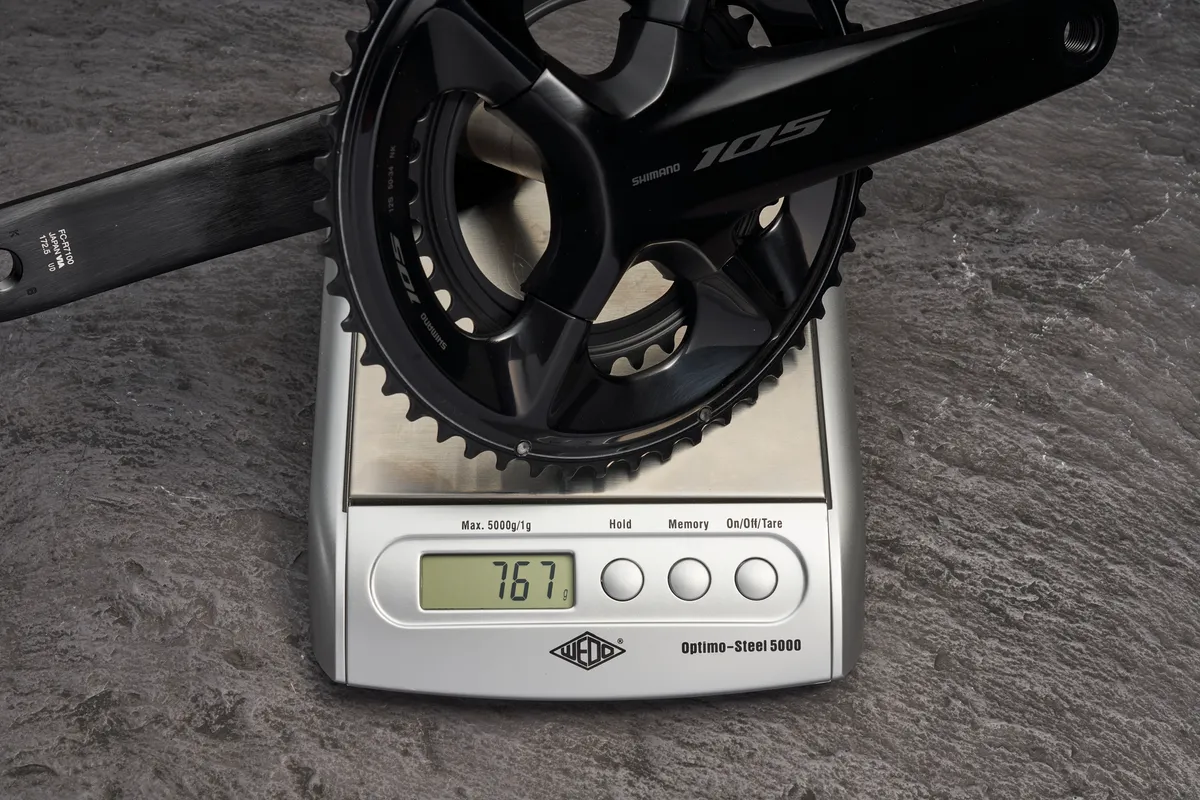
Totting up the weight of all the individual components, we reckon Tiagra comes out at around 3,075g while 105 mechanical weighs 2,875g.
The majority of that excess weight is in the Tiagra crankset, where the claimed weight is 153g greater for a 50/34t.
Other components are within a few grams of each other, while 105 and Tiagra share some components, such as brakes that are not groupset-specific, or borrow them from existing product ranges.
Price
There’s a similarly small difference in list price for the two groupsets as well, with our calculation showing Tiagra costing around £760 versus just over £800 at full price for 105, although that was the list pricing for 105 at launch in 2023.
As usual, you can expect a significant discount if you shop around for your groupset.
There’s likely to be more of a difference if you’re buying a complete bike, because brands will want to preserve some price differentiation between specs and to choose other components, such as wheels and tyres, to maintain this.
Shifters

The new Tiagra borrows the looks and ergonomics of 105. It sees easier reach to the levers for a wider range of hand sizes than old Tiagra, thanks to a repositioned lever pivot and fixing bracket.
The design mirrors 105 mechanical and is supplied with the BR-RS405 brake calipers, which are already available.
There’s only a 10g a pair weight increase over 105, to a claimed 622g for Tiagra.
Crankset

The Tiagra crankset is another component that mimics its 12-speed peers, with styling that’s even similar to Shimano’s premium Dura-Ace, even if the finish isn’t as polished.
The crankset is a lot heavier than 105, though, at a claimed 907g for a 50/34t versus 105, which weighs 754g. It’s the one component where you’d save a chunk of weight by choosing to go 12-speed.
You’d need to up-spec to Ultegra or Dura-Ace if you wanted a chainring combination other than 50/34t or 52/36t, though.
Front derailleur

Another element that mimics 105, the Tiagra front derailleur redesign sees a shorter lever throw than its predecessor. There are band-on and braze-on options for both. The 95g weight for Tiagra is identical to 105.
Rear derailleur

There are subtle differences between the Tiagra rear derailleur and that of the 105 mechanical groupset, even if on the surface the new Tiagra derailleur follows Shimano’s latest Shadow design.
The older 10-speed Tiagra rear derailleur sat under the cassette and was sold with short and mid-length cages to accommodate different cassette ranges. In contrast, the new Tiagra derailleur wraps around the cassette more, although the rear isn't quite as clean-looking as 105.
At 275g, it’s 26g heavier than the claimed weight for 105, which is 249g.
Cassette

The in-series 105 cassette has an 11-34t range, although the 105 derailleur is also compatible with an HG710-12 cassette with 11-36t range. In contrast, the Tiagra cassette is 11-36t only, although we’d expect it to be compatible with an 11-34t cassette also.
Many brands speccing 105 mechanical pair it with the 11-36t cassette for the lower ratio it offers for climbing, so we don’t see the lack of an in-series 11-34t as a great loss for Tiagra.
At 398g, the Tiagra cassette is only 7g heavier than a 105-compatible HG710-12 11-36t cassette, although you can drop 105’s cassette weight to 360g by choosing the 11-34t option, saving you 38g.
The Tiagra cassette’s ratios are reported to be 11, 13, 15, 17, 19, 21, 23, 25, 28, 32 and 36 teeth. For 105, the equivalent 12-speed cassette has 11, 12, 13, 14, 15, 17, 19, 21, 24, 28, 32 and 36-tooth sprockets.
The result for 105 is two extra ratios in the higher range, while losing a lower mid-range ratio for use when climbing.
Pedals
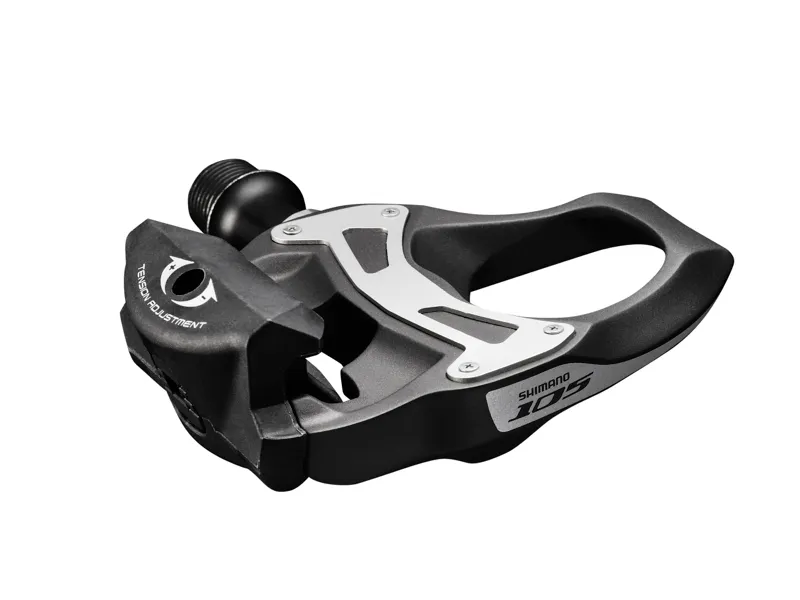
There’s no in-series pedal as part of the Tiagra groupset. Instead, you can choose between Shimano’s other pedals, with the composite PD-R550 being the budget choice and weighing 310g a pair, according to Shimano.
Alternatively, you could choose the carbon-composite 105 pedals with a 265g a pair claimed weight, any of Shimano’s other pedals, or pedals from another brand altogether.
Brakes
Brakes are another component where Shimano has decided to use its existing products rather than, figuratively speaking, reinventing the wheel. So Tiagra is specced with the existing BR-RS405 hydraulic calipers and there’s a similar choice of rotors as for 105.
Shimano Tiagra vs 105: weights and prices
| Weight (g) | Price (£) | |||
|---|---|---|---|---|
| Groupset | Tiagra | 105 | Tiagra | 105 |
| Rear derailleur | 275 | 249 | 64.99 | 59.99 |
| Front derailleur | 95 | 96 | 39.99 | 41.99 |
| Crankset (50/34t) | 907 | 754 | 139.99 | 159.99 |
| Shifters x2 | 622 | 612 | 349.98 | 359.98 |
| Cassette (11-36t) | 398 | 391 | 64.99 | 84.99 |
| Rotors x2 | 254 | 254 | 59.98 | 59.98 |
| Calipers x2 | 267 | 267 | Included with shifters | |
| Chain | 257 | 252 | 39.99 | 34.99 |
| Total | 3075 | 2875 | 759.91 | 801.91 |
Shimano Tiagra vs Shimano 105: which should you choose?

On the face of it, there’s not a lot to choose between Tiagra and 105, beyond the extra gear ratio for 105. If you’re usually riding faster in higher gears and fussy about your cadence, 105’s closer higher-range spread may be attractive. Many riders probably won’t notice the difference, though.
Price-wise, there’s little to choose between them, particularly since both groupsets are likely to be available with a discount.
Most cyclists will be buying a complete bike rather than the groupset, though. As noted above, this is likely to result in a greater price difference between Tiagra and 105-equipped full-bike specs. It’s also likely that Tiagra will displace CUES as the groupset featuring on road bikes below 105 in the future.
The update to Tiagra has seen it lose an array of options that old Tiagra R4700 had acquired over the years. If you’re looking for a triple crankset, flat-bar shifters or rim brakes, you’ll be disappointed. So there’s currently no reason to choose Tiagra over 105 for greater configuration choice.
We’d suggest that full-bike price is likely to be the most important determinant in whether to choose Tiagra or 105. If the two are similar for the bike you’re interested in, 105 may be the better option for its extra gear ratio; if there’s a greater price difference, Tiagra should offer you similar performance to 105.
If you want something more premium, or maybe rim brakes or a 46/36t crankset for cyclocross, you'll have to look to Ultegra R8100 and go electronic.