Anti-lock braking systems (ABS for short) have been around in the automotive world for years. However, in the bicycle world, ABS is far newer and more of a novelty. Why would riders want to hand control to a computer when it comes to managing how they brake?
These braking systems are becoming more prevalent, but will they ever be the norm? And do riders and racers need a complex set of sensors to prevent them from locking up a wheel?
Leading ebike motor supplier Bosch clearly thinks there’s something in it and is leading the charge when it comes to ABS.
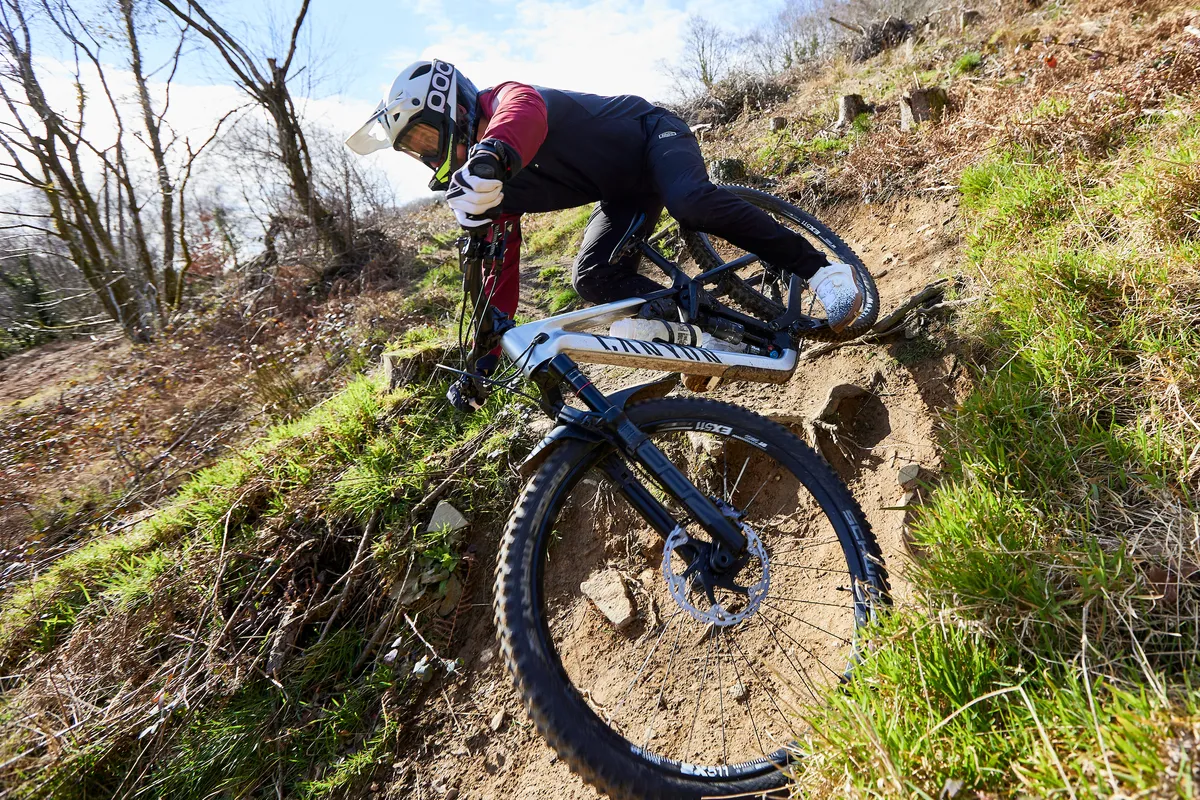
Multiple teams were seen testing ABS on downhill bikes at UCI World Cup rounds last year, looking to see whether it can provide any time-saving advantages.
In a bid to find out what the future holds, we've taken a deep dive into the tech, spoken to the brand behind it, and asked some seasoned riders, racers and mechanics what they think about ABS.
Behind the technology

Bicycle ABS isn’t new. Heavy, motorised cargo and city bikes with fewer concerns about weight saving have proven its effectiveness and we’re now seeing the system rolled out on electric mountain bikes.
Bosch-equipped ebikes offer the only widely available way to buy ABS (hard-wired into bike power supplies from new), but the tech is developing fast and this year might be its break-out season; especially considering multiple teams were seen testing ABS on DH bikes at UCI World Cup events last year.
Bosch’s latest iteration is refined and smaller, with a complete package weighing only around 400g. It can easily be added to regular eMTBs.
Key parts include a main control unit attached to the fork legs and plumbed into the hydraulic brake lines, as well as speed sensors fitted at both wheels.
Bosch’s Flow app can still bypass the ABS and main control unit, so brakes function as normal, with the lever force compressing fluid in the system, pushing pistons in the caliper.

Unlike a regular braking system, where brake pads squeeze the rotor to slow or stop the bike (pull harder and the wheels lock more and for longer), ABS modulates the braking automatically using computing power.
The ABS magic gauges whether the front wheel is rolling slower than the rear or rapidly decelerating and then metering clamping force to prevent the wheel from locking, skidding and skipping.
To work this out, brake rotors have an extra inner slotted sensor disc called a ‘tone wheel’.
The ABS system reads real-time data about rotor speed and accelerations, and a set of pressure valves in Bosch’s little box predict and react to either allow or restrict the incompressible brake fluid.
Adapted to more challenging off-road scenarios such as loose surfaces and higher speeds through hardware/software interplay and sensor developments, there are now two specific modes, called ‘ABS Trail Pro’ and ‘ABS Race’.
Does it work for riders?

The big idea behind ABS is that stopping the front wheel from locking up helps bike control and steering massively.
The system therefore works in real time to ‘feather’ your brake, which is what the best riders will be doing instinctively already. But Bosch explains ABS is, in part, a reaction to the performance of hydraulic disc brakes increasing so much in recent years that even skilled riders may not be able to apply the ideal amount of braking force in all situations.
ABS is also designed to maintain the natural riding sensation of a bicycle.
If that all sounds like a great idea, one potential limitation is there’s only a two-to-four second window of effectiveness; if you slam on the brakes and squeeze the lever for longer, the system is overridden and the wheel will still lock up.
Considering the system is developing fast (the latest, second-generation design is already 55% lighter and 77% smaller than the original), aspects such as this might change soon.
Another potential concern is many adventure motorcyclists disable ABS and prefer full rider control on mixed and loose surfaces. They claim relying on it off-road can mask skill deficits and that true control comes from understanding overall bike dynamics.
Bosch says mountain bikes aren’t as heavy and have a very different centre of gravity from motorbikes, so these dynamics are different.
Also, it says ABS addresses how cyclists are at more risk of pitching over the handlebar during heavy front-wheel braking than motorcyclists.
Despite Bosch’s ABS being fitted to downhill race bikes with a separate power supply, and adapted levers and hoses for testing (with Shimano XTR brakes), the German brand is keen to point out it only sees ABS as integrated into complete ebike systems, where it's viewed as being key to reliable function and safety.

That being said, we reckon this either hints clearly at further collaboration and a potential DH version coming, or Bosch plans on using feedback and data from DH racers to improve the current system.
Scores on the doors

Not all enduro motorcyclists are sold on ABS, but what do mountain bikers think?
And if ABS does make its way into racing, could it stir up controversies with concerns over machine- versus rider-controlled technologies as we’ve seen in Formula One?
It’s fair to say the reaction to Bosch’s ABS has been mixed.
There was an overall consensus that it could work well for leisure riders, but in extreme terrain and on continuously steep tracks, the very experienced and pro-level riders we spoke to were less impressed.
Steve Peat

Santa Cruz Syndicate head coach Steve Peat is looking for every advantage he can get for his riders.
Peaty's been involved in evaluating and testing the Bosch system with Shimano XTR brakes and told us he sees a lot of potential, but that none of the team riders will be running the system this year.
“It’s not something they have asked for yet and are very happy with the braking setups they have. I also think it might take an elite-level rider a full winter to get used to how the system works.”
For Peat, it’s more about habit. “Because I’ve been braking pretty much the same way for 45 years, it’s harder to adapt and I kind of find myself working around the system to an extent,” he explains.
And to some extent, this’ll be the same for a lot of more experienced riders and racers.
He continues: “I always brake late and hard, and end up stabbing at the lever and coming off fast, which is the way I’ve always done it, and it doesn’t really use the ABS to its full potential or allow it to kick in.”
However, there are some potential upsides. “I can see how it would be amazing for leisure riders to prevent them going over the bars or having an accident, and it could also be a great tool to stop brakes overheating in the Alps,” Peat says.
For those who are just getting started in mountain biking, he thinks there’s way more scope to use ABS: “My gut feeling is that the next generation of kids that grow up with it [ABS] are going to learn to use it to full advantage.
“As the technology stands, it’s potentially not offering significant enough advantages yet, but the bottom line is that DH teams have not had enough time to test it properly within a busy race season. If the clock reveals it’s faster like Bosch claim then it is obviously something lots of teams are going to be looking at.”
Alex Evans, former MBUK and BikeRadar senior technical editor

After clocking up significant miles on the Scott Patron 900 eMTB for a review, former BikeRadar tester Alex Evans was happy to state that he's not a fan of Bosch’s system.
After trying all the modes, Alex is convinced that while it could be useful for less experienced riders, it isn’t something he’d recommend for advanced ones.
“There were too many instances where I couldn’t slow down as effectively with the ABS activated, compared to with it off. Braking distances ended up increasing because the system was interfering with my inputs. Riders with good skill levels will be able to brake harder and faster without the system and manage brake modulation better via the brake lever and their fingers,” Alex noted.
Alex’s conclusion – that experienced riders will often be able to apply more stopping force by braking harder and modulating the power – is something the system can’t replicate.
He also claims advanced riders actively want the wheels to lock up at points to dig into the ground and to help enable directional changes. “Not being able to reliably lock up the wheels at will introduced elements of uncertainty, impacting confidence,” Alex said.

“On continuously steep tracks at Innerleithen, I frequently overshot corners and missed braking points. Not having the direct connection between brake lever and brake force reduced intuitive rider feel – overall, riding the steepest tracks was harder than without ABS.”
Alex added that while he can live with the mild warbling and pulsing of the activation, it’s more that ABS interrupted the connection between rider and bike, requiring significant relearning. It’s a little like when driving a new car for the first time – it takes time to learn how the brakes feel, where the bite point is and how hard you need to apply them.
Overall, Alex’s conclusion is the Bosch system won’t be for everyone, especially more advanced riders. However, riders who struggle with managing brake bite point and modulation will get some benefits from it.
World Cup DH team mechanic

Preferring to speak off the record, the World Cup DH team mechanic we chatted to has listened to feedback from professional DH racers that have tested a prototype Bosch ABS setup.
They’ve said the racers they’re aware of remain unconvinced of any benefits for racing compared to existing braking systems.
With athletes sweating the tiniest of details, scrutinising brake bleeds, lever angle and reach, throwing another variable (ABS) into the pot won’t necessarily sit well.
Racers rely on instant feedback and feel through the brake lever, and ABS could throw things off.
They are so used to braking as effectively as possible, that knowing exactly how something is going to perform might be more beneficial than having a computerised system work it out for you.
However, it’s worth remembering that Bosch’s DH setup is still a prototype (even if, to our eyes, the main control unit looks to be shared with Bosch’s ebike setup).
And don’t forget, racers are notoriously conservative about new tech because they can’t afford to be distracted by learning a new system. That means, if you don’t see it at World Cup round one this year, chances are you might not see it at all this season.
Looking ahead

Even considering some not-so-glowing reviews from the few riders we spoke to, the future will likely hold more ABS tech.
When you consider brands such as Magura, Shimano and TRP are already joining forces with Bosch, it shows they clearly believe in the system, which suggests there’s more to come.
Then there are bike manufacturers such as Cube, Canyon, Mondraker and Scott, further underpinning that point.
What’s more, with brands such as Brembo entering the chat (currently supporting the Specialized Gravity DH team) with the Sensify ‘intelligent’ braking system in the automotive world, it feels like there could be still more to come.
When it comes to the current system, Bosch says its ebike ABS already addresses the needs of experienced riders, "through a high degree of adaptability and specific control strategies implemented in the various ABS modes". It adds that, "for plenty of amateur riders, its tests indicate the system might mean you can brake later and with more control."
Our experienced riders' comments don’t necessarily bear this out, but it could be only a matter of time before ABS bicycle tech catches up with other motorised vehicles and becomes a standard safety and performance feature, surpassing human capabilities.
Reading between the lines of the people we chatted to, ABS is mostly there.
It's still got some way to go to better match the braking habits of experienced riders, though. Tweaks to the way the hardware and software interact could fix this, and deliver a feel that riders are comfortable with and boost predictability.
In short, it feels as though we’re getting closer to a system that even the pickiest riders could live with.
Even if ABS reaches a point where the computer is way smarter and more efficient than the humans holding the handlebars, and proves to be an advantage for beginners through to pro riders, there may still be a push back from purists who want to limit the tech on their bike.
Either way, it feels certain we’ll see more systems like this this appearing on bikes in the near future, and while they won't be for everyone, if developed correctly, they could offer performance gains.