Paris-Roubaix has always brought out the best and the worst in bike design.
With the 2026 routes for the men’s race covering 54.8km of cobbled roads and the women’s race 33.7km, riders will be looking for bikes and bike tech to give them the edge over their competitors and help make things more comfortable.
There are some classic hacks that continue to be used, such as double-wrapped bar tape and yet more bar tape to stop bottles escaping from their cages and cycle computers ending up in the mud. Alongside these, over the years, have come cobble-smoothing bike designs.
The modern trend, though, is to ride fairly standard aero road bikes, even if these are fitted with wider than normal tyres.
How did we arrive at the modern Roubaix-ready bike specs? Here are eight bikes ridden at Paris-Roubaix that showcased cobble-taming tech and were harbingers of modern Roubaix-winning bikes.
1. Greg LeMond and Gilbert Duclos-Lassalle’s 1991 Time

Greg LeMond and Gilbert Duclos-Lassalle both rode Paris-Roubaix in 1991 using a RockShox Roubaix suspension fork with 30mm of travel. Although neither won the race that year, Duclos-Lassalle returned with a suspension fork to win the race in 1992 and 1993, while Andrei Tchmil used a suspension fork to win the 1994 edition.
Suspension forks fell out of favour with the pros at Roubaix, though, due both to the extra weight and the need to build a frame to fit the fork for use in the one race.
2. Johan Museeuw’s 1994 full-suspension Bianchi

Johan Museeuw went one better in 1994, riding a full-suspension Bianchi that added a hinged rear triangle to a suspension fork. It didn’t end well for Museeuw, with the frame breaking with 24km to go.
Its designer claimed this was due to the rear section being made of aluminium alloy rather than steel and being bent by the bike builders to make enough space to fit the chainrings.
That 1994 race saw the high-water mark of suspension at Paris-Roubaix, with riders returning to the more traditional double bar tape, slightly-wider-than-usual tubulars and other Roubaix-specific hacks.
Museeuw may have lost out in 1994, but he returned without the suspension to win the race in 1996, 2000 and 2002.
3. Franco Ballerini's 1995 Colnago C40

In 1995, Franco Ballerini was the first rider to pilot a carbon bike to Paris-Roubaix victory. His Colnago C40 was the first in a line of Colnago C-series bikes that continues to this day.
Its lugged construction harked back to more traditional frame-building techniques than the monocoque carbon frames typical today, though, and Colnago continued to fit a steel fork to the C40 until the early 2000s.
Ballerini's C40 was a fairly typical road race bike of its time, saw victory in the Giro d'Italia in 1996 under Pavel Tonkov and was the bike raced by the top three UCI-ranked teams in 1998.
4. George Hincapie's 2005 Trek soft-tail
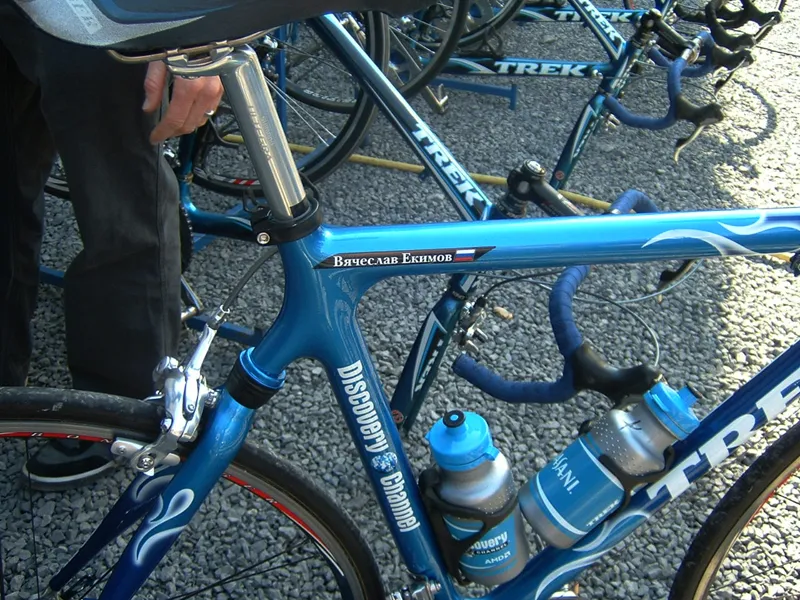
Despite its fall from grace, suspension made a comeback a decade later with a prototype Trek soft-tail road bike ridden to second place by George Hincapie. The SPA design included an elastomer at the top of the carbon frame’s seatstays. Along with pivot-less flex in the chainstays, this offered 13mm of rear-wheel travel.
More recent soft-tail bikes ridden at Roubaix have included the Pinarello Dogma FS piloted by Team Sky at the 2019 race. This had a similar setup at the rear to Hincapie’s Trek, with 11mm travel, but now electronically controlled and matched to 20mm of travel at the fork.
Plus, there was the first-generation Specialized Roubaix with its Zertz inserts and kinked seatstays, also claimed to provide passive vibration absorption, which was ridden to victory in the race by Tom Boonen and Fabian Cancellara.
Talking of which…
5. Fabian Cancellara’s 2010 Specialized Roubaix

He may have been accused of hiding a motor in his bike, but the secret to Fabian Cancellara’s 2010 win in Roubaix may have been his Zipp 303 aero carbon wheels.
Breaking a Paris-Roubaix taboo, Cancellara had opted for Zipp’s wide-rimmed carbon wheels over alloy rims. Prior to his win, carbon rims were considered by the pros to be too fragile for the cobbles; after his win, deep-section aero rims took over at the race.
Zipp claimed an aero benefit of more than 20 watts over box-section alloy rims, while the 1,152g reported weight for the tubular wheelset probably didn’t hinder his progress.
6. Matthew Hayman’s 2016 Scott Foil
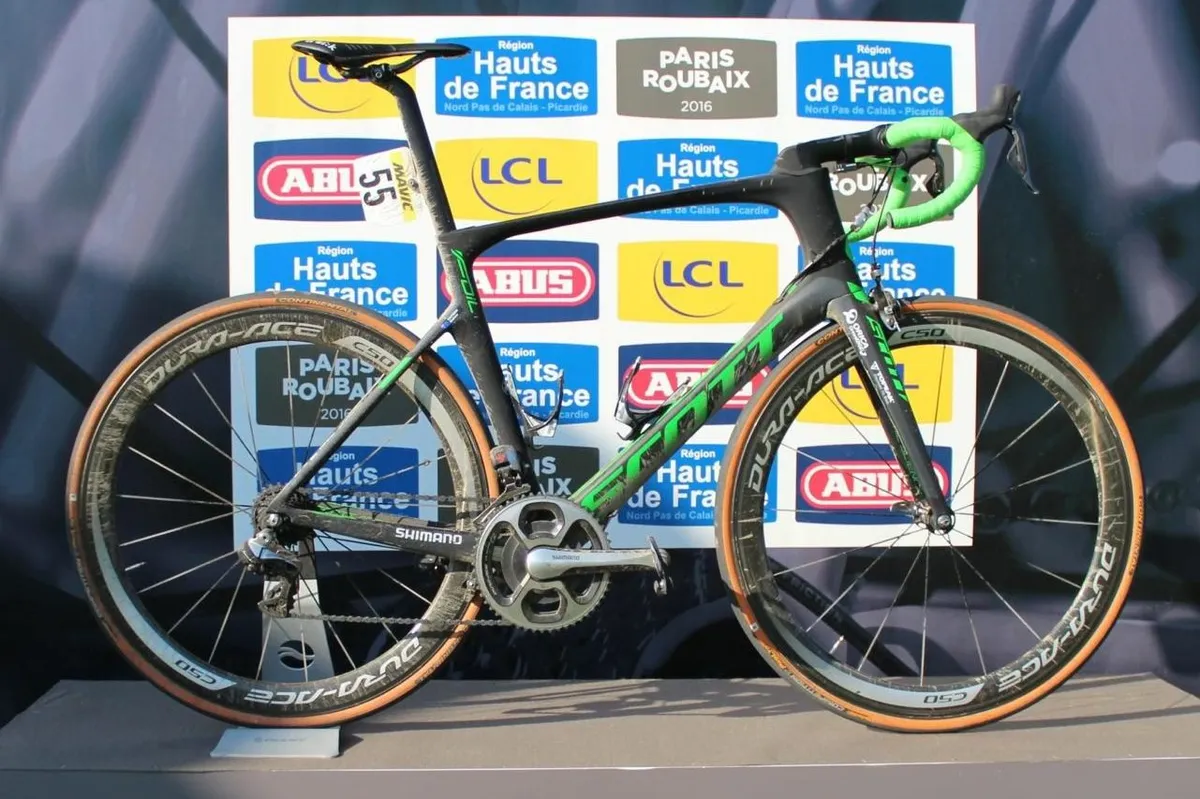
By the 2010s, Paris-Roubaix was the occasion to showcase a bike brand’s endurance bike, kitted out with the obligatory double bar tape and a range of other tweaks for the cobbles. That changed in 2016, when Matthew Hayman rode a more-or-less standard Scott Foil aero bike to victory.
Hayman had squeezed 28mm tubular tyres into the Foil rather than the then-usual 25mm tubs and had swapped from a 39-tooth to a 44-tooth small chainring. But otherwise, the aero wheels, electronic shifting, narrow saddle and single layer of bar tape were pretty much what you’d expect for a fast stage on tarmac.
Hayman’s win presaged an era of victories on more-or-less stock aero road bikes, including Sonny Colbrelli’s 2021 win on a Merida Reacto with 32mm tyres and, most recently, Mathieu van der Poel’s hat-trick of victories on the Canyon Aeroad CFR, also with 32mm tyres.
7. Philippe Gilbert’s 2019 Specialized S-Works Roubaix

Another portent of things to come was Philippe Gilbert’s 2019 win on a Specialized Roubaix. It was the first time Roubaix had been won on a disc-brake bike, as the pros’ 2016/2017 hissy fit over disc stoppers subsided and bike brands increasingly switched from rim brakes. In fact, all three podium finishers in 2019 were riding bikes with disc brakes.
Since that year, there’s been no win on a bike with rim brakes, while disc brakes have opened up the extra tyre clearance unavailable with rim brakes. Gilbert’s bike was equipped with 30mm tubulars.
8. Lizzie Deignan’s 2021 Trek Domane

Despite its billing as ‘hilly’, Paris-Roubaix is undulating rather than featuring any major climbs. Average speeds are high, too. That’s increasingly making a double-chainring groupset redundant, while a single chainring enables the use of a chain catcher, helping to prevent a dropped chain on the cobbles.
Lizzie Deignan won the inaugural women’s Paris-Roubaix on a Trek Domane endurance bike equipped with a single chainring and tubeless tyres.
Four of the five editions of the women’s race to date have been won on bikes equipped with a single aero chainring and Mads Pedersen came third in the 2025 men’s race on a 1x Trek Madone. It can only be a matter of time (and someone beating Mathieu van der Poel) for a 1x win in the men’s race.