The 2025 downhill racing season delivered some of the most dramatic and technologically rich competition the sport has ever seen.
While the on-track storylines were thrilling, from Vali Höll’s World Championships and World Cup series wins to the jaw-dropping finale in the men’s elite field, it was the tech evolving behind the scenes we were fixated upon.
From electronic suspension to wild cockpit attachments, teams and riders have spent the past year treating downhill bikes more like F1 cars, pushing tech to the very limit in a bid to ride as fast as possible.
The result? A season that pushed the boundaries of what’s possible in gravity racing and a glimpse at what’s coming next.
Electronic suspension gathers pace in downhill

Electronic suspension control has been around for a while now, but until 2025, it wasn’t particularly prevalent in downhill.
Now, though, more and more riders are sporting wireless systems that control their suspension damping, in a bid to make their bikes as efficient and fast as possible.
In fact, I think some riders would go as far as to say that without it, on certain tracks, you’d struggle to win.
As a result, the RockShox Flight Attendant and Fox Live Valve systems are something we’ve now seen quite of bit of, appearing on the bikes of Vali Höll and Troy Brosnan, along with others. And who could forget the super-secret Öhlins setup run on the Specialized Gravity Team bikes, which includes a PlayStation-like remote to control it.
SRAM appears to have adapted the RockShox Flight Attendant system to work with a Boxxer fork, even though it’s not available to buy. And it has even included a small lights display to ensure riders know which mode they're in.
For some, using these systems has provided a clear advantage at times. Loïc Bruni was using an Öhlins setup four years ago, on a bike littered with controls, hidden wires and a fully enclosed rear shock.
Look closely, though, and it isn’t only Bruni using a bar-mounted remote, despite the automated nature of this technology.
Although these systems optimise suspension settings automatically in real time, enabling riders to sprint on the pedals, hit jumps or blast through rough terrain without manually flipping switches or toggling modes, there will be times when riders still want control.
The reason you'll still see a remote on many of their bars is to enable them to override the system if they need to.
The advantage is simple: maximum efficiency on every section of the track: on long, fast courses such as Leogang and Lake Placid, racers used firmer settings for sprints and more open suspension for rock gardens, without ever taking their hands off the bar.
Smoother suspension: less pedal kickback, more speed

Rear-suspension movement can cause pedal kickback. This has long been a performance killer, especially when using long-travel bikes on rough terrain, as is the case in downhill racing.
In 2025, a wave of new components sought to fight that problem.
In the simplest possible terms, pedal kickback is caused when the suspension compresses and the distance between the rear wheel axle and the chainring increases. The upper part of the chain is put under tension and can cause the cranks to rotate backwards or ‘kick back’.
Resisting this kickback puts torque into the rear wheel, stifling the suspension’s movement and making it feel as if the suspension has firmed up a bit.
Products from brands such as Ochain and Rimpact offer chainring spiders that feature float within them, while e*thirteen and DT Swiss have created hubs that do a similar job, allowing just enough movement to limit the effects of the drivetrain on the suspension system. This, in turn, helps to deliver a smoother ride and reduce rider fatigue.
Teams rapidly adopted these systems, even those not officially sponsored by the manufacturers.
Riders reported fresher legs, less harsh feedback through the pedals and improved traction, especially on long, rough tracks such as Mont-Sainte-Anne.
Tuned mass dampers: a niche idea gains momentum

Once a curiosity, tuned mass dampers (TMDs) have gained traction among top riders seeking extra stability.
Tuned mass dampers are the small, vertically mounted cylinders you’ll spot fitted to racers' forks and rear triangles, or nestled low near the bottom bracket.
Inside, they contain a weight that is suspended from above and below by a spring. The mass of the weight and the stiffness of the springs controls the frequency at which the TMD oscillates.
These are designed to help counter or cancel out vibrations and create a more stable ride, potentially even boosting traction and reducing rider fatigue.
Riders such as World Cup series winner and world champion Jackson Goldstone, and the Mondraker squad, have been prominent adopters, often hiding them behind number boards.
While not a must-have for casual riders, TMDs appear poised to become more common in elite racing.
Adding weight to bikes: a surprisingly effective low-tech strategy

In 2025, we saw even more racers adding weight to their frames.
Exactly how team mechanics and riders approached this varied significantly.
From lead strips taped to down tubes to 600g factory-designed weight mounts (on the new Orbea Rallon), teams discovered smoother handling, more grip and improved suspension sensitivity by altering the sprung-to-unsprung mass ratio.
If you’ve ridden an eMTB, you’ll know what having extra mass low down on the bike feels like. The low centre of gravity and heavy sprung mass (thanks to the motor and battery mounted in the frame) compared to their relatively light unsprung mass, makes these bikes feel more planted than non-assisted MTBs. DH riders are looking to emulate this feeling by bulking up their frames.
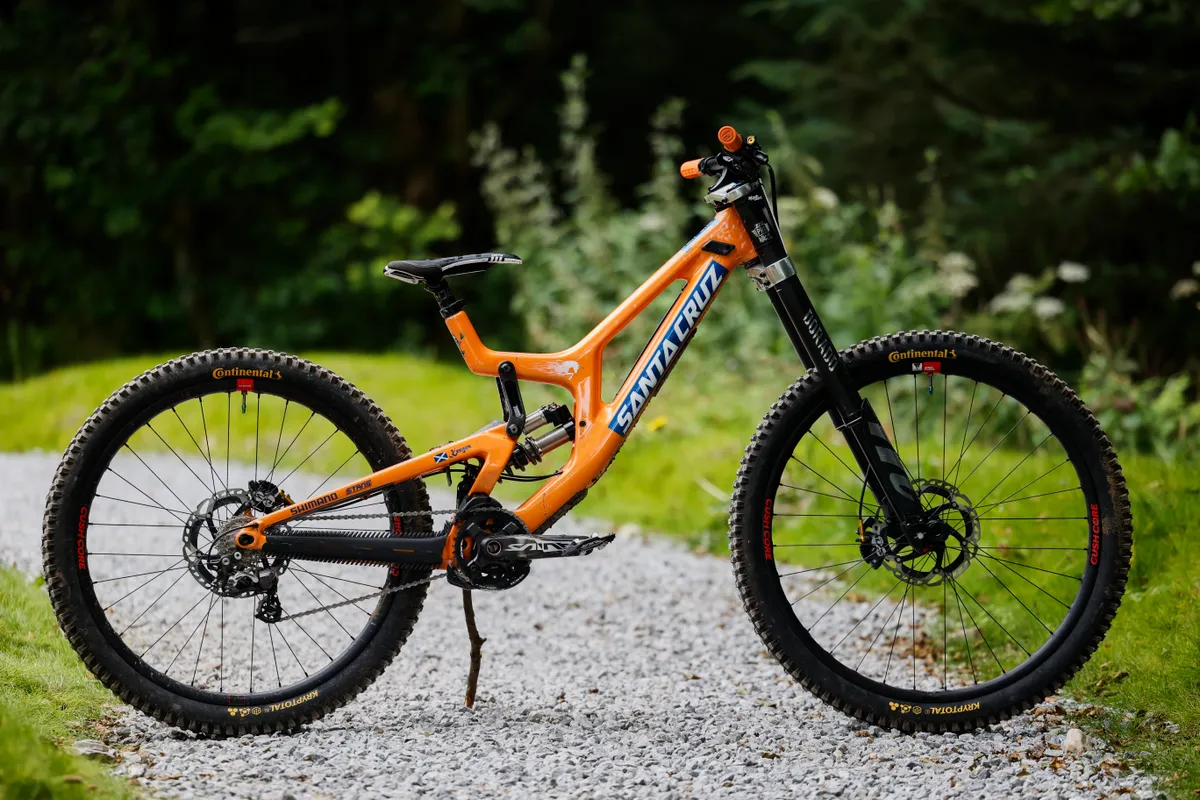
Goldstone reportedly ran as much as 2kg of additional weight low on his Santa Cruz V10 frame to stabilise the bike at high speeds.
Even wheel balancing came into play at the sharp end of elite racing: riders such as Lou Ferguson added tiny stick-on counterweights opposite the valve stem to prevent wheel imbalance upsetting the bike during lengthy spells in the air when tackling the massive jumps of Red Bull Hardline.
Gearboxes hit the big time

Gearboxes were perhaps the biggest off-season talking point heading into 2025.
By partnering with Pinion gearboxes and Gates for its carbon Belt Drive, Atherton bikes created bespoke gearbox-specific DH bikes, exclusively for its team riders. Intense upped the ante by moving most of its factory team onto gearbox-equipped bikes during the 2025 season.
Although the much-publicised €100,000 prize from Gates for the first elite belt-drive race win went unclaimed (a Junior, Ollie Clark, took the only belt-drive victory aboard his Zerode G3), teams continue to praise the durability, weight distribution and reduced unsprung mass of gearboxes compared to traditional gearing setups.
Both gearboxes and belt-drive systems can add drag compared to traditional drivetrains that use a chain, cassette and rear derailleur. But, with minimal pedalling on this year’s tracks, the drag became less of an issue.
It’s going to be interesting to see how these brands develop bikes for 2026.
Frame flex and multi-material designs evolve quietly

Over recent years, tuning frame stiffness has become a major engineering focus. Why? A bit of flex in the right places helps to boost rider comfort and, of course, all-important traction – which is particularly important when the bike is leant over through a rough turn.
Riders and teams experimented with different bike designs and setups to try to eke out these advantages. Notable mentions have to go Atherton, Mondraker, Gamux and Frameworks, who seemed to push boundaries continually.
Adjusting frame flex enables designers to tune the stiffness at various points on the frame. Balancing flex and stiffness in all the right areas isn’t easy, but can be done in a variety of ways.
There are a number of strategies teams are using to achieve the optimum balance.
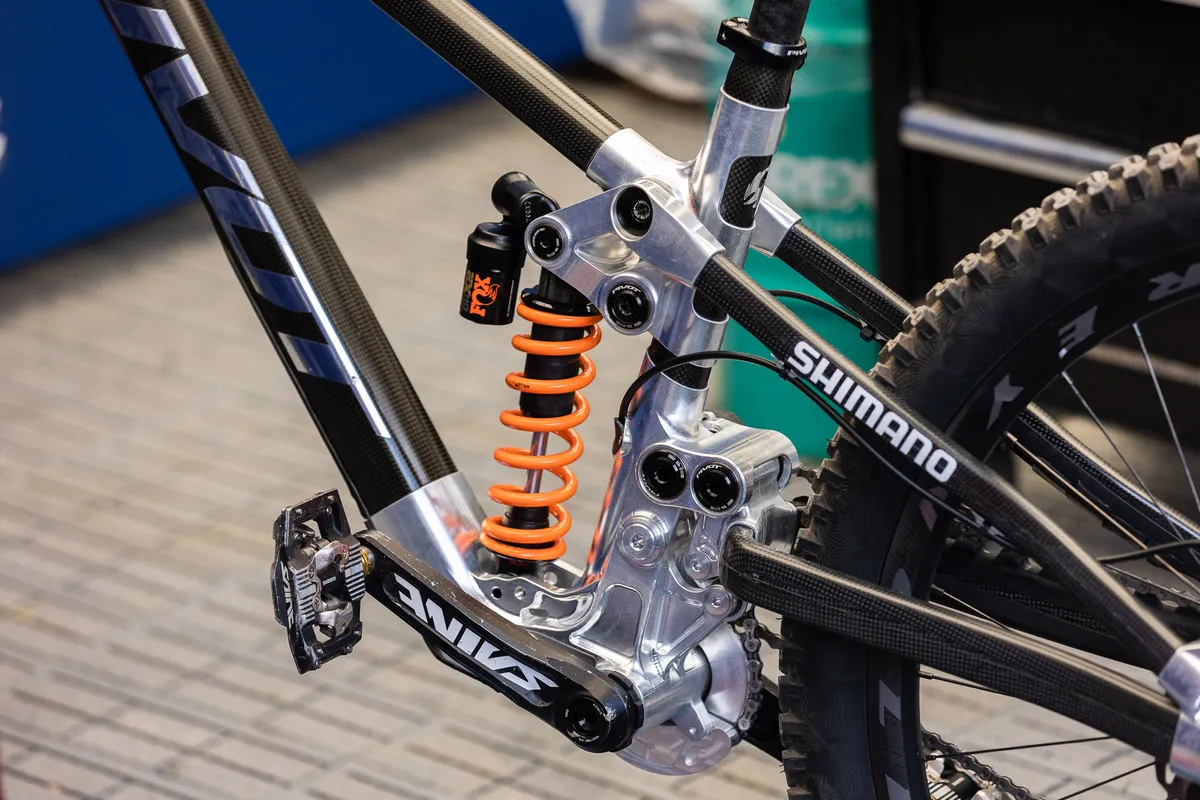
These include interchangeable flex plates, which can be bolted in place between two (or more) tubes of the frame (Mondraker uses removable plates between the seatstays, for example). These can be made of stiff materials such as steel or aluminium, intermediate materials such as carbon or 3D-printed substrate, or even left absent for maximum compliance.
Alternatively, different parts of the frame can be made of different materials.
Frameworks has experimented with aluminium, steel and carbon sections on its frames. Brands such as Atherton can alter tube thicknesses (because the tubes are bonded into 3D-printed titanium lugs) in order to add more flex here and there, or stiffen things up.
I’ve no doubt we’ll see more of this in 2026.
New bar-end devices to reduce arm pump

One of the year’s most visually striking innovations was Joe Breeden’s Get-A-Grip, large bar-end mounted discs.
These discs are fixed to the end of the handlebar and are designed to prevent the rider's hands sliding outward under braking forces. Word is, they reduce arm pump by giving riders something to brace against. This reduces their reliance on grip strength alone.
We saw an early prototype at the World Downhill Championships at Fort William in 2024 when the product was still in development.
The refined production version – a compact semi-circle rather than the early 'blue disc' prototypes – has gained traction, with DIY copies appearing across the pits, and even sported by multiple world champion, Loïc Bruni. As tracks get rougher and speeds get higher, more cockpit innovations could follow.
Reece Wilson’s moto-inspired fins

Late in the season, Reece Wilson debuted one of the boldest experiments of 2025: small aluminium wings bolted to the sides of the seat tube that rose up and flanked either side of his seatpost and saddle.
The goal here was to provide something for Wilson to squeeze with his knees or thighs, mimicking the feel of riding a motocross bike, to gain stability and control over the bike’s movement.
While unconventional, the eye-catching system quickly drew attention from riders and mechanics. With time margins so tight in downhill already, finding one per cent could be the difference between 10th place and a win.
What’s coming in 2026?

While most tech stories played out in plain view, sharp-eyed observers spotted prototypes hinting at next season’s innovations. Expected releases include:
- A new version of the Fox 40 downhill fork with revised lowers
- A redesigned RockShox Boxxer with new lowers and stanchions
- All-new Shimano Saint brakes, the first update since 2013
- Electronic downhill drivetrains from SRAM, likely a 7-speed DH-specific AXS wireless system
If 2025 was the year of experimentation, 2026 could see some of those experiments go into production.
A sport evolving faster than ever

Downhill racing has always been defined by speed, skill and risk. But the 2025 season illustrated that engineering is integral to performance.
With riders and teams embracing a Formula-1-style mindset, with frequent testing, incremental gains and radical ideas, the technology behind downhill racing is accelerating at unprecedented pace.
For DH fans, it means the bikes of 2026 and beyond are going to be wilder, smarter and faster than anything we’ve seen before.