No topic gets our blood boiling and eyes rolling quite like proprietary bike standards.
For every proprietary standard adopted by the industry, many fall by the wayside, leaving us asking what the point was and making it hard to find niche replacements for older bikes.
With this in mind, we’ve listed five of the worst proprietary road bike standards we’ve seen.
If you think we've missed any, let us know in the comments below.
- Read more: These are the 5 worst proprietary standards I've seen in two decades as a pro bike mechanic
Trek’s BB90 bottom bracket standard

The BB90 was a proprietary, direct-press bottom bracket standard that Trek introduced in 2007.
It was one of the first press-fit systems, with the bearings mounted directly into the frame, eliminating the need for external cups.
While this era of press-fit isn’t looked back on favourably, the BB90 developed an even bigger reputation for creaking and ovalising the bearing seat inside the frame.
In a tacit admission the standard was flawed, Trek even went as far as producing slightly oversized BB90 bearings to accommodate any slop in the shell that developed through wear.
The standard featured in many of Trek’s bikes, including the Madone of the era, with the brand admitting defeat in 2019 when it moved to a T47 threaded standard.
We’ve since seen many brands similarly drop press-fit and return to threaded bottom brackets, something we can all rejoice in.
Specialized’s 135mm thru-axle

The road from rim brakes to disc brakes was rocky, to say the least, with many brands creating new standards to facilitate a late-breaking brave new world.
A notable stand-out was Specialized’s 135mm thru-axle used on many disc-brake bikes from 2016 onwards, including the Roubaix, Diverge, Ruby and Crux.
While the standard was better than the brand’s quick-release disc dropout on the Tarmac SL4 of the time in terms of torsional stiffness, it never really caught on.
Instead, the industry moved towards the 142mm standard, something Specialized itself has followed.
Canyon’s CP0048 PACE T-Bar

It’s fair to say this modular handlebar raised a few eyebrows when it launched on Canyon’s Aeroad in 2024.
The PACE (Performance Adaptive Cockpit Ecosystem) enables riders to optimise the width, length and shape of the cockpit for comfort and aerodynamics.
In theory, it’s a very clever system – especially for a direct-order brand whose customers may want varying handlebar widths without purchasing a new bar.
However, in reality, it was more limiting than that suggests, and the system enabled very limited up and down movement.
It was only compatible with certain Canyon performance road bike forks and was intended exclusively for installation by a trained bicycle mechanic.
This locked you into using the bar on the bike, because you couldn’t spec a standard stem and handlebar.
It was also limited to adaptors, despite featuring the Gear Groove interface for cockpit accessories.
SRAM’s Flattop chain
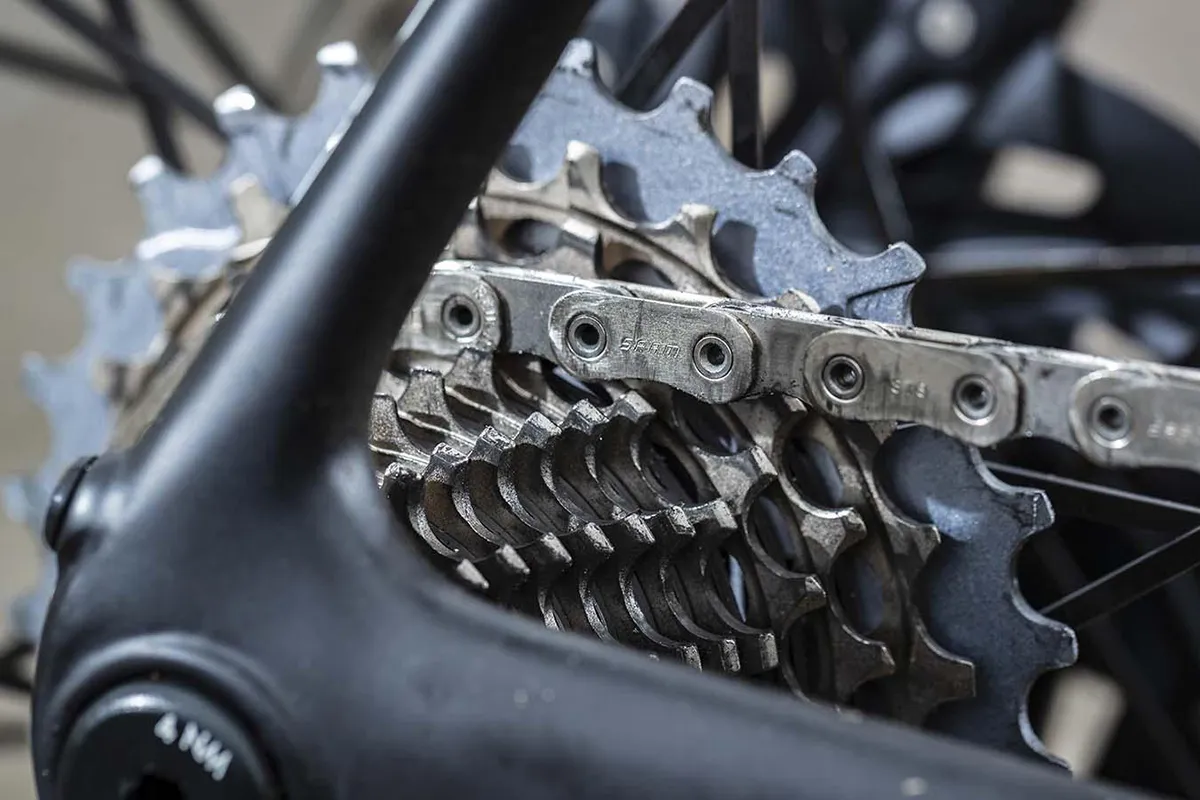
Launched alongside SRAM’s 2019 RED eTap AXS 12-speed road groupset, the Flattop chain has been used ever since.
The design is said to allow for a narrower 12-speed chain that's stronger, quieter and more durable than traditional chains, with the added portion of material on the top of the link said to increase durability.
It’s hard to scrutinse the brand’s claims, and the use of the Flattop meant you had to buy SRAM’s own chain.
The chain uses larger rollers and narrower inner widths that mesh with the X-Range gearing of 12-speed AXS / T-Type cassettes.
Using a traditional chain can cause skipping, and wear out your cassette and chainrings before their time.
Cannondale Ai wheel offset

Cannondale's Asymmetric Integration (Ai) was developed to enable the brand to shorten its seatstays and increase the stiffness of the rear wheel while operating on a 55mm chainline.
The system offset the rear hub, cassette and chainrings to the right by 6mm.
This enabled the rear rim to be centred between the hub flanges, creating a stronger wheel by using equal spoke lengths and angles.
There were benefits to the system, with the stronger wheels feeling more direct and the shorter seatstay adding more agility to the bike, but compatibility was always an issue.
It was also adopted by Cannondale’s mountain bikes.
Buying a new set of wheels meant redishing the rear to make it fit your bike, and you were sometimes limited on what crankset you could use with the system.
If you had a Lefty-equipped bike, such as the Slate, a new wheelset would end up costing a lot in modification.
Cannondale dropped the standard in 2023, when the fourth-generation SuperSix EVO came out with conventional rear spacing.
Enclosed seatpost clamps

While the rest of these standards have been attributed to a single brand, many have been guilty of this one.
Enclosed seat clamps enable designers to make bikes look more sleek, hiding the seat clamp away in the frame.
However, the often compromised finicky design makes it difficult to adjust your saddle height and it might be one of the bolts that requires the most concentration when tightening.
Should the tightening mechanism fall out of its seat, you’ll end up fishing it out of your seat tube and trying to reassemble it into the housing.
Mountain bikes have largely stayed away from this, and so should road bikes.