Road cycling is a sport governed by tradition. On the one hand, that can be seen as fairly inconsequential with riders opting to turn the number 13 race number upside down or insisting on shaved legs. On the other, it’s less fun with weird codes of conduct and rules potentially excluding newbies or those not familiar with bizarre etiquette.
Thankfully, the days of ‘the rules’, a tongue-in-cheek (but was it?) prescription of cycling's code of conduct, have passed. But one lingering gripe is the colour of bib shorts. Because, if you’re not aware, they must be black.
That’s part of the reason why Netcompany-Ineos received a fair amount of flack at the end of last year. The team revealed its new colour scheme, which included an orange and white jersey and white shorts (technically the colour scheme was orange and very light grey).
From "monstrosity" to trendsetters
Many deemed the shorts bad, with words such as “monstrosity” and “horrid” bandied around, and some cycling journalists even joined in to express their dislike of the kit.
Gobik, Netcompany-Ineos’ kit supplier, said the design was intended to stand out. The Spanish company’s CEO, Alberto García, said: “We wanted a colour that not only offered visibility and modernity, but also turned the kit into a trend-setting fashion statement within the peloton.”
While the white shorts disappeared briefly through the spring, they’re back for the Tour de France with a new green jersey. And it seems Netcompany-Ineos and Gobik have succeeded in turning them into a trend.
On stage 9 last Sunday, Lidl-Trek’s Quinn Simmons and Mathias Vacek raced in white bib shorts.
Then, on Monday, Red Bull-Bora-hansgrohe revealed a special kit to mark the Tour’s first race day. In a nod to the team’s 13th Tour de France appearance, and to the tradition of flipping the number 13, they switched their kit upside down. This turned their bibs – and possibly the faces of some die-hard rules fans – white.
It's hot out there
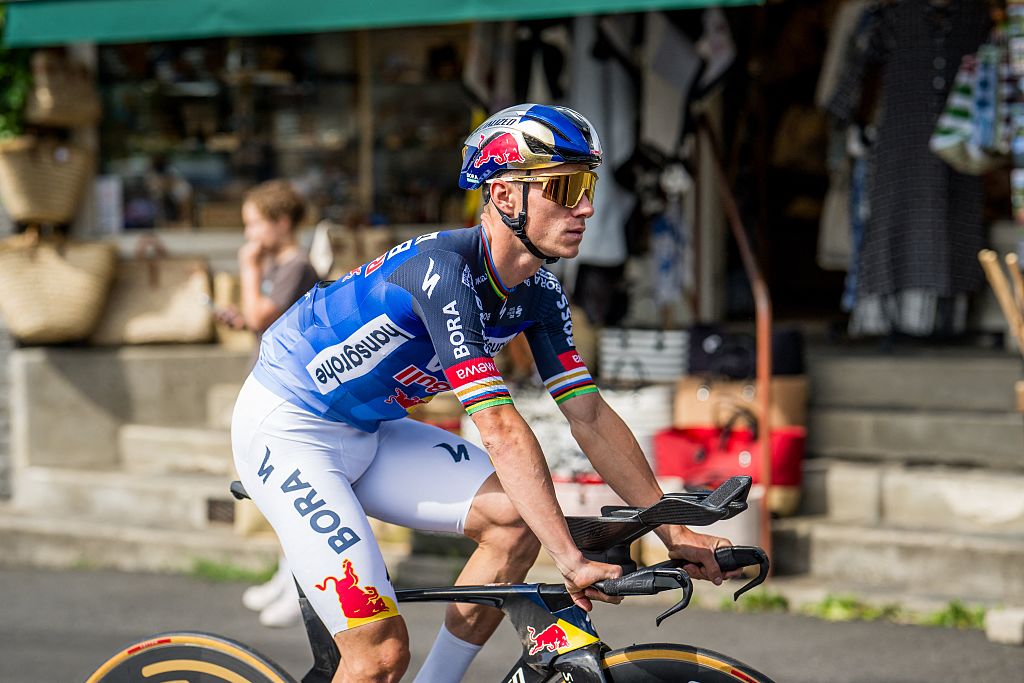
So García and Gobik have arguably achieved their goal of making white shorts a trend, but there’s another reason why the likes of Simmons would opt for white bibs. The heat.
This year’s Tour de France has been crushingly hot. Stage 9 winner Mathieu van der Poel said he struggled with the soaring temperatures at the beginning of the race, and he could only mount the kind of Spring Classics attack we know him for on Sunday after he’d acclimatised to the conditions.
After the stage, which was shortened due to temperatures approaching 40˚C, Tadej Pogačar went as far as saying if he had the power, there would be no racing in July and August.
White shorts, then, make a lot of sense. Sod wearing black and absorbing that extra heat when it can be reflected away.
Even if the practical difference is minimal, I would take the psychological benefit. But then maybe that’s easy for me to say. I’ve previously defended brown bib shorts, and I’ll admit my eyes roll when cyclists start saying what should or shouldn’t be done.
Standing out doesn’t make you cool, but in this instance it probably does.
More on the 2026 Tour de France
- UCI changes Tour de France rules in light of extreme heat
- Tadej Pogačar calls for radical overhaul of cycling calendar after Tour de France stage shortened due to heatwave
- The Tour de France has lost some of its magic – and that could spell trouble for cycling’s future
- Forget VO2 max – a Tour de France cyclist's defining quality is their frightening capacity to suffer
- Who is Isaac del Toro? 4 things you need to know about the Mexican who could be a future Tour de France winner
- A Tour de France breakaway only has a 2% chance of winning, so why join one?
- Every team bike at the 2026 Tour de France