
Although it's hard to imagine now, the Tour de France’s first visit to Alpe d'Huez was met with such a muted response that it would be almost a quarter of a century before the experiment was repeated.
In 1952, hoteliers at the nascent ski resort paid out the equivalent of €400,000 to host the Tour’s first summit finish, but despite a prestigious winner in the shape of Fausto Coppi, the day was not deemed a success.
A local artisan by the name of Jean Barbaglia had floated the idea of bringing the Tour to the Alpe, reckoning the climb’s 21 hairpin bends made for a natural amphitheatre. Rather than seeing riders simply flash past, spectators on the roadsides could watch their heroes grind their way slowly up the mountain towards them.
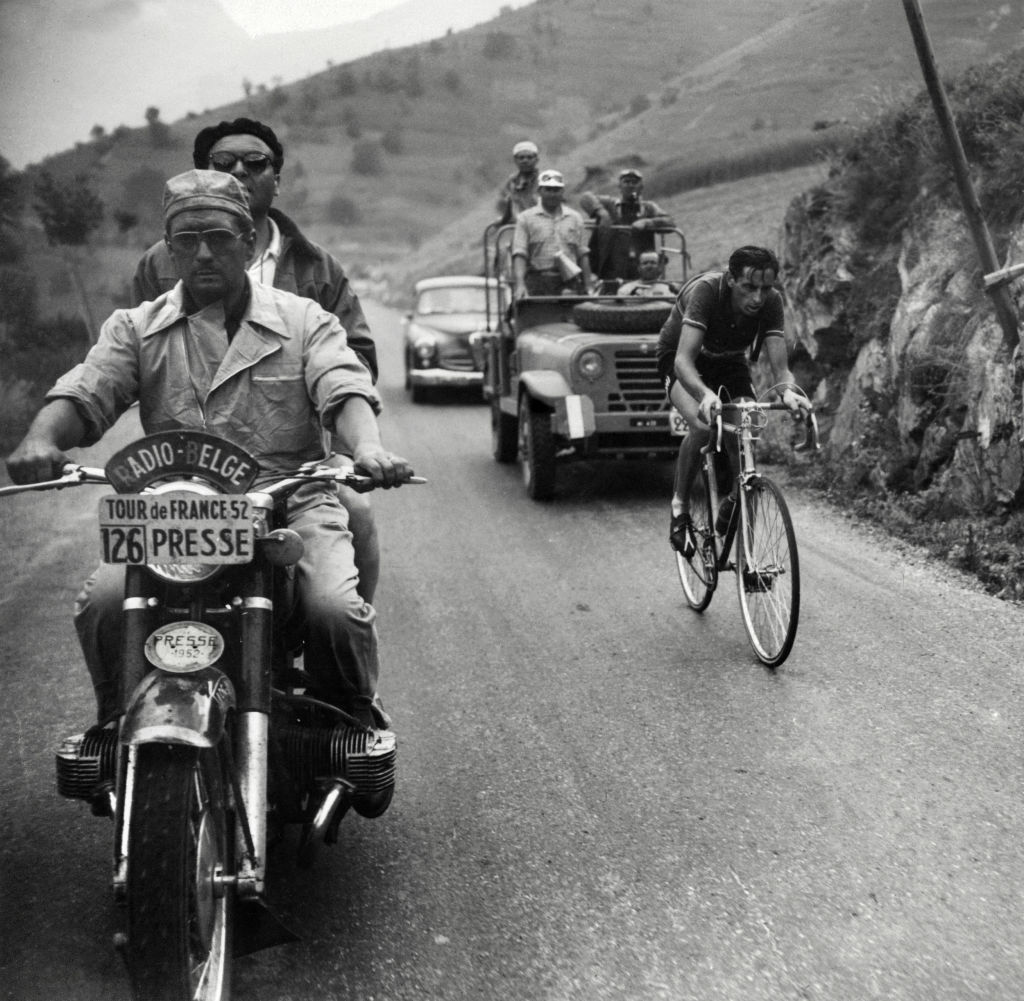
Yet crowds on the day were sparser than anticipated, while the newspapers grumbled that finishing at altitude had only served to stultify the racing until the lower slopes of the Alpe, where Coppi took flight to overtake home favourite Jean Robic.
If anything, though, Alpe d'Huez had been ahead of its time. For the first half-century of its existence, the Tour had been an event more imagined than watched.
Cinema newsreels apart, it was left to newspapers and radio to narrate the story of the race, and exercise poetic licence where they saw fit, but from the early 1960s onwards, live television began to make its presence felt. Not by coincidence, summit finishes steadily began to become a fixture.
By 1976, and now in glorious technicolor, Alpe d'Huez was ready for its close-up, and it quickly captured the popular imagination.
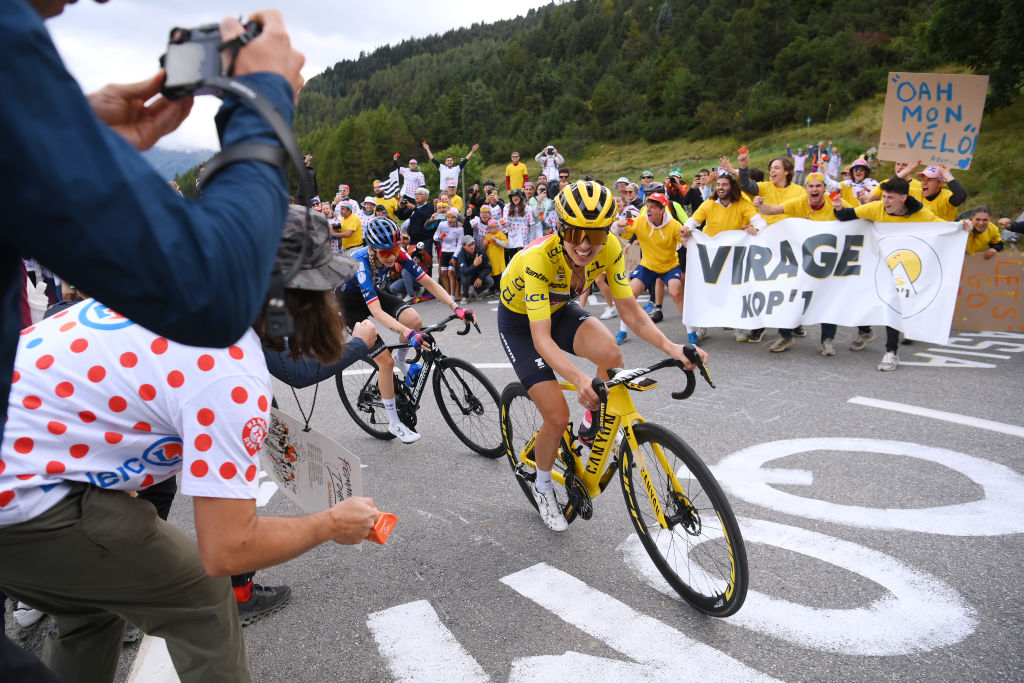
At 1,860m, it’s dwarfed by the nearby Col du Galibier. Its average gradient of 7.9 per cent is stiff, but by no means impassable. A shade under 14km, it’s barely two-thirds the length of Mont Ventoux. Under no metric can it claim to be the Tour’s toughest climb, but it proved to be something more important – the most visually compelling.
The panorama provided by its vicious switchbacks forms part of the appeal. Hanging over the town of Bourg d’Oisans, the road is slung like spaghetti across the mountainside, and from the valley below it reads like a warning sign.
But the most striking aspect is its people. The hairpin bends rise up like steep terracing and the Tour’s return brought an atmosphere more akin to a football ground. The similarity would heighten with each passing year as fans returned in greater numbers, thanks in no small part to a spate of Dutch wins.
Dutch Mountain
As the resort at Alpe d'Huez expanded in the 1960s, its first church had been built by a Dutch priest, Father Jaap Reuten, and when his fellow countryman Joop Zoetemelk won ahead of Lucien Van Impe in 1976, he marked the feat by ringing the bells in celebration.
He would do so three more times before the decade was out, as Hennie Kuiper (1977 and 1978) and Zoetemelk again (1979) triumphed at the summit, and the trend would continue into the 1980s. Peter Winnen claimed a brace of wins, while PdM’s terrible twins, Steven Rooks and Gert-Jan Theunisse, won in 1988 and 1989.
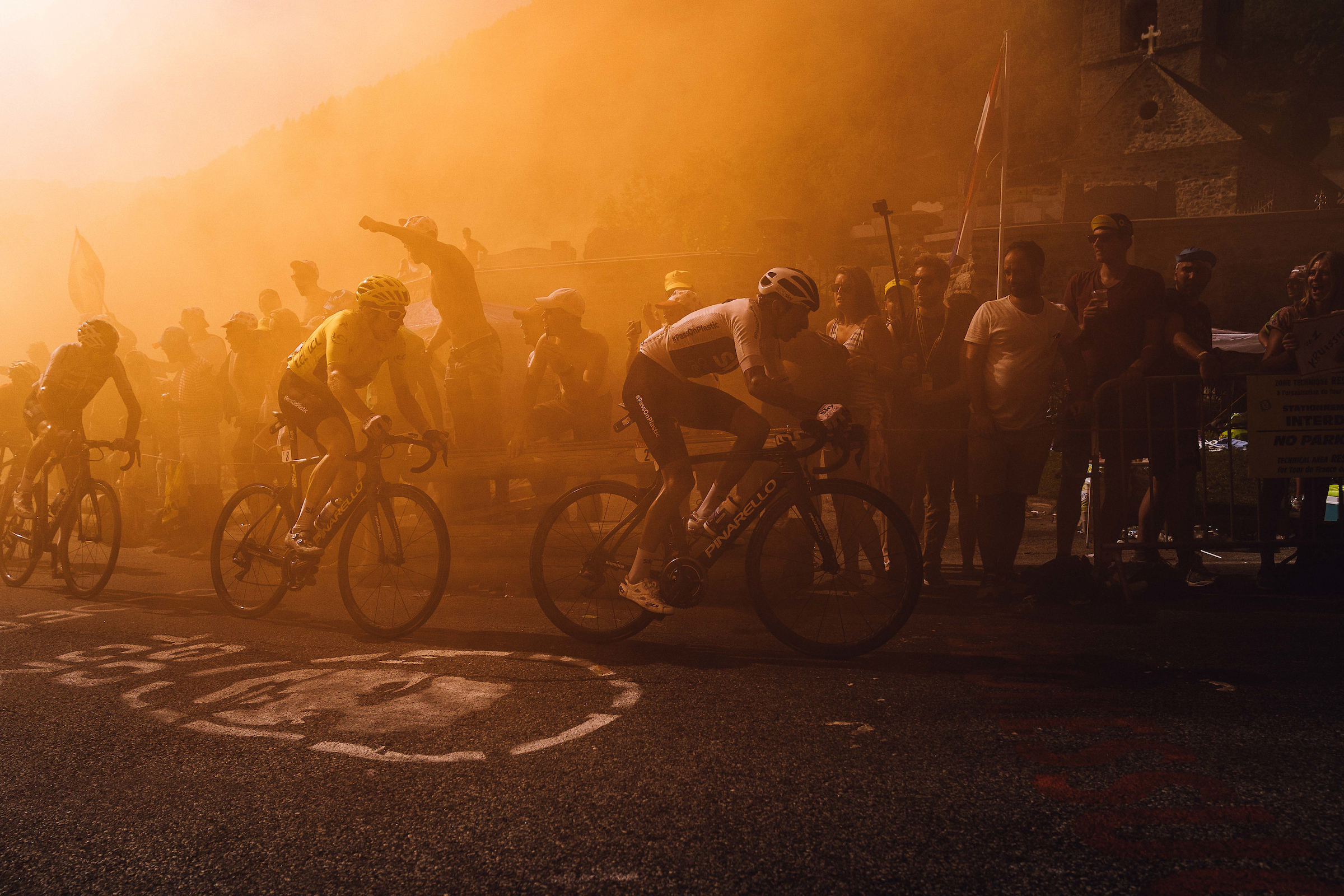
In tandem with those victories, hordes of orange-clad fans began to trek south from the Netherlands each summer, camping out on the Alpe for days in a bid to secure the best vantage points. It was quickly nicknamed ‘Dutch Mountain’ and, to this day, the tradition endures.
Hairpin 7 – the switchbacks count down from the base to the top – is known as ‘Dutch Corner’, occupied by colourful, boisterous spectators who have spawned imitators from across Europe. Fans from Denmark, Norway and Ireland are among those who have since looked to claim part of the Alpe as their own.
The second coming
The impact of the Alpe’s second coming at the Tour was remarkable, and seemingly unaffected by the fact that yellow jersey Michel Pollentier was excluded atop the climb in 1978 after he was caught trying to pass someone else’s urine off as his own at doping control.
By the following year, the cachet – and purchasing power – of the now booming resort of Alpe d'Huez was such that the organisers saw fit to include the climb as a summit finish on successive days, and it would go on to feature every year bar one in the 1980s.
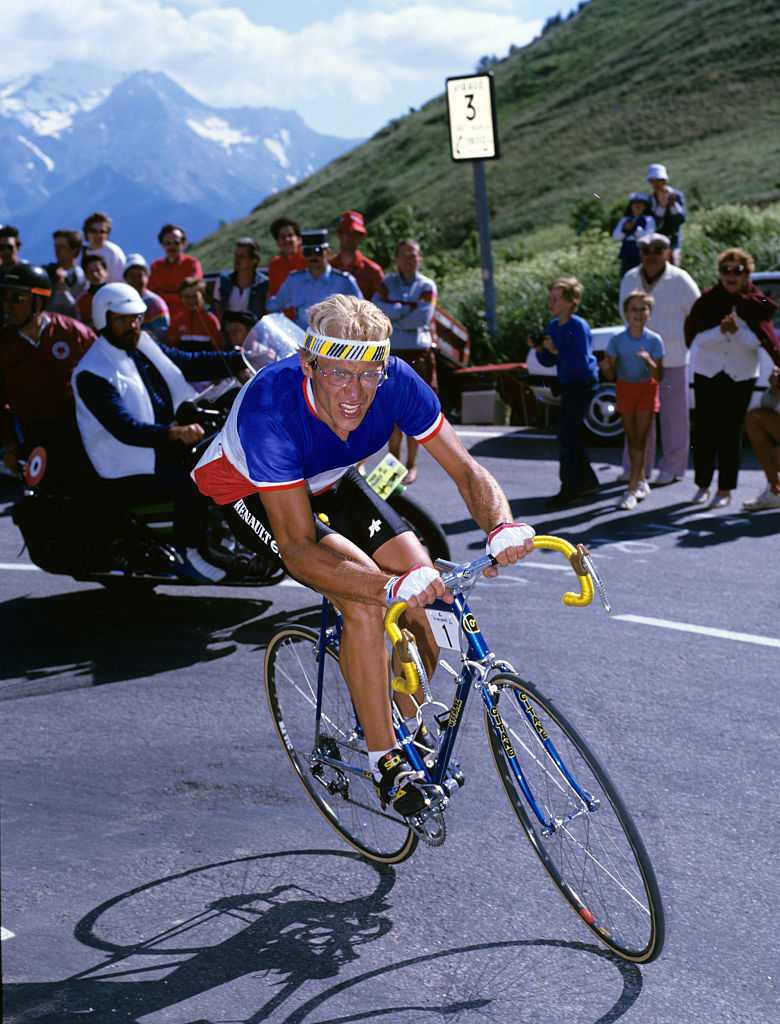
Its 1984 visit was a particularly dramatic one, as Bernard Hinault fired the final salvos in his forlorn bid to discommode defending champion Laurent Fignon.
The veteran Hinault went on the offensive on the Col du Coq and again on the Côte du Laffrey, but his illusions evaporated on the punishing lower slopes of the Alpe. Resplendent in the colours of the French champion, the bespectacled Fignon bridged up to his rival and then inched mercilessly past as Hinault cracked.
“When I saw him attacking like that I could only laugh,” Fignon shrugged after pulling on the yellow jersey at the summit, even if the day was not his alone.
Although he saw off the challenge of Hinault to seal his second overall victory, Fignon was himself caught and passed on the Alpe by the waif-like Luis Herrera, who announced his arrival as the decade’s pre-eminent climbing talent. Just as importantly, the Colombian heralded the widening of the Tour’s horizons, as he danced clear to become the first amateur and the first rider from the Americas to win a stage.
Domestique affairs
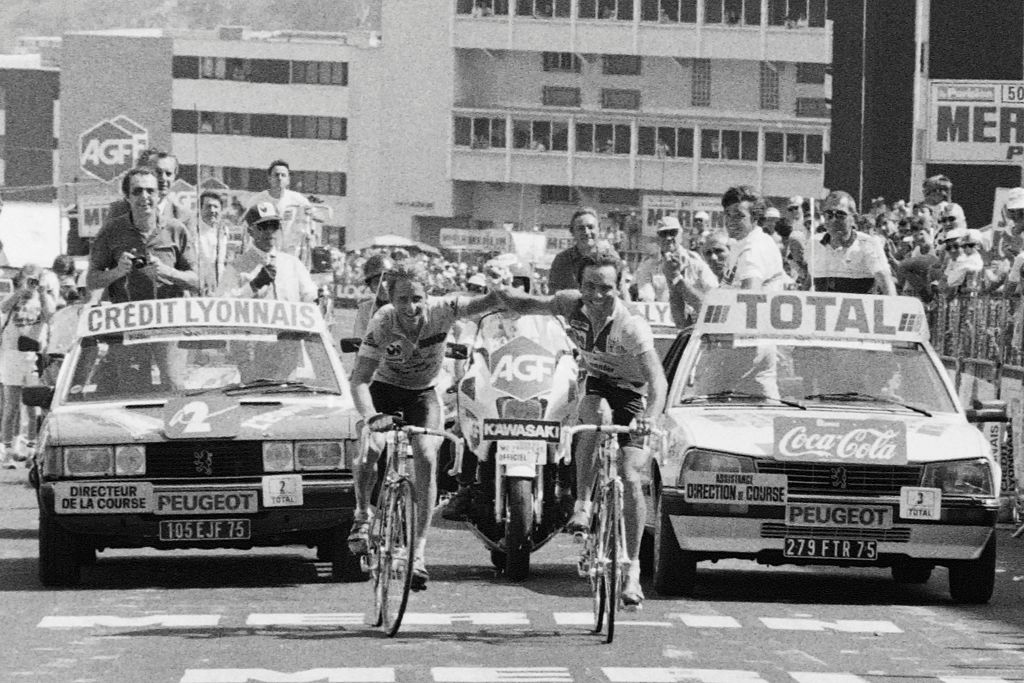
Two years later, the Alpe was central to the narrative as Greg LeMond became the first man from outside of Europe to win the Tour itself, with Hinault again a protagonist.
Hinault had promised beforehand to ride in support of his American teammate, but reneged on that pledge by moving into yellow in the Pyrenees. When the tables turned in LeMond’s favour in the third week, and Hinault realised he could no longer win the Tour, he resolved to claim the public relations battle instead.
Now playing the part of dutiful domestique, he acted as LeMond’s sherpa on the Alpe, guiding him up the mountain and then hamming it up for the cameras by crossing the finish line hand in hand with his teammate and rival.
"They put on a spectacle worthy of the biggest names on television shows," as L’Équipe put it.
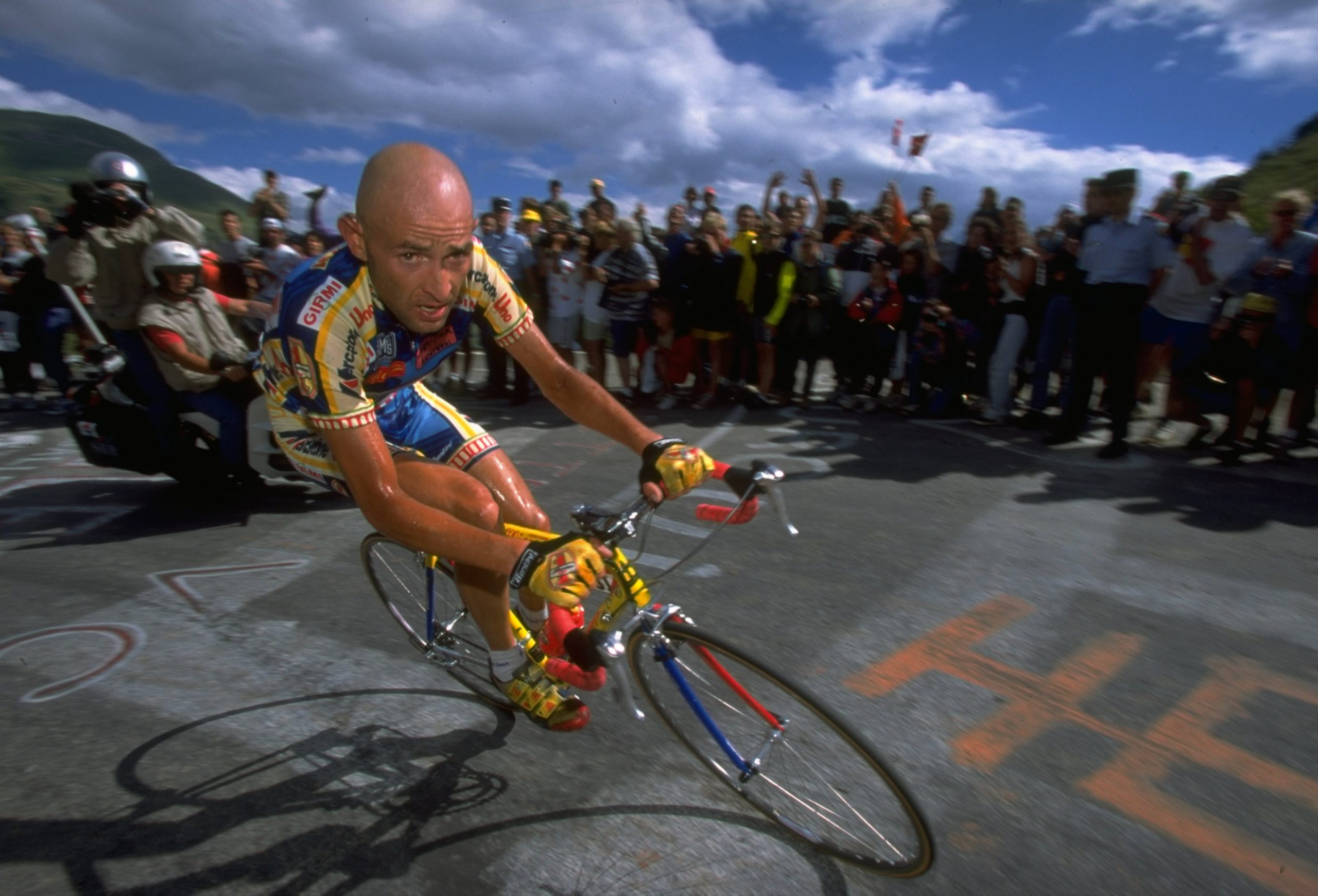
In the 1990s, the Alpe, just like cycling at large, came to be dominated by Italian riders, with Marco Pantani’s two wins, in particular, inspiring new levels of devotion on the mountainside.
In 1997, the crowds were so large that Pantani could scarcely see the road before him after ridding himself of Jan Ullrich and Richard Virenque midway up the climb.
At the last possible moment, the multitudes would part like the Red Sea, and at one point he even had to shake off the attentions of a man who tried to hug him on the bike, but it hardly slowed Pantani’s progress as he clocked a time of 37:35 for the ascent, a record that seems unlikely to be broken any time soon given the gradual tightening of anti-doping measures in the intervening period.
That timespan, of course, includes two wins on the climb by Lance Armstrong that were expunged from the record books in 2012, after he was found to have doped during each of his seven Tour victories.
Ironically, after winning the novel time trial on the Alpe in 2004, Armstrong had protested about the number of fans shouting doping accusations as he rode past, prompting speculation that the organisers would place barriers all the way up the mountain for the Tour’s future visits.
They didn’t, of course – if a fan knocking eventual stage winner Giuseppe Guerini off his bike in 1999 couldn’t do it, then what possibly could?
Final shootout
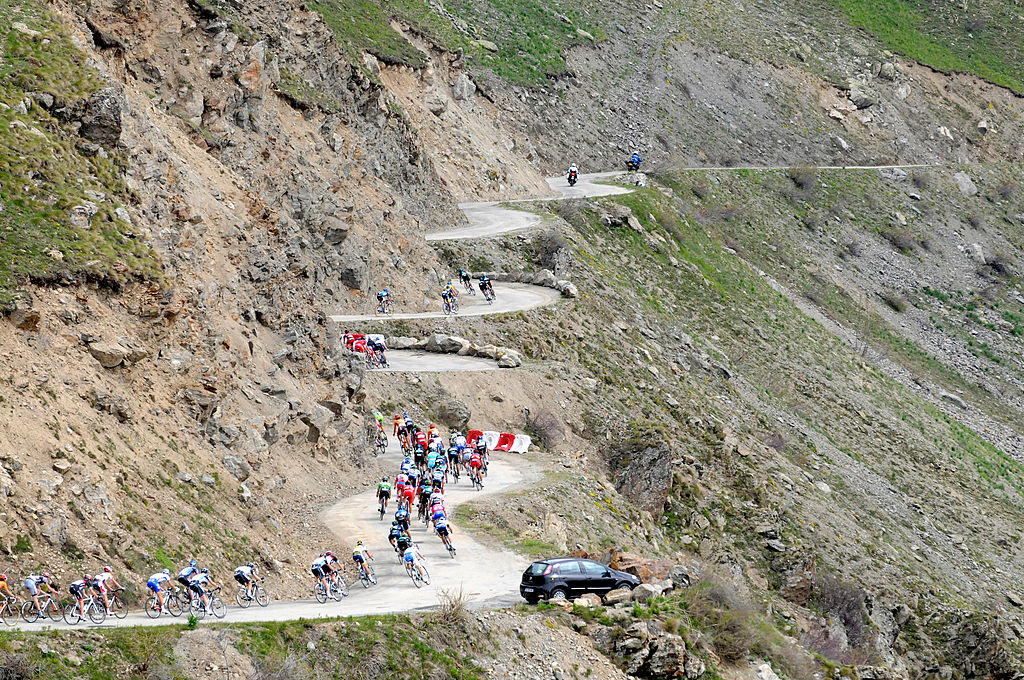
The time trial idea has not been revisited since, although each fresh visit to the Alpe seems to bring further innovation. In 2013, there was speculation that the 100th edition of the Tour would be marked by finishing on top of Alpe d'Huez rather than in Paris.
That particular pipedream was never likely to become a reality, but the Alpe was still an integral part of the celebrations as it was climbed twice in the same stage in the final week. It was the first time the Tour had ever dared to make a circuit race in the high mountains, linking the two ascents with the newly asphalted Col de Sarenne.
This time around, Alpe d'Huez is visited later than ever before, on the penultimate day of racing, as the organisers place the Tour’s sporting dénouement on its slopes for the first time.
“Alpe d'Huez is the most telegenic climb in France,” race director Christian Prudhomme said, and that is surely due to the spectators as much as to the scenery.
The great mountains of the Tour de France belong to legend, but Alpe d'Huez stands alone. It belongs to the people, and therein lies its enduring appeal.
More on the 2026 Tour de France
- The most influential Tour de France tech, ranked
- UCI changes Tour de France rules in light of extreme heat
- The Tour de France has lost some of its magic – and that could spell trouble for cycling’s future
- Forget VO2 max – a Tour de France cyclist's defining quality is their frightening capacity to suffer
- Who is Isaac del Toro? 4 things you need to know about the Mexican who could be a future Tour de France winner
- A Tour de France breakaway only has a 2% chance of winning, so why join one?
- Every team bike at the 2026 Tour de France


