Tuesday's stage 16 is the sole individual time trial at the 2026 Tour de France. Coming straight after the second and final rest day, the 26.1km time trial is far from straightforward.
Although both the start in Évian-les-Bains and the finish in Thonon-les-Bains are on the shores of Lake Geneva and so at the same altitude of 390m, between them there are 500m of climbing, with a 400m climb straight out of the start gate, a fast descent to the outskirts of Thonon and a twisty run through the town to the finish, also with a slight uphill.
It’s not a typical flat and straight time trial and the same considerations come into play as in the uphill finish of the stage 1 team time trial in Barcelona.
Ahead of the Grand Départ, we checked out seven riders’ time trial bikes; we’d expect minor changes for stage 16, with perhaps a change in gearing for the 9.7km, 4.3% climb to the Côte de Larringes.
Tadej Pogačar‘s Colnago TT2
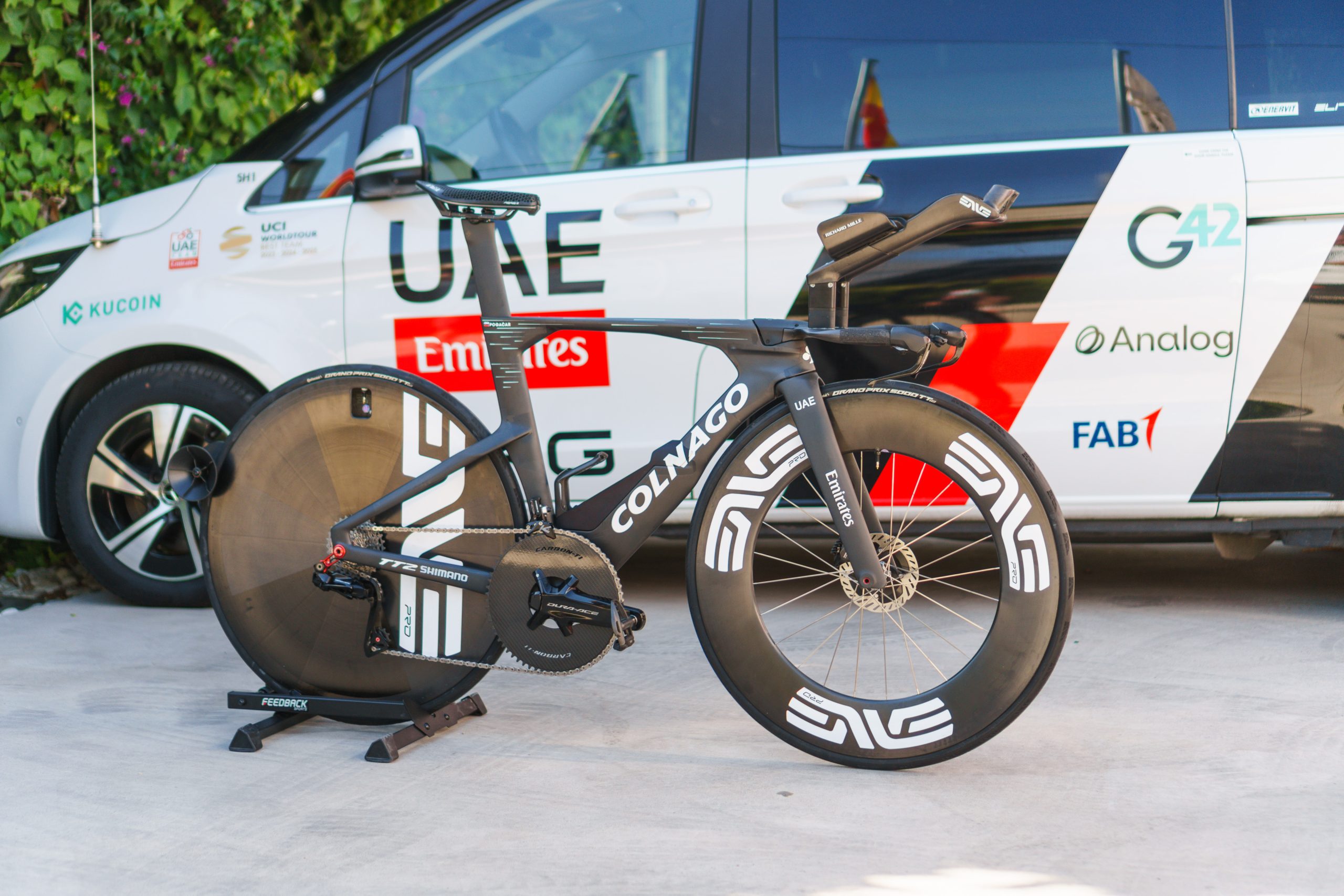
Star billing goes to Pogačar‘s Colnago TT2, not just because it’s the bike on which he may seal his fifth Tour de France victory today, but also because Colnago has designed the bike from the ground up to support his Tour title bid.
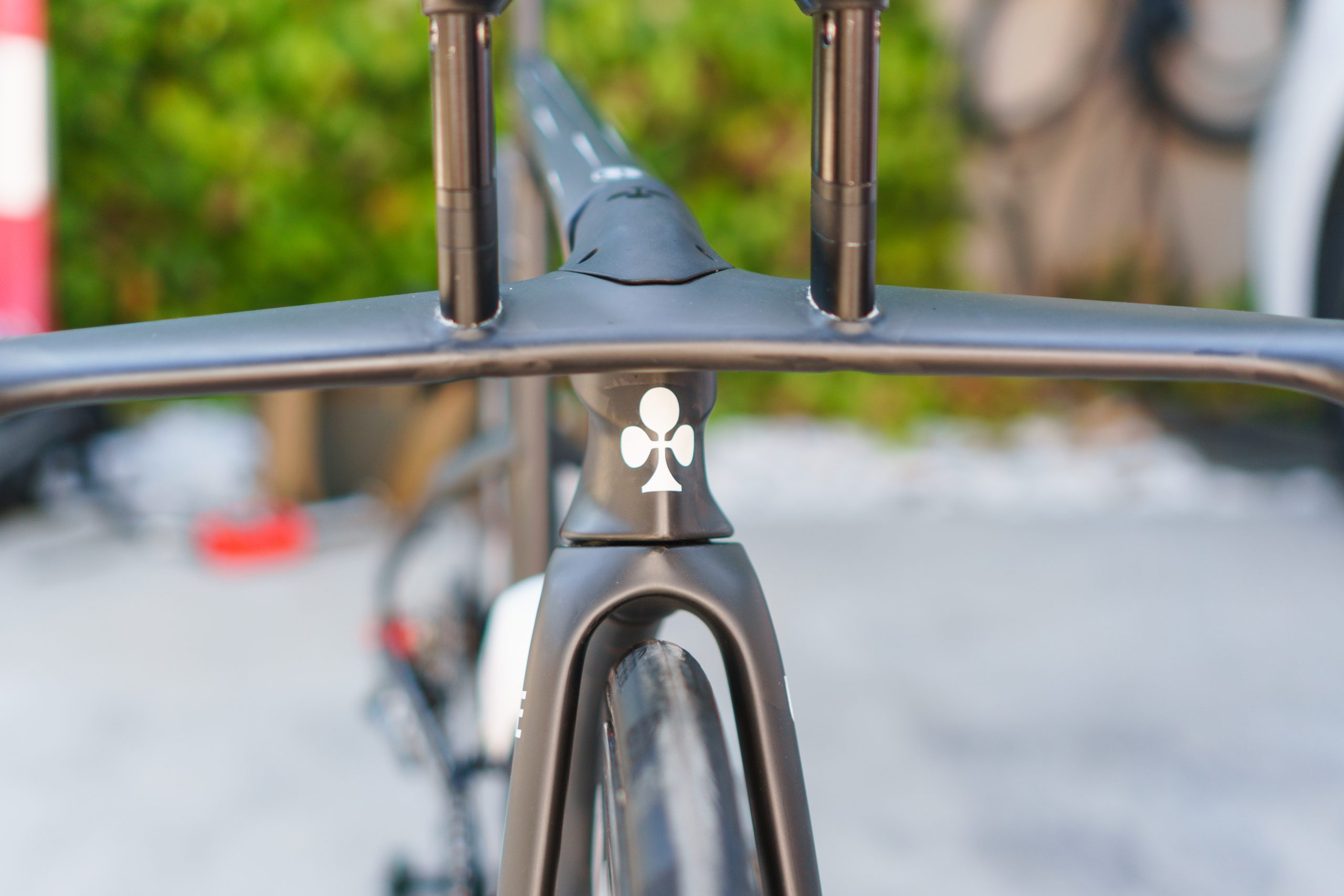
That starts with a 550g claimed weight reduction from the older TT1. Around 140g comes from the switch to a conventional steerer, with a head tube that Colnago has made as narrow as possible at only 32mm, with only 1mm either side of the steerer.
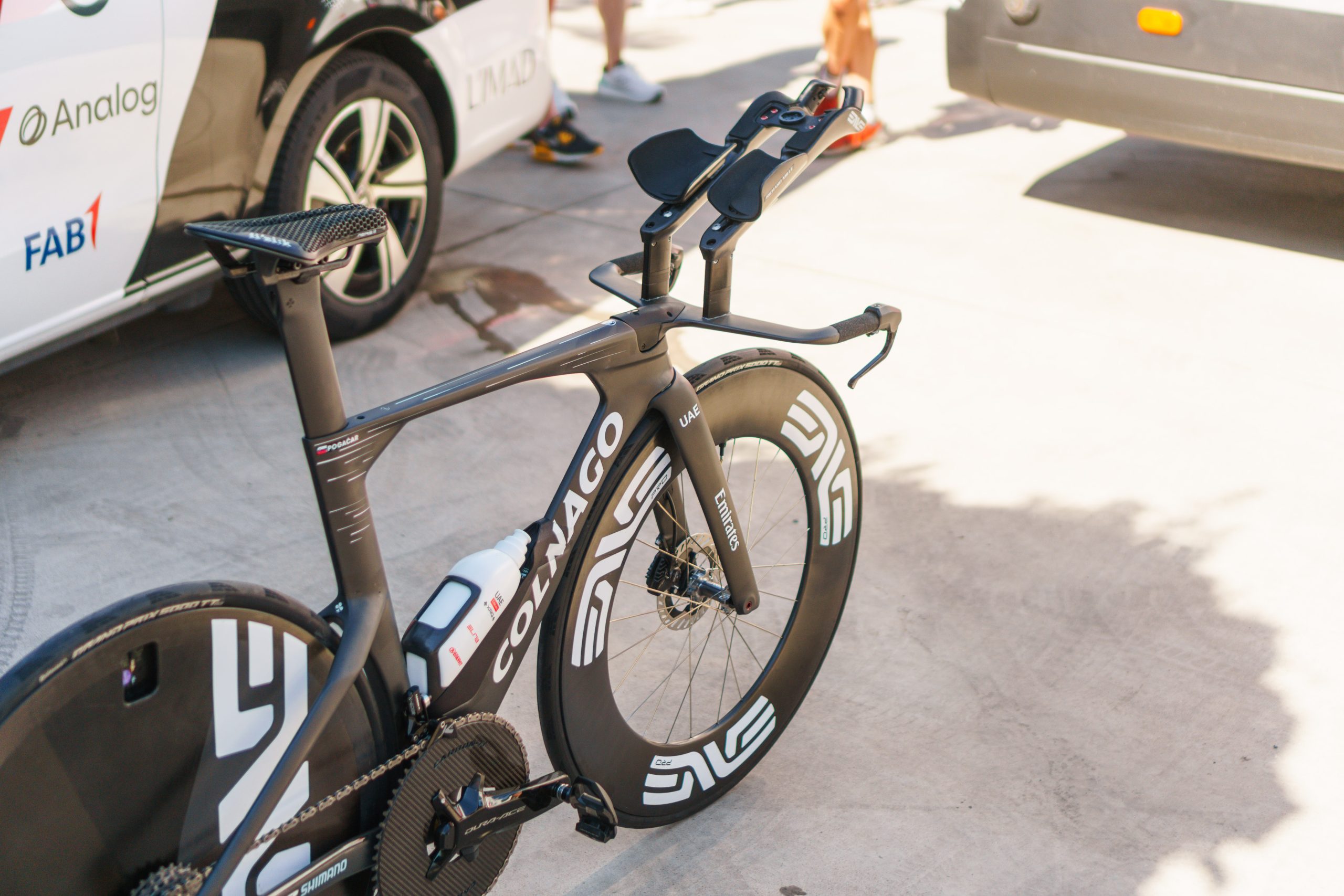
Despite the frame’s weight reduction to a claimed 985g and Colnago’s claim that a complete bike can be built up to sit close to the UCI weight limit, we weighed Pogačar‘s bike at 8.14kg.
This was his spare bike, though, and his main bike has custom carbon extensions rather than the adjustable ENVE-badged extensions on the bike we checked, which should make it a little lighter, probably dipping below 8kg.
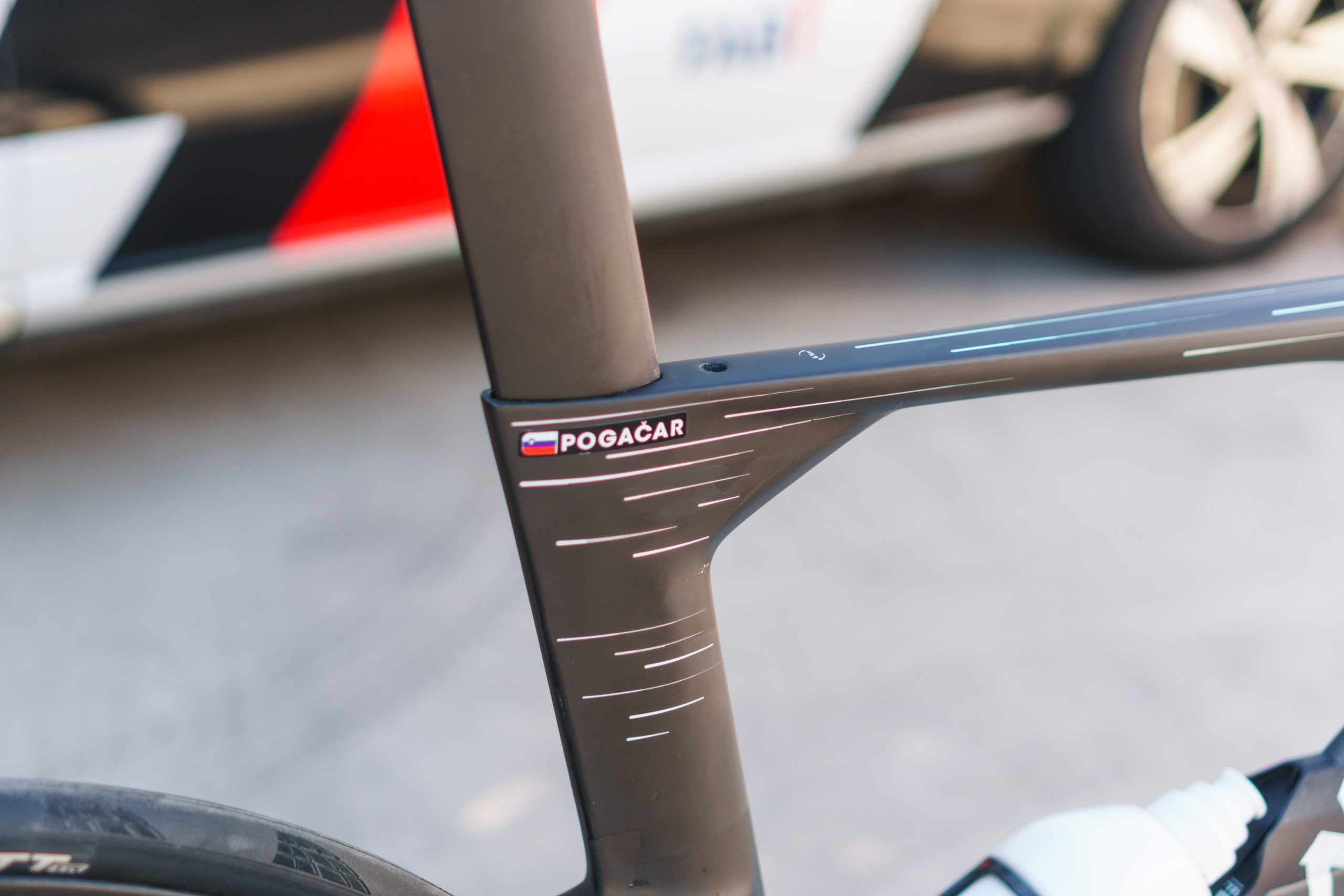
Colnago has also slimmed down the seat tube, making it less deep to save weight. The down tube, too, is narrow at its top, but widens to shield the water bottle – an Elite Crono rather than the purpose-designed Colnago bottle, due to sponsor commitments.
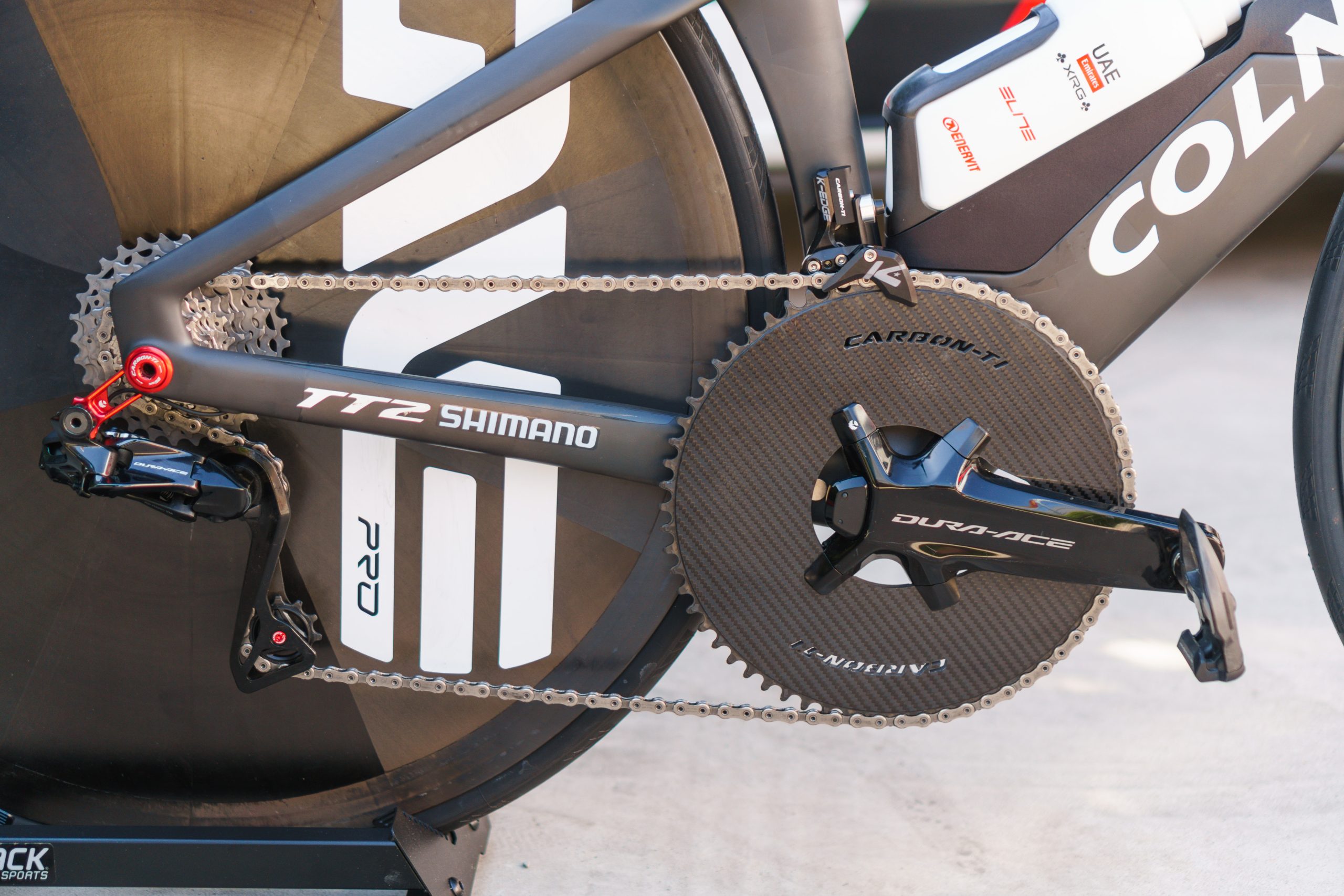
Pogačar had a 64-tooth 1x Carbon-Ti chainring fitted to his Dura-Ace power meter cranks in Barcelona. Will he fit something smaller for stage 16 or swap the 11-30t cassette for a wider range? There was a K-Edge chain catcher – not aero, but it holds the chain in place both to the inner side and the outside.
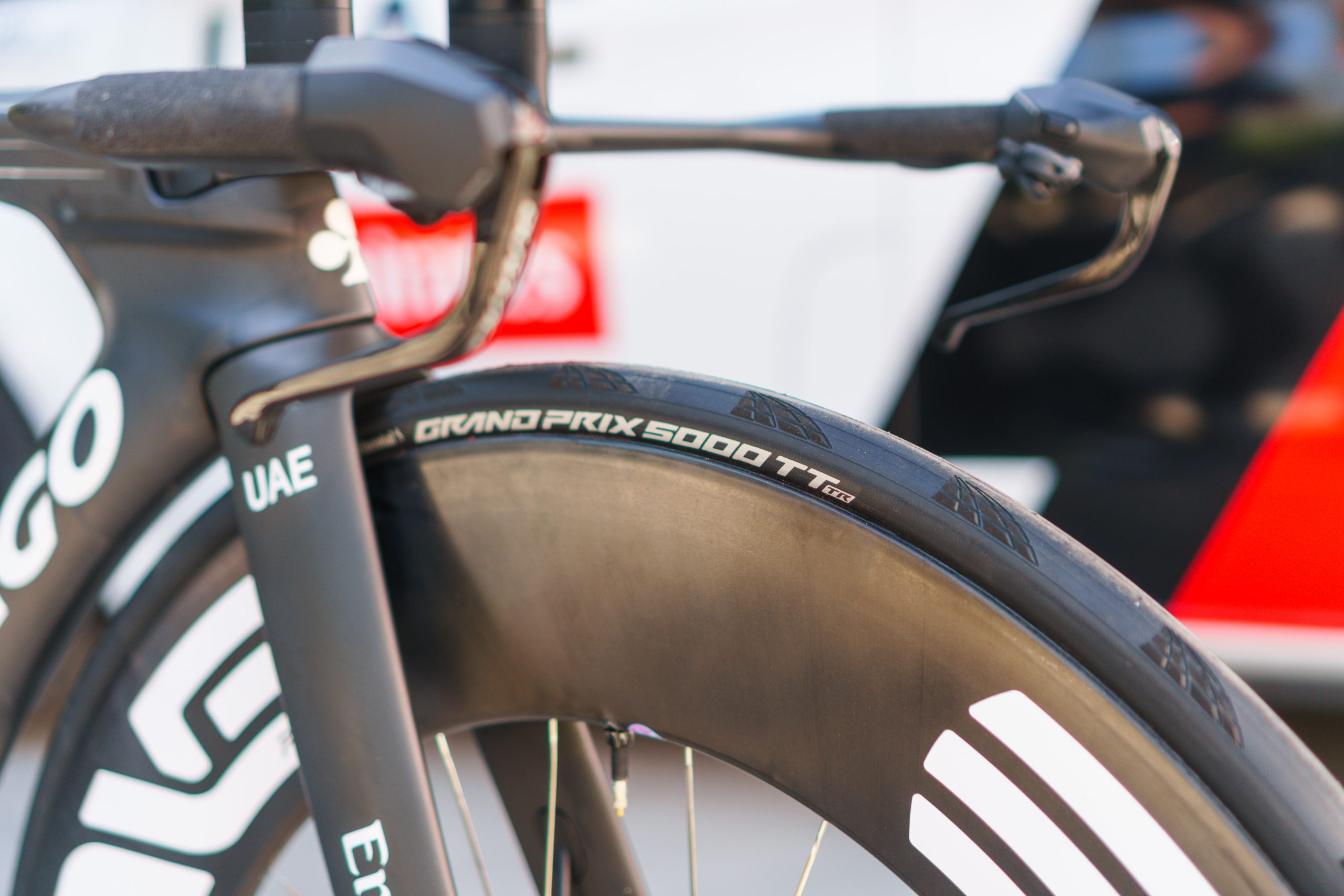
Pogačar‘s bike is fitted with ENVE's new disc rear wheel and SES 100 Pro front wheel. He was running 25mm Continental Grand Prix 5000 TT TR tyres in Barcelona, rather than the 28mm tyres ENVE claims are optimal for the rim profile. They measure around 28mm on the 22mm internal-width rims.
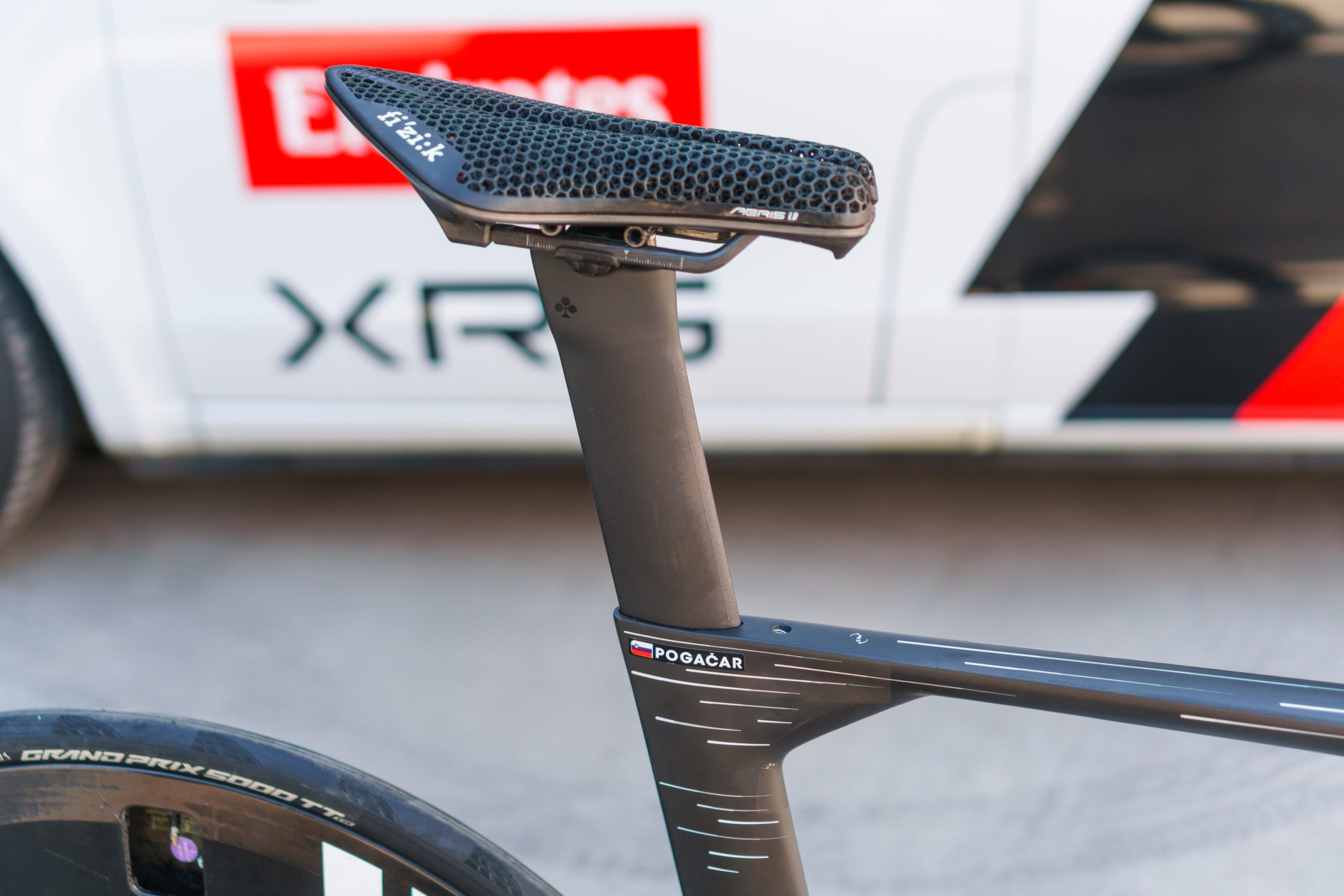
Pogačar sits on a Fizik Aeris R1 Adaptive Long Distance 3D-printed saddle.
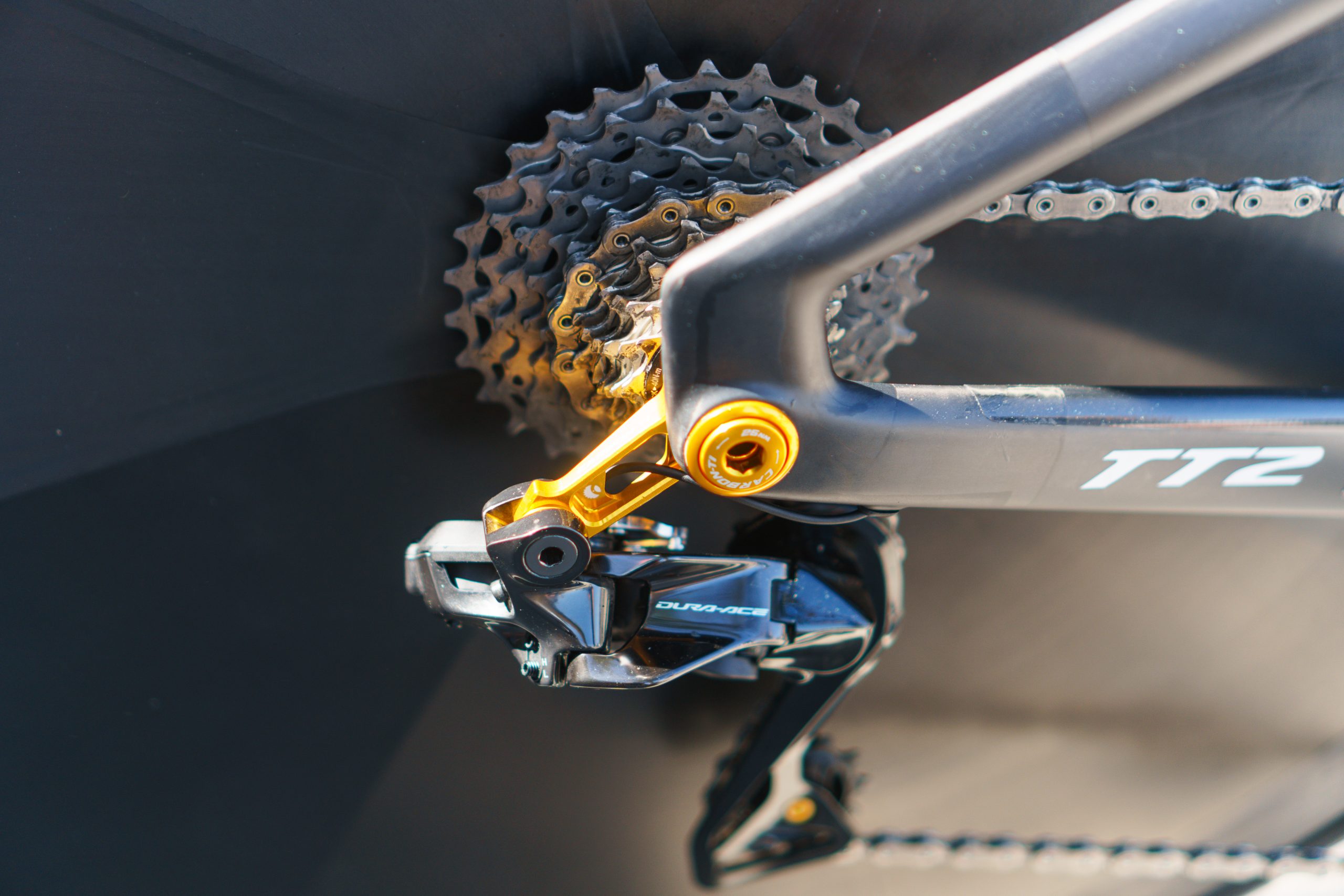
Carbon-Ti supplies other shiny bits for Pogačar‘s TT2, including the derailleur hanger and even the bolts, while the Bikone BSA bottom bracket is purpose-designed for UAE Team Emirates, with ceramic bearings and an aero left-side cup without external flanges.
Matteo Trentin’s BMC Timemachine Mpc
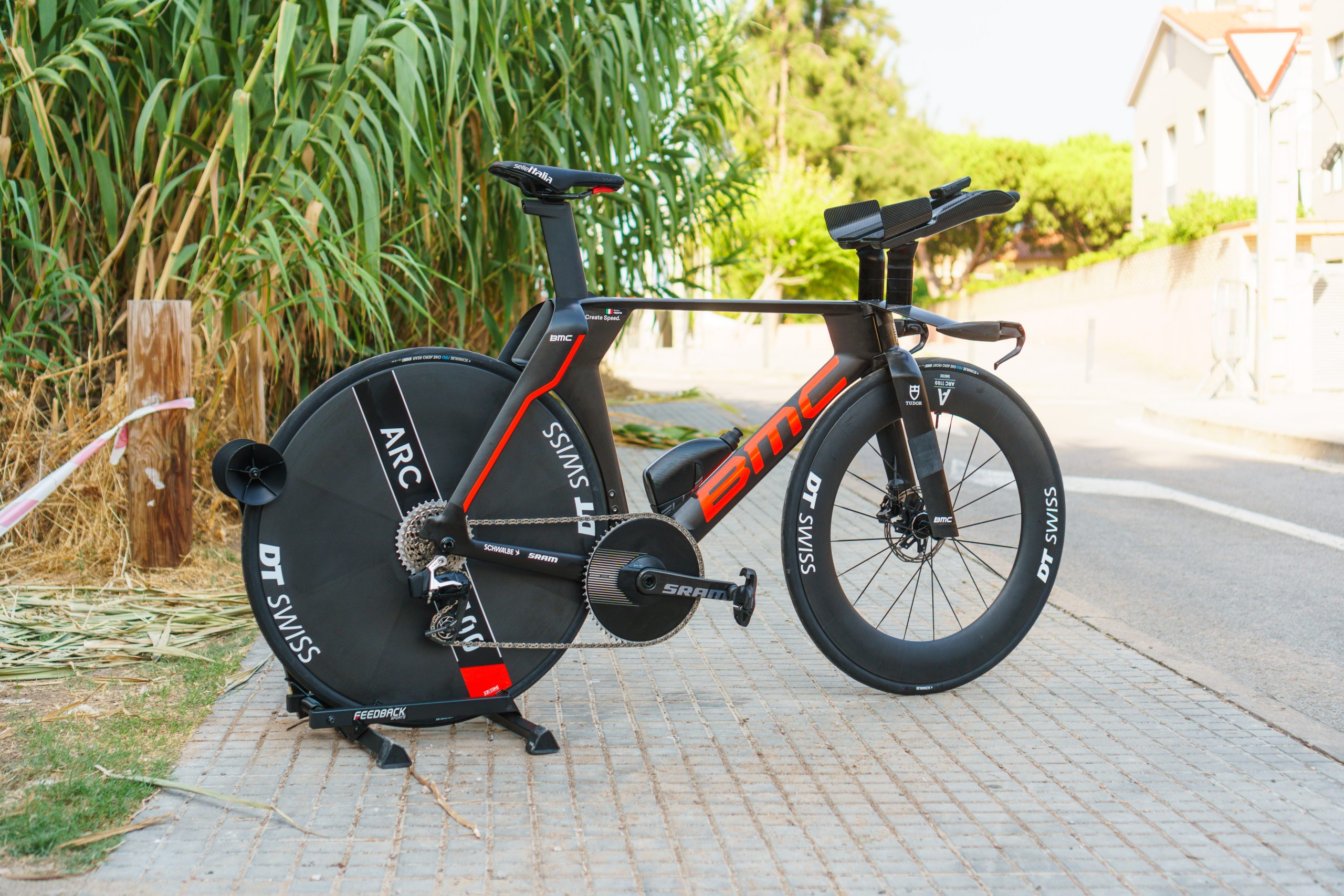
When it designed the latest Timemachine, BMC was inspired by the Hope Lotus track bike, setting the razor-thin fork blades and seatstays very wide apart. In fact, the seatstays were originally designed to be wider still, until the UCI set limits for the allowable width, forcing an 11th-hour redesign.
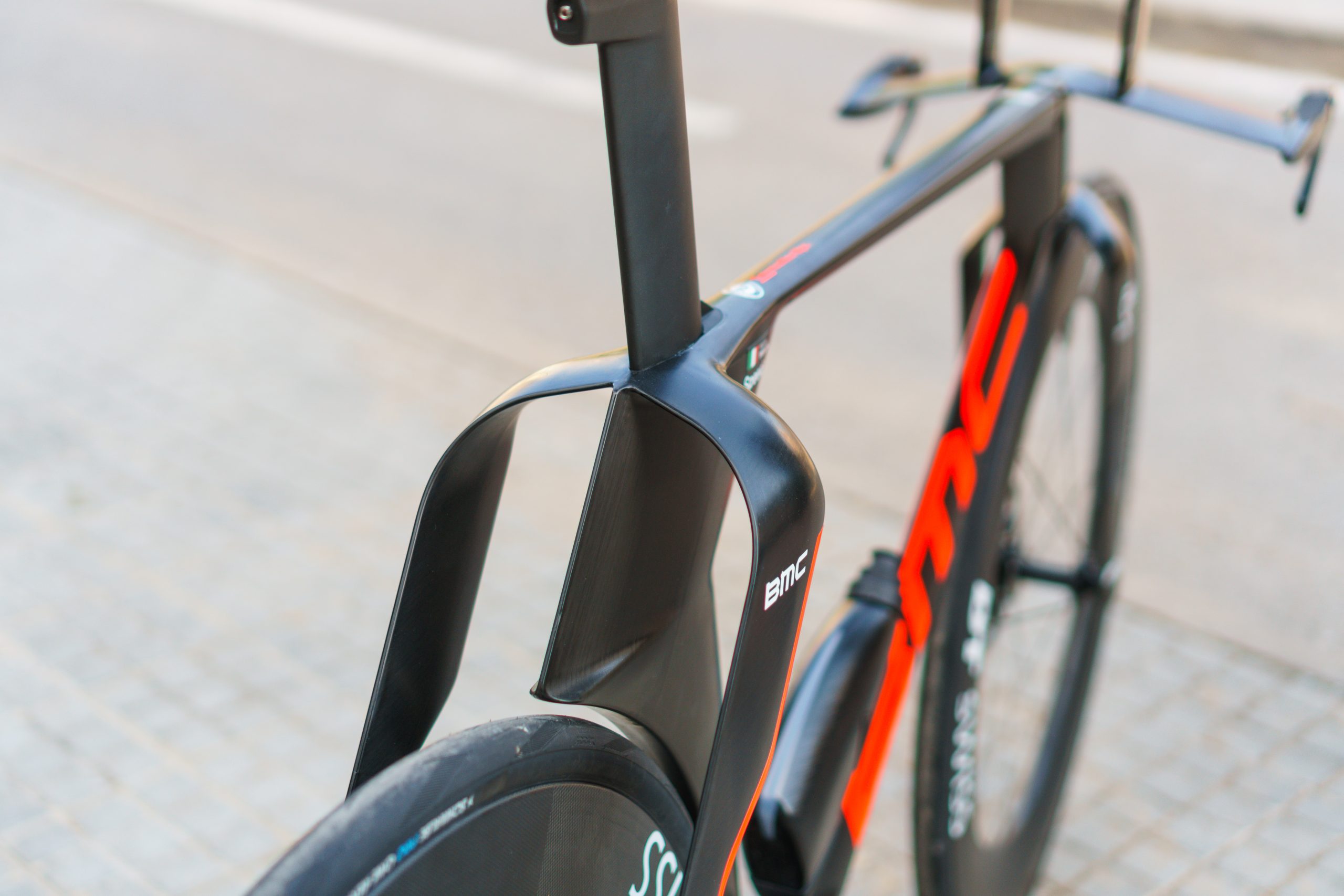
The Timemachine’s frame tubes are very slim too, rather than the more usual truncated aerofoils. The base bar is also very narrow at only 350mm and the risers are aerofoil profiled.
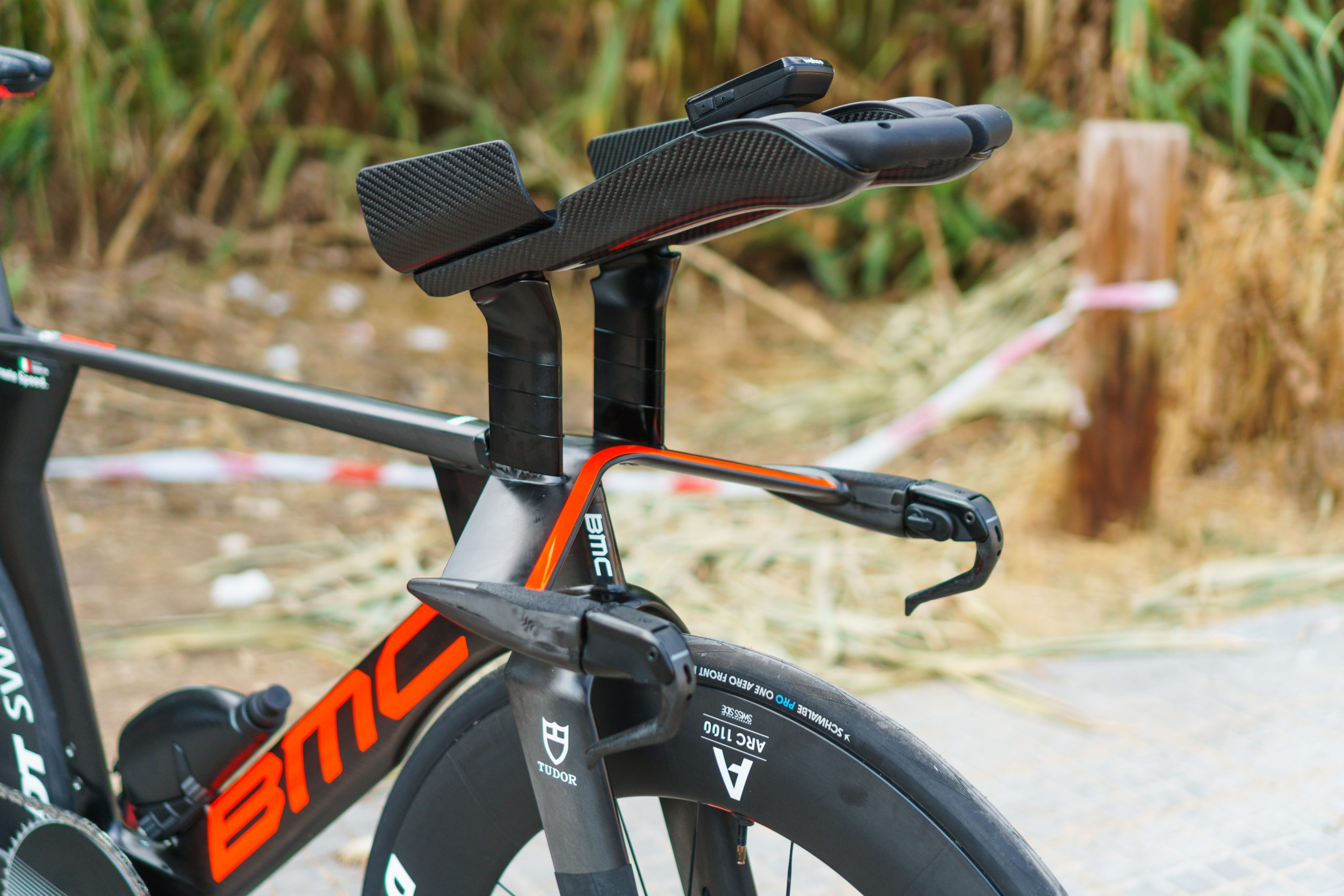
The WattShop carbon extensions have adjustable armrests and customisable end grips, and there’s a Selle Italia Watt time trial saddle and Elite aero bottle fitted.
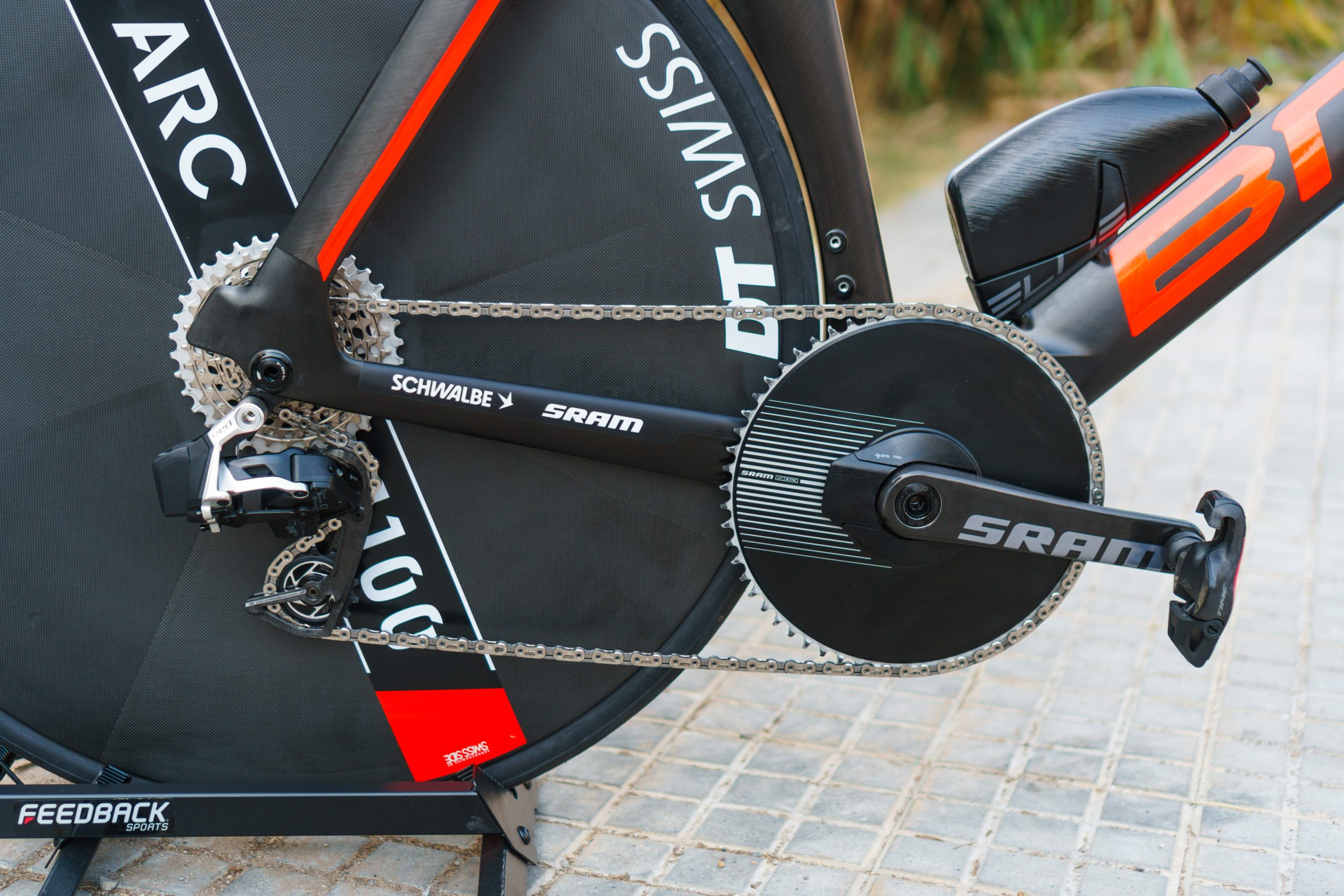
Tudor Pro Cycling is running SRAM groupsets and the Red AXS 1x crankset on Trentin’s bike has a 60T chainring with 172.5mm cranks and a 10-36t cassette. He’s using team-only Time XPro 12 pedals.
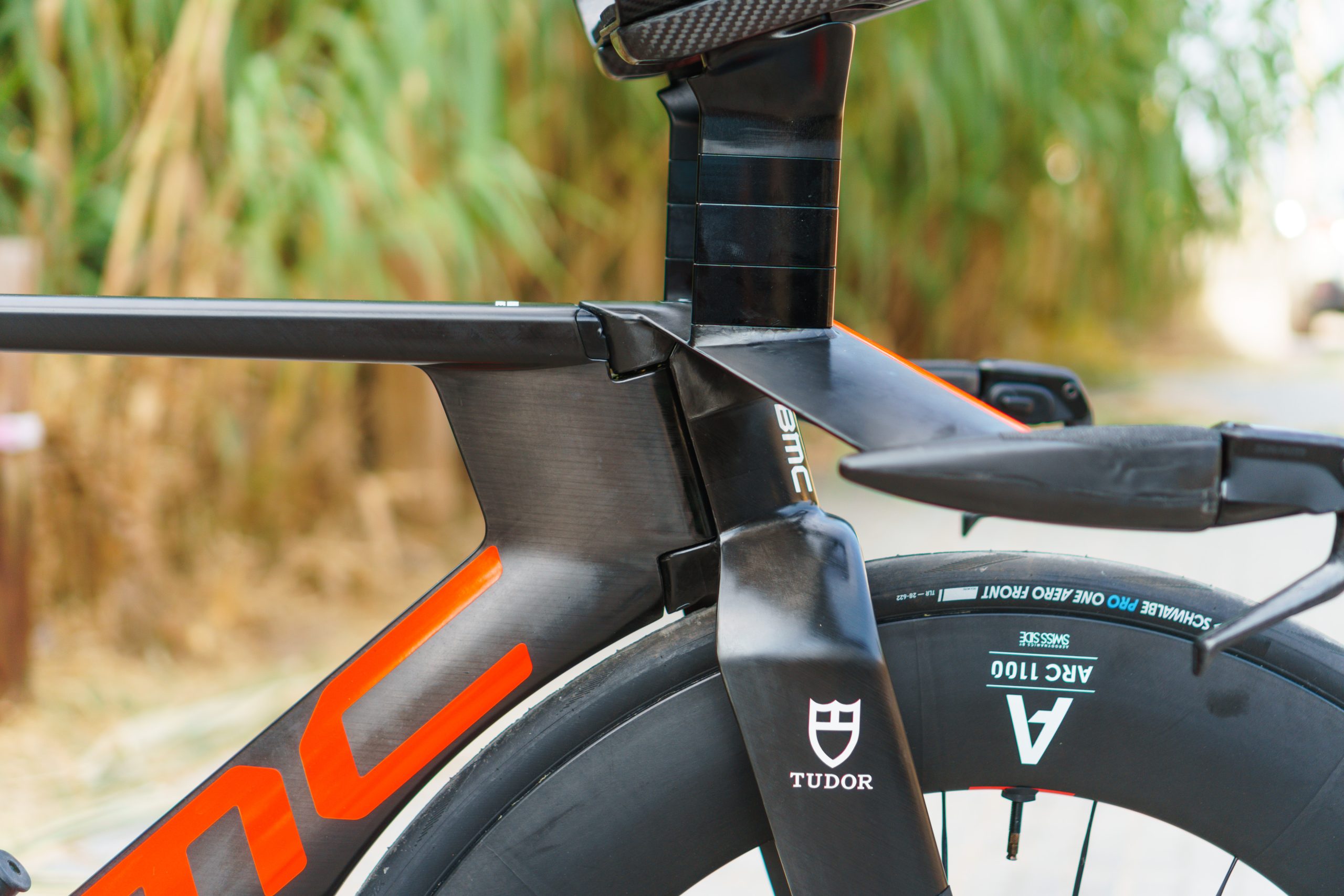
The wheels are DT Swiss ARC 1100, disc at the rear and 85mm deep at the front, alongside 28mm Schwalbe Pro One Aero tyres with Schwalbe’s Clik valves in place of Presta. Both tyres measure 29.38mm.
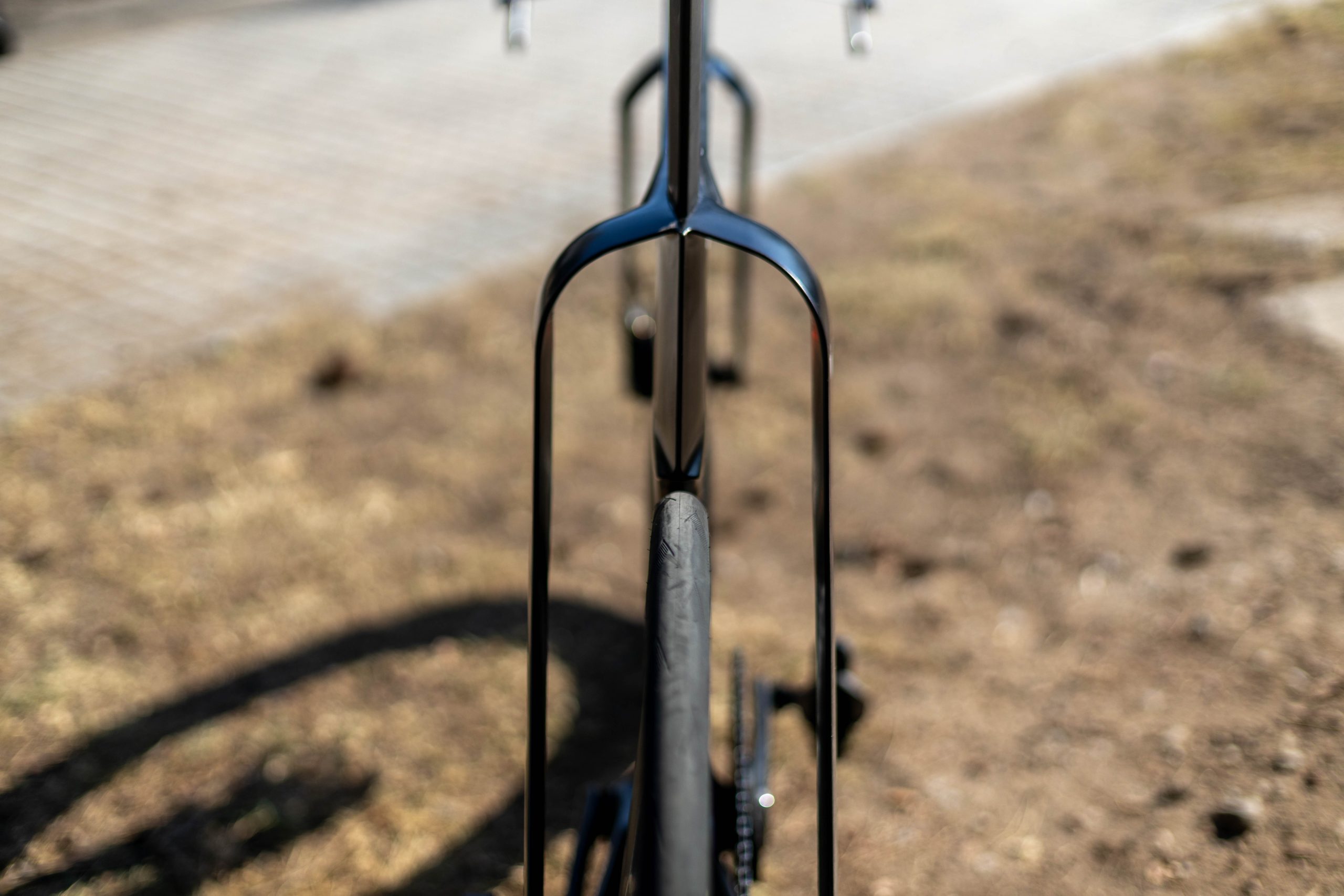
Trentin’s Timemachine weighs 9.8kg, which is towards the top end of Tour de France time trial bike weights.
Mauro Schmid’s Giant Trinity Advanced SL
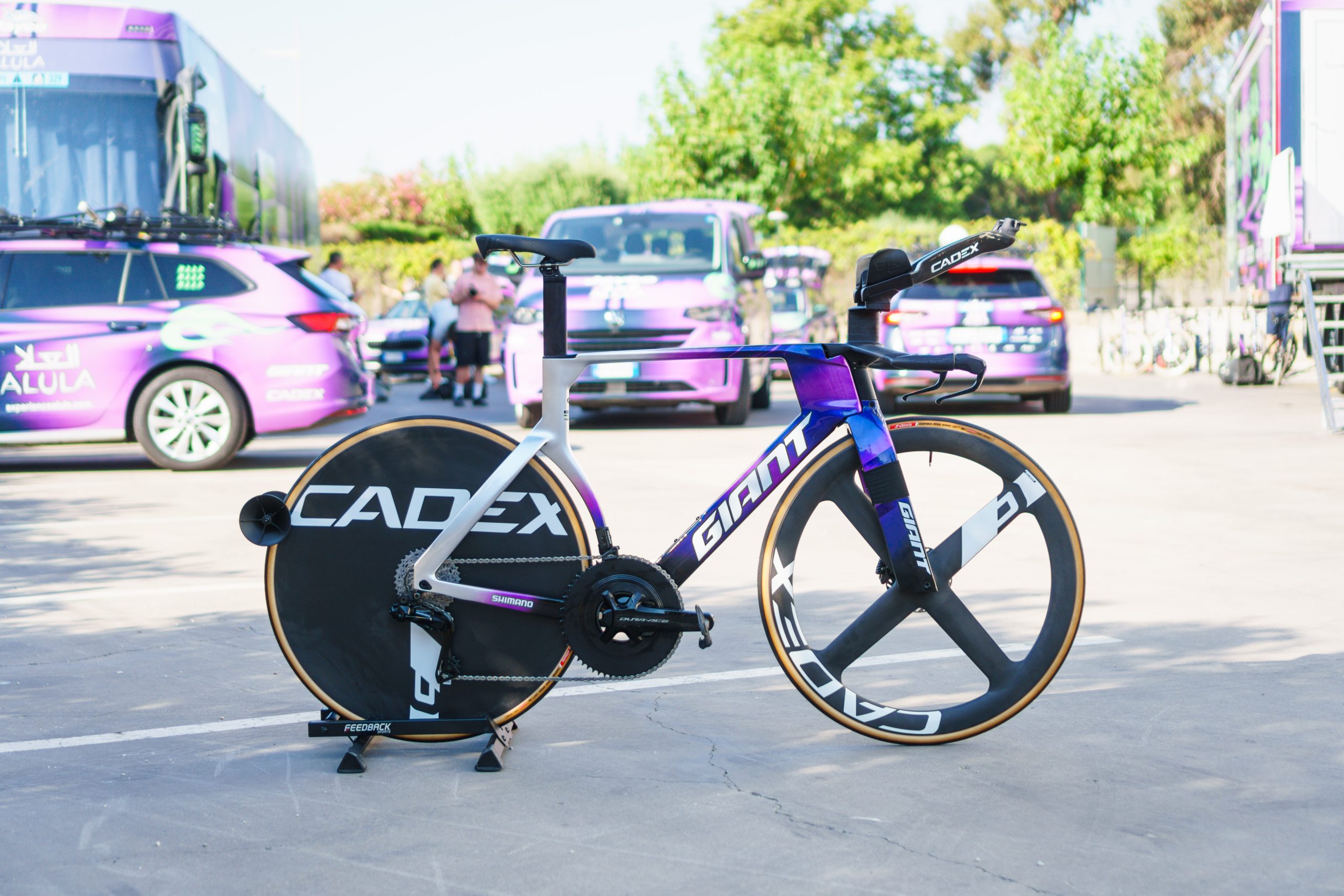
Jayco AlUla’s Schmid won stage 13 of this year’s Tour into Belfort, and was 2025 Swiss time trial and road race champion.
While team leader Ben O’Connor’s Giant Trinity Advanced SL is completely stripped of paint and sports a 130g saddle, Schmid’s Trinity is decked out in standard team colours and his saddle cedes almost 180g to O'Connor's.
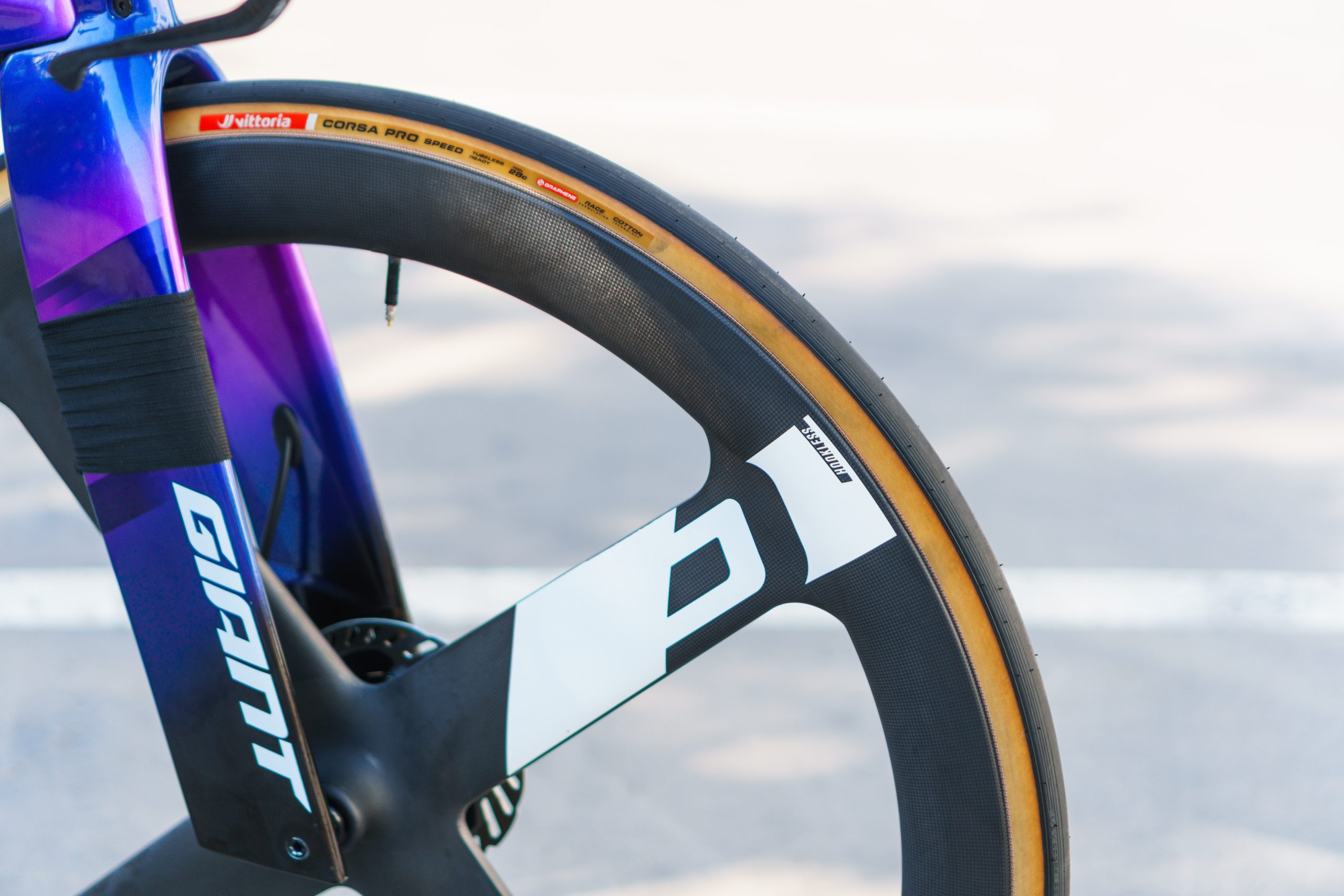
Schmid has 28mm Vittoria Corsa Speed tyres on his Cadex wheels, a four-spoke at the front and a disc rear.
Cadex has its own tyres designed alongside the wheelset and Jayco AlUla runs Cadex tyres on its Giant Propel road bikes, but it switches to Vittoria tyres for time-trial use. They measure just over their specified width: 28.8mm at the front and 28.1mm at the rear.
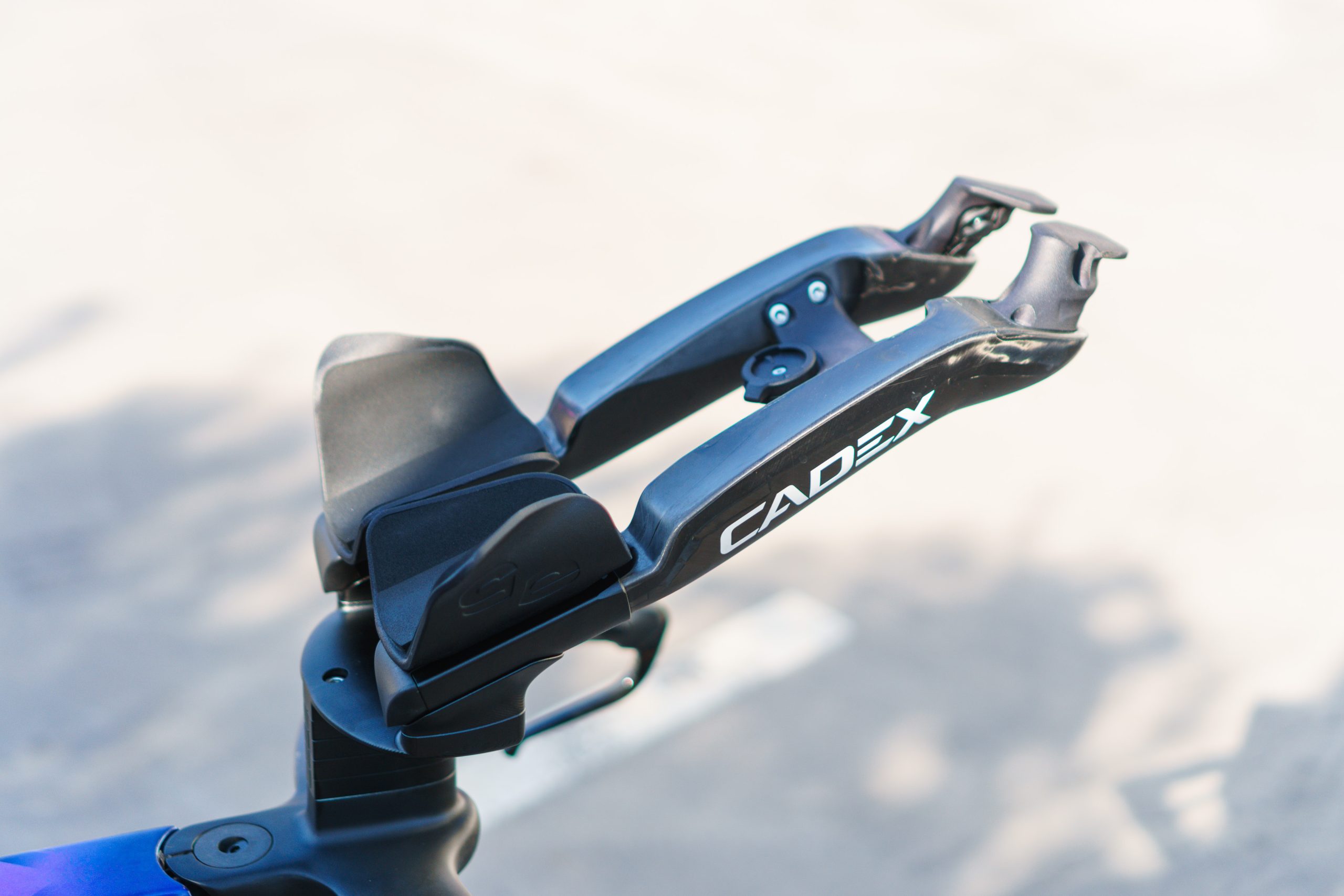
Cadex also supplies the mono-riser bar extensions. Cadex has its own triathlon frameset, although this has a dual riser, so the extensions are not a stock item and they’re not the standard extensions Giant sells with the Trinity.
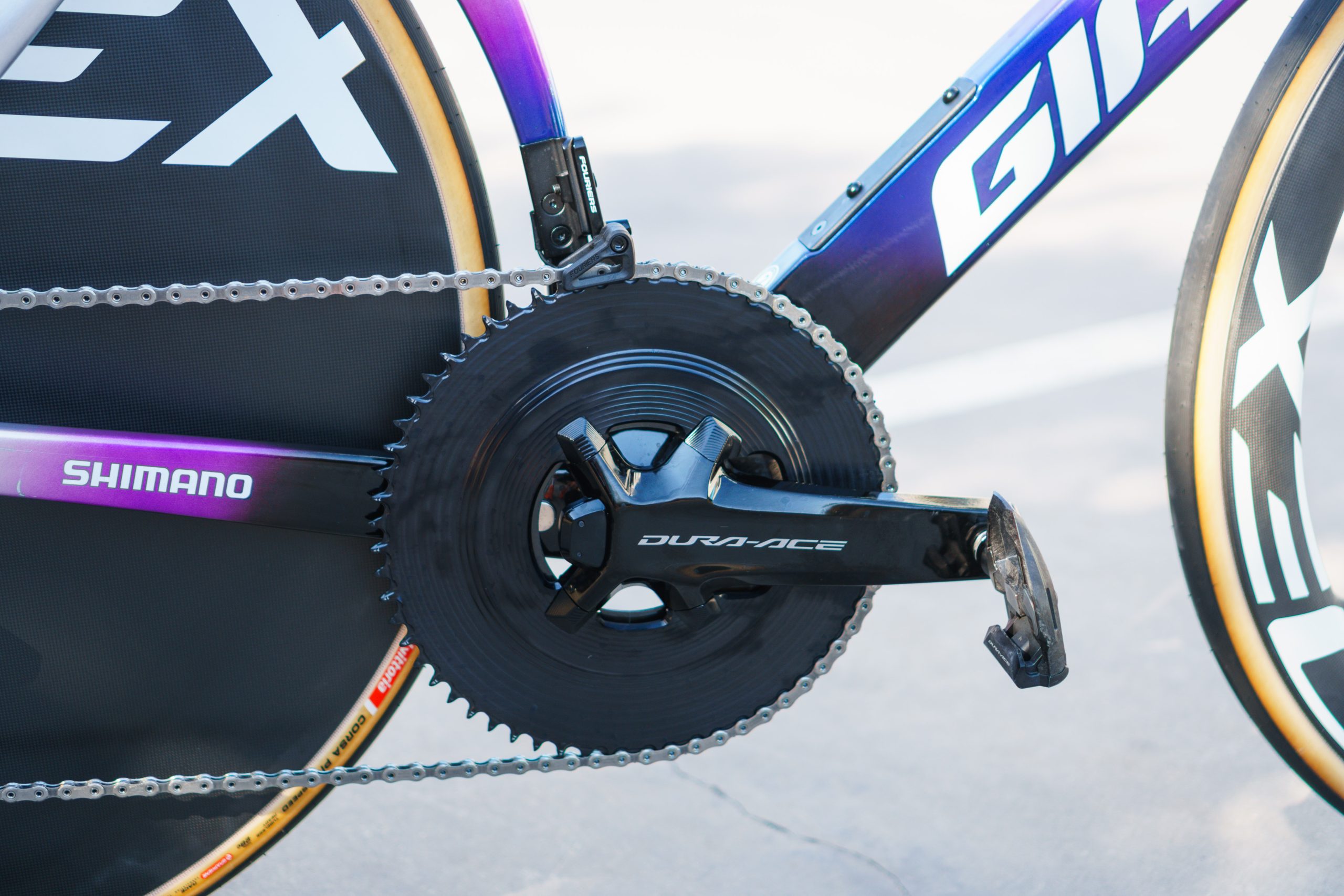
Jayco AlUla is a Shimano team and Schmid is running a 1x Dura-Ace configuration with a Fouriers carbon chain catcher.
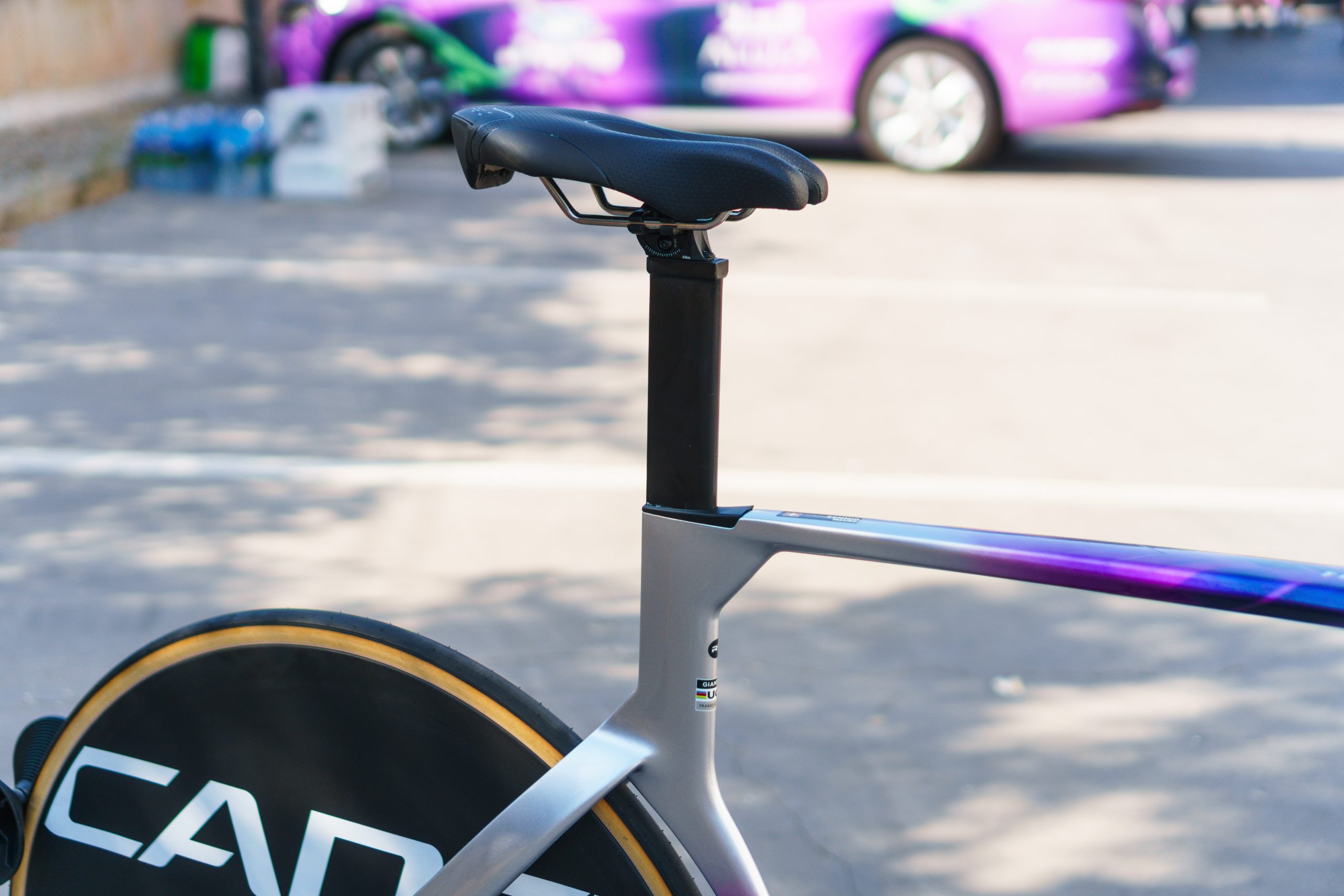
He sits on an ISM PS 1.0 twin-nose time trial saddle with a 307g claimed weight. It’s set well back on its rails and the saddle clamp is set in its rearward position to keep it in line with the UCI’s saddle-position regulations on the Trinity’s steep 77° seat tube.
We weighed Schmid’s bike at 9.3kg.
Tom Pidcock’s Pinarello Bolide F
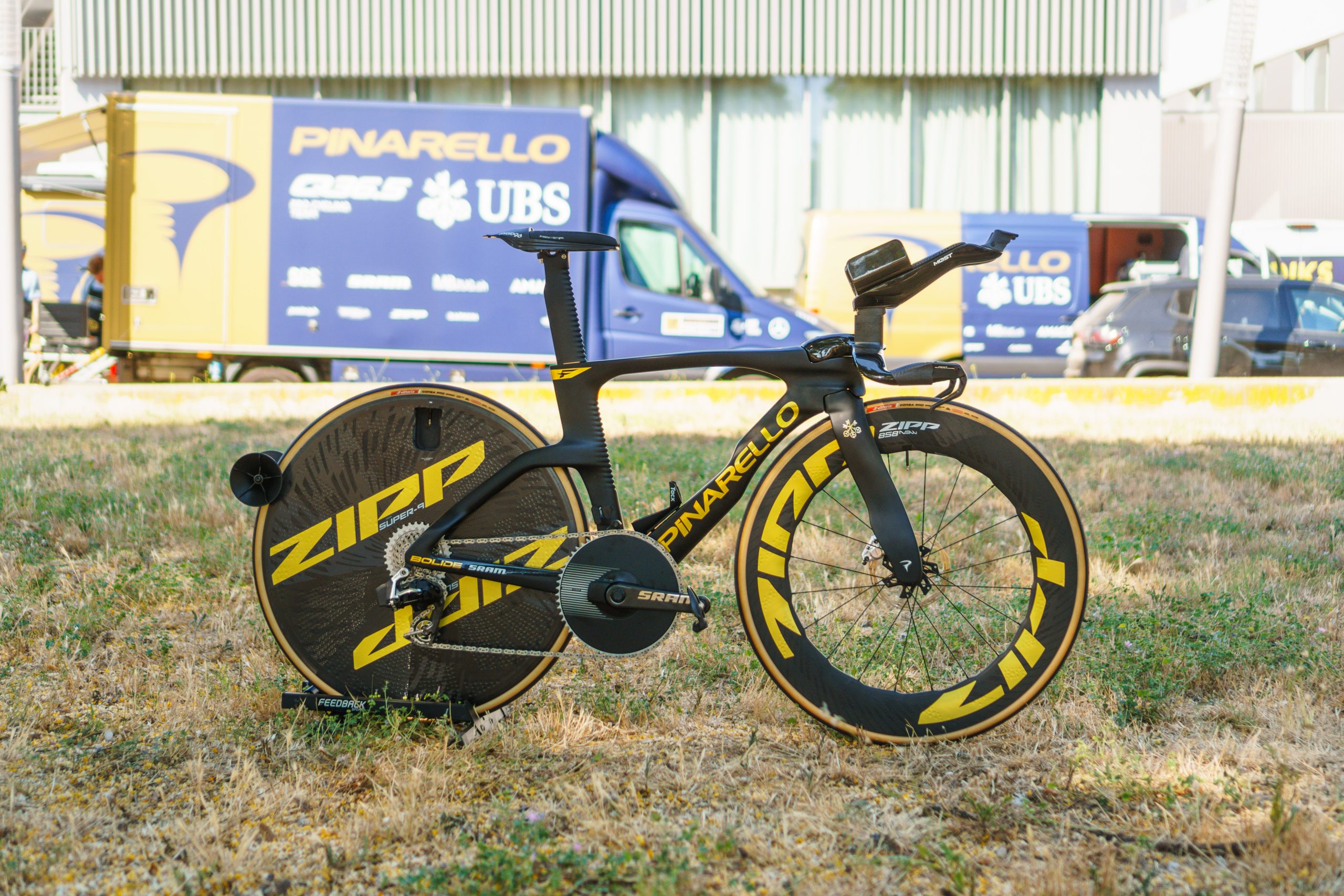
Tom Pidcock is riding the Pinarello Bolide F time trial bike, long a favourite with Netcompany Ineos, and based on the bike on which Filippo Ganna took the hour record back in 2022.
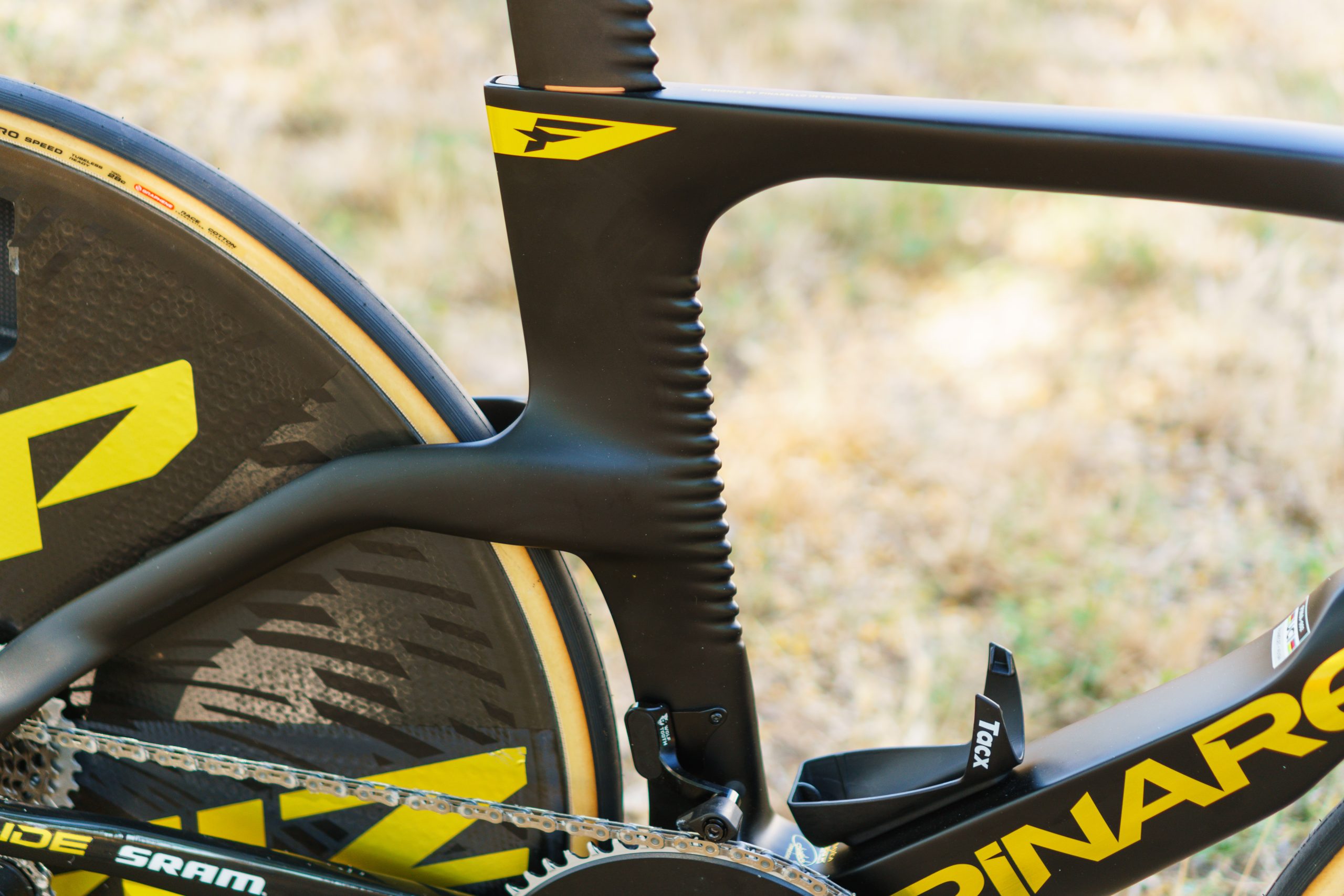
While Ganna’s hour-record bike was 3D printed in ‘Scalmalloy’ alloy, the Bolide F reproduces the ribbed leading edge of the seat tube and seatpost in carbon. The ribs are a piece of biomimicry based on whale skin. As with Pogačar‘s Colnago TT2, there’s a conventional internal steerer.
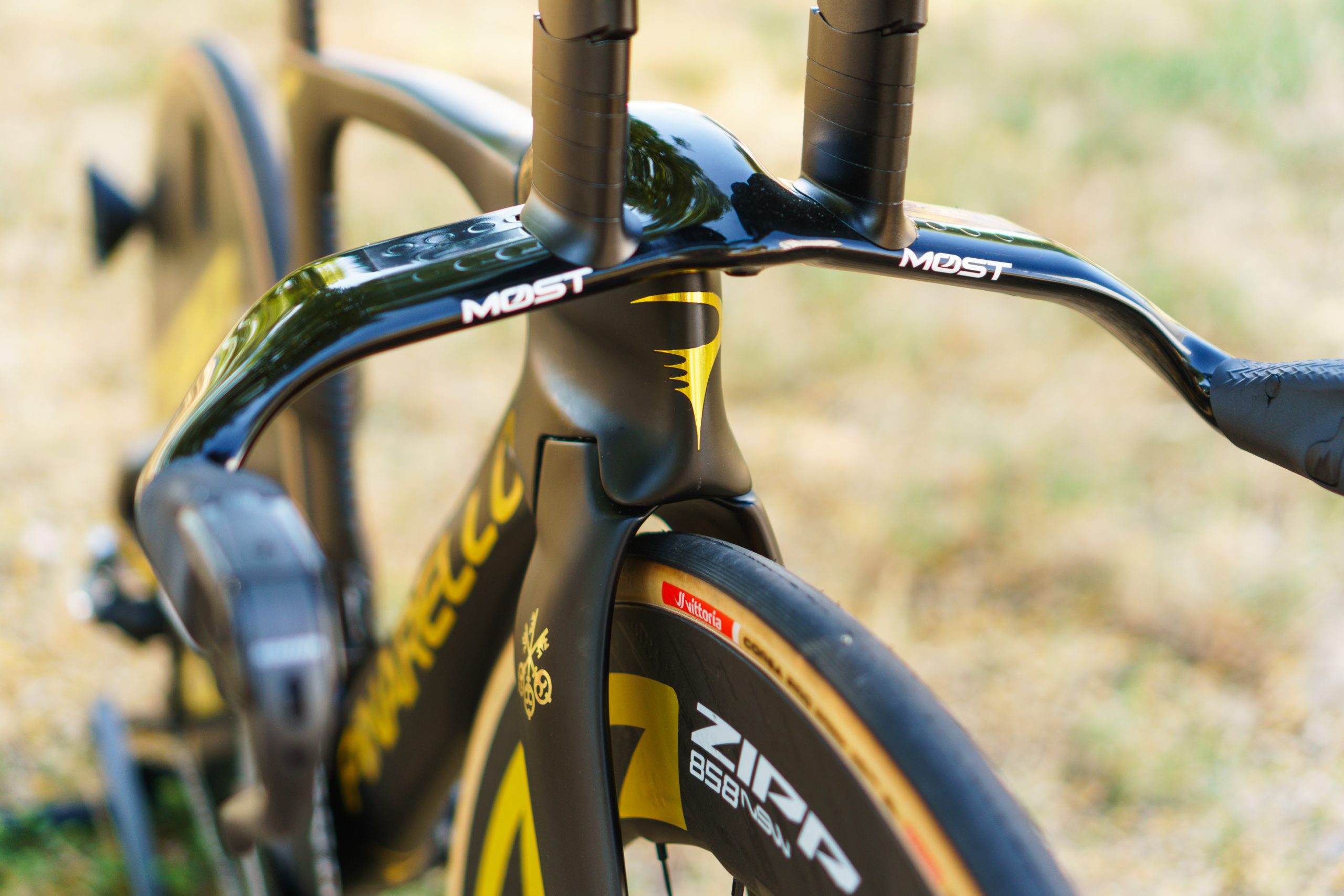
Pidcock is using Pinarello’s Most-branded base bar with separate Most carbon extensions, with 3D-printed padding for his forearms.
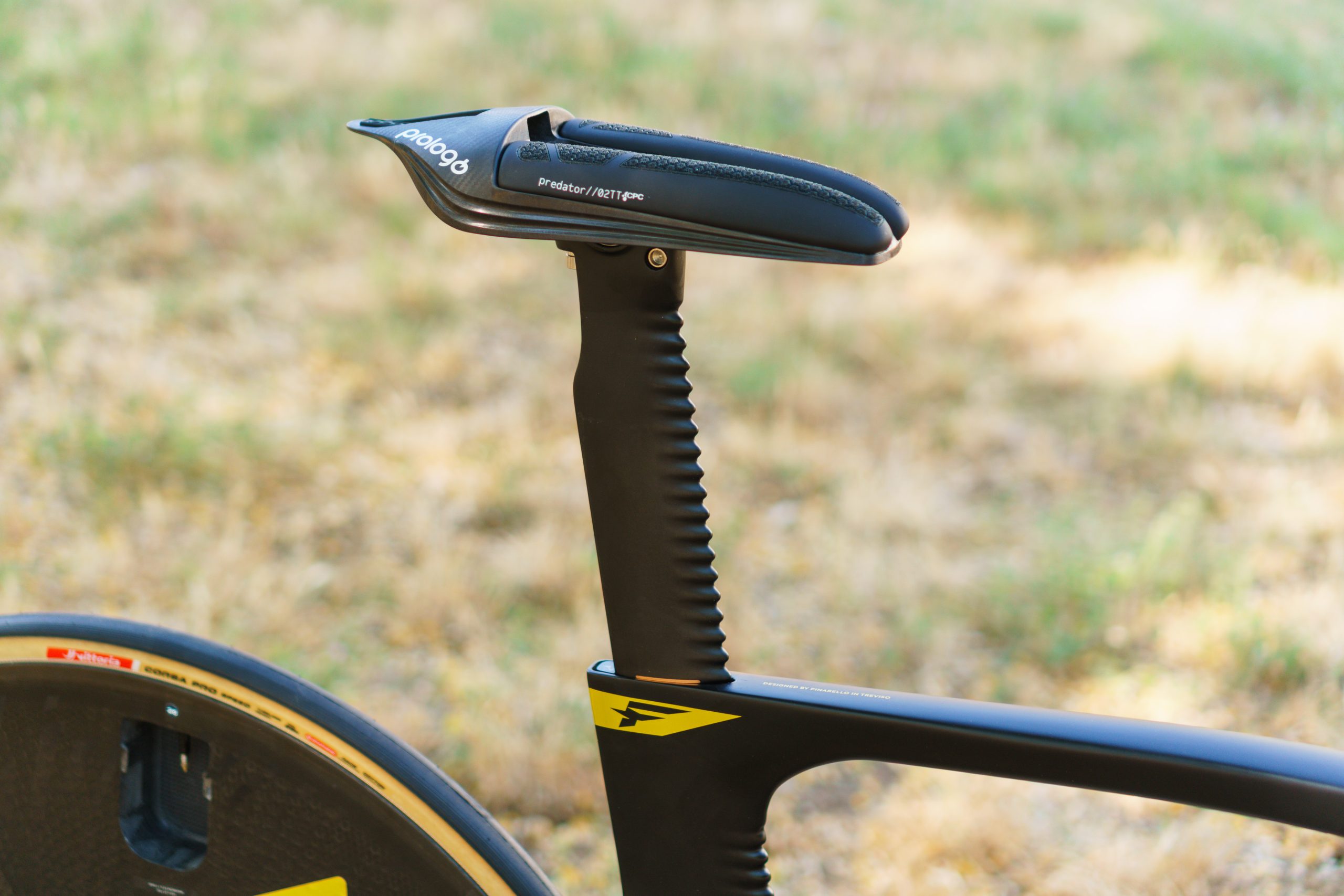
He sits on a Prologo Predator//01 TT saddle with Prologo’s CPC grippers to help him maintain his position and is held in place by a 3D-printed titanium saddle clamp.
There’s a flared down tube to shield the Tacx aero water bottle cage, while the seatstays hug the rear wheel; there’s a tendency in newer frames to spread them out in the manner of the Hope Lotus track bike, so they don’t interfere with the wheel aerodynamically.
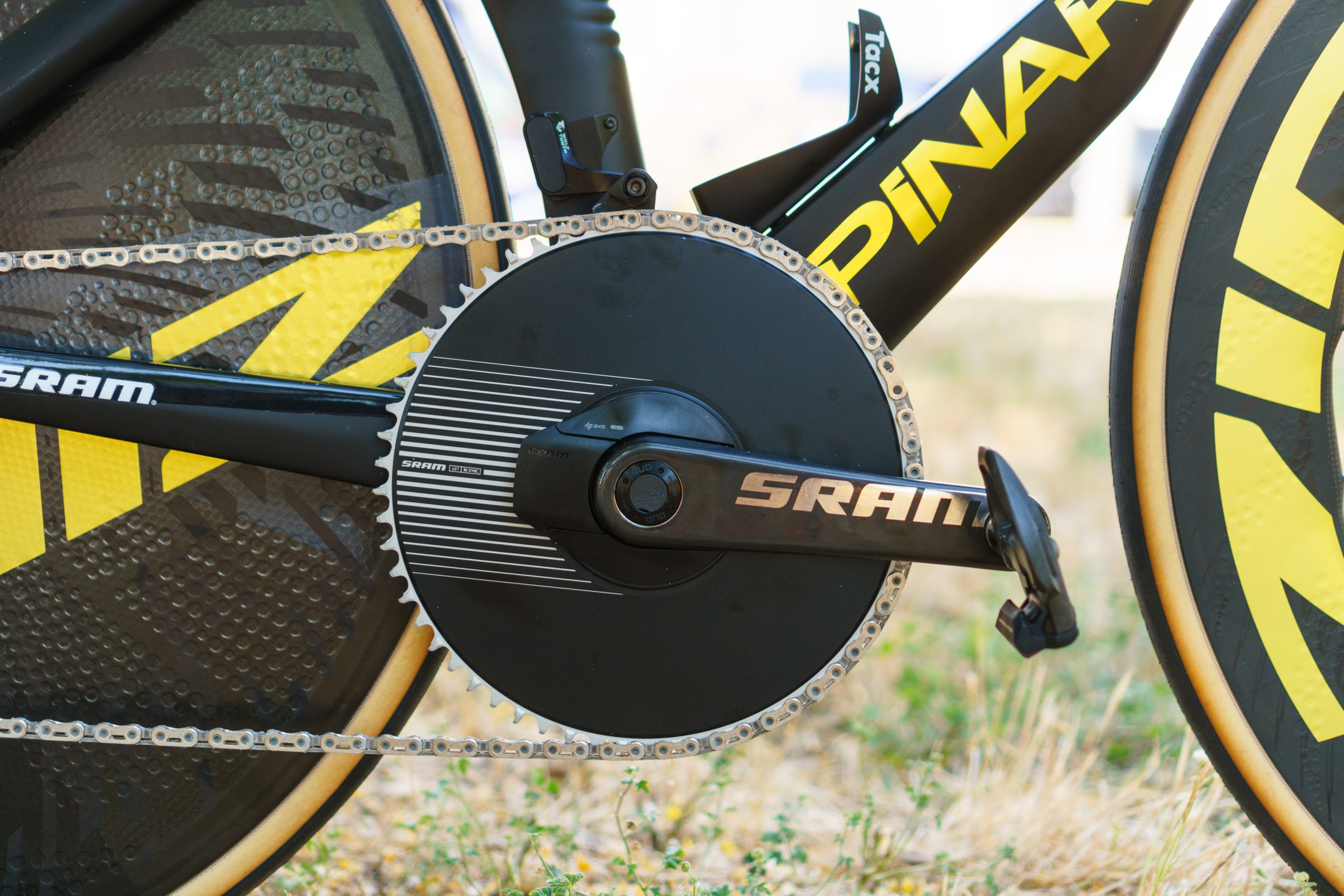
In Barcelona, Pidcock had a SRAM Red AXS 1x power meter with 160mm cranks, a 60T SRAM chainring and 10-33t cassette, with a Wolf Tooth chain catcher. His wheels are a Zipp Super 9 disc rear and an 858 NSW front with yet more biomimicry. His Vittoria Corsa Pro Speed 28mm tyres have no valve nuts, so he’s probably using latex inner tubes.
Despite the black and gold paint, which might be a little lighter than the rest of the team’s blue and gold, Pidcock’s Bolide F weighed 8.5kg – not too bad for a TT bike.
Per Strand Hagenes’ Cervélo P5
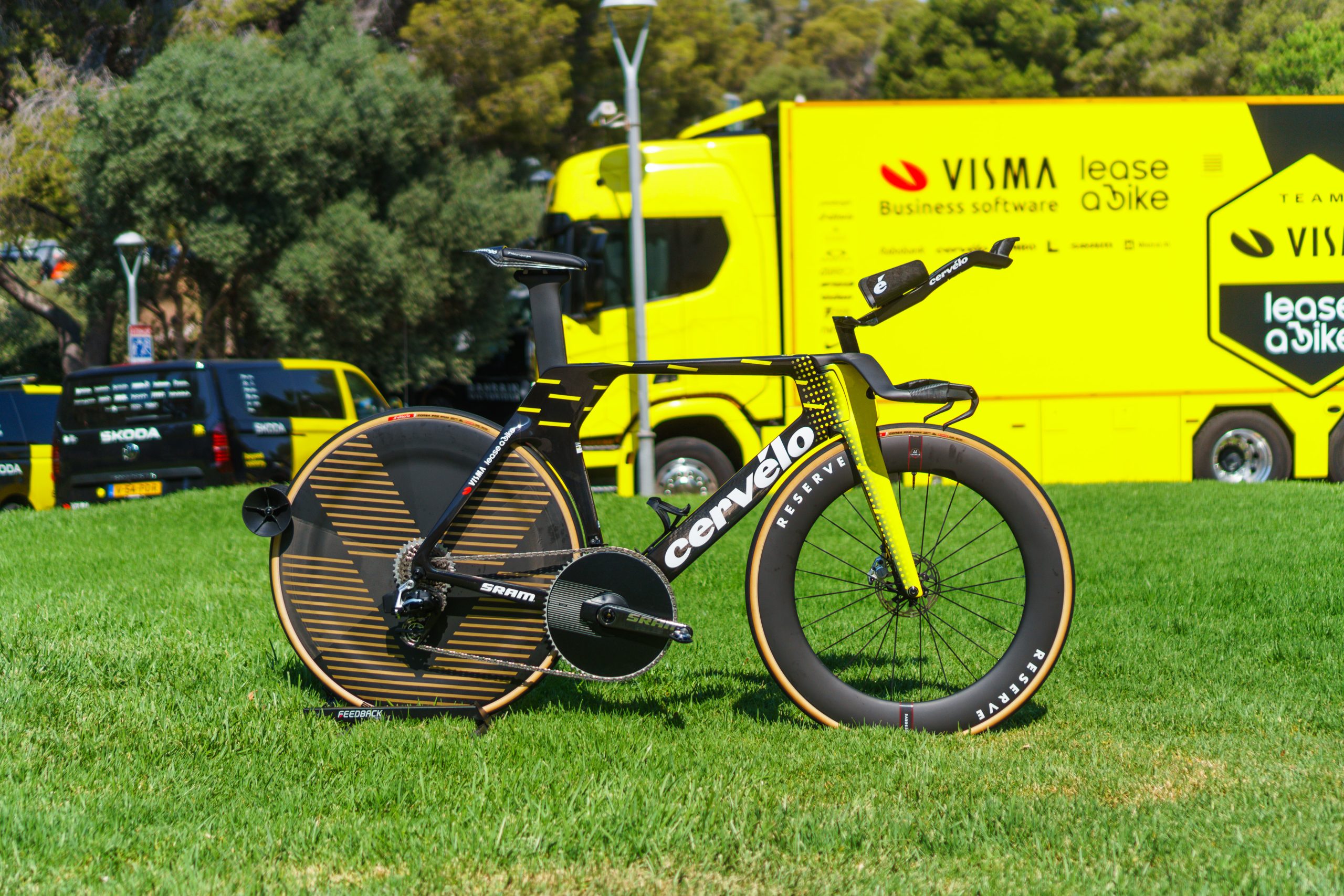
Norwegian Per Strand Hagenes had been riding in support of Jonas Vingegaard at the Tour, until Vingegaard's stage-15 crash forced him to abandon. At this year’s E3 Saxo Classic, he was the best of the rest, placing second when the breakaway group of four pulled Mathieu van der Poel, riding the new Canyon Endurace CFR, back to three seconds before letting him escape to the win.
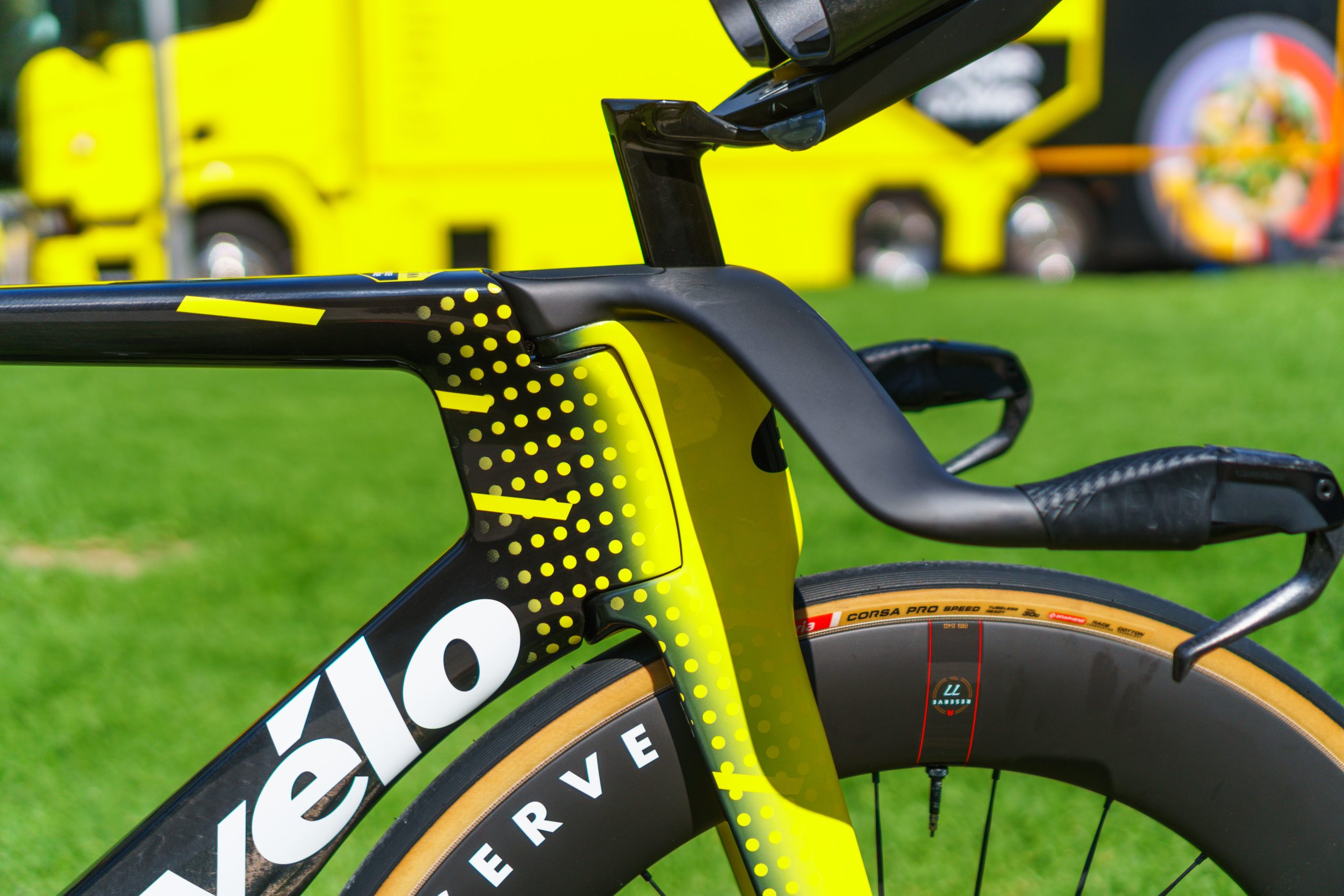
The Cervélo P5 has a bayonet fork, which helps to elongate and narrow the head tube. There's a standard Tacx bottle cage for use with a round bottle, rather than a more aero design.
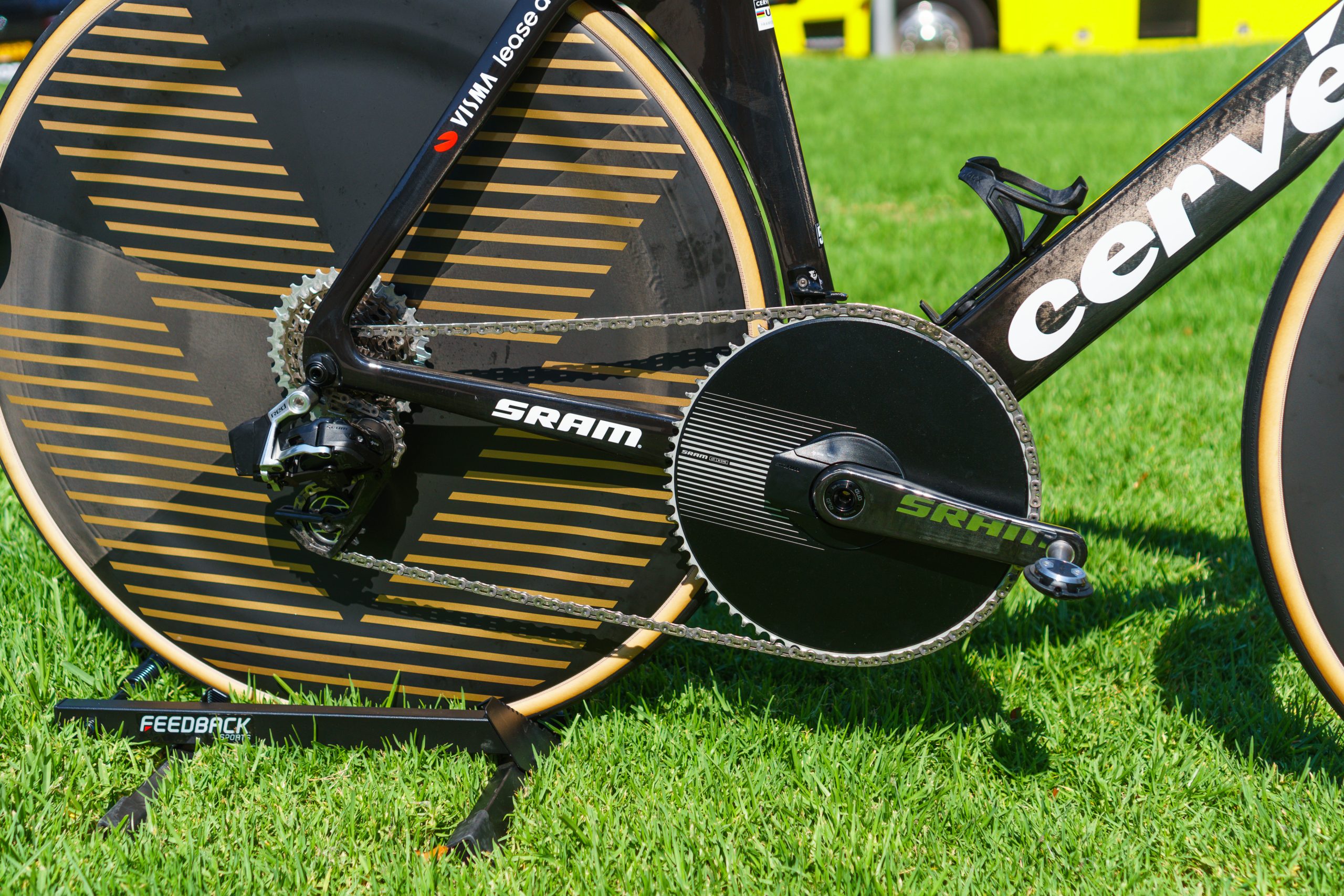
Strand Hagenes was running a 68-tooth SRAM aero chainring at the Grand Départ, the largest we’ve seen, with 160mm cranks and paired with a 10-33t cassette. There's a low-profile Wolf Tooth aero chain guide and Wahoo Speedplay Aero pedals.
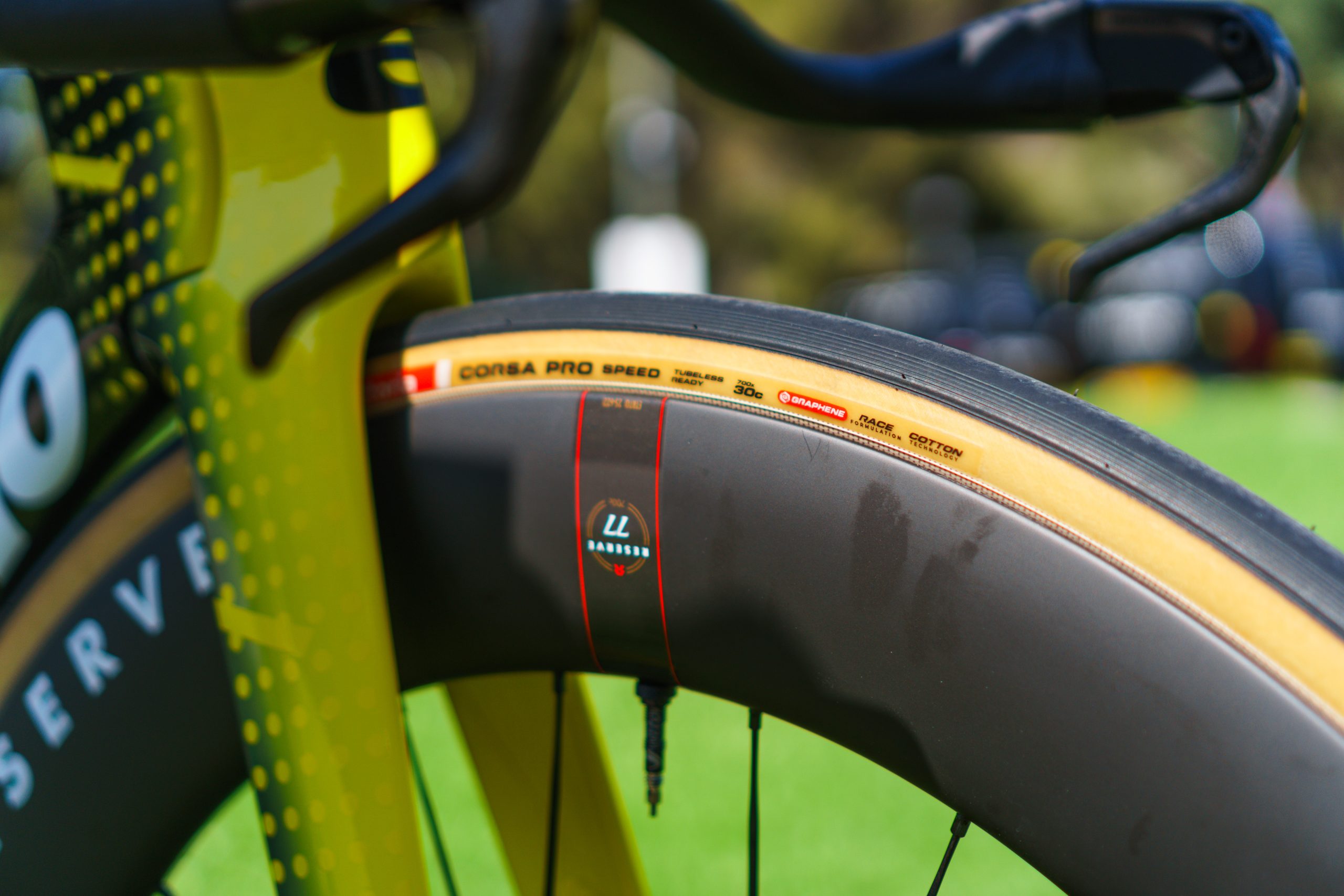
The wheels are from Reserve: a disc rear and a 77 front. They’re fitted with Vittoria Corsa Pro Speed 30c tyres, which measure 31mm at the front and 32.3mm at the rear.
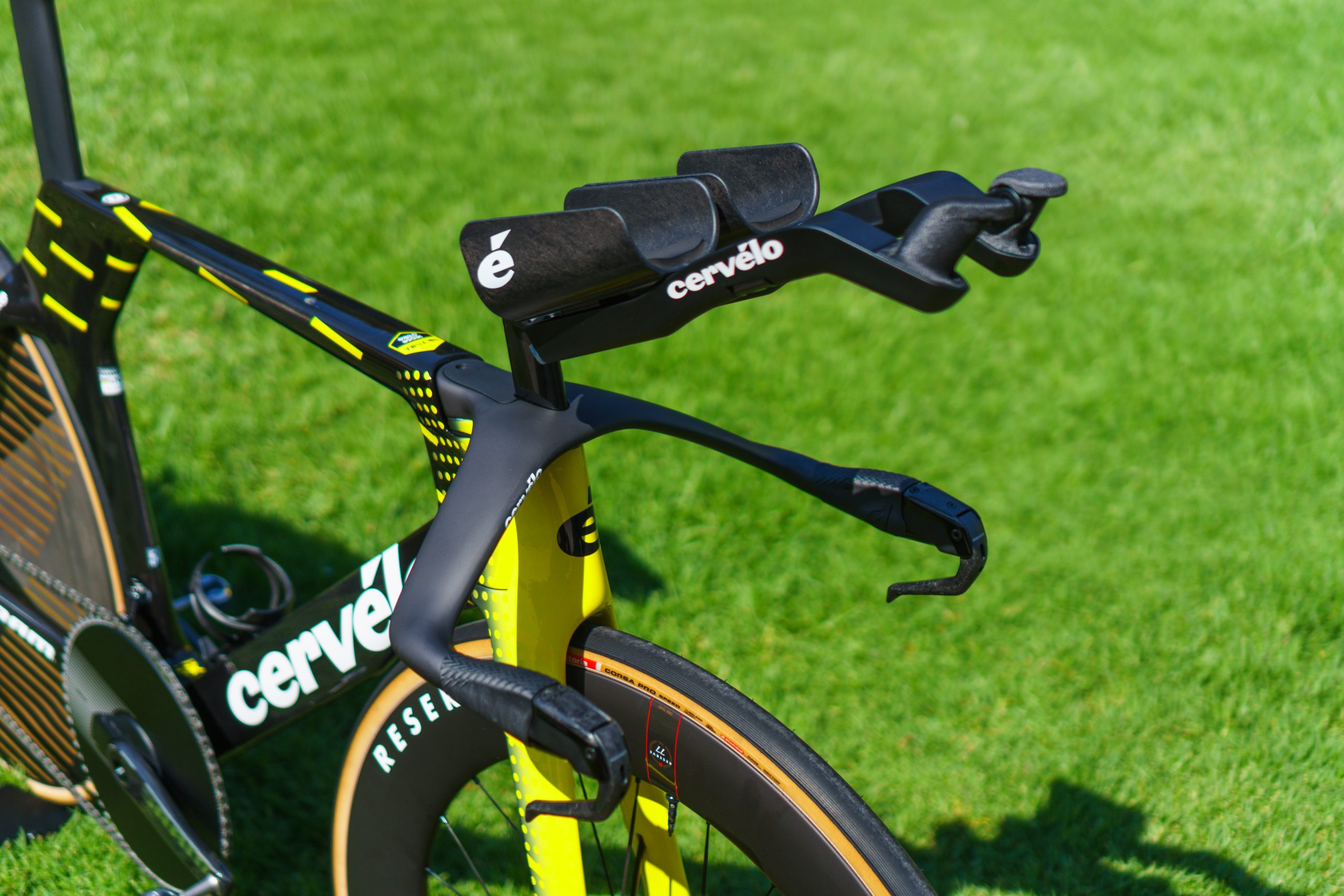
Rather than a double riser, the P5 has a mono-riser to fit the extensions, which have an adjustable angle and integrated Blips shifters, with another set of Blips on the base bar.
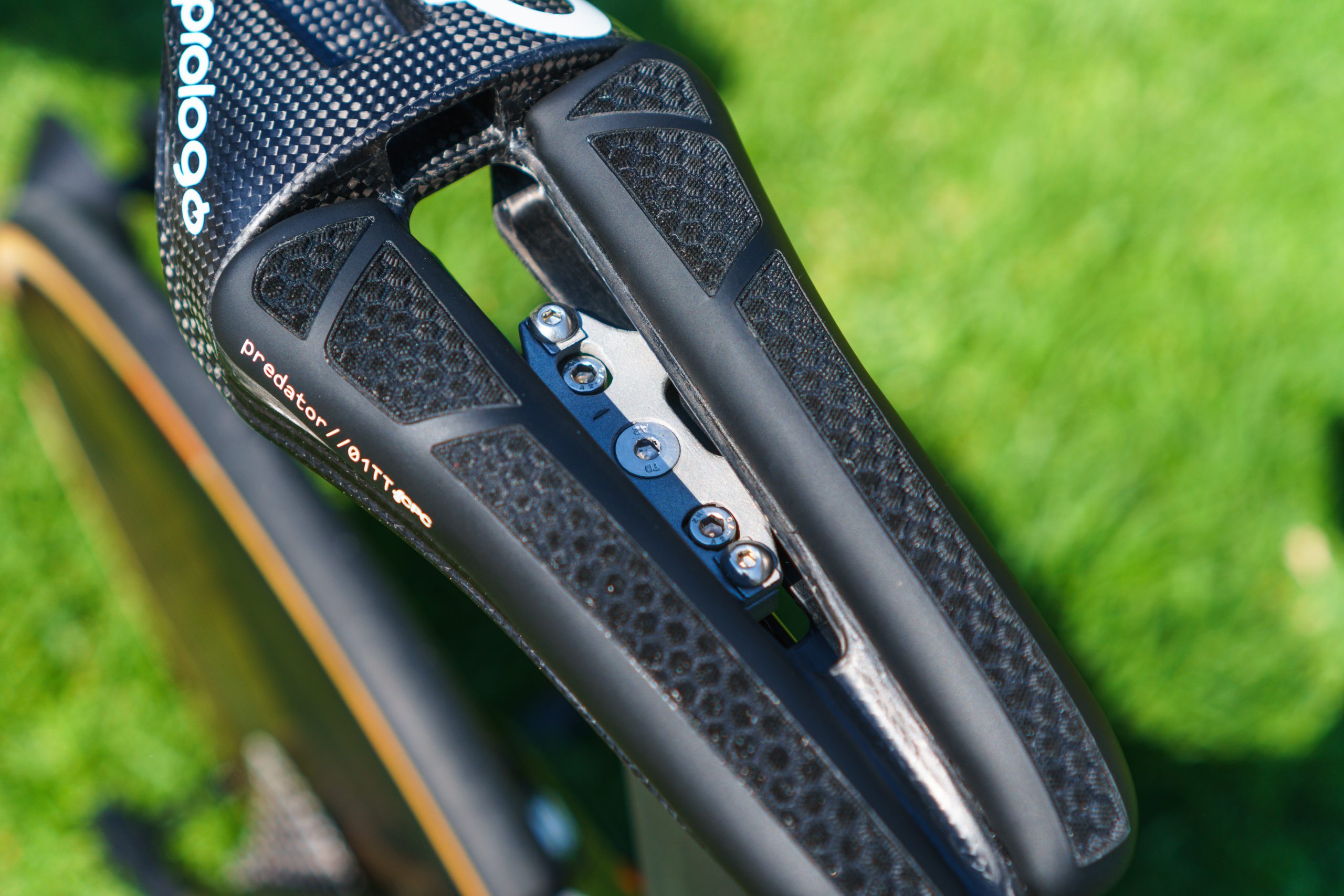
The saddle is a Prologo Predator, as used by Pidcock, with a carbon rear and CPC grippers. Again, as with Pidcock’s bike, the saddle clamp is 3D-printed titanium.
The 8.8kg bike weight isn’t bad for a bike fitting the 184cm-tall Strand Hagenes.
Lenny Martinez’s Bianchi Aquila RC
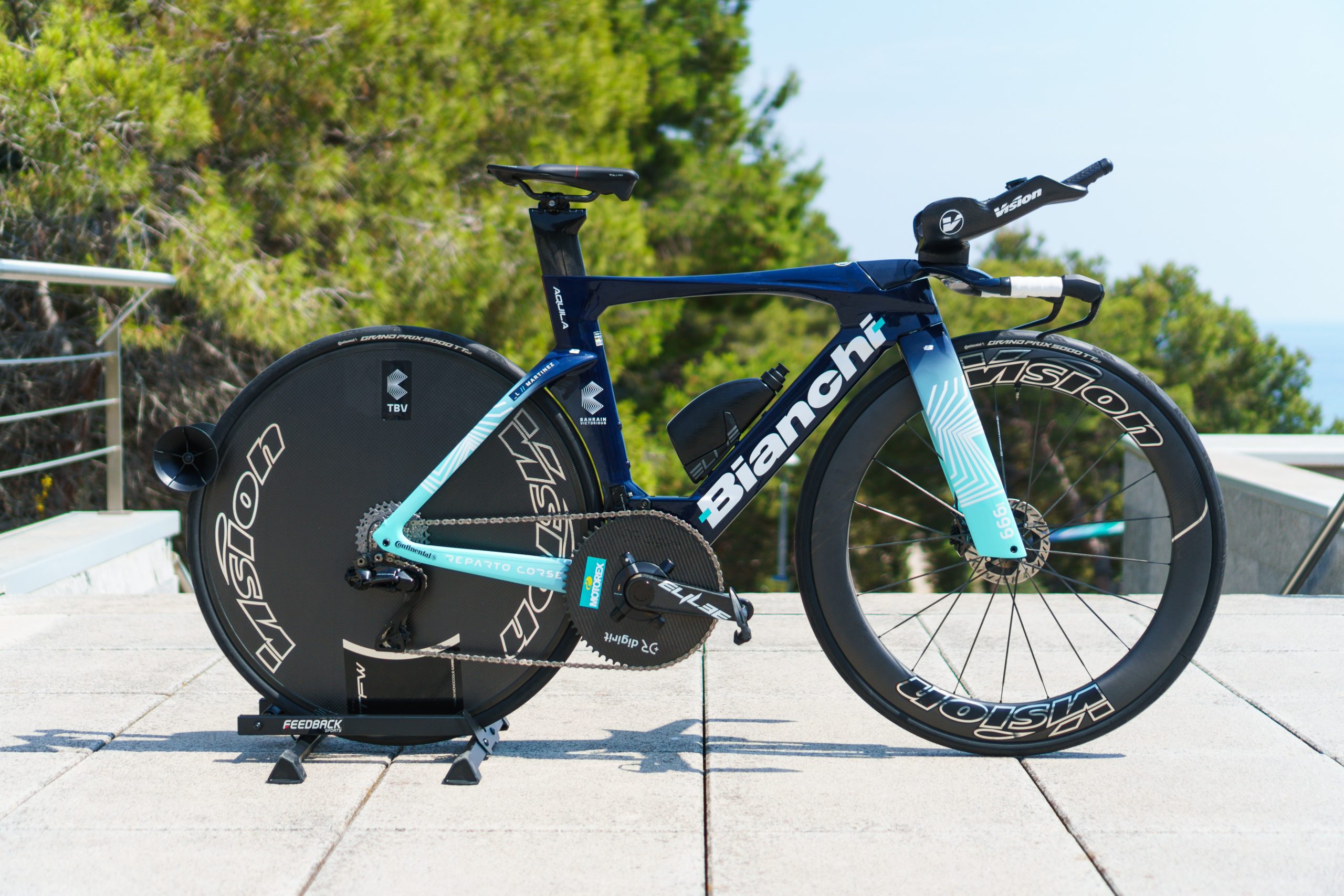
Bahrain Victorious team leader Lenny Martinez has been bubbling under in this year’s Tour de France and is also ranking well in the young rider competition. At 1.68m tall and around 52kg in weight, he’s placed well in the KOM ranking, too.
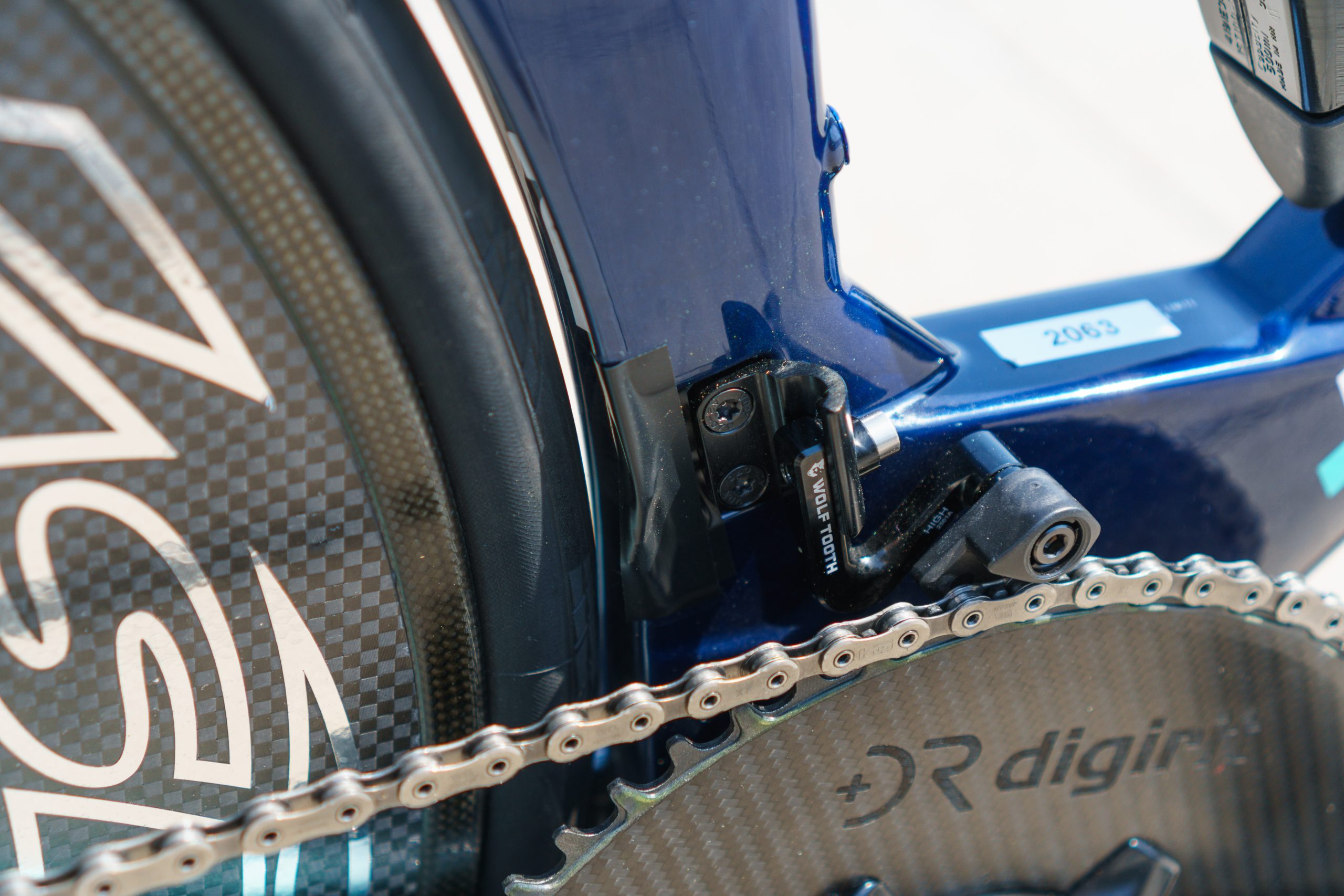
As you’d expect, Martinez rides a smaller bike and we weighed his Bianchi Aquila time trial bike at 7.77kg – a low figure compared to his competitors.
Launched in February 2025, the latest Aquila was the first generation to be built for disc instead of rim brakes, thus retiring the last rim-brake bike in the WorldTour. The new bike is also a claimed 16.1 watts faster at 50km/h.
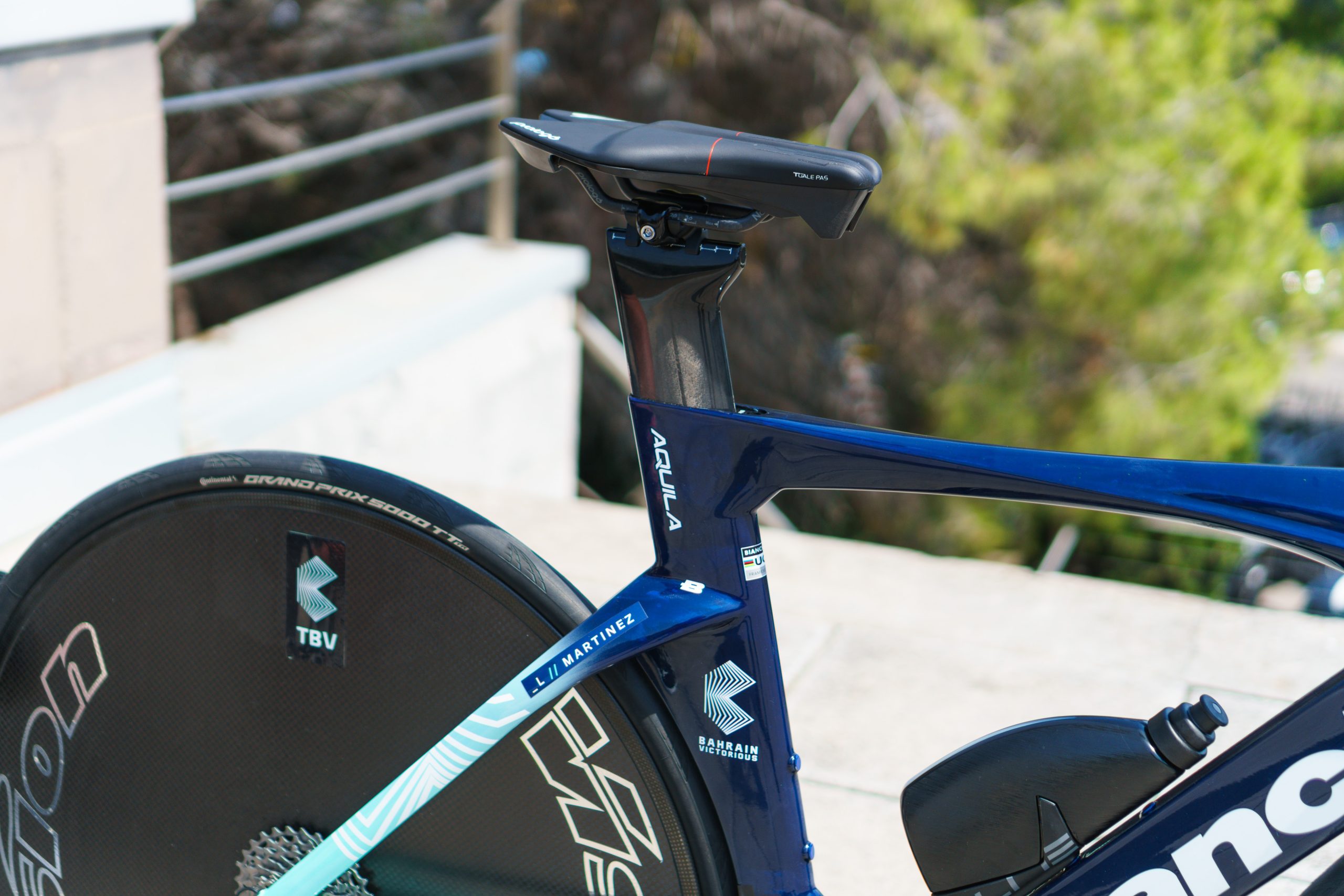
At 77.5°, the Aquila’s seat tube is even steeper than the Giant Trinity’s. Along with an extended reach, this is intended to place the rider in a more aggressive, more aero position.
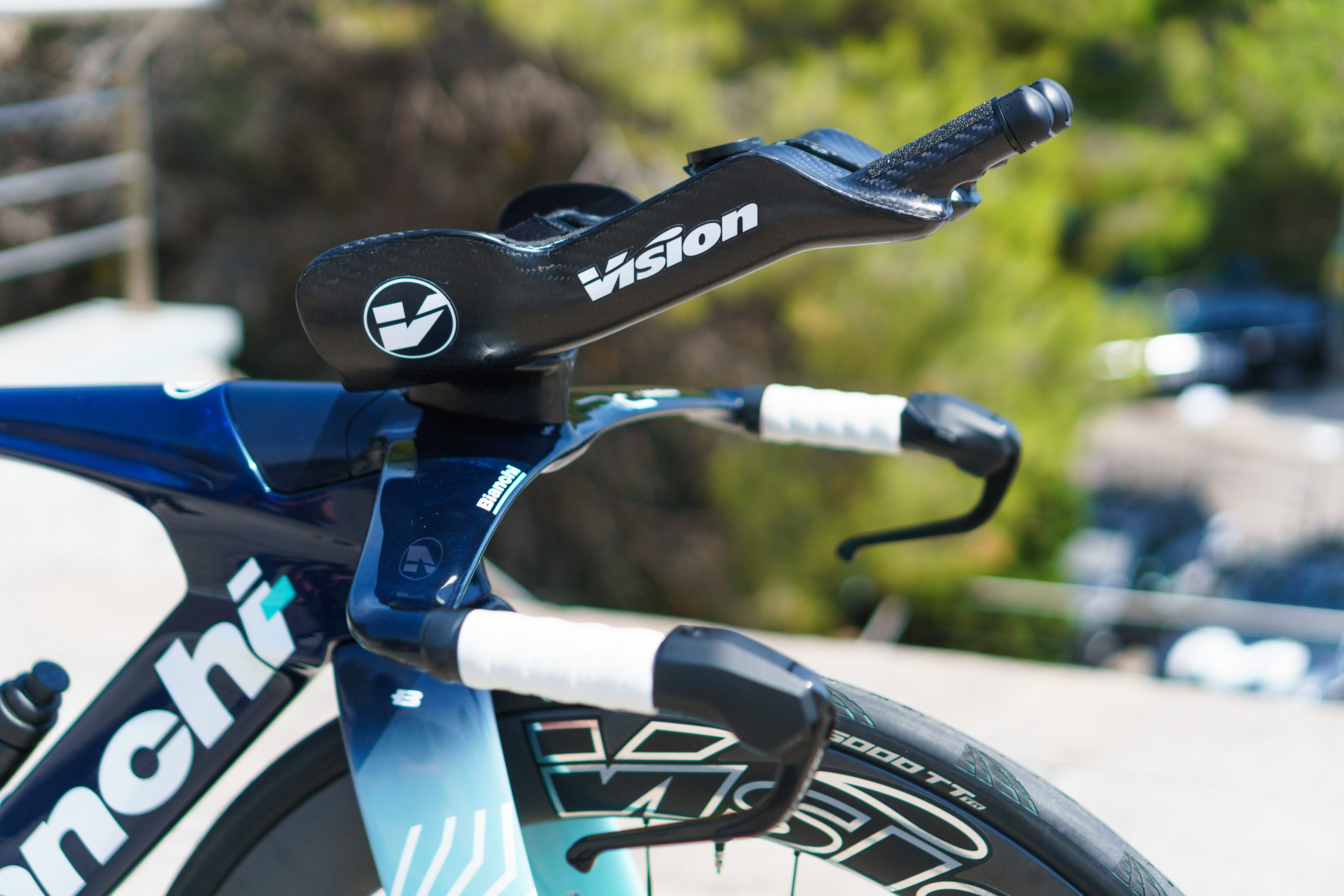
The deep tube sections are claimed to provide a sailing effect in sidewinds to help the bike go faster. It’s another bike with an internal steerer rather than a bayonet arrangement and the steerer top cap/stem integrates neatly with the top tube.
There are highly adjustable mono-riser carbon extensions designed alongside Vision, which also supplies the wheels, a disc rear and 81mm-deep front. Interestingly, the disc wheel still sports a rim-brake track and has a 19.5mm internal width.
The tyres are the Continental Grand Prix 5000 TT TR in a 28mm width, the widest the frame is designed to accommodate. Although we measured the front at 31mm, the rear tyre was a narrower 28.5mm.
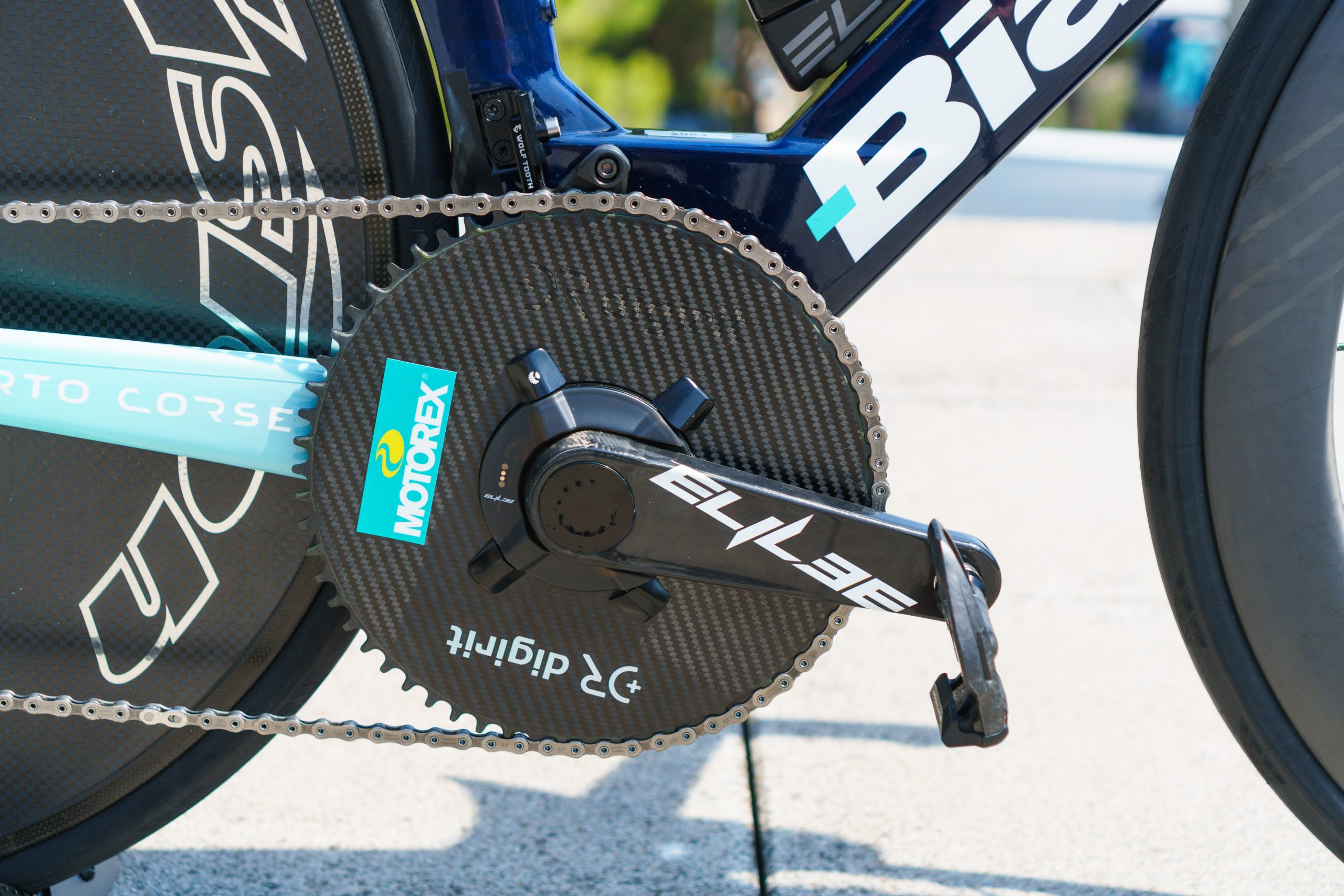
Martinez is running a Digirit carbon chainring, probably the 60-tooth that’s the largest the brand offers at retail. He has a carbon power meter crankset from Chinese brand Elilee, which is the same as fitted to the Bahrain Victorious road bikes.
It’s paired with a Dura-Ace derailleur and an 11-30t cassette, and there’s a Wolf Tooth chain catcher fitted.
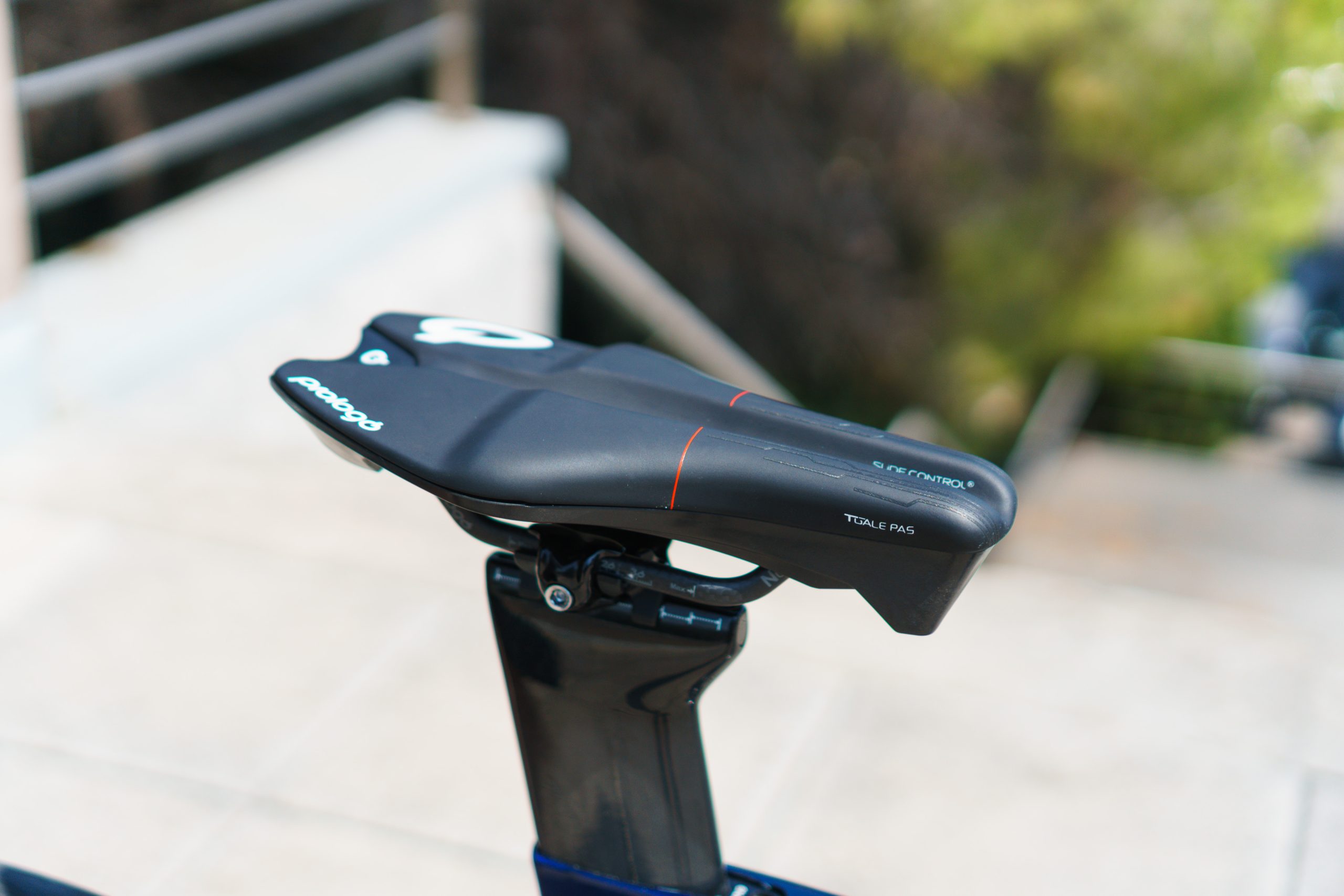
Martinez sits on a Prologo T-Gale PAS saddle and Bahrain Victorious is another team using the Elite Kit Crono CX aero water bottle.
Søren Wærenskjold’s Ridley Dean Fast
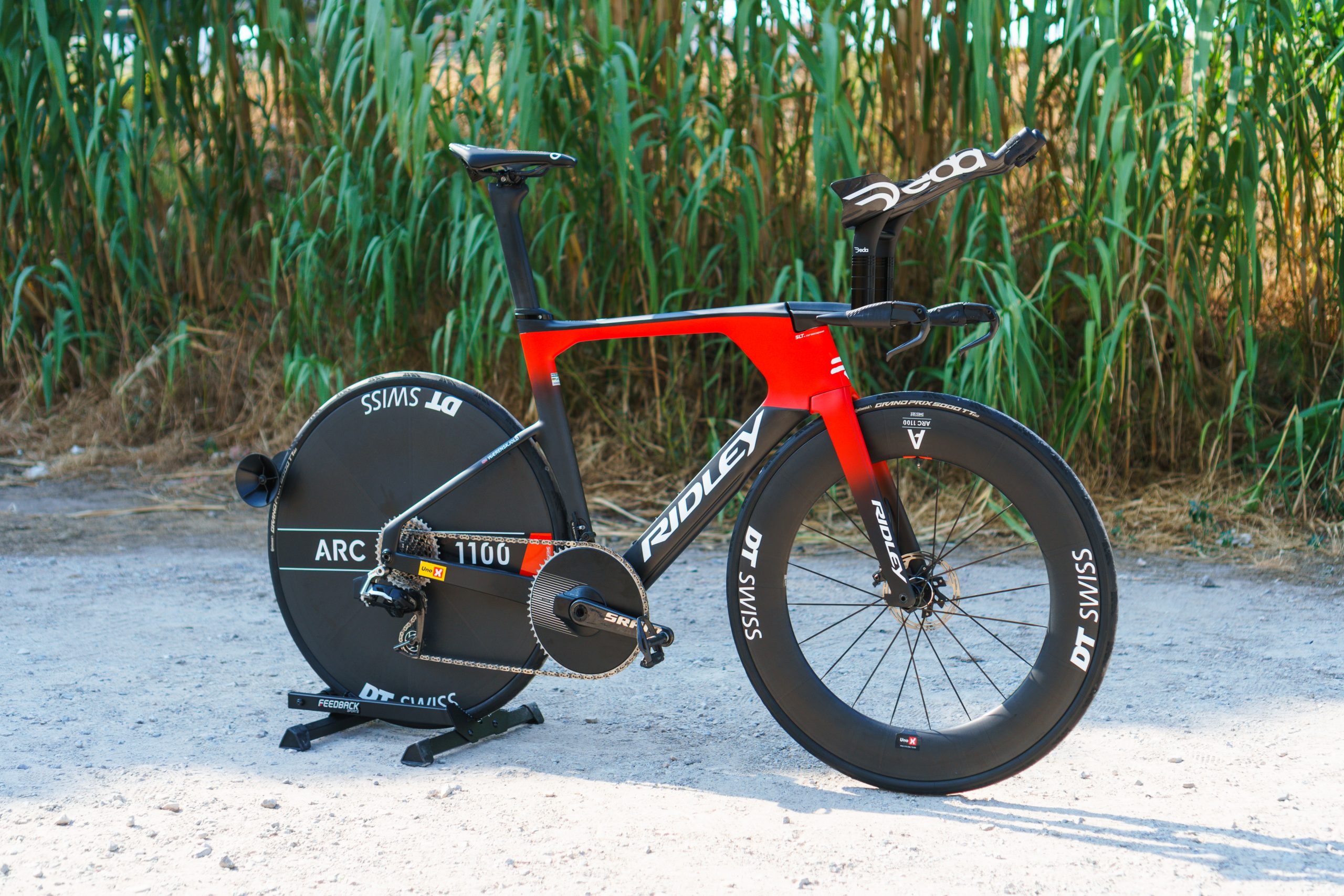
Søren Wærenskjold won the sprint into Nevers on stage 11 of the Tour de France, taking the Scandinavian team’s first Tour victory. He won Omloop het Nieuwsblad in 2025 and he’s no mean time triallist either, having won the U-23 world championships in 2022 and the Norwegian national title in 2023 and 2024.
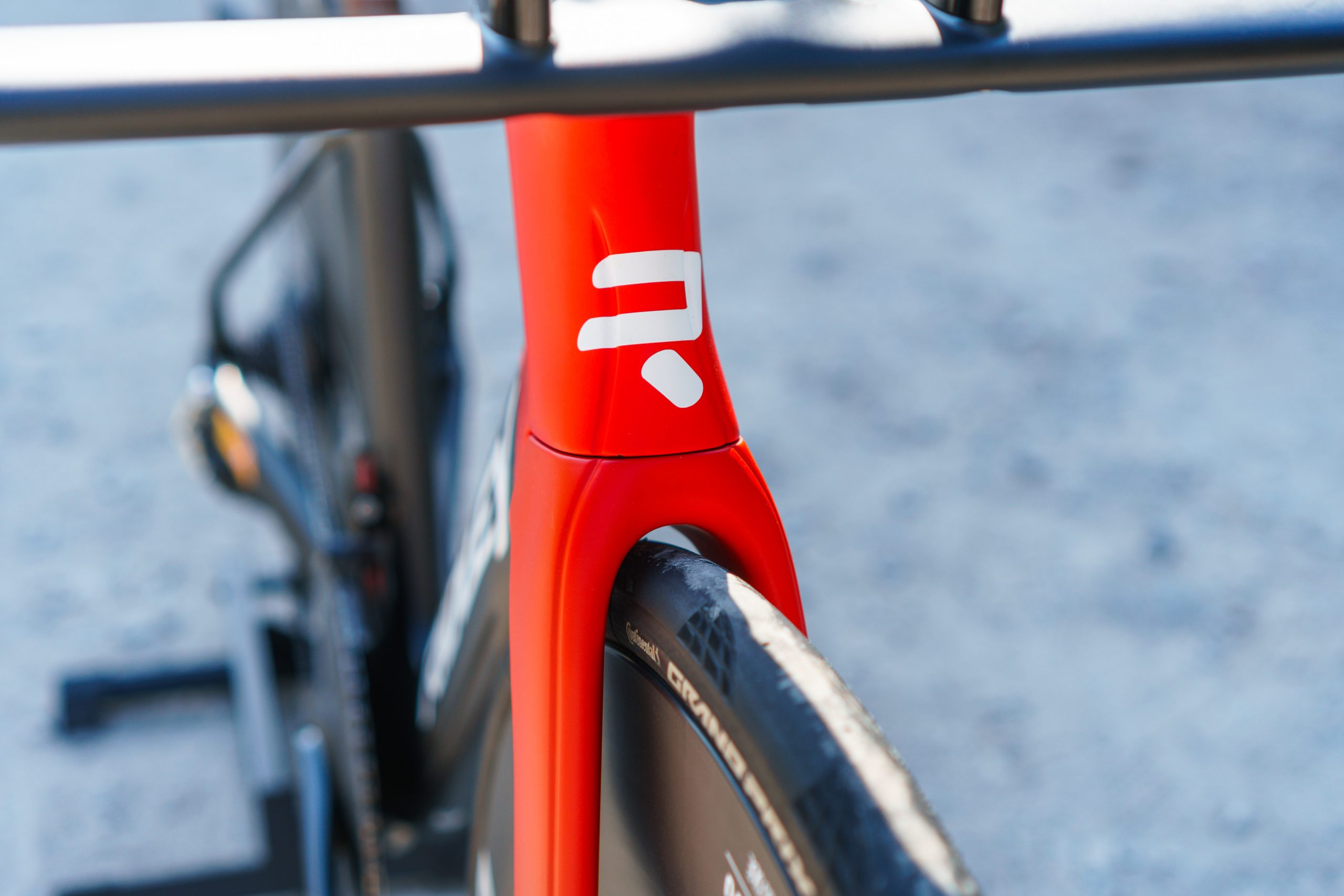
Wærenskjold’s Ridley Dean Fast time trial bike includes Ridley’s F-Surface Plus, a small groove towards the leading edge of the frame tubing, which Ridley claims helps reduce drag.
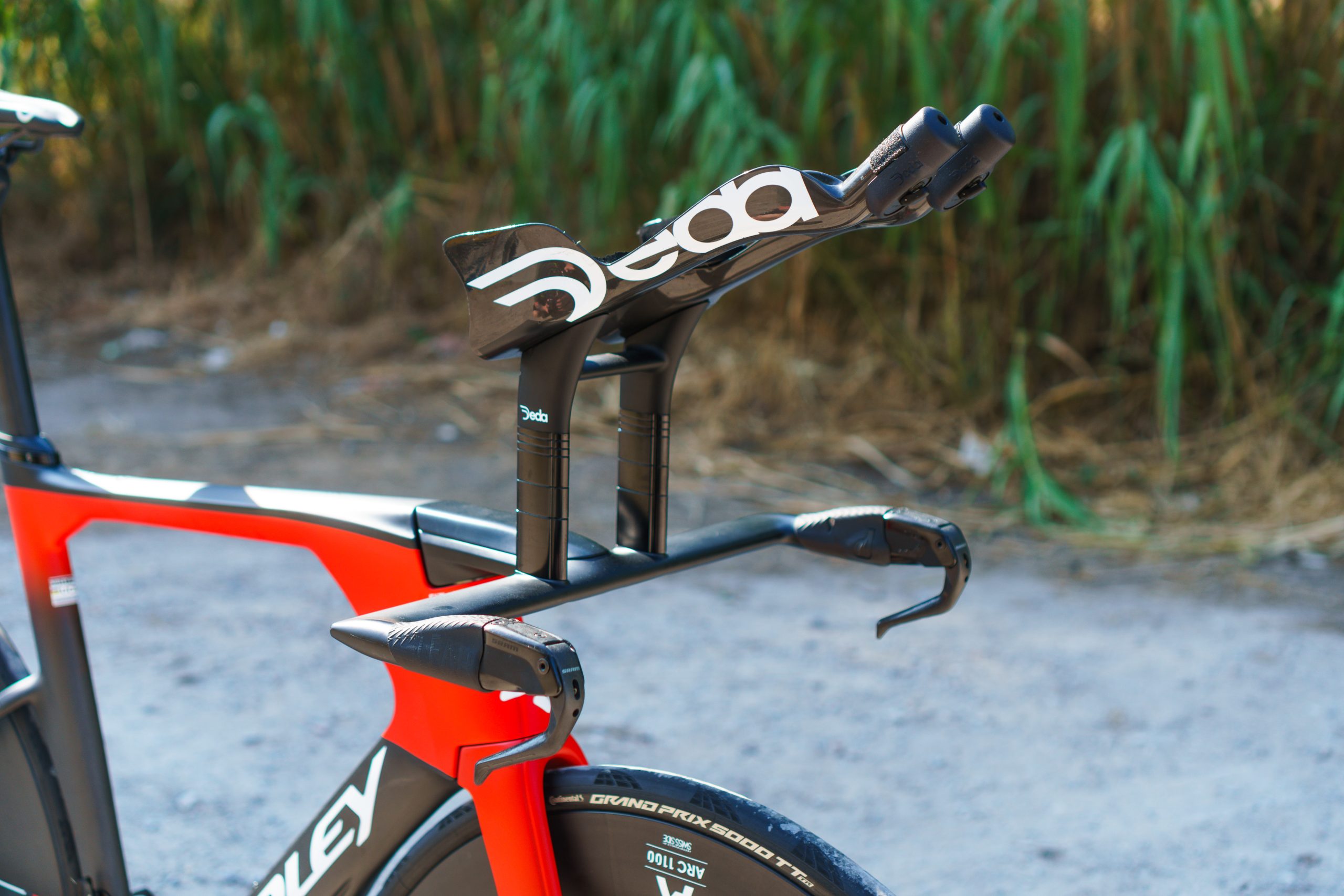
There’s a dual-riser system, with Jet2 Evo bar extensions from Deda.
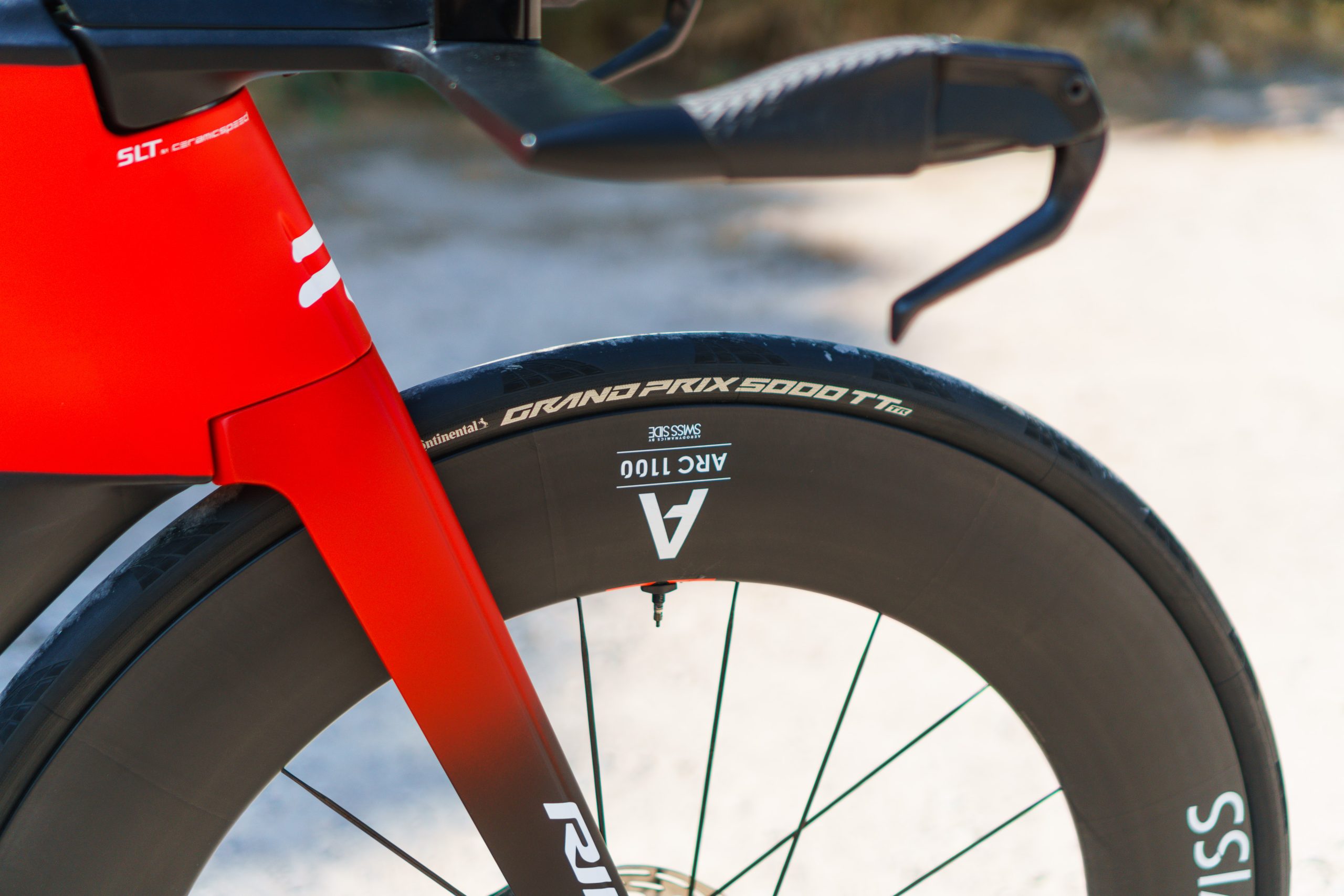
Alongside Ridley, Uno X Mobility are sponsored by DT Swiss and Wærenskjold has an 85mm-deep ARC 1100 front and disc rear wheel fitted, along with 28mm Continental Grand Prix 5000 TT TR tyres. We measured the rear tyre at 30.4mm, the front at 31.3mm.
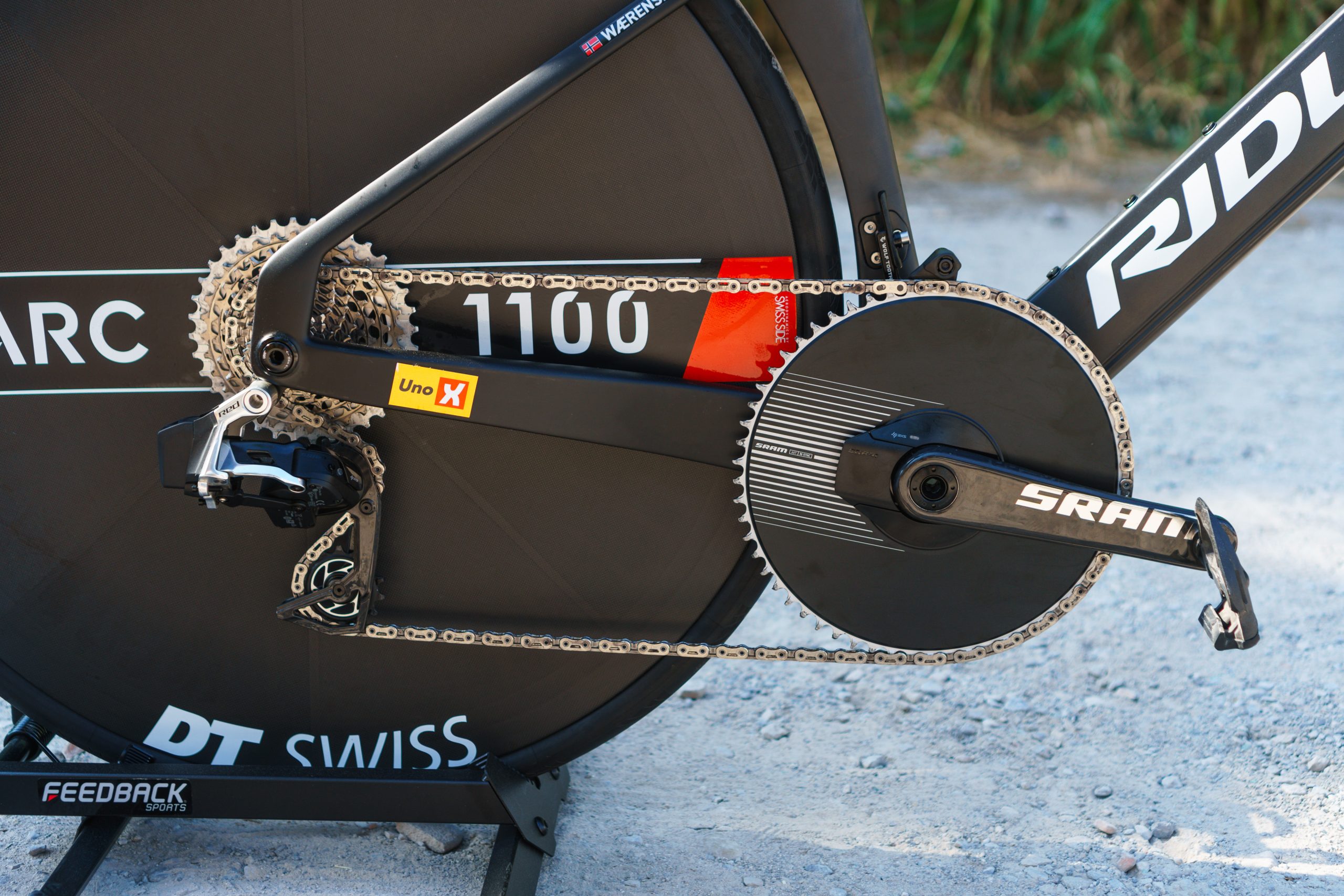
Wærenskjold has a SRAM power meter crankset with a 60-tooth chainring, 172.5mm crank length and Shimano Dura-Ace pedals, paired with a 10-36t cassette. He’s another rider running Wolf Tooth’s low-profile chain catcher.
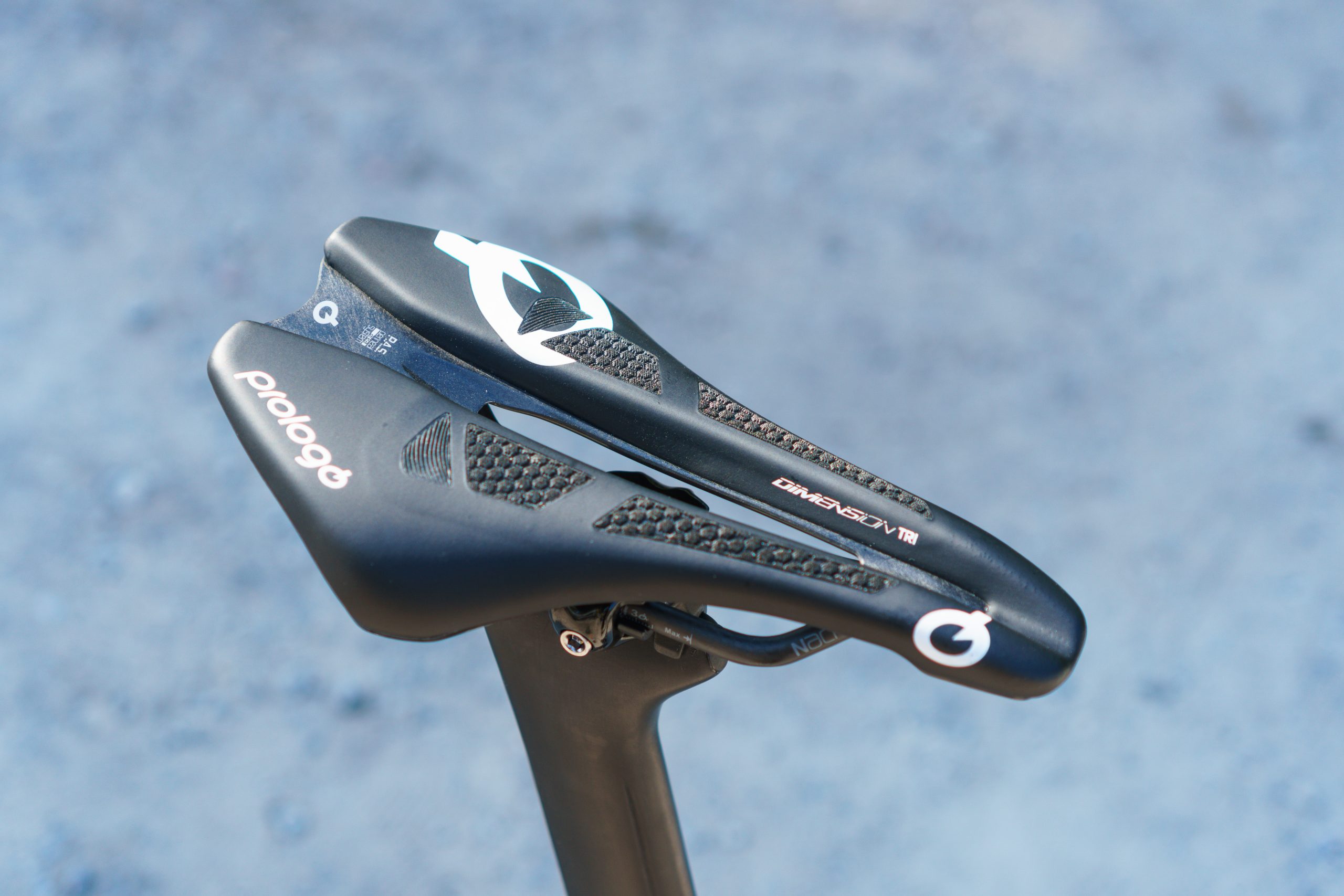
While other riders have opted for time-trial shaped saddles, Wærenskjold sits on a Prologo Dimension Tri CPC saddle with a road-like shape.