Not for the first time in the past few years, we’re wondering why the Tour de France has sped up.
Several massive speed records fell again in 2026. The overall average speed record of the race was smashed for the second time in two years, breaking 43km/h for the first time: 43.227km/h, according to official timing partner of the Tour, Tissot. In a race that really didn't favour the sprinters, either.
Since 2020 – let's call it the Tadej Pogačar era – the overall speed record has tumbled several times, and Stage 11 this year, won by Norway’s Soren Waerenskjold, finished in a record speed for a single stage: 50.91km/h over 161.3km.
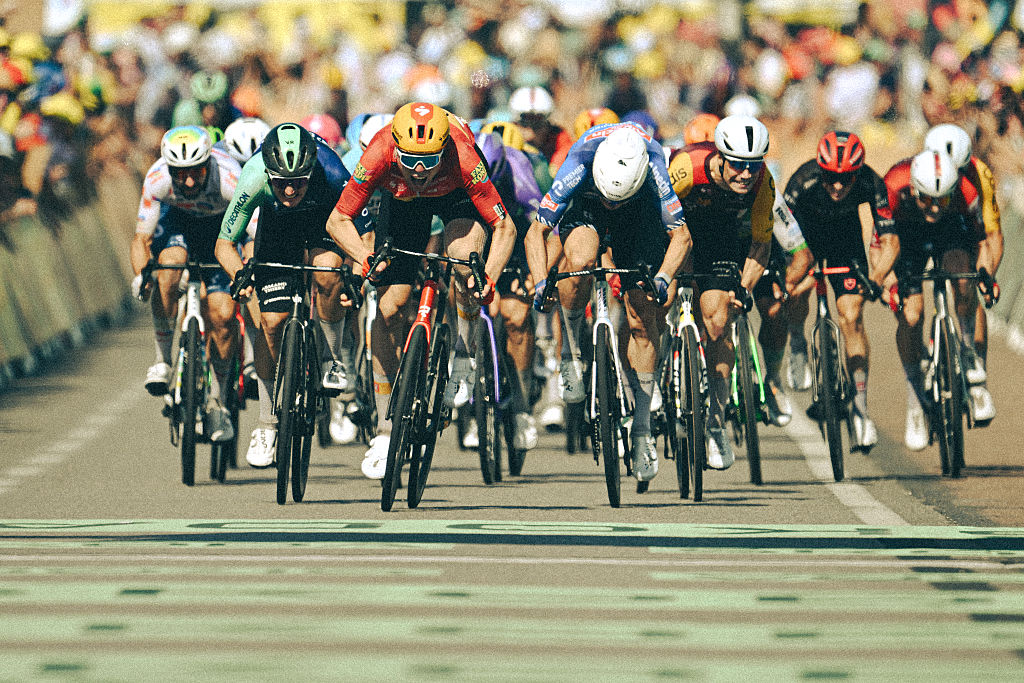
And, of course, Tadej Pogačar broke the time record on the Tour’s most iconic climb, Alpe d’Huez, blitzing its 13.8km in 35 mins 27 seconds – putting almost two minutes into Marco Pantani’s 1997 benchmark.
Some fans express incredulity at how riders are breaking long-standing records that were set in the dark doping-addled era of pro cycling.
That includes Pantani’s previous Alpe d’Huez benchmark and the previous fastest stage time, set in 1999 by Mario Cipollini.
Let’s put aside the spectre of banned performance-enhancing drugs – we must, because modern-day cyclists are far better policed through testing, the Whereabouts system and biological passport data (including through the now infamous night-time testing from this year’s race).
What we know is that with the investment, advancements and evolutions in equipment, aerodynamics, training, nutrition, tactics and recovery, it’d be a surprise if speeds and performances weren’t on the rise.
Equipment
The bikes of 2026 are a very different proposition from even 10 years ago, let alone the Pantani era. Lighter, more aero, stiffer in the right places, smoother and less likely to go wrong than bikes from the 90s, nobody could suggest they haven't been a major factor in the speeding up of the peloton.
“Cycling has become an arms race. The bikes, the wheels, the clothing… If you’re not dialled in, you’ll be left behind,” Australian pro Luke Durbridge, an 11-time rider of the Tour, told us recently.
Pantani’s blue and yellow Wilier Triestina bike from 1997, with its silver Shimano Dura-Ace groupset, remains a thing of beauty. However, its heavy 1.2kg aluminium frame and savage gear ratios (Pantani spent a lot of time in a 39-19 low gear during his Alpe d’Huez record) would be nobody’s idea of a sprightly climber in 2026.
Pogačar’s climbing bike from last year’s Tour had a 40-34 bottom gear, in line with the trends of his era for lower gears, and made possible by the capabilities of modern groupsets.
Pantani’s inefficient out-of-the-saddle style – which was necessary in part because of such big gears – has been replaced by Pogačar’s aggressively seated approach, a trend that has risen in time with the technology available.
At around 7.8kg total bike weight, it’s about 1kg heavier than Isaac del Toro’s Colnago V5Rs (6.735kg) that we weighed at the start of this year’s Tour de France.
1kg is huge on climbs, but it’s the aerodynamics of modern bikes – wider tyres and aero everything – that has really ramped up speeds, particularly on flatter stages.
Greg LeMond opened the door to aerodynamics with his 1989 Tour de France win, but it didn't take off fully for another 20 years or so.
With the UCI weight limit for bikes still at the 6.8kg it was set at in 2000, the obsession with weight eventually had to give way to something, which turned out to be aerodynamics.
Now everything on the bike and rider is fine-tuned in wind tunnels and, as of 2026, even more high-tech than that, to extract every gain possible.
Nutrition
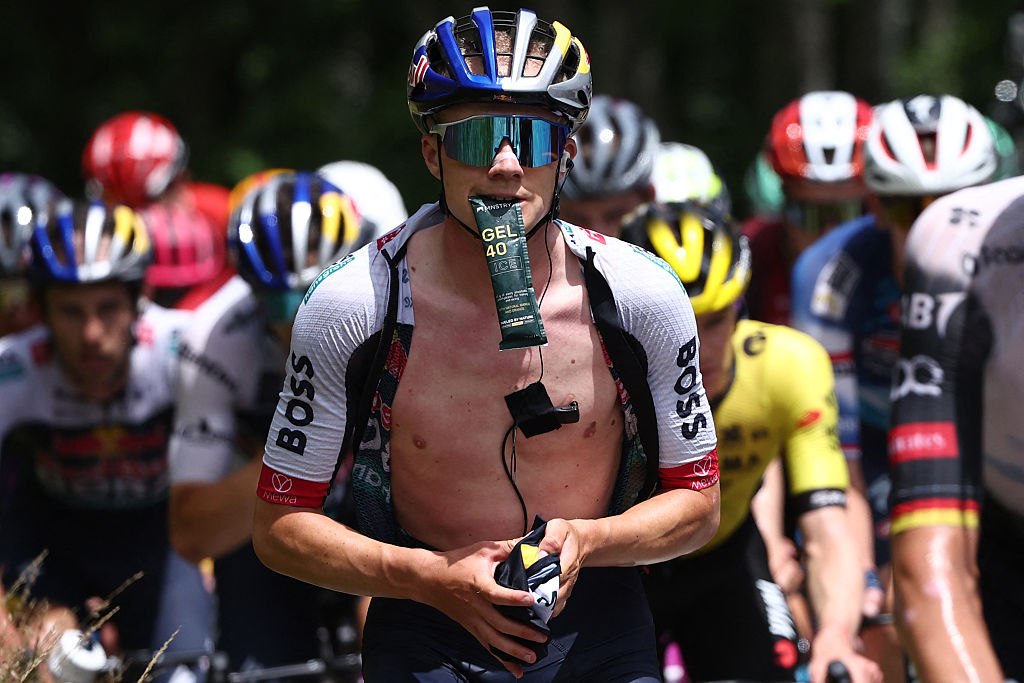
Durbridge told us in 2023 that on-the-bike nutrition had seen the “greatest evolution” since he started racing. He said 60g of carbohydrate each hour had become 120g because riders had trained their guts to handle the bigger quantities and power endurance.
Three years later and that figure has continued to rise, with reports of some athletes successfully adapting to 200g an hour – a huge boost for longer, harder efforts because your body can only store 500g of fast-acting carbohydrate (in glycogen form).
As we've seen, your gut being able to tolerate such large quantities is different from being able to absorb it all, but bespoke carb testing and feeding plans are now commonplace in the peloton, enabling each rider to consume the carbs that are right for them.
Pogačar has been using a new gel from Enervit that combines 90g of carbohydrate with 10g of lactate, which is said to give an additional fuel source at the end of a stage.
It’s easy to scoff at the idea of optimised nutrition being the reason for faster racing in a sport that’s been so scarred by drugs such as EPO, but being able to absorb and utilise more than double the fast energy as before should not be underestimated in performance leaps.
Tactics
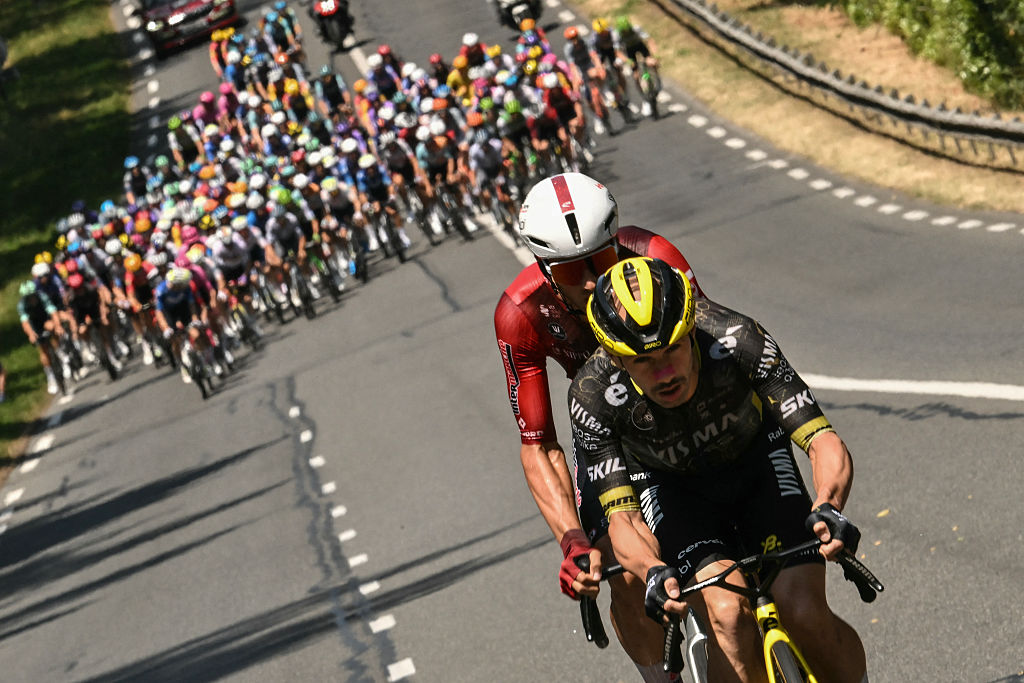
Combine faster equipment with better fuelled and more rested riders and it likely has something to do with the tactics shift we’ve seen at the Tour de France in recent times.
How often does the GC group take a day off these days and let a break go clear to the finish? It’s increasingly rare.
Riders say the fight to get into a day’s break has never been more ferocious. If one does manage to get away, it’s often later in the stage, by which point the speeds have been lightning quick.
The break is often kept on a very tight leash, and when it does succeed, the group is sometimes so big that it’s almost become a second peloton, packed with high-calibre riders (see stage 13 this year, which swelled to more than 50 riders at one point).
Route planning

Of course, the design of a shorter route is going to result in faster racing. A shorter overall route isn’t a recent trend – it’s changed slowly over decades, with several outliers (the 2002 route would have been shorter than this year’s, without 2026 having two wildfire-curtailed stages).
However, with short prologues falling out of fashion, the overall length of a race is a bit of a red herring, because it doesn't reflect the shortening of stages overall.
While driven in large part by the trends in viewing habits and waning attention spans, shorter stages have added more dynamism to stages.
It should also be said that having a less predictable route, one that keeps riders guessing with hard-to-categorise stages laced with sneaky surprises and twists in the tail, is a hallmark of the Christian Prudhomme era.
This state of alertness makes for a twitchy peloton, in a constant state of fight or flight. Or perhaps fight and flight.
Training

Riding kilometres on the bike has, and always will be, the biggest part of a cyclist’s training programme, but off-the-bike strength training and mobility has never been more of a string to the discerning pro’s bow.
Pogačar admitted to Cycling Pro Net at the Tour de Romandie in the spring that he was heavier than usual heading into the stage-racing season, having put on muscle ahead of his (unprecedentedly successful) Classics season. “I got a little bit carried away in the gym… I really, really liked it and got into it," he said.
Pogačar incorporates strength training in varying degrees throughout the season, with increasing work on his core as the years tick by.
To be able to crank out the power he does on climbs without getting out of the saddle requires huge core strength, as does any position where he’s trying to hold extreme aerodynamic positions, such as in time trials or on solo breaks.
Recovery
Sleep – or lack of it – received much coverage at this year’s race. Getting good-quality sleep after a hard day’s cycling is vital if you are to do it all again the next day, with muscle repair, the release of human growth hormone and restocking of glycogen (the body’s store of carbohydrate) all happening during deeper stages of sleep.
The extreme temperatures in the first half of the race would have made any room without air-conditioning uncomfortable, but for some there were added complications.
Uno-X Mobility riders took to sleeping on their balcony, while riders including Pogačar and Jonas Vingegaard were woken in the middle of the night to provide samples for drug testing. Never wake sleeping babies or Tour de France cyclists was the message the following day.
Such was the importance Pogačar’s team placed on sleep that each rider made use of an Eight Sleep Pod – a mattress cover that regulates body temperature and tracks sleep. The company says it increases deep sleep by up to 34%.
Sleep aside, there's all manner of recovery aids that riders take to bounce back better from one stage to the next. Tart cherry juice is downed at the end of each stage by the whole peloton and is one of the first steps to getting good shut-eye, while broccoli shots are now being used to reduce inflammation post-stage.
Tadej Pogačar

You could argue Pogačar himself is the thing that's most influenced the speed of the Tour de France.
Since he first took the yellow jersey in the 2020 Tour de France, the overall average speed of each of the five editions has been above 41km/h. Only once before this, in 2005, did it get over 41km/h. The breaking of the 43 threshold marks a significant jump.
Numerous long-standing climbing records have also fallen on Pogačar’s watch, to go alongside his Alpe d’Huez scalp.
Pogačar’s times on Mont Ventoux from Bedoin in 2025 and Col du Tourmalet this year (breaking his own record) means he holds the records on the Tour’s three most iconic climbs.
He’s the target that everyone is trying to hit when they head to their altitude camps, driving them on to be better than the year before.
At races, his progressive, attacking style of racing has reshaped the way the yellow jersey is contested. Most days in the mountains are now GC days, whether it’s him going on a solo rampage at a point where the stages used to start ratcheting into life, or his teammates pulling for him like HGVs. Everyone has to go full pelt because he is the one setting the standards.
In response to perceptions of Pogačar's dominance being boring, chief rival in 2026 Remco Evenepoel insisted that while a TV audience might see it that way, from his perspective in the bunch it’s anything but.
"He's a superstar, the best rider ever. I don't think people should consider it as boring," Evenepoel said. "I understand if you watch TV and he goes whenever he wants, it's boring, but for us it's a challenge and a big honour to race against a champion like that. I understand if people think it's boring, but for me it's exciting to see it from very close by.”
More from the 2026 Tour de France
- 5 records Tadej Pogačar set during the 2026 Tour de France – and one he’s yet to beat
- Which bike brands won the most stages at the 2026 Tour de France? The winners (and losers) revealed
- Tadej Pogačar’s special 2026 Tour de France yellow bike celebrates all five of his Tour wins
- I’ve worked in cycling for nearly 30 years and I’m done with Tour de France bikes – here’s why
- The 10 most iconic climbs in Tour de France history, ranked